Color Stability Science: Why Some Pink Quartz Fades
By Luna Harper
Interactive Optical Science
Color Stability Science: The Physics of Pink Quartz Sun Fading
A vibrant pink specimen placed by a window slowly transforms into an opaque, ghostly white over several months. This is a fascinating demonstration of Photosensitive Gemstones reacting to ultraviolet light at an atomic level. Stop blaming "negative energy" for the loss of color; start examining the mineral lattice.
⚗️ Veteran Insight: The Photobleaching Reality Check ▼
I clearly recall the sinking feeling in 2018 when I lifted a prized Madagascan crystalline pink quartz from an east-facing display shelf. When I turned the specimen over, the contrast was violently apparent. The side facing the wall retained a deep, vitreous rose hue. The side facing the morning sun had bleached to the color of dirty snow. It felt chalky to the imagination, stripped of its visual depth. That single oversight taught me a harsh lesson about the unforgiving nature of photobleaching.
The ugly truth of quartz collecting is that we are constantly fighting entropy. We often see generalized advice suggesting that "keeping crystals out of direct sunlight" is sufficient. It is not. To understand Quartz Color Stability, you must understand the concept of the Radiation Color Center. In crystalline pink quartz, the color is not a physical pigment you can scrape off. It is an atomic anomaly.
Millions of years ago, natural gamma radiation from the surrounding earth crust irradiated the quartz lattice. This radiation possessed enough electron-volt energy to knock an electron out of a bonded oxygen atom near a phosphorus or aluminum impurity. This creates a "hole" — an unpaired electron state that absorbs specific wavelengths of visible light, reflecting back that delicate pink.
When you place this stone on a windowsill, you are bombarding it with high-energy UV photons. These photons excite electrons in the crystal, giving them enough kinetic energy to fall back into those "holes." The structural anomaly is neutralized. The color center is destroyed. The pink vanishes. This process is entirely irreversible through natural ambient means. You cannot "recharge" a bleached lattice by leaving it under the moonlight, despite popular options suggested in community forums. Moonlight simply lacks the ionizing radiation required to displace an electron. You trade temporary display aesthetics for the permanent destruction of geological history.
Under the Microscope: Two Distinct Structures
Why do some pink stones fade in weeks, while others remain vibrant for centuries? The answer lies in microscopic formation. Use the virtual UV flashlight below to reveal hidden atomic structures.
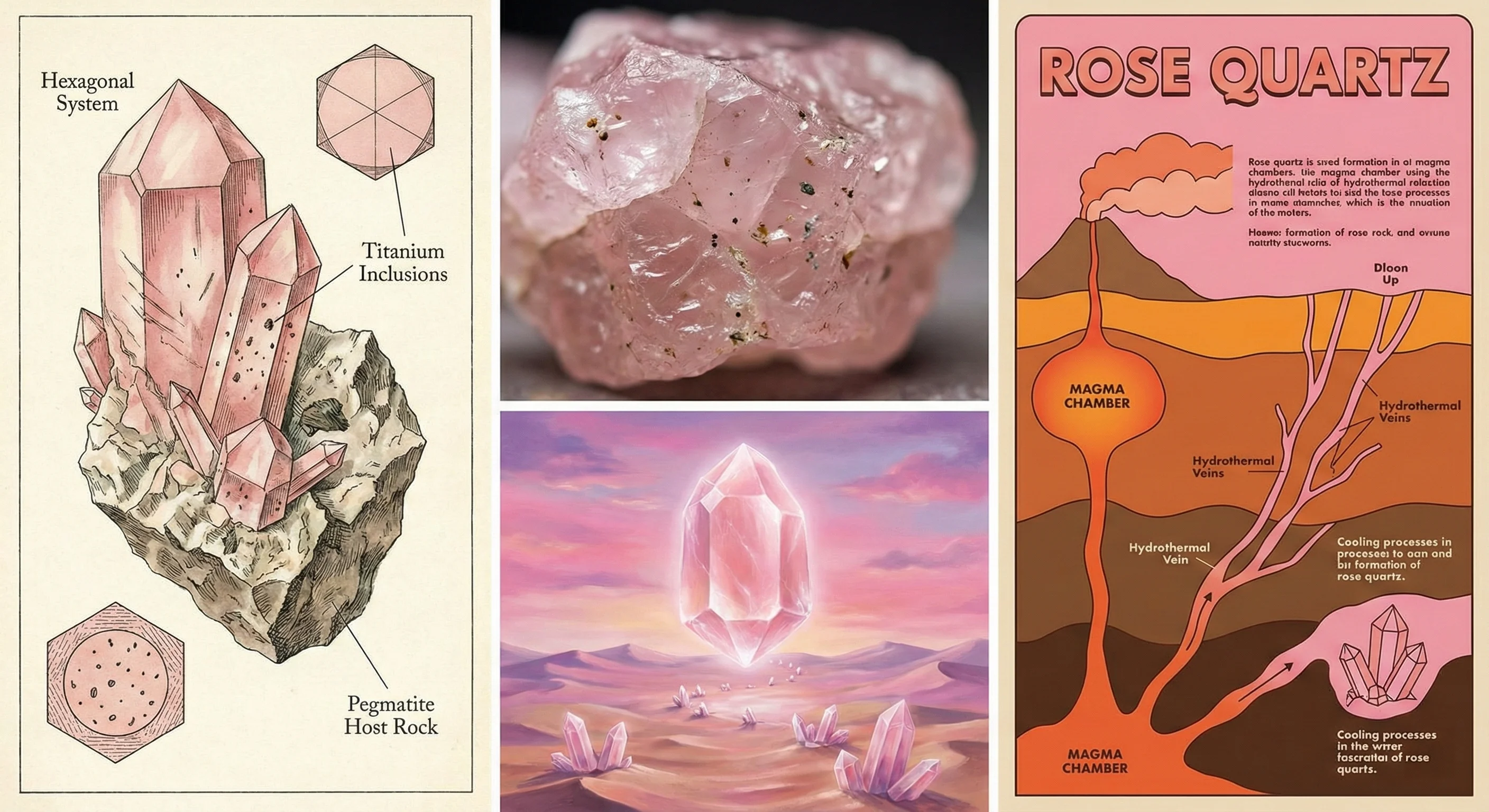
Massive Rose Quartz
The color originates from microscopic, physical inclusions of pink dumortierite fibers trapped within the quartz during formation.
Photostable ProfileCrystalline Pink Quartz
Forms in perfect geometric terminations. The color is an optical illusion created by Aluminum & Phosphorus trace elements excited by natural earth radiation.
Photosensitive Profile🔬 Trade-off Thinking: The Collector's Dilemma ▼
The distinction between Massive Rose Quartz and Crystalline Pink Quartz represents a classic trade-off in mineralogy. You are essentially choosing between structural stability and optical clarity.
Massive Rose Quartz is robust, heavy, and typically opaque. When I handle rough massive pieces straight from Brazilian pegmatites, they have a gritty, substantial texture. Because the color relies on actual physical fibers of a completely different mineral (often identified as a variation of dumortierite) embedded like a dense thicket inside the silica, UV light simply bounces off or gets absorbed without altering the chemical structure of the pink fibers. You gain immense environmental stability. The sacrifice? It lacks the crisp, glassy transparency that defines high-end gemstones. It rarely forms natural crystal points; it usually occurs in huge, cloudy boulders.
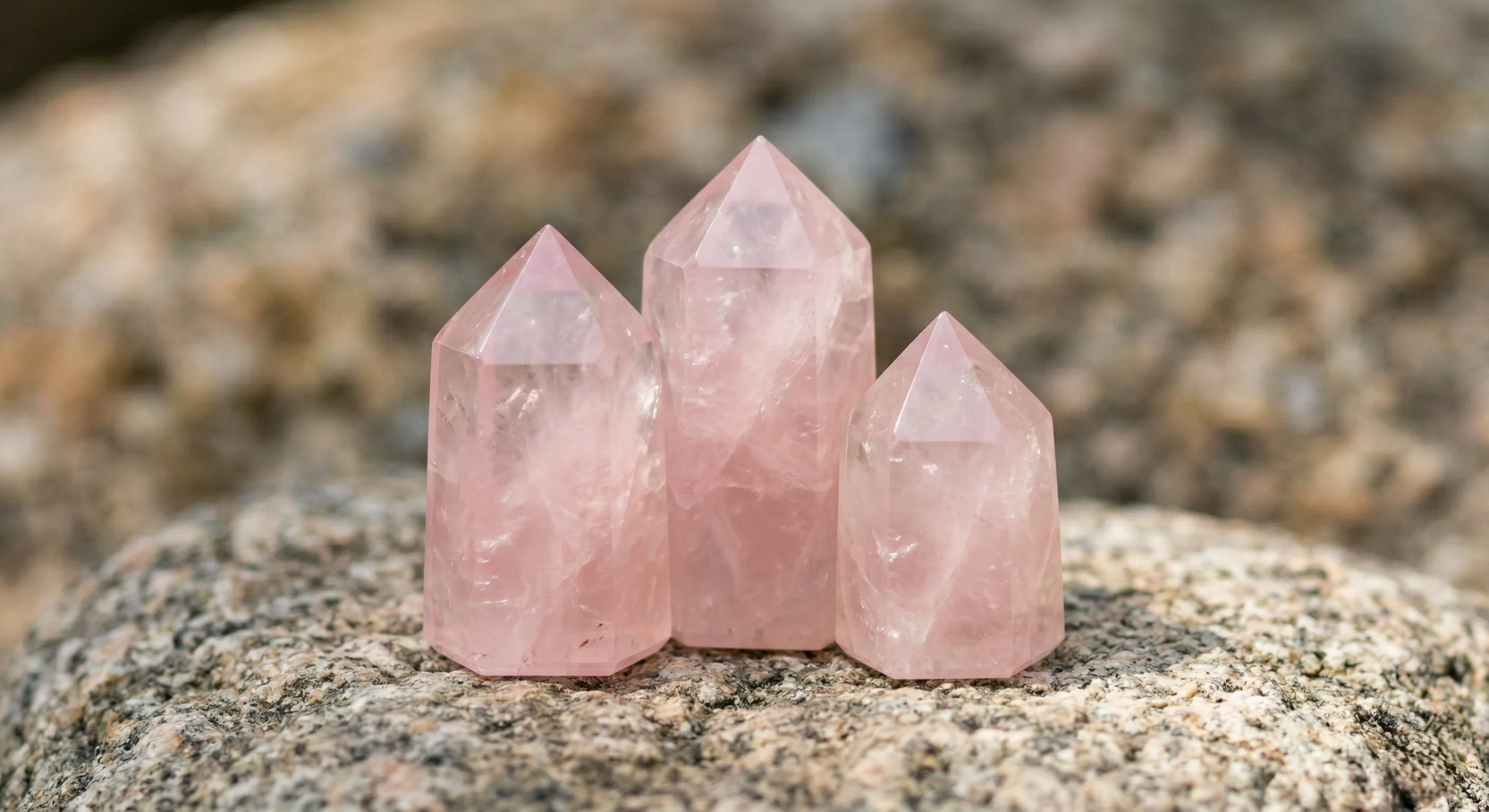
Crystalline Pink Quartz, found famously in Minas Gerais or Madagascar, forms exquisite, distinct euhedral crystals. They can be water-clear, catching the light with a sharp, vitreous luster. When you tap two small points together, they produce a distinct, high-pitched glassy clink. However, this aesthetic superiority comes with a devastating fragility. Because its color is entirely structural—relying on the precarious balance of electron holes—it is highly unstable.
I advise institutions to stop treating these two materials identically in archival storage. Exhibiting crystalline variants requires low-lux lighting and strict UV filtration. Exhibiting massive variants is mostly worry-free regarding light, though extreme localized heat can cause the internal water inclusions to expand, leading to catastrophic micro-fracturing.
The Photobleaching Time-Lapse
Experience the phenomenon of "photobleaching." Drag the slider to simulate 12 months of direct environmental exposure and observe the physical saturation decay.
Color Saturation: 100%
Environmental Degradation Rates
This chart compares saturation loss across different environments. Notice how ambient indoor light still contributes to a slow, methodical degradation.
📊 Data Context: The Illusion of "Safe" Indoor Lighting ▼
The interactive chart above represents an aggregated model based on prolonged exposure tests. While direct sunlight destroys color centers aggressively, the most insidious damage occurs indoors.
Many collectors assume that keeping a specimen away from windows ensures stability. The reality check? Ambient bounce light, combined with specific artificial light emissions, performs a slow, methodical erasure of color. Early in my career, I examined a display case lit by older, high-output halogen bulbs. Halogens run exceptionally hot and emit a small but measurable amount of UV radiation. Over three years, the ambient heat (thermal bleaching) combined with trace UV stripped 40% of the saturation from a supposedly "safe" interior display.
Thermal bleaching is the silent partner to photobleaching. When the crystal lattice is heated, the atomic vibrations increase. If the temperature reaches roughly 300°C (which happens during certain lapidary polishing processes if water cooling fails), the trapped electrons gain enough thermal energy to escape the color center instantly. Even at lower, sustained temperatures—like sitting inside a hot car or near a radiator—the threshold for photon-induced bleaching lowers.
UV-blocking window films are a frequently explored option. But here is the downside nobody mentions: standard archival films degrade. After about three to five years, depending on sun intensity, they develop a slight yellow tint and microscopic bubbling at the edges. They lose their UV-A blocking efficiency long before they visually peel. You trade a ruined crystal for a persistent, reoccurring maintenance task.
Visualizing the Shift: Optical Clarity
When color centers neutralize, the stone reveals its natural internal cloudiness. Drag the slider left and right to compare the vibrant optical state with the bleached structural reality.
👁️ Optical Mechanics: Why Faded Quartz Looks "Cloudy" ▼
The slider above demonstrates a crucial visual transition. When crystalline pink quartz loses its color, users frequently report that the stone looks "cloudy" or "dirty," assuming a surface residue has built up. They attempt to scrub it, only to find the dullness remains.
The dullness is not on the surface; it is an unmasking of the interior. In its vibrant state, the intense pink hue created by the active color centers effectively overwhelms the eye. The deep saturation masks microscopic internal fractures, fluid inclusions, and natural growth lines within the silicon dioxide matrix.
Once photobleaching empties those electron holes, the dominant color is removed. Light entering the crystal no longer gets selectively absorbed by the color centers; instead, it hits every internal micro-flaw and scatters. This light scattering (similar to how a cracked car windshield looks white and opaque) is what creates the sudden appearance of cloudiness. The stone hasn't degraded physically; its structural imperfections have simply been laid bare. It is a stark reminder that in mineralogy, color often acts as a visual filter, hiding a chaotic internal topography.
Photobleaching Vulnerability Assessment
Analyze the environmental stability of a specific specimen. Answer three geological questions to calculate its structural photobleaching risk.
Question 1/3
What is the primary formation type of the specimen?
Authoritative Geological References
For individuals seeking to explore the peer-reviewed physics and chemistry underlying silicate optical phenomena, consult the following academic resources.
Gemological Institute of America (GIA): Color Centers in Quartz
A comprehensive breakdown of how trace elements like Aluminum and Phosphorus interact with gamma radiation to produce temporary color states in otherwise clear silicon dioxide lattices. Details the specific electron-volt thresholds required for photobleaching.
Explore GIA Database →Mindat.org: Mineralogical Data on Dumortierite Inclusions
The foremost open-access mineral database providing structural and chemical data confirming that massive pink quartz achieves its hue via physical nano-fibers of borosilicate minerals, rendering it highly stable compared to its crystalline counterparts.
Explore Mindat Archive →Journal of Applied Physics: Thermal Degradation of Silicate Lattices
Academic papers detailing the specific thermodynamic limits of quartz, explaining how sustained temperatures above specific ambient thresholds accelerate the release of trapped electrons, exacerbating the fading process initiated by UV light.
Academic Portal Entry