Workplace symbolism
Why “Emotional Armor” is the 2026 Workplace Essential
A Rose quartz corporate talisman feels relevant in the 2026 workplace because many people want a small, private way to stay composed without pretending work is emotionally neutral. “Emotional armor” is useful here as a metaphor: not a shield with special power, but a symbolic object that reminds its user to pause, soften their tone, protect their boundaries, and enter difficult conversations with more steadiness.
Rose quartz already carries a cultural association with gentleness and care. A talisman, in the broad cultural sense, is an object given protective or symbolic meaning. In a workplace shaped by constant messaging, hybrid expectations, visibility pressure, and blurred limits, a rose quartz desk object can become a quiet cue: respond, do not react.
The short answer: soft armor, not a harder personality
“Emotional armor at work” can sound defensive, as if the goal is to become untouchable. That is not the most useful reading for a rose quartz corporate talisman.
In this context, emotional armor means a softer boundary. It is the reminder to stay open enough to communicate, but firm enough not to absorb every mood, deadline, or escalation around you.
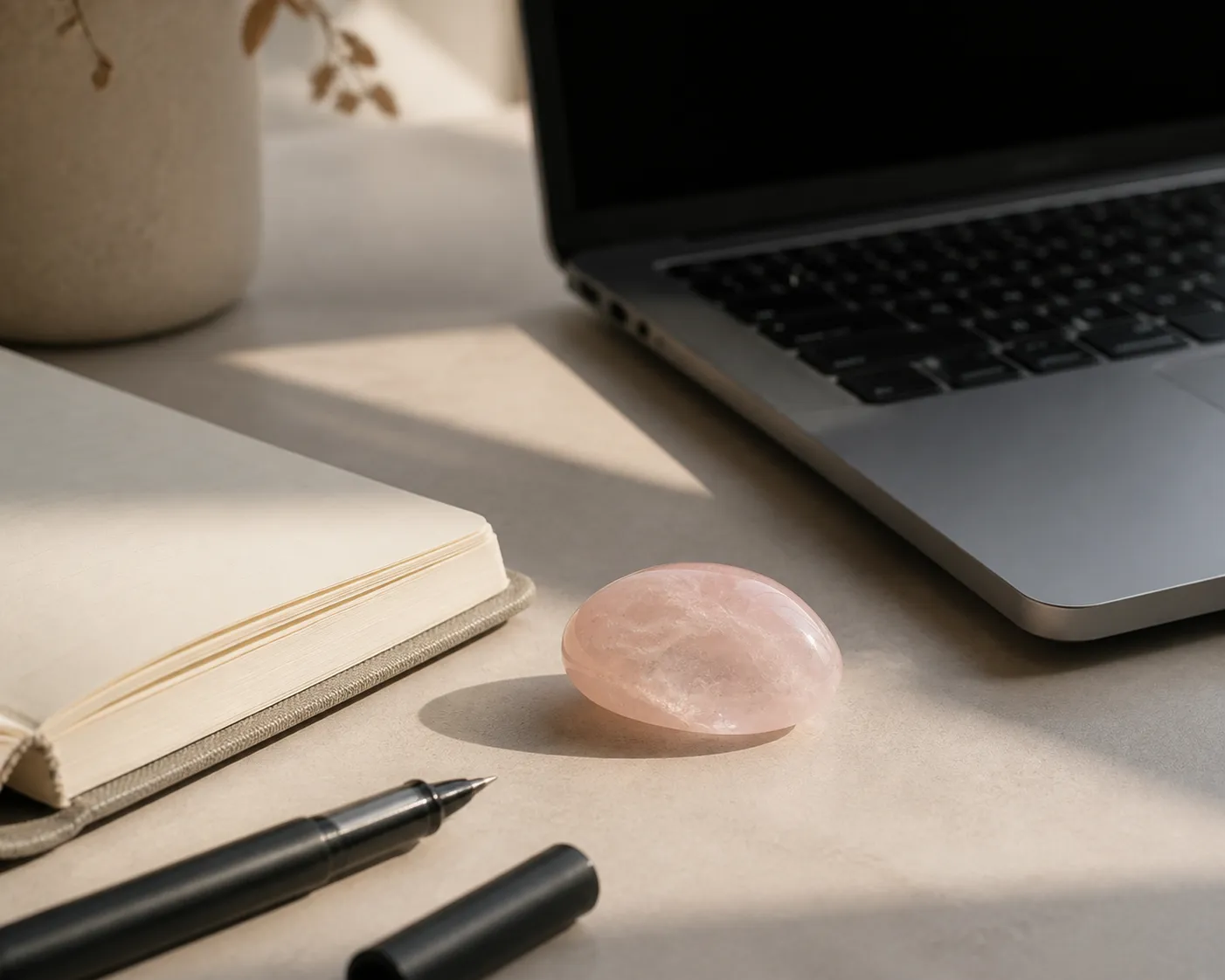
A small piece of rose quartz on a desk, in a pocket, on a pendant, or near a keyboard does not need to announce itself. Its value, for people who use it this way, is often in the interruption it creates. Before replying to a sharp message, before walking into a tense meeting, before saying yes too quickly, the object can become a private cue to pause.
The stone is not doing the emotional work. The person is. The object gives that intention a physical place to live.
That distinction matters. Rose quartz is a real mineral material: a pink variety of quartz described in mineral references in physical terms. The meaning people attach to it belongs to culture, ritual, aesthetics, and personal practice. Keeping those two kinds of knowledge separate prevents the stone from being presented as a workplace performance tool or a wellbeing intervention.
Why this language feels timely in the 2026 workplace
The modern office is not only a place where tasks happen. It is also a field of notifications, meetings, social reading, written tone, urgency, feedback, and small emotional adjustments.
Even people who like their work may spend a day managing how they sound in messages, how direct they can be in meetings, how quickly they are expected to respond, and where their availability ends. That is one reason “emotional resilience” has become such common workplace language.
Workplace wellbeing research gives context for that mood. Gallup’s workplace reporting has tracked employee stress, engagement, and wellbeing as major organizational concerns. That does not show that crystals improve resilience. It does explain why so many workers are drawn to language about steadiness, pressure, burnout, belonging, and sustainable work.
A rose quartz corporate talisman makes an abstract intention visible. It can sit on the desk as a small boundary marker beside the laptop: slow down; answer with clarity; do not let someone else’s urgency become your identity.
For some readers, the appeal is spiritual. For others, it is aesthetic. For others, it is tactile. A smooth rose quartz pebble gives the hand something to touch while the mind chooses a next sentence. That is a modest claim, and it is the right-sized one: objects can carry personal meaning, and personal meaning can shape how someone relates to a workspace.
What a rose quartz corporate talisman can realistically do
The most grounded way to understand a rose quartz talisman is as an object-based ritual. It does not need to be elaborate or public. It can be as small as touching the stone before opening a difficult email, placing it beside a notebook before a review, or moving it to the edge of the desk before a boundary-setting conversation.
Used this way, the stone may serve four practical symbolic functions.
It can act as a tactile pause cue.
A pause does not solve workplace stress or conflict by itself. But a physical cue can interrupt the first reaction. In practice, that might mean rereading a message before sending it, asking one clarifying question, or choosing a calmer opening line.
It can become a visual reminder of tone.
Rose quartz’s soft color is part of its appeal. On a desk full of screens, cables, documents, and task lists, a pale pink stone reads differently. It can symbolize warmth without requiring performative sweetness. For someone who values calm communication, it may become a reminder to stay direct without becoming sharp.
It can mark a boundary.
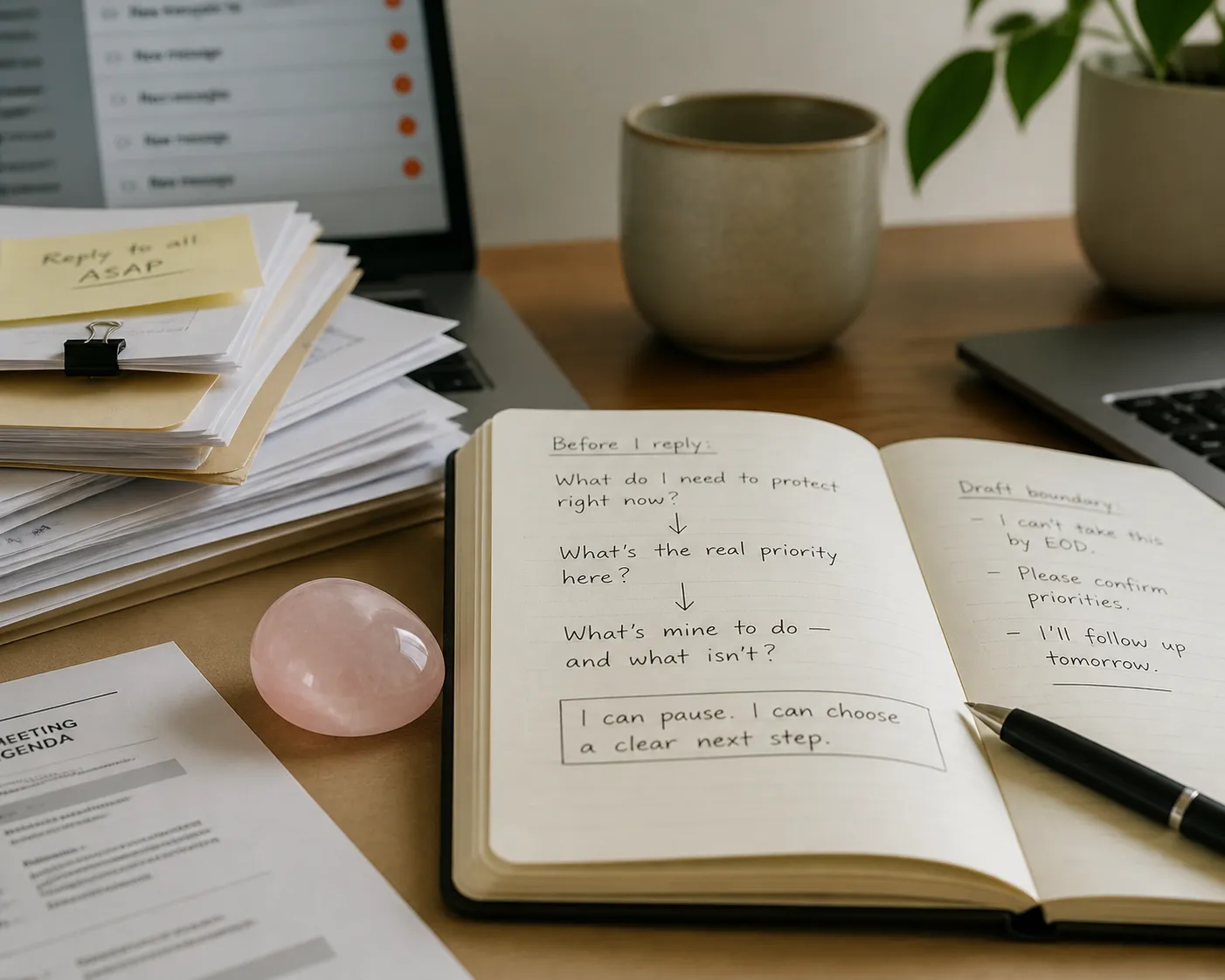
Boundary setting at work is often plain, not dramatic: “I can take this on next week,” “I need the decision in writing,” or “I am not available after that time.” A rose quartz desk object does not create those boundaries. It can represent the intention to remember them.
It can hold personal meaning in a professional space.
Work can flatten people into roles, calendars, and outputs. A small personal object quietly resists that flattening. It says, privately: there is a person here, not only a function. In that sense, a rose quartz talisman belongs to the same broad pattern as desk photos, plants, notes, keepsakes, and other objects people use to make a workspace feel inhabited.
This is also where “de-escalation energy” needs careful language. As a phrase, it captures a desire for less heat and less reactivity. But it should be read as metaphor, not as a measurable force. A grounded version would be: the stone reminds the user to bring de-escalating habits into the moment.
What makes it useful instead of performative
A rose quartz talisman is most useful when it is personal, quiet, and tied to a specific behavior. It becomes less useful when it is asked to do too much.
If the stone is simply placed on a desk because it looks beautiful, it may remain décor. That is valid. But it is different from a ritual object. If it is connected to one clear intention — pause before replying, keep my boundary, soften my first sentence — it has a more defined role.
The workplace setting matters too. In a private office, a visible rose quartz desk object may feel natural. In a shared office, a smaller stone in a drawer or pocket may feel more appropriate. In a conservative corporate environment, jewelry or a discreet object may fit better than a conspicuous display. The point is not to announce a belief system to coworkers. The strongest version of this practice is often private.
The user’s own relationship to symbolism matters as well. Some people respond strongly to objects, textures, and rituals. Others do not. A person who dislikes crystals, desk items, or symbolic practices is unlikely to find this language useful. A rose quartz corporate talisman is not a universal workplace essential in the literal sense. It is “essential” only for the kind of reader who wants a small, meaningful anchor for composure and boundary awareness.
It also works best beside real communication choices: drafting before sending, asking for priorities, documenting agreements, taking a short pause before a meeting, or naming a limit in plain language. A stone near the laptop cannot repair an unsafe dynamic, unclear role, harassment issue, or unsustainable workload. When those are present, the next step belongs with appropriate support: a manager, HR process, medical or mental health professional, conflict mediator, legal resource, or safety plan, depending on the situation.
Common confusion: talisman, crystal claim, and workplace tool
The word “talisman” can create confusion because it has a long history of protective and symbolic use. Britannica describes a talisman as an object associated with magical or protective power in cultural belief. In this workplace article, the word is being used in a modern symbolic sense: an object the user invests with personal meaning.
That is different from saying rose quartz has demonstrated workplace effects.
It is also different from turning the stone into a productivity, health, or conflict-resolution claim. A rose quartz desk object should not be framed as something that guarantees focus, prevents burnout, fixes workplace conflict, or changes other people’s behavior. Those claims go beyond the available evidence and beyond the purpose of a symbolic workplace tool.
Burnout language needs similar care. The World Health Organization describes burnout as an occupational phenomenon, not a casual synonym for a difficult week. That context matters because workplace strain can be structural. A personal object may support a private ritual, but it is not a substitute for workload changes, management action, HR processes, medical care, conflict mediation, or safety planning when those are needed.
There is one more common mix-up: confusing rose quartz geology with rose quartz meaning. Geology tells us what the material is. Symbolism tells us what people have come to associate with it. Both can sit in the same article, but they are not the same kind of knowledge. Rose quartz being a real mineral does not make every emotional claim about it a mineral fact.
A grounded way to use the “emotional armor” idea
The cleanest version of emotional armor is simple: choose one work moment where you tend to lose steadiness, and let the rose quartz object stand for the response you want to practice.
For example:
- Before a difficult Slack or Teams reply, touch the stone and reread the message once.
- Before a tense meeting, place it beside your notebook as a reminder to stay clear and courteous.
- Before accepting extra work, use it as a cue to ask, “What should this replace?”
- After a sharp interaction, let it mark the transition back to your own pace instead of carrying the exchange into the next task.
None of these examples require a public explanation. They do not require coworkers to believe anything. They also do not require the reader to treat rose quartz as a force acting on the room. The object is a symbolic workplace tool: quiet, personal, and modest.
The better phrase may be “soft armor.” Not armor that hardens the person, but armor that protects the space between stimulus and response. Not armor that blocks feeling, but armor that reminds the user not to abandon themselves in order to keep the peace.
That is why rose quartz fits the 2026 workplace mood. People are tired of productivity language that asks them to optimize every emotion. They are also tired of vague wellness claims that turn stress into an individual branding problem. A rose quartz corporate talisman sits somewhere gentler and more honest: a small material symbol for composure, boundary setting, and calmer communication, without pretending to be more than it is.
Bottom line
“Emotional armor” is useful only when it stays metaphorical. A rose quartz corporate talisman is not an emotional shield, a burnout solution, or a tool that de-escalates other people. It is a personal object that may help some people remember how they want to move through pressure: with softness, clarity, and boundaries intact.
In that narrow sense, it feels essential for 2026 because the workplace keeps asking for emotional resilience, while many people need something more concrete than a slogan. A small rose quartz object can make that intention visible, touchable, and private — an anchor for the person, not a claim about the stone.