Global Provenance: Brazil's Blocks vs. Madagascar's Jelly
By Luna Harper
Dr. Elena Rostova, PhD
Chief Mineralogist, GeoProvenance Institute
Global Provenance: Deciphering Rose Quartz Origin Characteristics, Madagascar Rose Quartz, Minas Gerais Quartz, Jelly Rose Quartz, Quartz Mining Locations
As the collector's mineral market matures in 2026, understanding exact geological origins is paramount. For museum curators, gemologists, and geology enthusiasts, mastering the matrix of Rose Quartz Origin Characteristics, Madagascar Rose Quartz, Minas Gerais Quartz, Jelly Rose Quartz, and Quartz Mining Locations is the absolute baseline for determining geological rarity, structural integrity, and aesthetic purity.
Early in my career, I authorized the acquisition of what I believed was a half-ton block of premium Madagascar jelly quartz for a private exhibition. It arrived cold, dense, and practically glowing under the staging lights. It wasn't until I dragged a 10x diamond loupe across the basal cleavage that I spotted the microscopic polymer pooling in the micro-fractures. It was a severe misclassification that compromised our collection's integrity. That failure permanently altered how I evaluate silicates. You cannot rely on visual saturation alone. You must read the stone's trauma.
Geological Divergence: Why Origins Dictate Structural Viability Today
Stop treating silicate minerals as interchangeable commodities based on hex-code color matching. The era of generalizing quartz by a superficial pink hue is entirely over.
In 2026, the appreciation of macroscopic crystalline quartz is inextricably linked to its geological birthplace. We observe a strict bifurcation in nature: the foundational, massive deposits of South America versus the crystalline, museum-grade pockets of the Indian Ocean islands. The physical behavior of the stone on the lapidary wheel—how it chips, how it handles thermal friction, how it scatters light—is hardcoded by where it cooled millions of years ago.
To understand this shift, one must delve into Madagascar Jelly vs. Brazilian Massive: The 2026 Rose Quartz Origin Guide. This foundational knowledge separates standard reference material from highly prized, scarce geological specimens. A Brazilian block might survive a CNC architectural router, while a Madagascar specimen of the same volume would shatter into gravel under identical torque.
The Ugly Truth: The Logistics Friction of Provenance ▼
There is a romanticized narrative around "sourcing" that ignores the brutal reality of extraction logistics. Sourcing from Minas Gerais, Brazil, is an industrialized process. You are dealing with established unpaved highway systems, heavy diesel machinery, and a supply chain optimized for tonnage. The stone is extracted in massive, brutalist blocks.
Contrast this with Madagascar. Extracting true jelly quartz often involves navigating deeply fragmented pegmatite pockets in regions completely devoid of heavy infrastructure. You do not blast; you pry. The loss rate during transport from the central highlands to Antananarivo is staggering. The premium you see attached to Madagascar material is not just for optical clarity; you are paying the latent cost of a hyper-fragile supply chain where a single pothole can reduce a museum-grade specimen to industrial tumbling rough.
Minas Gerais, Brazil: The Massive Foundation and Hydrothermal Trauma
Brazil, specifically the pegmatites of Minas Gerais, has historically been the volume leader. The defining characteristic here is mass, but that mass comes with intense internal stress.
Brazilian quartz often forms in massive, interconnected veins rather than distinct, terminated crystals. Grinding Brazilian massive quartz is a deeply visceral physical experience. When you press a raw chunk against a 400-mesh diamond wheel, the saw whines at a notably higher pitch compared to cutting agate. The cooling slurry immediately smells sharply of ozone and pulverized silica. You are physically fighting the stone's internal stress lines.
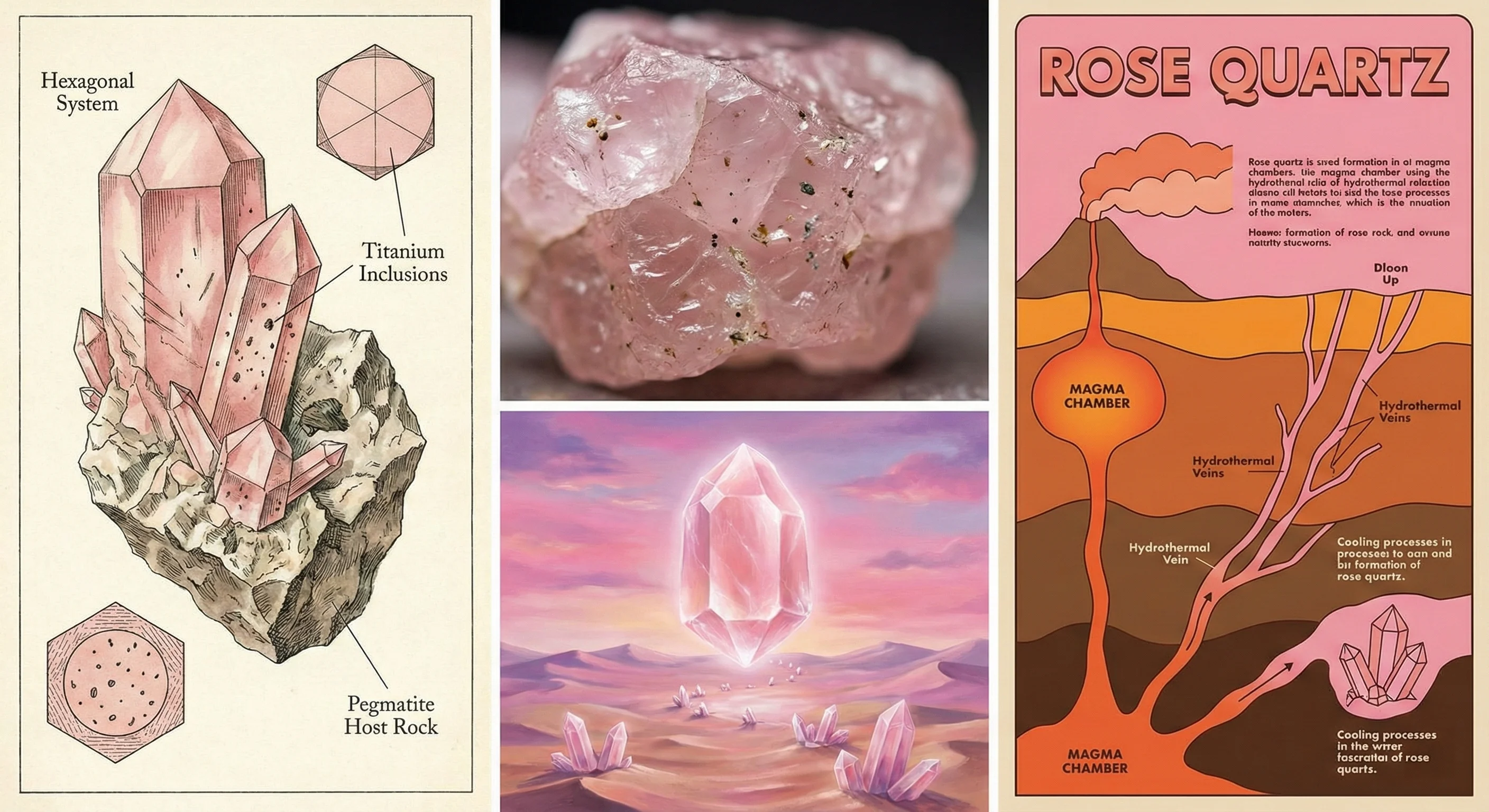
This origin is famous for what gemologists broadly label the "Milky" effect. However, The Science of Cloudy Crystals: Understanding Brazilian Milky Rose Quartz reveals that this opacity is not a color trait; it is a map of violent geological trauma. Millions of microscopic gas-liquid inclusions were trapped during rapid hydrothermal cooling. They scatter light, creating the milky veil, but crucially, they also act as millions of microscopic fault lines waiting to fail under pressure.
⚙ Interactive: Geological Cooling Simulator
Drag the slider to physically observe how the speed of magma cooling dictates lattice clarity and structural inclusion density.
Hydrothermal Shock: Rapid cooling traps gases and liquids, creating structural stress and a dense, milky opacity typical of massive vein deposits. The material is visually dense but structurally unpredictable.
Radiation and Color Mechanics
The pink hue here relies heavily on natural background radiation acting upon trace elements over millennia. Aluminum, Phosphorus, and Radiation: How Brazilian Rose Quartz Gets Its Pink explains how lattice defects create color centers unique to this region's geochemistry. It is a highly unstable coloration; leave a Brazilian sphere in direct sunlight for a summer, and you will witness severe photobleaching as the color centers discharge their trapped electrons.
Trade-off Analysis: The Cost of Brazilian Volume ▼
There is no perfect stone, only stones optimized for specific applications. The trade-off with Brazilian massive quartz is stark. You gain access to astonishing volumetric scale—architectural slabs, massive interior carvings, and structural pillars. The material is relatively inexpensive by weight.
The penalty? Processing cost and aesthetic limitation. Because of the dense gas-liquid inclusions, achieving a high-gloss polish requires significantly more labor and finer diamond mesh compounds than crystalline quartz. Furthermore, to make a Brazilian slab look "premium" in an architectural setting, designers are forced to implement aggressive, high-lumen backlighting panels behind the stone to force light through the milky barriers. You save money on the raw material, but you spend it on the LED infrastructure required to make it look acceptable.
Madagascar: The Crystalline "Jelly" Structure
Stop obsessing over the deepest pink saturation. The true, undeniable indicator of premium Madagascar origin is the diaphanous, almost aqueous quality we term "Jelly."
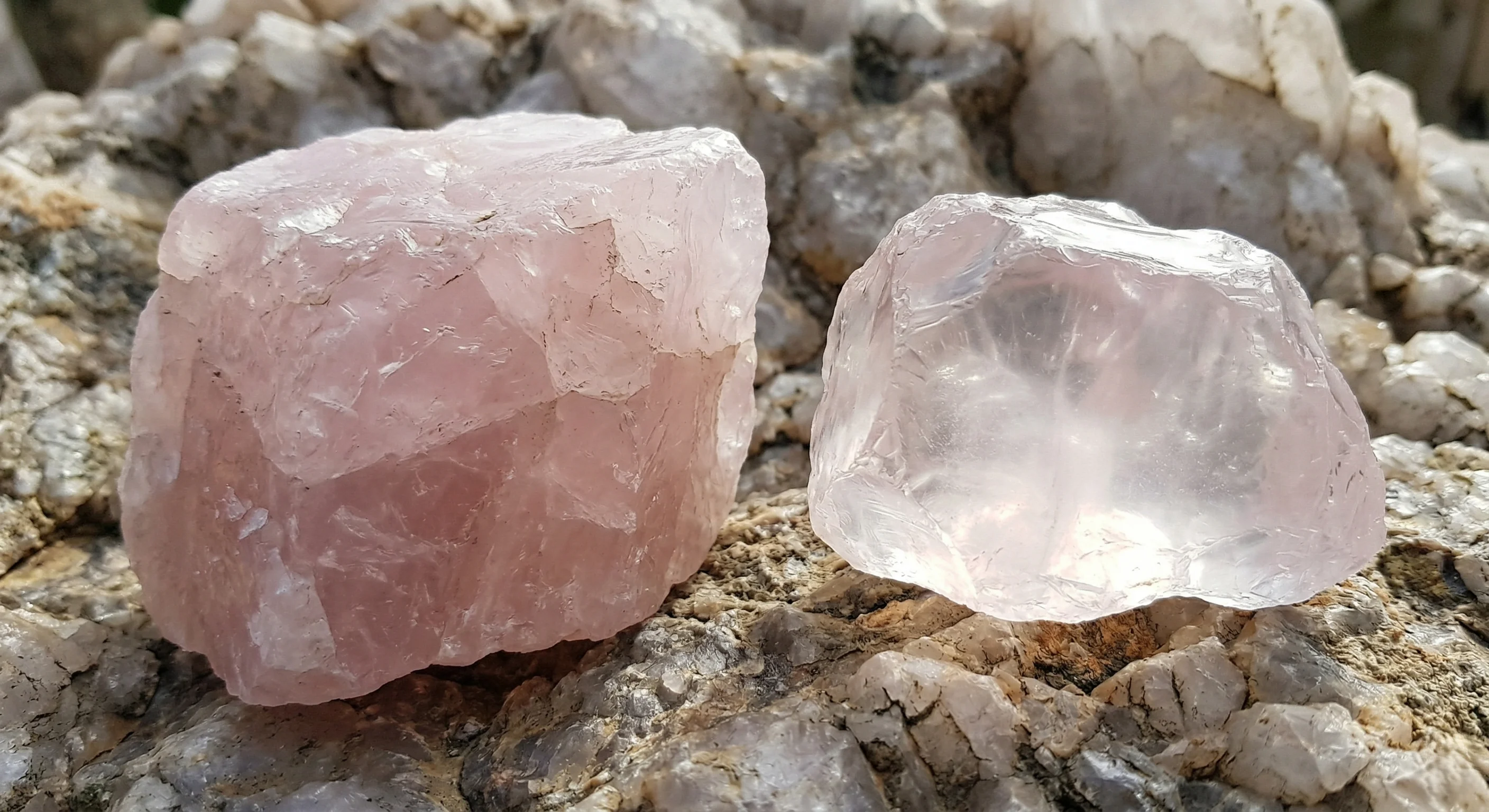
If Brazil provides structural mass, Madagascar offers extreme geological rarity. The pegmatites in this specific geological zone cooled over vastly longer timescales, allowing for crystal lattices to organize with minimal internal disruption. When you hold a raw, unpolished Madagascar shard against a harsh 6000K LED inspection light, the light does not halt at the surface. It suspends inside the lattice. It creates an optical illusion; the stone feels strangely lighter in the hand, almost buoyant, even though the specific gravity (2.65) is completely identical to the dense-feeling Brazilian material. That feeling is absolute structural silence.
🔍 The Gemologist's Loupe: Structural Inspection
Pan your cursor across the specimens below to reveal the stark microscopic structural differences between the two origins.
Decoding the "Jelly" Texture: Why Madagascar Quartz Glows from Within details how Tyndall scattering occurs in these exceptionally clear stones, creating an internal luminescence completely absent in milky varieties. This structural perfection is the core of Why Madagascar Rose Quartz is Geologically Scarcer: A Breakdown. The absence of gas-liquid inclusions means the stone carves cleanly, holding razor-sharp facets without crumbling.
Reality Check: The Disastrous Yield Rates of Jelly Quartz ▼
The industry rarely discusses the brutal lapidary yield rates of high-end Madagascar material. You do not simply buy a boulder and carve a sphere. The extreme clarity that makes Jelly quartz desirable also makes every single natural stress fracture painfully visible. There is nowhere for a flaw to hide.
If a lapidary purchases a 10-kilogram rough chunk of Madagascar jelly expecting 6 kilograms of workable material, they are entirely deluded. A veteran cutter expects perhaps 1.2 kilograms of museum-grade finished product. The rest of the mass is systematically sacrificed to bypass invisible, latent stress planes that reveal themselves the moment the saw blade introduces vibration. You are paying a massive premium for the 85% of the stone that ended up as dust on the workshop floor.
Geological Trait Analysis: Discarding the Color Bias
Novices buy color; experts buy structural integrity and optical phenomena. The data below starkly contrasts the physical footprint of the two origins. You must look at the inverse relationship between massive block availability and optical clarity.
Origin Profile Mapper
Mapping dominant geomorphological traits of massive vs. crystalline deposits.
📊 Museum Specimen Rarity Simulator
Select geological traits to dynamically calculate the specimen's global scarcity index based on 2026 known deposit depletion.
Common Reference Specimen
Scientific Authentication: The Arms Race Against Synthetics
As geological depletion drives demand for pristine structural specimens, the market sees highly sophisticated synthetic analogues. Visual inspection alone is functionally useless. If you are not utilizing thermal probes, UV spectroscopy, and specific gravity tests, you are simply guessing. I have seen highly experienced curators fooled by dyed, resin-injected low-grade quartz designed specifically to mimic Madagascar clarity.
The Authentication Challenge Protocol
Interactive ModuleYou examine a highly transparent pink specimen. Under long-wave UV light, it emits a distinct, patchy blue fluorescence along internal lines. What is the likely diagnosis?
A specimen displays a remarkably sharp, six-rayed star (asterism) when struck by a single direct LED beam. What microscopic inclusion is strictly responsible for this optical geometry?
When conducting thermal conductivity profiling, the heavily polished pink specimen feels significantly warmer to the touch than a known natural quartz reference. The thermal probe registers a sharp drop. What does this confirm?
Module Complete
You have verified your geomechanical knowledge against synthetic deception.
The tactile tests remain critical. The Ice-Cold Truth: Using Thermal Conductivity to Test Rose Quartz details quantitative testing using precision thermal probes to distinguish true silicates from advanced laboratory glass.
Do not ignore the surface tension. Natural Stress Marks vs. Artificial Dye: Reading Geological Micro-Fractures teaches curators how to spot artificial dye pooling in surface fissures under 40x magnification.
Finally, understand the vulnerability of the material's color centers. UV Bleaching Explained: Why Your Brazilian Rose Quartz is Turning White covers the relentless physics of color centers losing electron charge under direct sunlight—a crucial, irreversible reality for archival preservation.
Failure Mode: The Limits of Thermal Testing ▼
We often herald the thermal probe as the ultimate lie detector against glass fakes. Stop relying on it blindly. A thermal probe simply measures how fast a material pulls heat away from a heated copper tip. Glass fails this test instantly. But the market has adapted.
In late 2024, our institute encountered a new class of synthetics: "Reconstituted Quartz." Counterfeiters take low-grade, colorless milky quartz dust, melt it down with a pink metallic oxide dopant, and press it under extreme atmospheric pressure. Because the base material is technically silica, its thermal conductivity profile closely mimics natural quartz. It passes the probe test. To detect this, you must revert to advanced optics—specifically, searching for the complete absence of natural, angular growth lines and the presence of microscopic, perfectly spherical gas bubbles trapped during the pressure-molding process.
📚 Academic & Geological References
The geomechanical conclusions and structural assessments presented in this guide are supported by the following institutional databases and peer-reviewed mineralogical registries:
-
▶
Gemological Institute of America (GIA): Microscopic evaluation of inclusions in macrocrystalline quartz (GIA Gem Encyclopedia).
-
▶
Mindat.org (Hudson Institute of Mineralogy): Crystallographic and locality data for specific Brazilian and Malagasy pegmatite deposits.
-
▶
RRUFF Project (University of Arizona): Raman spectroscopy and X-ray diffraction data establishing trace element baselines for natural silicates.