Is Your Rose Quartz Real? A Geological Identification Manual
By Luna Harper
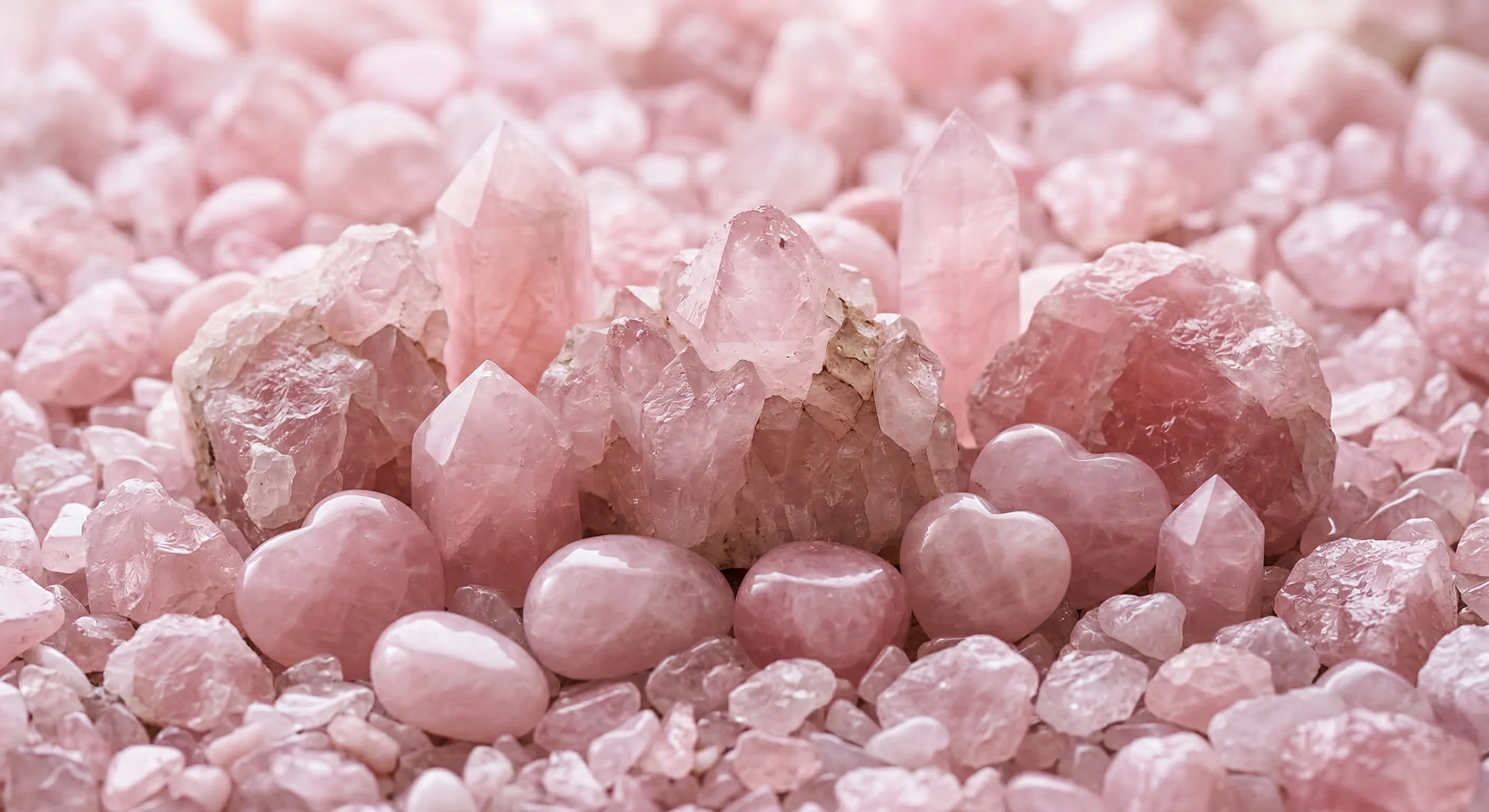
The Collector's Guide:
Is Your Rose Quartz Real?
Building a genuine mineral collection is an exercise in geological appreciation. However, the modern specimen market is highly sophisticated. Distinguishing between Real vs Fake Rose Quartz requires a scientific, forensic-level understanding of crystallography. From understanding the visual mechanics behind Cherry Quartz Identification to spotting synthetically treated Dyed Crackle Quartz, this interactive manual serves as your foundational education in authentication.
The Scientific Baseline
To accurately catalog your collection, you must understand the material differences. While historical fakes relied on simple glass (amorphous silica), 2026 laboratories produce High-Purity Quartz (HPQ). Observe the physical property variations in the diagnostic chart below.
Material Property Comparison Matrix
Data represents index scores. Note the stark contrast in thermal conductivity and inclusion complexity between natural earth-mined quartz and manufactured glass.
Veteran POV: The Supply Chain Reality
I've spent over a decade cataloging mineralogical specimens, and the harsh truth is that the 2026 market is an absolute minefield. Stop doing what amateur collectors do: blindly trusting a certificate of authenticity from an unknown seller. Start relying on empirical physical properties. I have ruined thousands of dollars worth of inventory learning this the hard way.
The days of easily spotting cheap glass are over. Today, we are dealing with High-Purity Quartz (HPQ) cast-offs from the photovoltaic solar industry. These are synthetically grown crystals that mimic the chemical composition of SiO2 flawlessly. The trade-off? They are too perfect. You sacrifice the unique, chaotic geological footprint for sterile, algorithmic stratification. Industrial autoclaves produce these crystals in weeks, stripping away the millions of years of tectonic history that true collectors value.
The Cost of Ignorance: Buying a visually flawless 100mm synthetic sphere might cost you $150 today, but its resale value to a serious geode collector tomorrow is literally zero. You are buying polished sand.
Laboratory Simulations
Explore the methodologies professional gemologists use to verify the covalent bond lattice of genuine minerals. Interact with the modules below to understand the science without risking damage to your collection.
The Flaw Finder Simulator
Interactive Observation: Hover or drag your finger over the samples below using your virtual loupe.
The Glass Bubble Myth: Amorphous glass imitations contain perfectly round air bubbles. Natural Quartz: Exhibits cloudy flocculant and irregular natural ice cracks.
Sample A Authentic
Sample B Imitation
Thermodynamics Racer
Interactive Observation: Click 'Run Simulation' to observe the difference in thermal conductivity.
The Ice Melting Test: Genuine quartz has extremely high thermal conductivity and rapidly transfers ambient heat (melting the ice). Glass acts as an insulator, preserving the ice much longer.
Structural Integrity Testing
How professional gemological laboratories safely verify physical properties without compromising the specimen's aesthetic or structural value.
01 The Quartz Scratch Test
Based on the Mohs Hardness Scale, Quartz ranks at 7, while typical glass ranks around 5.5. In highly controlled environments, gemologists observe that quartz can score glass. (Note: Destructive testing is absolutely not recommended for personal collections as it permanently damages cleavage planes).
02 Acetone Swipe Protocol
To definitively identify Dyed Crackle Quartz, professionals use specialized chemical solvents like high-purity acetone applied with precision swabs. If surface-dyed wax or artificial color alteration is present, the synthetic pigment instantly transfers to the swab, revealing the treatment.
Veteran POV: The Ugly Truth About Destructive Testing
Stop doing the scratch test at home. I cannot emphasize this enough. Yes, textbook geology states that quartz (Mohs 7) will scratch glass (Mohs 5.5). What the introductory textbooks omit is the massive micro-trauma you inflict on the crystal lattice when you apply that sheer force. You might successfully leave a gouge in a glass bottle, but you are simultaneously inducing microscopic stress fractures along the internal cleavage planes of your specimen. You are sacrificing long-term structural integrity for a momentary confirmation of authenticity. It is a barbaric method for high-end collections.
Furthermore, let's discuss the tactile illusion of the "cold to the touch" test. The thermal conductivity of a covalent bond lattice is indeed exponentially higher than amorphous silica. But if your hands are sweaty, or if the ambient room temperature is above 78°F, the relative thermal draw feels nearly identical to high-density acrylics. I have watched seasoned buyers get thoroughly fooled at outdoor trade shows because the ambient humidity completely compromised their sensory baseline.
Diagnostic Checklist
Evaluate a physical specimen in your collection by answering these specific observational questions. The algorithm will estimate the probability of geological authenticity.
Authenticity Probability
Awaiting input... Select options to calculate score.
Advanced 2026 Index
As analytical tools evolve, so does synthetic replication. Expand the academic modules below.
The Origin of Pink: Dumortierite
Unlike other quartzes colored by massive irradiation, true rose quartz gets its specific hue from microscopic fibrous mineral inclusions of dumortierite and titanium substitution. The reality check: textbooks tell you to look for these fibers. The ugly truth? Most commercial pieces are entirely too opaque or internally fractured to see them without heavy transmitted lighting and a high-grade 60x microscope.
Decoding Cloudy Translucence
Understanding natural ice cracks versus flawless synthetics is mandatory. The prolonged geological growth cycle ensures a cloudy flocculant presence. I actively reject specimens that look like clear pink water. That extreme clarity is a chemical red flag indicating the structural matrix was accelerated in an industrial crucible rather than forged by the earth's erratic crustal movements.
UV Fluorescence Verification
Intervalence charge transfer mechanisms dictate that long-wave UV can severely bleach certain fake dyes over time. Under a 365nm UV light, natural stones remain stoically stable, exhibiting almost no reaction. Conversely, polymer-injected dyed crackle quartz may emit an unnatural, jarring neon fluorescence.
The 2026 Synthetic Surge (HPQ)
High-Purity Quartz (HPQ), originally refined for sensitive semiconductor and photovoltaic solar applications, is now routinely utilized to create flawless, algorithmic stratification synthetics for the commercial market. The cost of producing lab-grown quartz has plummeted over the last three years. In 2026, faking it on an industrial scale is vastly cheaper than ethically mining it.
Authoritative References
-
Gemological Institute of America
Reference material on the microscopic evaluation of HPHT treated and synthetic quartz structures.
-
Mindat.org Database
Peer-reviewed crystallographic data regarding the macroscopic inclusions of dumortierite.
-
RRUFF Spectral Data
Open-access Raman spectroscopy and X-ray diffraction data for verifying mineral compositions.
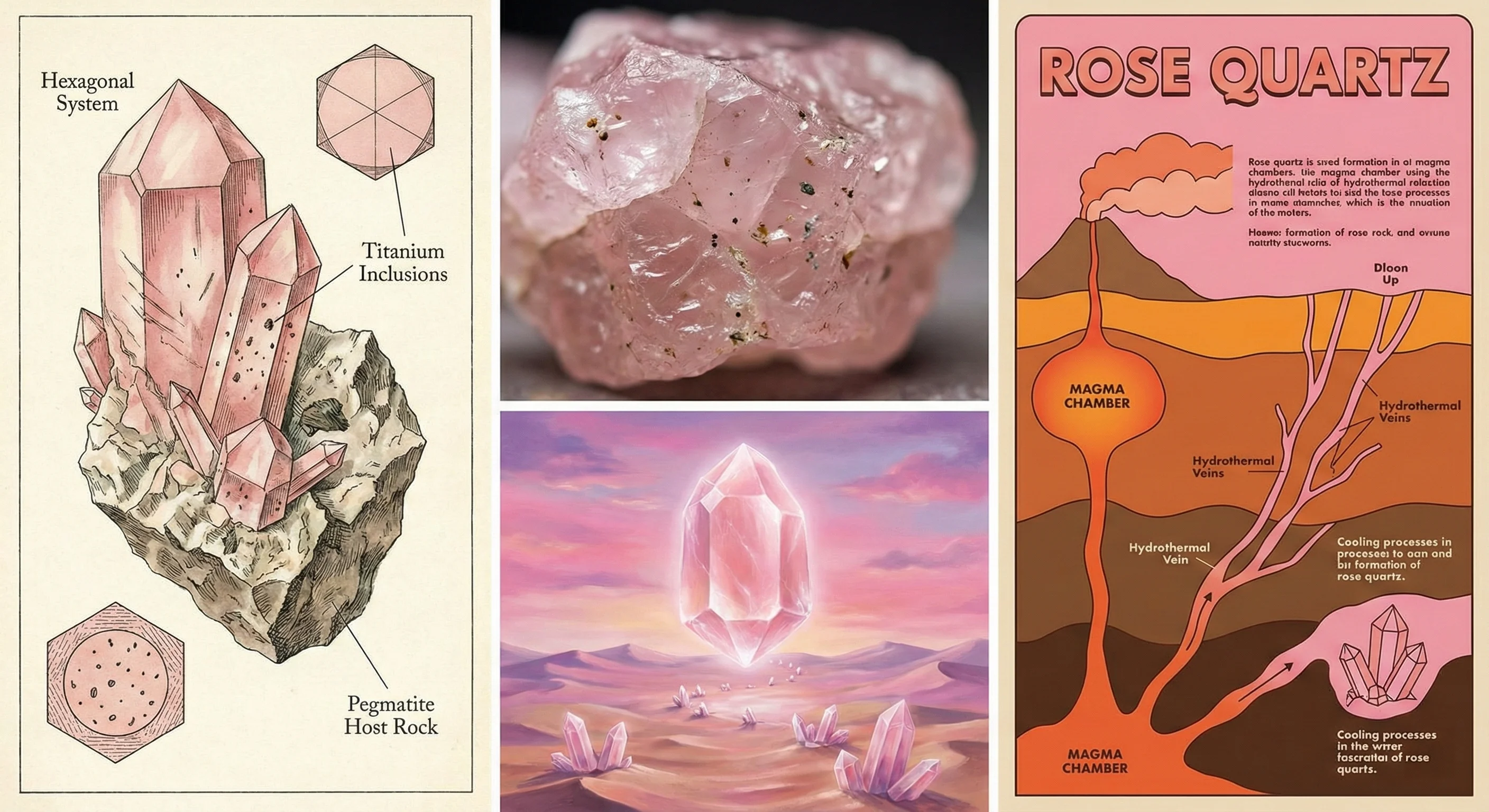
The Science of Rose Quartz: Geology, Identification & Authenticity
This forensic identification manual is a specialized chapter belonging to our comprehensive masterclass. Return to the pillar article to explore geological origins, macroscopic structures, and holistic authenticity.
Return to Pillar Article