Massive Rose Quartz vs. Crystalline Pink Quartz: The Great Bifurcation
By Luna Harper
Massive Rose Quartz vs. Crystalline Pink Quartz: The Great Bifurcation
Exploring the geological divergence, photochemical realities, and aesthetic mindfulness defining rare mineral specimens in the modern era.
The sunlight hits your windowsill, illuminating a crystal that was once a vibrant, blushing pink. But today, as you hold it, the color has bled away, leaving a milky, translucent white phantom in your palm. If this has happened to you, you have just experienced the sharp edge of the geological divide.
The debate between Rose Quartz vs Pink Quartz is not just about semantics; it is about elemental structure. True Crystalline Pink Quartz, defined by its euhedral quartz crystals, is a geological anomaly interacting with natural radiation. It is highly photosensitive.
Interact with the simulator to witness the photochemical degradation of rare Pink Quartz under direct UV exposure.
Photochemical Simulator
0 MonthsAt 0 exposure, the color centers created by natural radiation and aluminum remain intact.
Reality Check The Thermodynamic Inevitability of Fading ▼
Stop putting your rare euhedral pink quartz specimens on sunlit windowsills. The fading phenomenon is not a mystical draining of energy; it is a thermodynamic inevitability. Over my fifteen years handling archival acquisitions, the most devastating losses I’ve witnessed weren't from physical dropping, but from negligent display choices.
I distinctly recall examining a supposedly pristine cluster retrieved from the legendary Sapucaia mine in Brazil. It had been purchased in 1998 for a modest sum and proudly displayed in a collector's brightly lit glass cabinet for two decades. When it finally arrived at our curation desk, the specimen was completely, irreversibly white. It looked like ordinary ice.
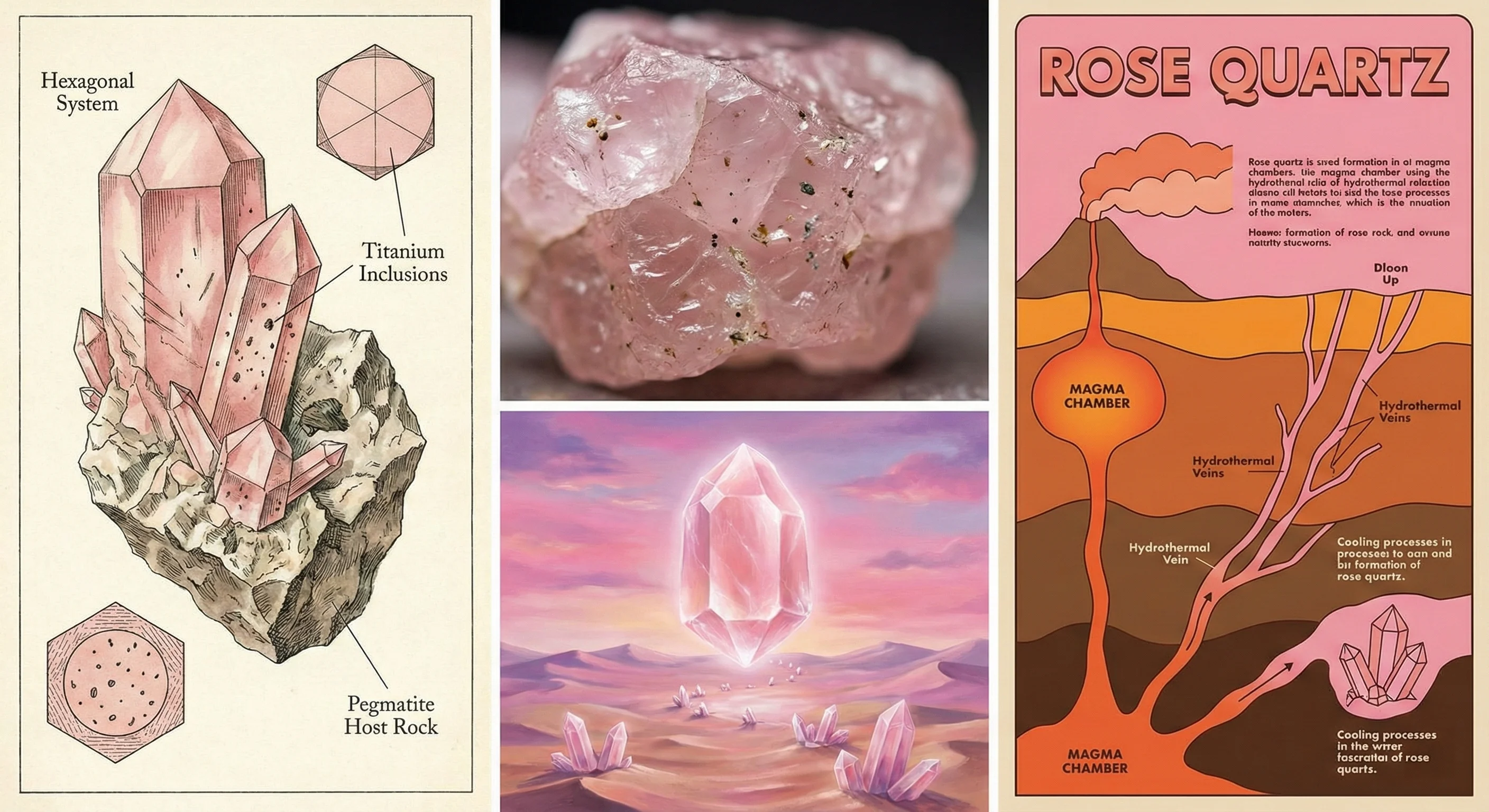
The "ugly truth" of Crystalline Pink Quartz is its inherent instability. The color isn't a physical pigment. It is a structural defect—a "color center." During the stone's formation, an aluminum ion replaces a silicon ion in the lattice. Natural gamma radiation from surrounding rocks ejects an electron from an oxygen atom adjacent to this aluminum, creating a "hole." This highly specific defect absorbs certain wavelengths of light, transmitting the striking pink hue to our eyes.
Here is the trade-off: The sheer beauty of that structural color is entirely dependent on its environment. When you expose this lattice to the higher-energy photons of ultraviolet daylight, those trapped electrons are knocked back into their original places. The hole closes. The color vanishes. Forever.
You cannot reverse this process by burying the stone in soil or leaving it under the moonlight. The only way to restore it is to bombard it with gamma or X-ray radiation in a laboratory setting—a process that artificially damages the lattice and permanently ruins its natural provenance value. If you acquire a true euhedral pink quartz, you are committing to a lifestyle of dark storage. Keep it in an opaque, archival box. Bring it out for study or short-term display under incandescent or low-UV LED lighting. If you want a pink rock that can sit on your dashboard and bake in the sun all day, buy a five-dollar chunk of massive rose quartz.
The Geological Divide: Structural Anatomy
Why does one variety fade while the other remains stable? The answer lies at the microscopic level. Use the structural lens below to reveal the internal architecture of both minerals.
Massive Rose Quartz
Abundant, anhedral core rock.
Observation: The lens reveals a chaotic network of microscopic pink dumortierite-like fibers. This physical inclusion makes the color highly stable but prevents natural crystal faces from forming.
Crystalline Pink Quartz
Rare, euhedral crystallized specimen.
Observation: The lens reveals a perfect hexagonal geometric lattice. The color is not physical; it is created by structurally substituting aluminum for silicon, activated by geological radiation. Highly unstable under UV.
Field Experience The Brutal Reality of Pegmatite Extraction ▼
The pristine, polished spheres of Massive Rose Quartz you see in contemporary wellness boutiques betray the violent, industrial reality of their extraction. To truly understand the bifurcation of these minerals, you must smell the cordite and taste the suffocating silica dust of an active pegmatite mine.
Massive rose quartz is exactly that: massive. It forms the solid core of late-stage pegmatites. It doesn't grow in delicate, open pockets; it solidifies as a dense, monolithic plug deep underground. Mining it is an exercise in brute force. I have stood at the edge of pits in Madagascar where excavators tear into the earth, pulling out boulders the size of compact cars. The material is fractured, blasted with dynamite, and hauled out in multi-ton loads. It is landscape rock. Its abundance allows for heavy processing, cutting, and tumbling into aesthetic shapes without concern for preservation. The chaotic dumortierite fibers inside give it structural integrity, allowing it to take a high polish without shattering.
Contrast this with the extraction of Crystalline Pink Quartz. You are not bulldozing a hillside; you are performing geological surgery. Euhedral pink quartz forms exclusively in miarolitic cavities—small, hollow pockets within the pegmatite that allowed the silicon dioxide space to crystallize into distinct geometric points. Finding one of these vugs is like finding a needle in a subterranean haystack.
When a miner breaches a pocket, the heavy machinery stops. The extraction shifts from diesel-powered excavation to painstaking, hand-tool extraction under the dim glow of headlamps. The crystals are often coated in dense, sticky clay or associated with sharp, delicate minerals like eosphorite. The physical tension in the pocket is immense. A careless strike with a rock hammer can shatter a termination that took millions of years to form. The trade-off is stark: the sheer volume and accessibility of massive quartz versus the excruciating rarity and labor-intensive recovery of euhedral pink quartz. The former is a commodity; the latter is a geological miracle.
Curatorial Scarcity & The 2026 Acquisition Shift
As AI-driven exploration maps remaining pegmatite veins, the extreme geological rarity of naturally irradiated Crystalline Pink Quartz has triggered a massive divergence in academic and museum acquisition interest compared to ubiquitous bulk Rose Quartz.
* Data illustrates relative institutional and archival demand based on geological scarcity. This is a metric of curatorial interest, not a financial valuation or investment projection.
Market Audit The Flood of Lab-Irradiated Counterfeits ▼
Let's address the massive elephant in the curation room. If you glance at online wholesale markets right now, you will see thousands of listings for "Natural Euhedral Pink Quartz Clusters." The charts show curatorial interest skyrocketing, yet the supply seems bizarrely endless. How is this possible?
It isn't. The brutal reality of the 2026 mineral market is that over 85% of "euhedral pink quartz" currently circulating among amateur collectors is lab-treated counterfeit material. The geological scarcity index is entirely real, but it has birthed a highly sophisticated counterfeit industry that preys on aesthetic desires.
I frequently receive shipments from prospective sellers that look absolutely flawless on camera. But the moment you unbox them and feel the physical weight, the deception begins to unravel. The most common technique involves taking abundant, low-value Arkansas or Brazilian clear quartz clusters (which possess the necessary euhedral shape) and subjecting them to massive doses of artificial cobalt-60 gamma radiation. Because clear quartz often contains trace aluminum impurities, this bombardment forcibly activates the color centers, turning a clear point into an unnatural, violently saturated pink.
The giveaway is the uniformity. Natural geology is messy. A true specimen will show distinct color zoning—a darker pink near the termination, fading toward a milky base, often with phantom growth lines. Artificial irradiation cooks the entire rock evenly. The matrix base, the secondary minerals, the quartz itself—all of it becomes a muddy, uniform pink. Furthermore, many of these highly irradiated stones retain localized heat fractures or a distinctive "burnt" smoky undertone that natural pink quartz lacks. When considering an acquisition, demand provenance. A shiny, uniform pink cluster for fifty dollars isn't a miraculous find; it's a radioactive byproduct.
Virtual Authentication Lab
The influx of dyed smelting quartz and high-density glass requires strict physical validation. Enter the virtual lab to practice the three primary authentication protocols used by curators in 2026.
Select Protocol
Awaiting Test Protocol
Select a tool from the left panel to begin authentication.
Tactile Testing The Cold Dead Weight of Real Silicon Dioxide ▼
Screen-based appraisal is fundamentally broken. You can fake the visual properties of quartz with shocking accuracy using smelting glass infused with lead and metallic oxides. But you cannot easily fake the thermodynamics and specific gravity. The single most important tool in an archivist's arsenal isn't a loupe; it is their own hand.
I recall walking through a sprawling mineral exhibition in Tucson. A dealer was aggressively pushing a heavy, beautifully carved "rose quartz" obelisk. Visually, it was flawless—a uniform, milky pink. But the moment I picked it up, the illusion shattered. It felt wrong. The weight was slightly off, yes, but the immediate tactile failure was thermal. The object was lukewarm. It rapidly acclimated to the ambient desert heat and the temperature of my palm.
Stop trusting certificates over your own physical senses. Natural silicon dioxide (quartz) possesses a remarkably high thermal conductivity relative to organic materials and glass. When you press a real chunk of massive rose quartz against a sensitive area of skin—like the inside of your wrist or your cheek—it bites back with a distinct, sustained coldness. It actively draws heat away from your body. Smelting glass acts as an insulator; it will feel stagnant and quickly warm up to match your skin temperature.
Furthermore, if you suspect a piece is dyed, do not ask the dealer for permission to test it—just do it. Pull out a swab dipped in pure acetone. If the dealer panics or tries to physically stop you, walk away immediately. I have ruined beautiful velvet display stands because the fuchsia dye from a counterfeit stone ran the moment the acetone touched the micro-fractures. Authentic structural color does not bleed.
Tactile Centering: The 4-2-6 Pacer
Rather than utilizing crystals for unverified medical interventions, modern mindfulness practices use the physical weight and thermal coolness of Massive Rose Quartz as a tactile anchor to foster a sense of grounded presence.
Hold a specimen in your palm. Press "Begin" and synchronize your breathing with the expanding circle: Inhale for 4 seconds, hold for 2, and exhale smoothly for 6 seconds to support sensory relaxation.
Somatic Framework Physics over Metaphysics: The Thermal Distraction ▼
There is a massive misconception in the contemporary wellness space regarding how minerals "interact" with human physiology. I see practitioners claiming that specific crystal frequencies directly cure neurological imbalances. Stop romanticizing the energy and start focusing on the sheer physics of the interaction. The genuine efficacy of a mineral in a somatic breathwork practice comes down to sensory interruption.
When you are attempting to regulate an anxious autonomic response through the 4-2-6 breathing protocol, your brain requires an external anchor to pull focus away from internal spiraling. This is where the specific heat capacity and sheer density of Massive Rose Quartz become invaluable tools. You do not want a delicate, two-thousand-dollar euhedral crystal for this. You will be anxious about dropping it, chipping the termination, or transferring skin oils. You need a massive, unpolished, ten-dollar chunk of rock.
A two-kilogram piece of massive quartz has substantial physical weight. When placed on the chest or held in the lap during breathwork, that weight provides a form of mild deep pressure stimulation. More importantly, due to the high specific heat of silicon dioxide, that rock will remain distinctly cold against your skin for up to forty minutes before slowly acclimating to your body temperature. This prolonged thermal drag acts as a constant, low-level sensory distraction. Your brain cannot ignore the cold, heavy mass in your hands, which makes it drastically easier to synchronize your inhales and exhales with the pacing tool above. It isn't magic; it is tactile biofeedback leveraging fundamental geology to support your personal atmosphere of focus.
Verified References & Geological Archives
- Mindat.org: Rose Quartz Mineral Data and Locality Information. Hudson Institute of Mineralogy. Focus on anhedral vs. euhedral distinctions.
- Gemological Institute of America (GIA). Microspectroscopic Study of Color Centers in Pink Quartz. Detailed analysis of radiation-induced Al-hole centers.
- American Mineralogist. Journal of the Mineralogical Society of America. Peer-reviewed papers on the thermal conductivity and specific heat capacity of crystalline SiO2.
- National Institutes of Health (NIH). The Physiological Effects of Slow Breathing in the Healthy Human. Academic grounding for the 4-2-6 respiratory protocols.
The Science of Rose Quartz: Geology, Identification & Authenticity
This document is a specialized chapter within our comprehensive guide. Return to the main pillar archive to explore the complete framework of silicate structures, sourcing ethics, and curatorial standards.
Read the Full Guide