The Great Bifurcation: Why Massive Rose Quartz and Crystalline Pink Quartz Are Fundamentally Different
By Luna Harper
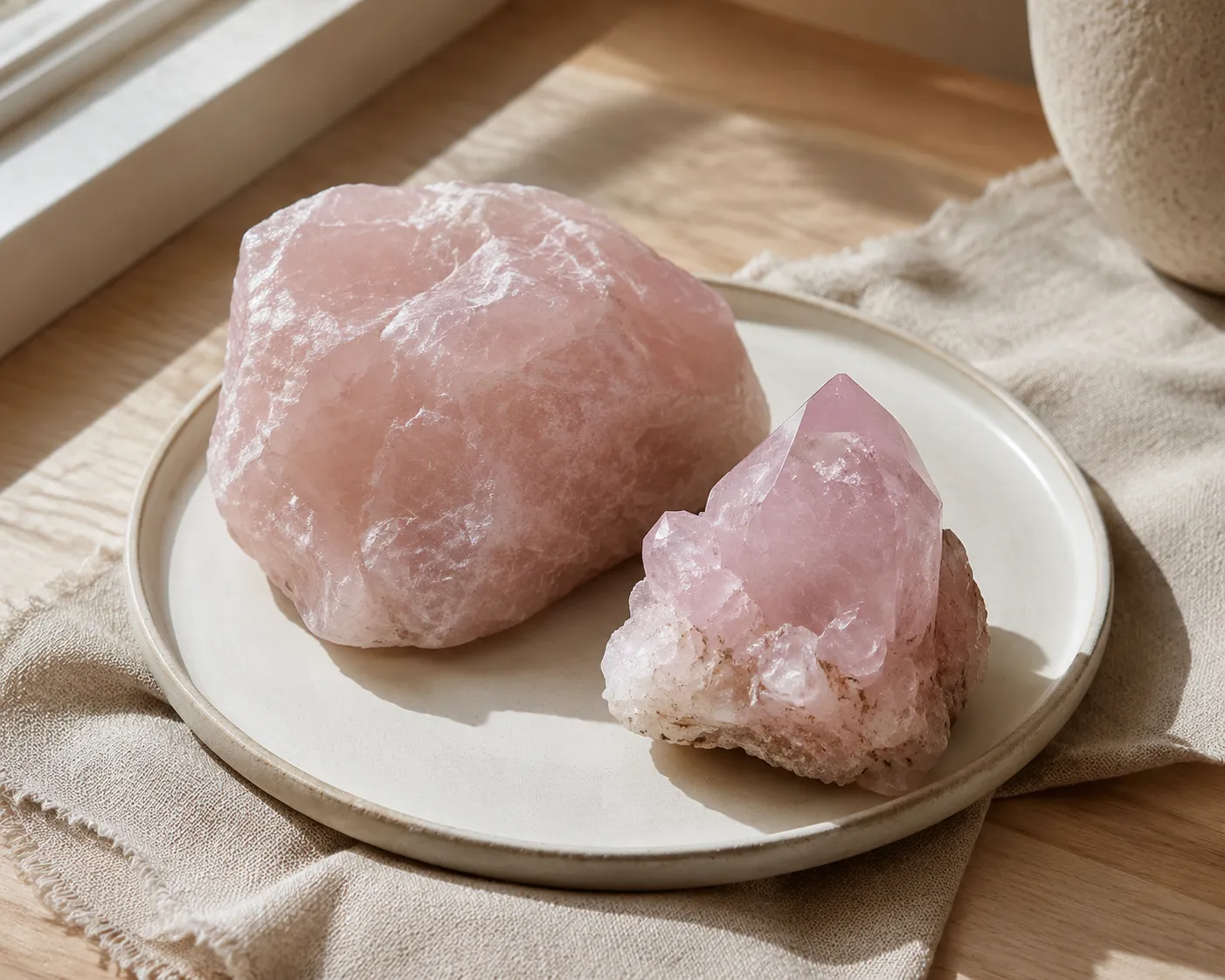
Material distinction
The Great Bifurcation: Why Massive Rose Quartz and Crystalline Pink Quartz Are Fundamentally Different
Massive rose quartz and crystalline pink quartz are both pink varieties within the quartz family, but they are not simply the same material in different shapes. In the Massive vs Crystalline Quartz distinction, “massive” means rose quartz that is crystalline internally but does not show natural external crystal faces. Crystalline pink quartz refers to rare pink quartz crystals that visibly grew with faces or terminations. The difference matters because habit, color cause, transparency, light sensitivity, and naming are not the same.
The direct distinction: same quartz family, different habit
The easiest misunderstanding to clear up is the word “massive.” In mineral language, massive does not mean fake, melted, glassy, or non-crystalline. Massive rose quartz is still quartz. The term describes outward habit: the material occurs as compact masses rather than as individual crystals with obvious natural faces.
That is why familiar rose quartz is often seen as chunks, slabs, beads, cabochons, spheres, bowls, eggs, towers, freeforms, and carved points. Those objects may be made from genuine rose quartz, but their shape usually comes from cutting and polishing, not from the way the quartz naturally grew.
Crystalline pink quartz is different at the specimen level. It may occur as individual quartz crystals or clusters with natural prism faces and terminations. In stricter mineral and gem references, this material may be separated from ordinary rose quartz with terms such as “pink quartz,” “crystalline pink quartz,” or “crystalline rose quartz.” Shops do not always use those names carefully, but the distinction itself is useful.
A practical shorthand:
- Massive rose quartz: internally crystalline quartz, outwardly massive, commonly cloudy to softly translucent, usually without natural crystal faces.
- Crystalline pink quartz: visibly formed quartz crystals with natural faces or terminations, much rarer, often clearer, and associated with a different color mechanism.
So the split is not “real versus unreal,” and it is not “crystal versus non-crystal.” It is a split between common massive rose quartz and rare naturally crystallized pink quartz.
Why the outward form changes what you see
Massive rose quartz usually does not show the crisp geometry people associate with quartz crystals. It is commonly found as irregular bodies or larger masses, which makes it suitable for carving, polishing, and decorative objects. Large rose quartz lamps, bowls, spheres, and interior pieces are generally made from massive material.
Crystalline pink quartz is expected to look more like a mineral specimen: smaller, more defined, and visibly grown as quartz crystals. Natural terminations matter here. A carved rose quartz point is not the same thing as a quartz crystal that grew with its own termination.
A rose quartz tower may have six sides and a pointed top, but those faces were shaped by lapidary work. A naturally terminated pink quartz crystal shows growth faces that belong to the crystal itself. The point is not that one is better. It is that one form is human-shaped, while the other preserves natural crystal habit.
Transparency can also differ. Massive rose quartz is often cloudy, milky, or softly translucent. It may glow warmly when backlit, but it commonly has internal haze. Crystalline pink quartz can be clearer, sometimes with pink color appearing in zones within an otherwise more transparent crystal. Transparency alone is not proof, but it is one useful clue.
Size is another practical cue. Massive rose quartz is the material most often available in larger decorative forms. Crystalline pink quartz specimens are much rarer and are usually treated as mineral specimens rather than bulk carving material.
Color mechanism: inclusions versus color centers
The difference is not only shape. The pink color is also explained differently in mineralogical and gemological sources.
For massive rose quartz, the color is commonly associated with microscopic fibrous inclusions or nanofibers within the quartz. Research has described these fibers as dumortierite-like or related to a dumortierite-type aluminum borosilicate material. The chemistry is more complex than a simple “one impurity makes it pink” story, but the useful point is this: familiar massive rose quartz is pink largely because of tiny included material inside the quartz.
That internal texture helps explain its appearance. Massive rose quartz is often hazy or turbid because light interacts with those internal features. Related internal structures are also discussed in connection with asterism, the star-like optical effect seen in some properly cut rose quartz.
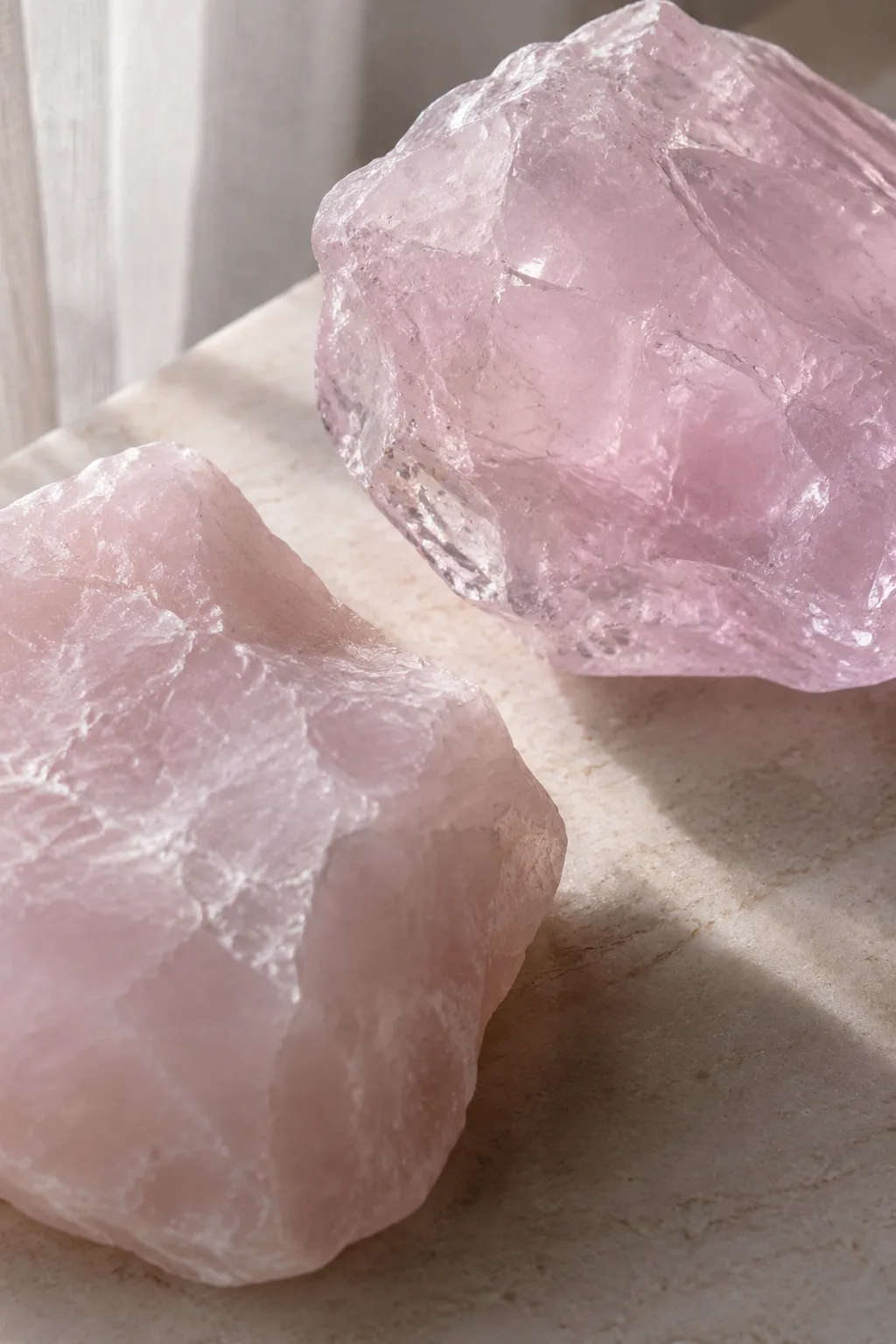
Crystalline pink quartz is usually described differently. Its color is generally tied to color centers in the quartz structure, associated in the literature with aluminum and phosphorus substitution and natural radiation. In plainer terms, the color is not usually explained as the same fibrous-inclusion color seen in massive rose quartz.
This difference can show up visually. Massive rose quartz often looks softly and fairly evenly pink, though it ranges from very pale to stronger pink and may carry lavender or warm tones. Crystalline pink quartz may show zoning, with pink concentrated unevenly or stronger near terminations. A clear quartz crystal with pink zoning should not automatically be treated as ordinary massive rose quartz in crystal form.
Light sensitivity is another reason the distinction matters. Crystalline pink quartz is often described as more prone to fading under prolonged exposure to natural light. Massive rose quartz is generally treated as more stable in ordinary display conditions, though fading reports exist and not every case has a simple explanation. If color preservation matters, the cautious care note is simple: keep pink quartz specimens, especially clearer crystalline ones, away from prolonged direct sunlight.
Why shop labels can blur the difference
The naming around rose quartz is messy because casual language, mineral collecting language, gemology, and retail language do not always use the same level of precision.
In everyday use, “rose quartz” often means any pink quartz-like material sold for jewelry, decor, or symbolic use. In stricter mineral discussion, familiar rose quartz usually means the massive, cloudy pink material, while rare naturally crystallized material may be called pink quartz or crystalline pink quartz.
The phrase “rose quartz crystal” is especially ambiguous. It may mean:
- a piece of rose quartz sold in a crystal shop;
- a carved rose quartz point, tower, wand, or pendant;
- a naturally grown pink quartz crystal with external faces and terminations.
Only the third meaning points to crystalline pink quartz in the stricter visible-habit sense. The first two may still be genuine quartz, but they do not show that the external form is natural.
A careful visual check can help:
- Look for natural, unrepolished crystal faces rather than perfectly uniform cut facets.
- Check whether the termination appears grown rather than carved.
- Notice whether the material is cloudy and evenly pink or clearer with color zoning.
- Treat very large carved forms as likely massive rose quartz unless there is strong evidence otherwise.
- Be cautious with labels that use “crystal” as a broad retail category without describing natural habit.
These cues can support a reasonable reading, but they are not laboratory confirmation. Color mechanism, microscopic inclusions, and structural defects require technical testing to identify with confidence.
What the difference does and does not mean
The geological distinction between massive rose quartz and crystalline pink quartz is real, but it should stay in its lane.
It does mean that a carved rose quartz object and a naturally terminated pink quartz crystal may have different formation histories, visual traits, rarity expectations, and care concerns. It also means that “rose quartz vs pink quartz” can be more than a naming preference when the terms are used carefully.
It does not mean that massive rose quartz is lesser, artificial, or not truly crystalline. It also does not mean that crystalline pink quartz is automatically more authentic. Both can be natural quartz materials. The distinction is about habit and color origin, not a ranking of value.
For readers who use rose quartz in symbolic, ritual, or interior settings, the same boundary applies. Someone may prefer massive rose quartz for its soft color, polish, and familiar presence in a room. Someone else may prefer a rare pink quartz crystal because natural terminations feel personally significant. Those are aesthetic or interpretive choices. The mineralogical difference does not establish that one form creates stronger personal effects than the other.
The grounded answer is this: massive rose quartz is the familiar pink quartz material most people meet in jewelry, carvings, and decor; crystalline pink quartz is the rarer visibly crystallized pink quartz that can grow with natural faces and terminations. They overlap as quartz, but they diverge in outward form, color mechanism, visual character, naming, and sometimes care.
Short FAQ
Is massive rose quartz still crystalline?
Yes. “Massive” describes outward habit, not the internal nature of the mineral. Massive rose quartz is crystalline quartz material, but it usually does not show individual natural crystal faces or terminations.
Is a rose quartz tower a natural crystal?
Usually no. A rose quartz tower or point is commonly cut and polished from massive rose quartz. It may be genuine rose quartz, but its pointed form is typically shaped by lapidary work rather than grown as a natural termination.
Is pink quartz the same as rose quartz?
In casual use, the terms are often blurred. In stricter usage, rose quartz commonly refers to massive cloudy pink quartz, while pink quartz or crystalline pink quartz may refer to rare naturally crystallized pink quartz with a different color mechanism. The label alone is not enough; habit, transparency, color zoning, and context all matter.
Sources
Sources and further reading
Reference links are limited to sources considered suitable for public citation in this page.