Mineral comparison
The "Pink" Imposters: Pink Amethyst & Mineral Lookalikes
A pale pink stone on a shelf can look settled until the label changes the story. One tag says rose quartz; another says pink amethyst; a third uses softer trade language that feels more like a mood than a mineral name. That is why people search for Pink Amethyst vs Rose Quartz: color alone is a fragile way to name a specimen.
The better question is slower: what is visible, what is only a seller’s phrase, and where does the identification need testing rather than confidence? This page compares the clues that matter most — form, structure, color distribution, naming habits, inclusion language, and the limits of practical pink minerals identification.
broader context
Rose quartz context note
This narrower page makes more sense after the broader rose quartz context page.
Pink Amethyst vs Rose Quartz Begins With Form
A pink surface is usually the first clue, but it is rarely the deciding one. Rose quartz and pink amethyst overlap visually because both names pull the eye toward soft color words: blush, dusty rose, pale violet, lavender-pink, or warm translucent pink. Those words shift under different lighting, camera settings, polish, background color, and expectation.
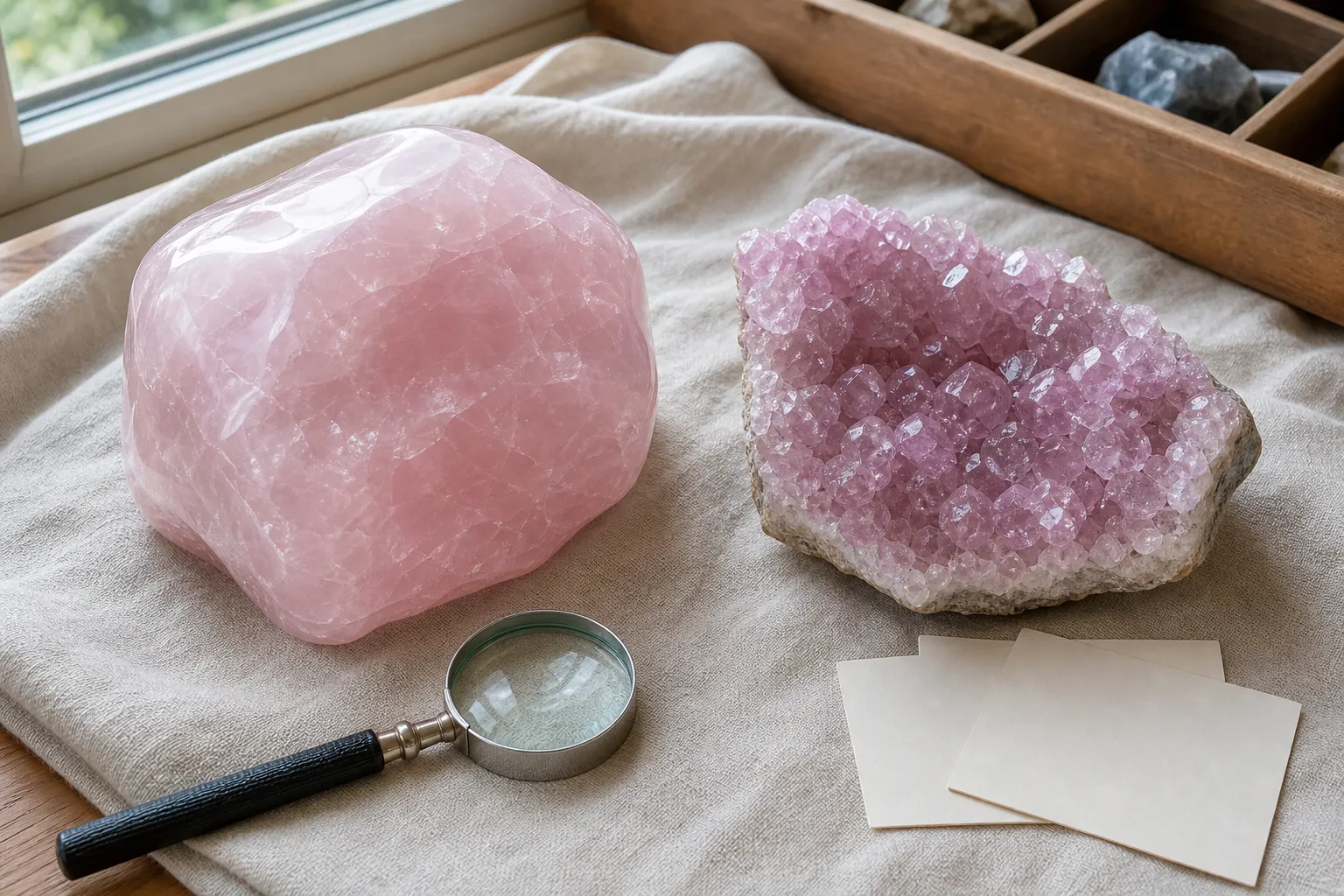
Form gives a more useful first separation. Rose quartz is often encountered as massive material: tumbled stones, carved hearts, spheres, palm stones, bookends, and decorative chunks where individual crystal points are not visible. Pink amethyst is often discussed around crystalline or geode-like pieces, where the surface may show many small crystal faces rather than one continuous cloudy body.
That distinction can guide the first read, but it cannot finish the identification. Cutting, polishing, repair, coating, damage, and display style can hide the original habit of a stone.
Cloudy, continuous pink body
May suggest a massive quartz-style presentation, but does not confirm rose quartz.
Sparkling crystal faces or cavity surface
May suggest a crystalline or geode-like specimen, but does not confirm pink amethyst.
Purple-pink zoning or uneven color
May point toward a different naming discussion, but does not identify the mineral by itself.
A label using “rose,” “amethyst,” or “pink quartz”
Shows market language, but does not function as mineral testing.
The strongest practical move is to separate the specimen from the name attached to it. A stone can be pink and still need a better identification context.
Why Pink Mineral Lookalikes Get Mislabeled
Pink mineral lookalikes become confusing because the market often groups objects by color, room use, or symbolic tone before it explains material reality. A pastel geode, a polished pink tower, a cloudy sphere, and a banded carving may be photographed under the same visual theme. The shared color creates a family feeling; the minerals may not belong to the same family at all.
Rose quartz naming confusion usually starts with familiarity. The phrase is simple, widely recognized, and culturally loaded, so it can become casual shorthand for almost any gentle pink quartz-like object. Pink amethyst naming confusion works differently. It often carries novelty, locality language, or specimen-style appeal, and the listing may not show enough evidence for a reader to judge the claim.
Other pink materials can enter the same lane. Pink calcite, pink fluorite, treated stones, glass, composites, and other lookalikes may appear in retail or collector spaces. A responsible comparison should not identify them from color terms alone. The safer point is broader: many minerals and materials can appear pink, and several can be shaped, polished, or photographed in ways that resemble one another.
Before trusting a pink mineral label, ask:
- What structure is visible: massive, crystalline, banded, layered, granular, or glassy?
- What supports the label beyond color and sales language?
- What would change the answer: lighting, magnification, known source, documentation, or editorial review?
The name is a clue. It is not the specimen.
Pink Amethyst Geology Needs a Narrower Claim
Pink amethyst geology sounds precise, but precision depends on sources. Without credible mineralogical references tied to a specific claim, this article should not state formation environment, locality, rarity, treatment history, or exact color cause as settled fact. Those details need geological or gemological support, not repeated shop descriptions.
What can be said more carefully is that “pink amethyst” is used as a mineral and specimen label in contemporary crystal language, and readers often meet it near discussions of quartz variations, color zoning, inclusions, and geode surfaces. The label invites comparison with amethyst because of its violet-pink range, and with rose quartz because of its pinkness. That overlap is where many mistakes begin.
Treat pink amethyst as a claim that needs context
- Visible crystal faces may support asking about a crystalline quartz specimen, but they do not settle the name.
- Pale pink, dusty mauve, or lavender-pink color may explain why the label feels plausible, but hue is not a diagnostic test.
- Origin, rarity, and special-use claims belong to market or cultural language unless backed by appropriate evidence.
- If the name raises the price, the evidence standard should rise with it.
The same restraint applies to quartz variations more broadly. Trade names can describe appearance, habit, locality, or market category, but exact mineral facts need source-backed handling. Visual comparison is useful; certainty belongs to stronger evidence.
Hematite Inclusions and Color Explanations Need Care
Hematite inclusions often appear in conversations about pink, red, or purple-toned minerals because inclusions can affect appearance. The phrase may be used when a specimen has warm pink patches, rusty points, red-orange dusting, or smoky mauve zones. Still, “hematite” should not become a casual explanation for every warm pink tone.
A safer three-layer reading
Visible feature
Claim type: “There are reddish specks or cloudy zones.” Safer reading: describe what is visible before naming the material.
Interpretation
Claim type: “Those marks may be inclusions.” Safer reading: possible, but not final from appearance alone.
Mineral claim
Claim type: “This color is caused by hematite.” Safer reading: needs stronger evidence for the specimen.
This matters because inclusion language can sound scientific even when it is being used loosely. A seller may mention hematite inclusions, iron staining, natural color, or internal mineral traces; each phrase may point toward a real possibility, but none should be treated as proof without suitable support.
The same caution applies when scientific vocabulary is borrowed for symbolic or promotional language. Crystal structure is a real subject; it should not be turned into a decorative explanation for guaranteed outcomes, ritual certainty, or mood claims. Mineral literacy works best when the specimen is described before interpretation is added.
A Practical Frame for Pink Minerals Identification
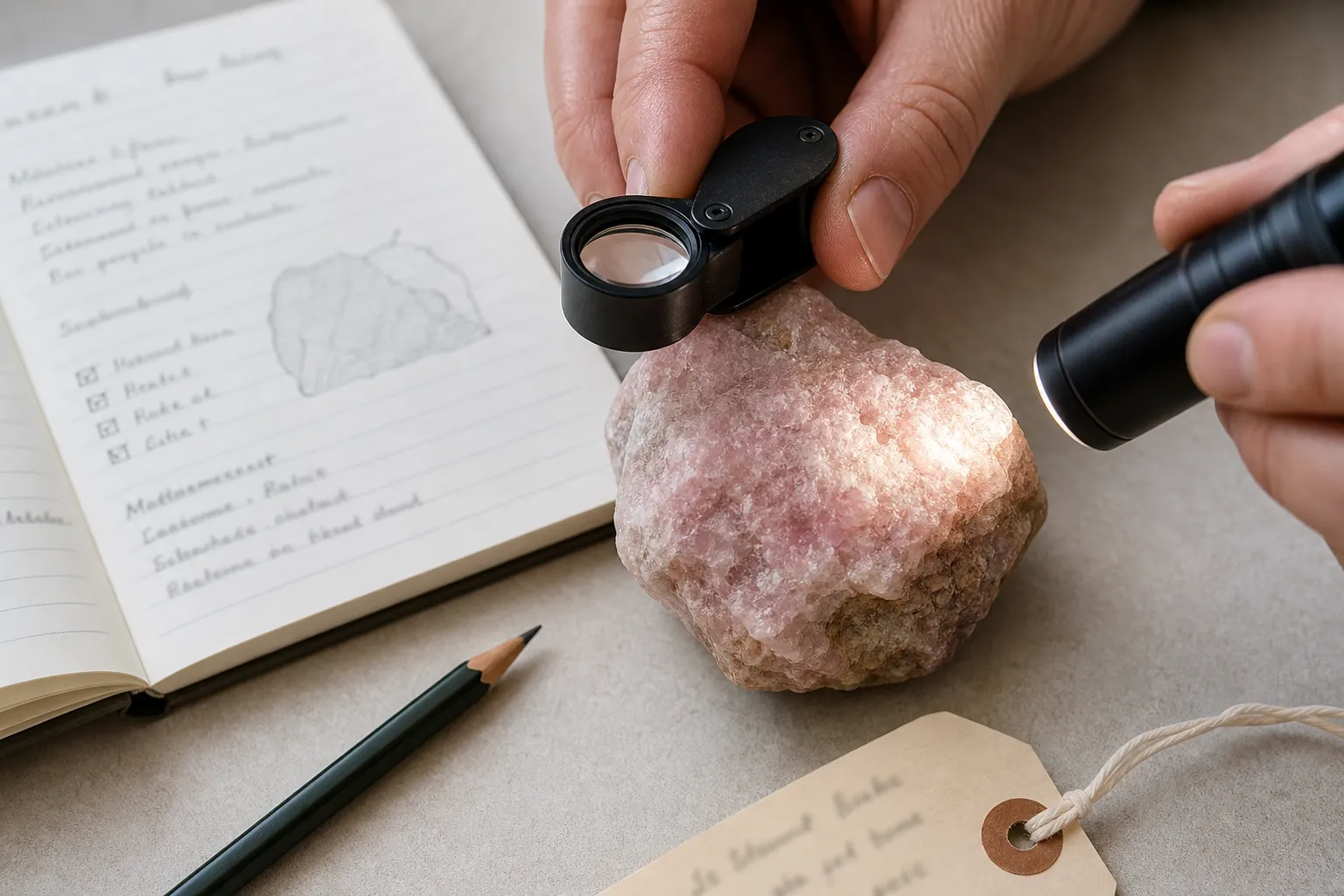
Practical pink minerals identification is not one perfect trick. It is a chain of clues, plus the discipline to know where the chain ends. For most readers, the goal is not to produce a laboratory report at home. It is to avoid confusing a label, a color, and a familiar feeling with confirmed identity.
Use this decision frame
- Start with presentation. Is the piece raw, polished, carved, tumbled, jewelry-set, or geode-like? A polished carving removes many natural surface clues.
- Look for structure. Does the stone appear massive and cloudy, or does it show many crystal faces? This can help separate rose quartz appearance comparison from pink amethyst appearance comparison, but only provisionally.
- Check color distribution. Is the pink even, zoned, patchy, coated, or concentrated along surfaces? Uneven color often raises more questions than it answers.
- Read the label as language. “Rose,” “pink,” “amethyst,” “quartz,” and locality phrases may be useful, but they should not replace evidence.
- Escalate when the answer matters. If value, collecting accuracy, resale, or formal documentation matters, seek qualified gemological or mineralogical testing.
Some popular tests need careful placement. A Mohs scratch test can damage a specimen and still may not answer the exact naming question. A vinegar reaction belongs to certain carbonate identification discussions, but it should not be used casually on valued pieces. UV light may reveal fluorescence in some materials, but fluorescence is not a universal authenticity stamp. Saltwater, sunlight, smoke, and abrasive cleaning can affect some surfaces or finishes; they should not be treated as harmless simply because a stone is marketed for décor or symbolic use.
Non-destructive observation comes first. Testing belongs where it is appropriate. Higher-stakes claims need better confirmation.
Where Ritual and Interior Language Can Mislead the Mineral Question
A pink stone in a bedroom, on a desk, or near a small ritual arrangement carries more than mineral identity for many readers. It may belong to a color palette, a memory, a seasonal arrangement, or a symbolic practice. That lived aesthetic use is real as context, but it does not identify the stone.
This matters when pink amethyst and rose quartz are described through emotional or energetic language. A piece may be framed as calming, heart-centered, grounding, cleansing, receptive, or suited to a particular moon, year, grid, or meditation style. Those phrases belong to cultural and personal practice language. They should not be used as evidence that a specimen is rose quartz, pink amethyst, calcite, fluorite, or anything else.
Newer claims can sound technical while still leaving the mineral question unanswered: digital mineral passports, pre-ritual verification, frequency matching, piezoelectric programming, sonic cleansing, or lattice reprogramming. Some borrow scientific vocabulary; others belong to symbolic routines. Without credible evidence and a clear identification process, they do not solve the specimen’s identity.
For interiors, the reading can stay gentler. If a pink mineral object works visually in a room, its decorative value does not require perfect naming unless authenticity, value, or collection accuracy matters. For ritual use, the same principle holds: an object can be used symbolically, but symbolic use should not be mistaken for mineral confirmation.
A room use is not a test. A label is not a test. A feeling is not a test.
When the Answer Changes
The answer to “Is this pink amethyst or rose quartz?” changes when the evidence changes. A single photo may suggest one direction; a close view of crystal faces may suggest another; documentation from a reliable mineral source may change the reading again. Good identification is conditional.
Surface form
Massive, cloudy material and crystalline cavity surfaces lead to different questions.
Transparency and texture
Milky, glassy, granular, sugary, banded, or coated appearances can shift the comparison, but none acts alone.
Color distribution
Even body color differs from surface staining, zoning, or patchy deposits.
Cut and polish
Towers, spheres, hearts, and cabochons may erase natural clues visible in rough specimens.
Documentation quality
Clear provenance, lab reporting, or reliable mineral dealer documentation is stronger than a vague listing title.
Purpose of identification
Casual décor requires less certainty than collecting, resale, appraisal, or educational labeling.
Mineral identification limits are part of the answer, not a footnote. If a stone is low-cost décor, a conservative description may be enough for personal organization. If it is sold as rare, locality-specific, or unusually valuable, a higher standard is fair. The more the claim asks the reader to pay, trust, or repeat, the more evidence it should carry.
A Reader’s Checklist for Pink Amethyst Identification Limits
Before accepting a pink mineral label, keep confidence proportional to evidence.
What observation can usually note
- General color range: pale pink, rose, lavender-pink, mauve, reddish, or mixed.
- Surface habit: massive-looking, crystalline-looking, banded, coated, carved, or polished.
- Visible features: specks, clouds, zoning, fractures, cavities, sparkle, or surface deposits.
- Presentation context: specimen, décor object, jewelry, ritual object, or shop listing.
What observation should not decide alone
- Exact mineral identity when several pink lookalikes remain possible.
- Specific color cause, including hematite inclusions, without support.
- Treatment status, locality, rarity, or value.
- Authenticity based only on a name, photograph, or symbolic description.
When stronger confirmation is reasonable
- The specimen is expensive or being purchased for a collection.
- The label includes rarity, locality, or specific geological claims.
- The stone will be resold, appraised, cataloged, or used for teaching.
- The surface has been polished, coated, dyed-looking, repaired, or altered in a way that hides natural evidence.
This frame does not make the comparison less useful. It makes the answer more honest.
FAQ
Can I distinguish pink amethyst from rose quartz just by color?
Usually not with confidence. Color can suggest a comparison path, but lighting, polish, surface condition, and naming habits can make different pink minerals look similar. Structure, documentation, and, when needed, testing matter more than hue alone.
Is every crystalline pink geode sold as pink amethyst correctly labeled?
A crystalline or geode-like surface may explain why the label is used, but it does not prove the identification by itself. The claim needs supporting context, especially if rarity, locality, or high value is part of the sale.
Are hematite inclusions the reason pink amethyst looks pink?
That may be stated in some discussions, but it should not be treated as confirmed for a specific specimen without reliable mineralogical evidence. Visible reddish specks or warm color zones are observations first.
Should I use home tests on pink mineral lookalikes?
Use caution. Some tests can damage specimens or give incomplete answers. Non-destructive observation is the better first step, and higher-stakes identification should move toward qualified gemological or mineralogical review.
The Cleanest Way to Read a Pink Label
The cleanest way to approach pink amethyst vs rose quartz is to slow the label down. First look at the specimen: form, surface, color distribution, polish, and visible structure. Then read the name as a claim that may be accurate, loose, or incomplete. Finally, decide how much certainty the situation actually requires.
For everyday interiors or personal symbolic use, a cautious description may be enough: a pink quartz-like specimen, a rose-colored polished stone, a crystalline pink display piece. For collecting, resale, or authenticity claims, that wording is not enough. The identification needs better evidence.
Pink minerals can carry meaning in a room or ritual context without being overnamed. The specimen comes first; the story should stay proportional to what can be seen and supported.