Color stability science
Color Stability Science: Why Some Pink Quartz Fades
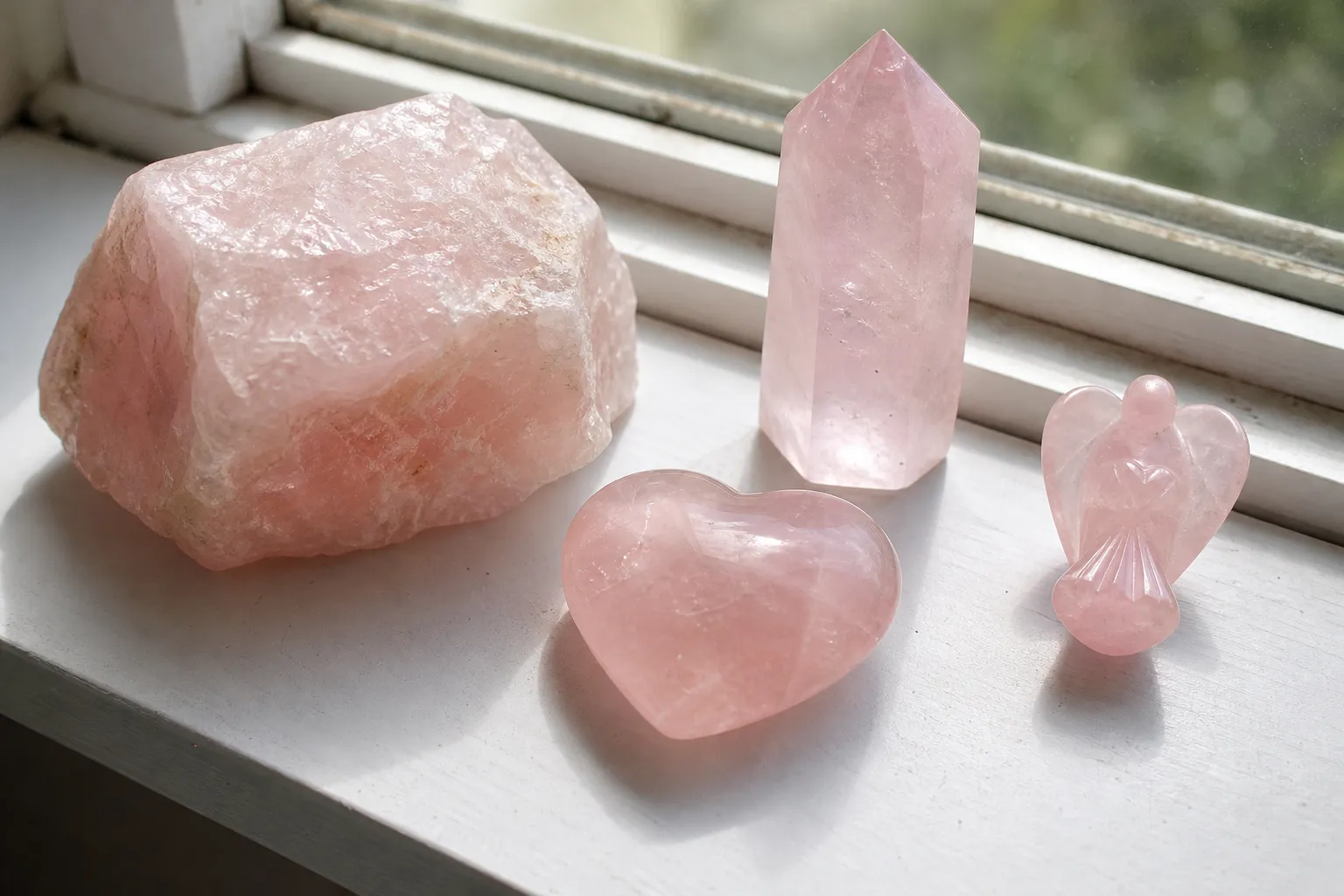
A pink quartz piece on a sunny windowsill raises a practical kind of doubt: is the stone naturally pale, or is the room slowly taking the pink out of it? That is the real concern behind Rose Quartz Sun Fading. The answer is not a clean yes or no, because “pink quartz” is not one single color system.
A carved rose quartz heart, a cloudy massive chunk, a transparent pink crystal, and an altered quartz specimen may all be sold or described with similar language. They do not necessarily share the same color origin, exposure history, or stability behavior. Color stability begins with that difference.
broader context
Broader rose quartz guide
This narrower page makes more sense after the broader rose quartz context page.
Why “rose quartz fades” is too simple
The fading claim usually starts with something visible. A specimen looks less saturated than before. A seller warns that sunlight will bleach it. A collector notices that a once-warm pink object now looks gray. Those observations may be real, but the explanation is often compressed too far.
Pink color in quartz is not always a surface coating, and it is not always one light-sensitive pigment waiting to disappear. Massive rose quartz, the familiar cloudy to translucent material used in palm stones, spheres, towers, beads, and interior objects, is often discussed separately from rarer transparent pink quartz crystals. Mineralogical research on massive rose quartz links its color discussion to extremely fine internal features, including fibrous nanoinclusions. That matters because color tied to internal mineral-scale structure is different from color added at the surface or introduced through a treatment.
Other quartz color discussions use color-center language. A color center is a defect in a crystal structure that changes how light is absorbed. Radiation color centers belong to the wider vocabulary of quartz color stability, especially when people compare smoky quartz, amethyst, and altered quartz. The available evidence for this page, though, does not support turning every rose quartz fading report into one specific color-center story.
“Pink quartz fading” can therefore describe several different situations:
- a naturally pale specimen being mistaken for a faded one;
- a color system that may be more sensitive to light, heat, or both;
- an altered stone losing an introduced color effect;
- surface wear, polish change, or grime making the color look weaker;
- a real color change whose mechanism cannot be read from appearance alone.
A careful answer starts with classification, not certainty.
Massive rose quartz and pink quartz are not the same stability question
Collectors often use “rose quartz” broadly, but the distinction between massive rose quartz and other pink quartz matters when discussing fading. Massive rose quartz usually appears compact, cloudy, milky, or translucent rather than sharply formed and transparent. Its color can range from barely blushed to deeper pink, often with uneven distribution through the stone.
Transparent pink quartz crystals are less common and can carry a different set of questions about color origin, photosensitivity, and specimen history. If a label says “pink quartz” rather than “rose quartz,” that may be more than a naming detail. It may point to a different mineralogical discussion.
Many rose quartz fading misconceptions begin here. One person reads that a type of pink quartz is light sensitive and applies that warning to every cloudy rose quartz object in the house. Another owns a massive rose quartz piece that has not visibly changed after years of ordinary display and assumes no pink quartz can change. Both conclusions move too quickly.
Massive rose quartz
Often discussed with internal inclusion-related coloration; it should not be assumed to behave like every transparent pink quartz specimen.
Transparent pink quartz
May belong to a different color-stability discussion; photosensitivity claims need specimen-specific support.
Altered quartz
Color may depend on treatment history; appearance alone may not reveal stability.
Commercial “pink quartz” objects
Naming can be loose; the label may not explain color origin or future behavior.
This does not make massive rose quartz automatically immune to change. It means the evidence does not support treating all pink quartz as one fading category. The specimen before the label matters.
What sunlight, bright rooms, and heat can realistically change
For an owner, the practical question is usually not laboratory physics. It is a window, a shelf, a lamp, or a display case. Can sunlight, bright lighting, heat, or storage make a pink stone look less pink over time?
Light is a reasonable preservation concern. General stone-object conservation guidance treats unnecessary intense light and heat as avoidable risks, especially when composition, surface condition, previous treatment, or associated materials are uncertain. That supports cautious display habits. It does not prove a rose-quartz-specific fading rule.
Heat belongs in the same conversation, but it should not be turned into a dramatic universal claim. Some online phrasing suggests that heat alone explains whitening, or that ordinary display lighting is quietly destroying every pink quartz object. The evidence available here does not support those broad statements for all specimens. A steadier reading is that light and warmth can combine in real rooms: sunlight through glass, enclosed cabinets, hot lamps, radiators, and dark display surfaces can all change the exposure environment.
Window display is the clearest everyday scenario. A specimen in direct sun receives stronger and more variable exposure than one on a shaded shelf. If it is near glass, a heat source, or a warm surface, the care question is no longer only “UV or not UV.” It becomes a combined environment question: brightness, duration, heat, airflow, and the object’s own color origin.
The available material does not justify exact thresholds. It does not show that a specimen will fade after a set number of hours, that one UV cutoff settles the matter, or that a stable-looking piece can never change later. Practical care stays broader: reduce prolonged direct sun, avoid avoidable heat, and check color under consistent lighting before assuming a cause.
Photosensitive gemstones are a comparison, not a verdict
Rose quartz is sometimes placed beside broader lists of photosensitive gemstones. The comparison can help because it reminds readers that some mineral colors are less stable than others under light. It can also mislead if it makes all pink stones sound chemically alike.
Photosensitivity is not one property shared equally across gemstones. It depends on material, color cause, defect structure, inclusions, treatment history, and environment. A mineral may be stable in one color form and less stable in another. A specimen may be affected by intense exposure but not ordinary shaded display. An altered piece may behave differently from untreated material with a similar color.
For rose quartz, the comparison should stay narrow. Color stability is a valid concern for pink quartz objects, especially when color origin is uncertain. It is not a reason to say that every palm stone, lamp, bead strand, or rough specimen will visibly fade in ordinary indoor use.
This distinction matters for interiors and ritual use as much as for collecting. A rose quartz object may carry visual softness in a room, or personal symbolic value in a small practice. That does not require placing it in harsh light. Meaning can sit beside material care. A shaded bedside shelf, a low-heat display area, or a fabric-lined drawer can preserve the look of the object without turning it into an exposure test.
Radiation color centers: useful language with strict limits
Radiation color centers appear often in quartz color discussions, and the term is worth understanding at a basic level. A color center is a structural defect that affects how a crystal absorbs light. In some quartz varieties, irradiation and heat treatment are part of the known color conversation. That is why the term enters debates about quartz color stability.
For this page, the limit is important. The available research allows color-center concepts to be mentioned as part of the wider quartz-color vocabulary. It does not provide enough detail to make strong claims about exact behavior in rose quartz. It does not support saying that a faded pink quartz object can always be restored by a laboratory process, that analytical instruments can settle future stability for every consumer specimen, or that treatment history can be read from color alone.
Analytical tools can help trained researchers investigate material properties, but a home collector should not be told that visual inspection solves the whole question. A pale specimen may be natural. A brighter specimen may be stable. A specimen that lost color may have changed through a pathway that is not obvious from appearance.
The practical takeaway is modest: color-center concepts explain why quartz color can be structurally complex, but they do not give a simple household prediction method for every pink quartz piece.
Why fading can look real even when the cause is uncertain
A rose quartz object can appear less pink for reasons that are not all internal color loss. Owner reports are hard to interpret without controlled comparison.
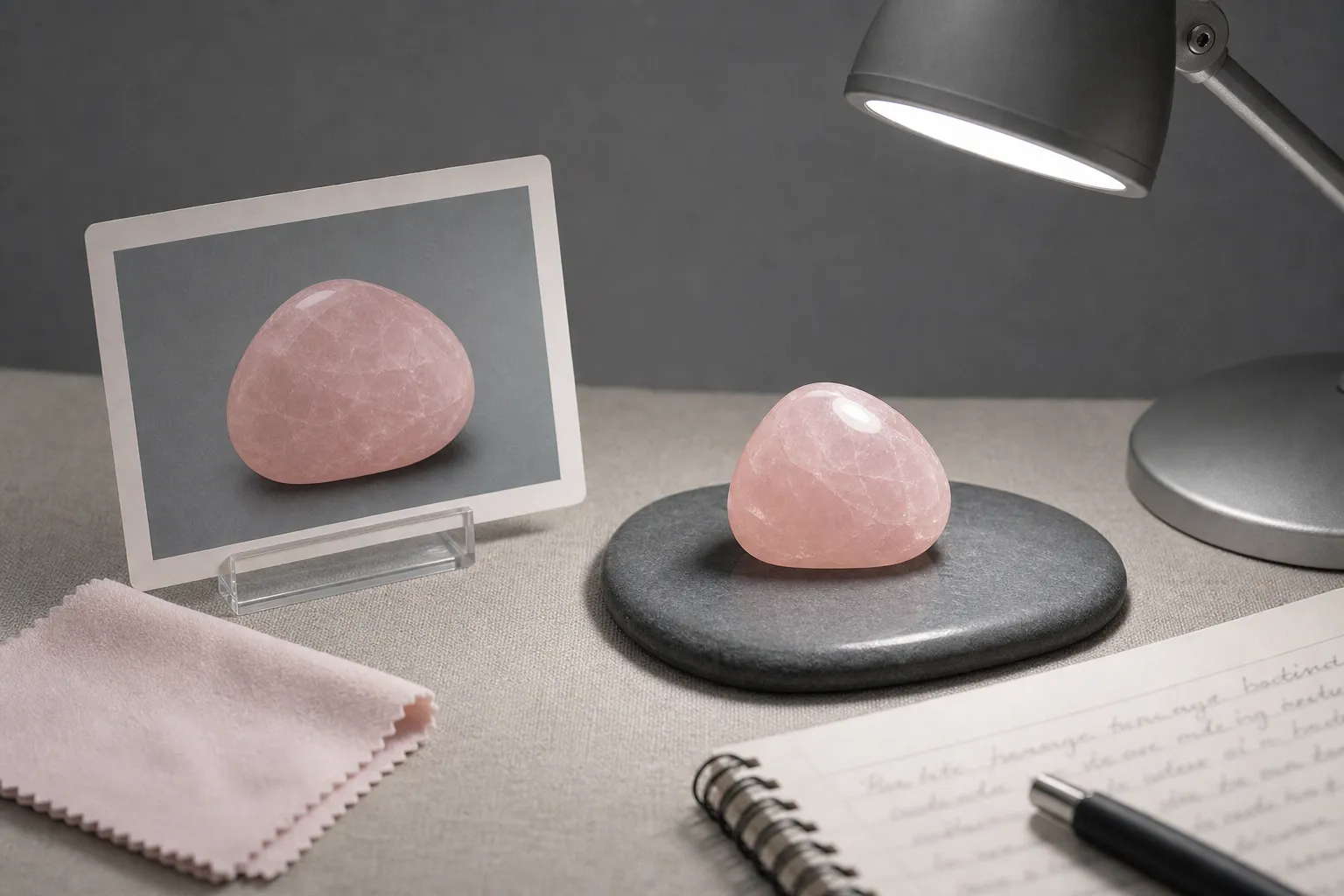
Lighting changes perceived color. A stone that looked warm in late-afternoon sun may look gray under cool LEDs. A piece photographed against white may appear paler than it did on wood, linen, or a darker shelf. Polished surfaces also behave differently from rough surfaces; a dulled polish can scatter light and make the color look flatter.
Dust, skin oils, cleaning residue, and surface wear can change how light enters and leaves the stone. For a bead, palm stone, or handled object, surface condition may shift long before internal color does. For a rough specimen, matrix minerals, iron staining, fractures, and inclusions can make one area look more saturated than another.
Memory adds another layer. Many owners remember the feeling of the first purchase more clearly than the exact color under controlled light. Without a dated photograph taken in similar lighting, it is difficult to separate real fading from changed viewing conditions.
This does not dismiss fading. It keeps the interpretation honest. If color loss matters, compare the object under the same lamp, at the same time of day, against the same background, and with an earlier photograph if one exists. Consistent comparison is more useful than a dramatic guess.
Preserving pink quartz without pretending certainty
Preserving pink quartz is mostly risk reduction. The goal is not to create panic around every sunny room, and it is not to promise museum-level protection for ordinary home objects. It is to avoid conditions that add unnecessary stress to color, surface, polish, and associated materials.
For display, keep valuable or personally important pink quartz out of long-term direct sunlight. Bright indirect light is usually a better interior compromise because the color remains visible without making the stone a long exposure experiment. If a window shelf is part of the room design, place less sensitive objects there and keep the most meaningful pink quartz in a shaded position.
Avoid unnecessary heat. A closed glass cabinet in a sunny window, a shelf above a radiator, or a lamp that warms nearby objects creates more than a simple light question. If a stone feels warm from its display location, the placement deserves reconsideration.
For storage, choose stable, dry, clean conditions. Soft wrapping can help reduce scratches on polished pieces, while separated compartments limit abrasion between stones. If a specimen includes pyrite or other associated minerals, care becomes more complex because different minerals can have different vulnerabilities. The supplied evidence does not support advanced archiving instructions for ordinary rose quartz owners, so that language belongs to specialist conservation rather than home-care defaults.
For ritual use, avoid practices that add avoidable stress. Long outdoor sun sessions, repeated heating and cooling, salt exposure, or wet storage may be presented in popular crystal culture as symbolic maintenance, but symbolism does not remove material risk. A dry cloth, shaded placement, or brief intentional handling keeps the object in lived use without turning care into a durability test.
A restrained routine is enough:
- display pink quartz away from prolonged direct sun;
- keep it away from heat sources and hot enclosed cases;
- store important pieces separately to reduce abrasion;
- use consistent lighting when checking for color change;
- treat unusual, vivid, valuable, or matrix specimens more cautiously.
The advice is intentionally modest. It reduces avoidable risk without claiming to predict every specimen.
What the available evidence does not settle
The strongest boundary for this topic is not that rose quartz is fragile. It is that the evidence does not support over-specific certainty.
The curated material supports three main points: pink quartz should not be treated as one uniform color system; mineral terminology matters when separating massive rose quartz from other pink quartz; and general stone-object care supports cautious habits around light, heat, handling, and storage. It does not provide a controlled fading chart for household rose quartz.
Several popular claims should therefore stay outside the certainty line:
- exact fading rates for rose quartz in sunlight;
- precise UV wavelength cutoffs for pink quartz color loss;
- guaranteed reversibility through laboratory treatment;
- a visual test that proves future color stability;
- a universal rule that heat explains all whitening;
- a claim that every unfaded piece is permanently immune.
That boundary may feel less satisfying than a yes-or-no answer, but it is more useful for real objects. A collector does not need exaggerated certainty to make a better display decision. The better question is not “Will all rose quartz fade?” It is “Does this specimen deserve a lower-risk placement?”
For most owners, if the pink matters, direct sun should not be its permanent home.
A grounded decision frame for rose quartz sun fading
First, look at material type. Is it massive, cloudy rose quartz, a transparent pink crystal, an altered-looking decorative object, or a mixed-mineral specimen? The label may help, but it is not the whole answer.
Second, consider the color. Is it evenly distributed, concentrated in zones, strongest near fractures, or unusually vivid for the object type? Appearance alone cannot prove the mechanism, but it can show why one fading rule may be too crude.
Third, review the environment. Direct sun, hot lamps, enclosed cases, window shelves, and heat sources all raise the preservation question. Ordinary shaded display is a different condition from repeated intense exposure.
Fourth, compare consistently. If you suspect fading, use the same background and lighting, and keep dated photographs. A pale impression under different lighting is not strong evidence by itself.
Finally, decide based on value. A common tumbled stone used casually in a room may not need strict control. A rare specimen, vivid pink crystal, sentimental object, or carefully chosen interior piece deserves a lower-risk placement.
Rose quartz can carry symbolism in a space, but its color is still part of material reality. The stable answer is conditional: some pink quartz may fade or appear to fade under certain conditions, not all pink quartz belongs under one mechanism, and preservation works best as quiet prevention rather than certainty theater.