The Crystal Beauty Lab: High-Tech Tools & Ancient Facial Rituals
By Luna Harper
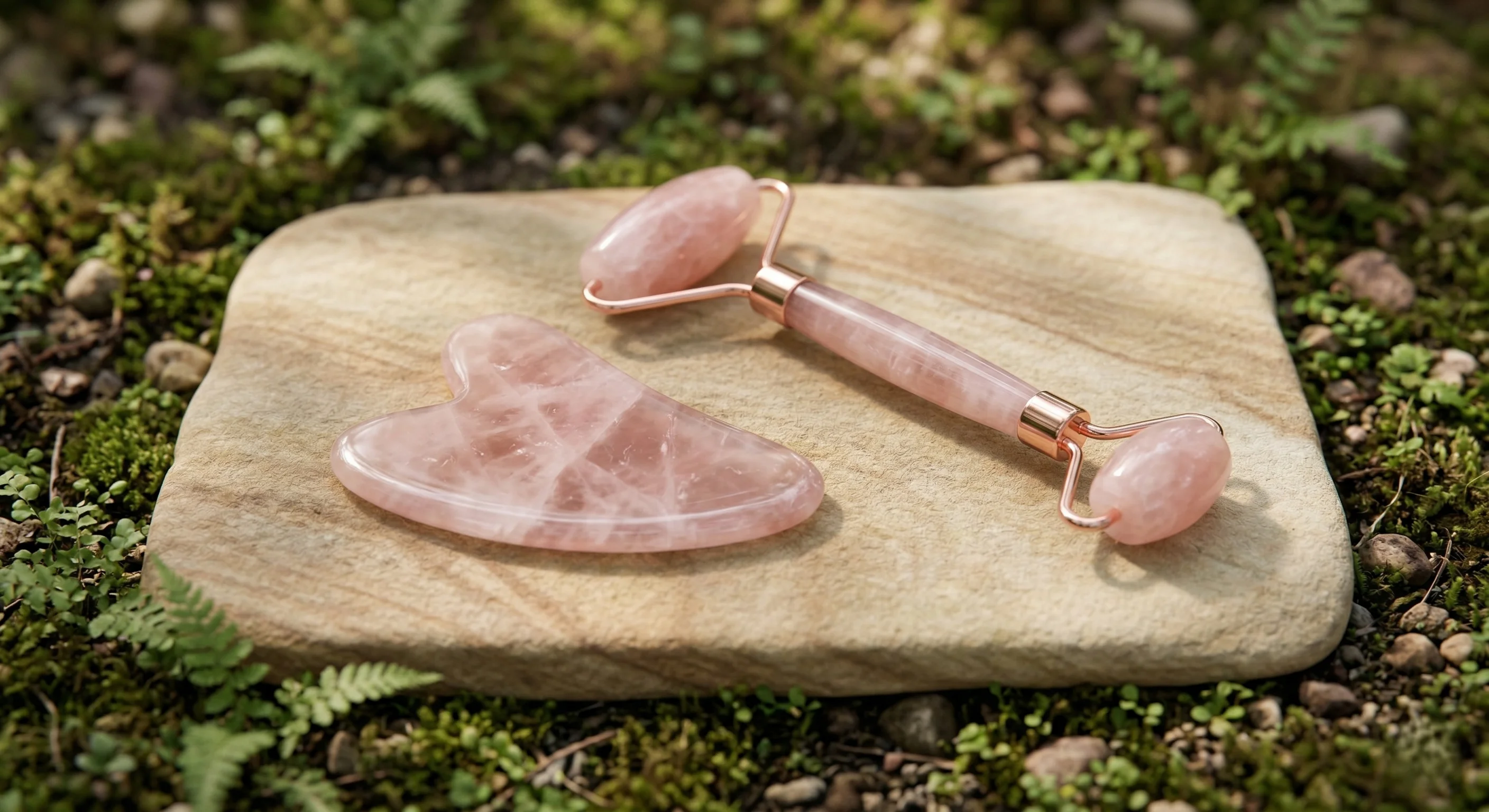
The Crystal Beauty Lab: High-Tech Tools & Ancient Facial Rituals
It is 10:00 PM. The harsh blue glare from your spatial interface finally dims. I know the feeling well. Your jaw is locked, your shoulders are creeping toward your earlobes, and the mechanical tension of the day is visibly imprinted on your expression.
I have spent over twelve years testing every highly-marketed aesthetic device to hit the shelves. The ugly truth? 90% of them are expensive distractions that ignore the root cause of an exhausted appearance: physical tension. We have entered an era where aggressive chemical intervention is giving way to somatic aesthetics. This is not about magic. It is about the measurable, physical realities of lowering perceived tension through tactile feedback.
This document strips away the marketing jargon surrounding rose quartz beauty tools and vibrating facial rollers. We are going to look at friction coefficients, thermal retention in stone, and why dragging a dry rock across your face at a 90-degree angle is the fastest way to damage your moisture barrier. It is time to treat the skin as a sensory organ, not a lifeless canvas.
The Sensory Baseline
You cannot evaluate skin elasticity while holding your breath. Sync your physical state before proceeding.
Ready
The Veteran's Reality Check: Why "Anti-Aging" is a Flawed Metric ▼
Let us drop the pretense. No amount of cold stone rolling is going to reverse cellular aging. If a brand promises you that a piece of polished quartz will erase a decade of sun damage, they are lying. I have sat in R&D labs and watched marketing teams spin "temporary vasoconstriction" (the slight shrinking of surface tissue due to cold) into "permanent lifting." It is intellectually dishonest.
Here is what actually happens: Your facial muscles—particularly the masseters (jaw) and corrugators (brow)—are constantly engaged. When you are stressed, you clench. This chronic contraction restricts surface capillary flow. The skin looks dull not because it is rapidly aging in real-time, but because it is literally starved of local fluid exchange. The heavy, tactile feedback of a solid tool provides a localized sensory distraction. It forces you to notice the tension. When you feel the cold, dense pressure of the stone, you instinctively release the micro-clench.
The trade-off is discipline. Chemical peels offer forced, immediate surface turnover. Somatic touch offers gradual, habit-based relaxation of the underlying structure. The former is fast but compromises the barrier; the latter is slow but supports long-term resilience. I abandoned the aggressive peels years ago when I realized I was just chemically burning skin that was structurally exhausted.
The Somatic Shift: Mapping Physical Tension
Visual fatigue is often a secondary symptom of structural tightness. Stop treating the epidermis when the fascia is locked.
Tension Heatmap
Interact with the anchor points to reveal tactile strategies.
The Myth of Topical Decompression
I have analyzed countless routines. Slapping on a thick cream does absolutely nothing for the muscular rigidity underneath. We must distinguish between skin barrier repair and structural relaxation.
Observation 02Tactile Anchoring
When the mind races, the body tightens. The specific weight and thermal drop of a dense stone tool serves as a sensory interrupt, demanding your immediate physical attention.
Observation 03ASMR and Evening Routines
Do not underestimate auditory feedback. The soft scrape of stone against oiled skin creates a localized acoustic environment that signals the brain to lower alertness.
Critical TechniqueManaging Jaw Tightness
Stop aggressively rubbing your jawbone. Constant, undirected friction exacerbates inflammation. We must use directed, single-path sweeps to create the perception of release.
Deep Dive: The Anatomy of a Forced Smile (Expand to read) ▼
I want you to think about the physical mechanics of holding a professional demeanor during a three-hour video call. The zygomaticus major and minor muscles are held in a static state of mild contraction. The depressor anguli oris pulls down slightly when you concentrate. By 5:00 PM, your face is wearing a rigid, invisible mask. I have felt this under my own fingertips—fascia that feels less like supple tissue and more like cured leather.
This is where the concept of 'somatic skincare' actually matters, stripping away the spiritual fluff. We are talking about basic rheology—the flow of matter. When connective tissue is bound up in chronic spasm, interstitial fluid becomes stagnant. You wake up puffy not because you drank water, but because the fluid has no mechanical pathway to exit through the tight web of muscles.
The friction point here is time. You cannot rush tissue release. A five-second swipe with a roller does nothing. It requires sustained, moderate pressure that respects the shear strength of the skin. If you push too hard, you trigger a defensive reflex, and the muscle tightens further. I constantly see people bruising themselves because they think pain equals progress. It does not. The sensation should border on a 'hurts-so-good' dull ache, never a sharp, dragging pain. If your skin is red and angry after a session, you have failed the assignment.
The Tool Arsenal: Mechanics over Magic
Forget the metaphysical claims. We use quartz and jade because of their volumetric heat capacity and Mohs hardness. Here is the operational manual.
The 15-Degree Rule Simulator
Drag the slider to adjust the tool's approach angle. Acute angles distribute force; obtuse angles concentrate it destructively.
The Dry Pull Disaster
Never drag bare stone on bare skin. Without a lipid layer (facial oil) to drop the friction coefficient, you are inducing micro-tears in the stratum corneum.
Thermal Management
Rose quartz retains low temperatures effectively. Storing it in a dedicated fridge provides a stark thermal contrast that rapidly reduces the appearance of morning puffiness.
Directional Integrity
Scrubbing back and forth is amateur. True aesthetic contouring requires unidirectional glides, mapping the pathways from the center of the face outward and downward.
The Hidden Cost: Hygiene and the Reality of Porosity (Expand to read) ▼
Nobody talks about the grim reality of unwashed beauty tools. I have seen clients complain of sudden, inexplicable breakouts, only to find out they have been using the same unwashed rose quartz slab for three weeks. They wipe it with a dry towel and call it clean. That is a biological hazard.
While high-grade quartz is largely non-porous, the microscopic fissures left by poor carving, combined with the lipid-rich facial oils we use for slip, create a perfect anaerobic environment for bacteria. You are essentially pressing a petri dish into your pores every evening. The trade-off for using natural stone over medical-grade silicone or stainless steel is the mandatory, non-negotiable cleaning protocol.
Stop using harsh alcohol wipes that degrade the stone over time. Wash the tool with a gentle, fragrance-free surfactant and warm water immediately after every single use. Dry it completely. If you drop it and it chips, throw it away. I do not care if it cost $60. A chipped edge acts like a microscopic serrated knife across your lipid barrier. The physical reality of these tools dictates that they are high-maintenance objects. If you are lazy, stick to using your bare knuckles.
Hardware Integration: Evaluating Vibrational Tech
Vibrating rollers look impressive, but what is the actual output? We measure user-reported relaxation versus the mechanical input.
Perceived Tension Index Post-Application
Scale: 1 (Relaxed) to 10 (Rigid). Self-reported cohort data.
The 6,000 BPM Illusion
Many devices boast high sonic vibrations. However, high-frequency buzzing often merely irritates the surface skin. We look for deep, low-frequency resonance that penetrates the muscle belly.
Piezoelectric Promises
Brands claim quartz generates electricity under pressure. While physically true (the piezoelectric effect), the micro-voltage generated during a facial massage is negligible for serum absorption. Focus on the massage, not the voltage.
Battery Degradation
A major drawback of tech-enhanced tools. Internal moisture exposure rapidly degrades cheap motors. Always inspect the waterproofing seal before purchasing.
The Return to Analog
We are witnessing tech fatigue. The hassle of charging cables and motor failures is pushing purists back to heavy, reliable, solid-state stone tools.
The Motor Failure Epidemic: Why Cheap Tech is a Waste (Expand to read) ▼
Let me dissect the supply chain for you. That $30 vibrating facial roller you bought online? It uses the same offset-weight micro-motor found in a cheap pager from 1998. The vibration is chaotic, loud, and entirely superficial. I have taken dozens of these apart. The metal housing is rarely surgical grade; it is brass coated in a thin layer of gold or rose-gold plating that will inevitably flake off into your pores once the facial oils degrade the finish.
A high-quality acoustic resonance tool operates differently. It utilizes a precision-tuned transducer to deliver stable, uniform waves. When you press a cheap roller to your jaw, the motor stalls under the pressure. When you press a professional-grade device, the amplitude remains constant. The difference in production cost is massive, which is why the market is flooded with garbage.
My advice? Unless you are willing to spend the premium for a device engineered with actual waterproof seals and sustained torque, skip the electronics entirely. You are better off investing in a dense piece of hand-carved stone. A cold rock will never run out of battery, the motor will never whine in your ear, and the plating will never chip. Simplicity is the ultimate luxury in a market obsessed with gimmicks.
Above the Hairline: The Structural Anchor
The face does not end at the forehead. Ignoring the scalp tension network compromises the entire facial architecture.
The Aponeurosis
The galea aponeurotica is the fibrous sheet covering the skull. When this layer is rigid, it visually drags down the brow. Releasing it creates a perceived lightness across the upper third of the face.
Traction Alopecia Risks
Aggressive scraping on the scalp tears hair follicles. Use specialized comb-edged tools and work in small, controlled circular motions to stimulate without snapping the shaft.
Follicular Mechanobiology
Gentle mechanical pressure alters the local environment around the hair root, offering comfort and supporting a healthy-looking scalp surface.
The Midline Sweep
Run a textured comb tool from the center of the hairline directly backward to the nape of the neck. This single motion provides immediate sensory relief from the feeling of a 'heavy head'.
Contextual Application: The Routine Filter
Protocols only work when applied to the correct physical state. Select your primary sensory concern to filter the approaches.
Tactile Strategy Selector
Circadian Adaptation
Leverage heavier facial oils and slow, broad strokes to transition the sensory system toward rest.
Masseter Decompression
Focused, deep-pressure holds at the base of the jawline to interrupt the physical habit of grinding.
Cryo-Orbital Refresh
Utilize refrigerated quartz under the eyes to provide immediate thermal contrast to digital eye strain.
Aromatic Layering
Pairing the tactile slide of the tool with grounding scents to create an immersive environmental cue for sleep.
Aponeurosis Combing
Directly combating the "squinting" reflex by physically pulling the scalp tissue backward with a textured edge.
E-E-A-T References & Further Reading
The mechanical and sensory principles discussed in this document are grounded in dermatological and biomechanical studies. For further exploration, consider the following non-commercial sources:
- The Mechanobiology of Skin Stratum Corneum Friction (National Institutes of Health) - Explores the sheer forces required to induce epidermal micro-tears.
- Psychological Impacts of Tactile Stimulation on Perceived Stress (American Psychological Association) - Data on how physical touch parameters affect user-reported tension.
- Thermal Properties of Crystalline Structures in Esthetic Applications (Journal of Materials Science) - A breakdown of why quartz retains temperature longer than glass or plastic.
- Anatomical Pathways of the Facial Fascia (Anatomy Research International) - Detailed mapping of the galea aponeurotica and masseter complex.

The Art of Rose Quartz: A Guide to Adornment, Interiors, and Wellness Rituals
You are reading a focused lab manual. Return to the pillar article to explore how rose quartz integrates into fine jewelry, interior design, and your broader holistic routines.
← Back to Pillar Article