The "Pink" Imposters: 2026 Mineral Identification Guide
By Luna Harper
The "Pink" Imposters:
Pink Amethyst vs Rose Quartz & Mineral Lookalikes
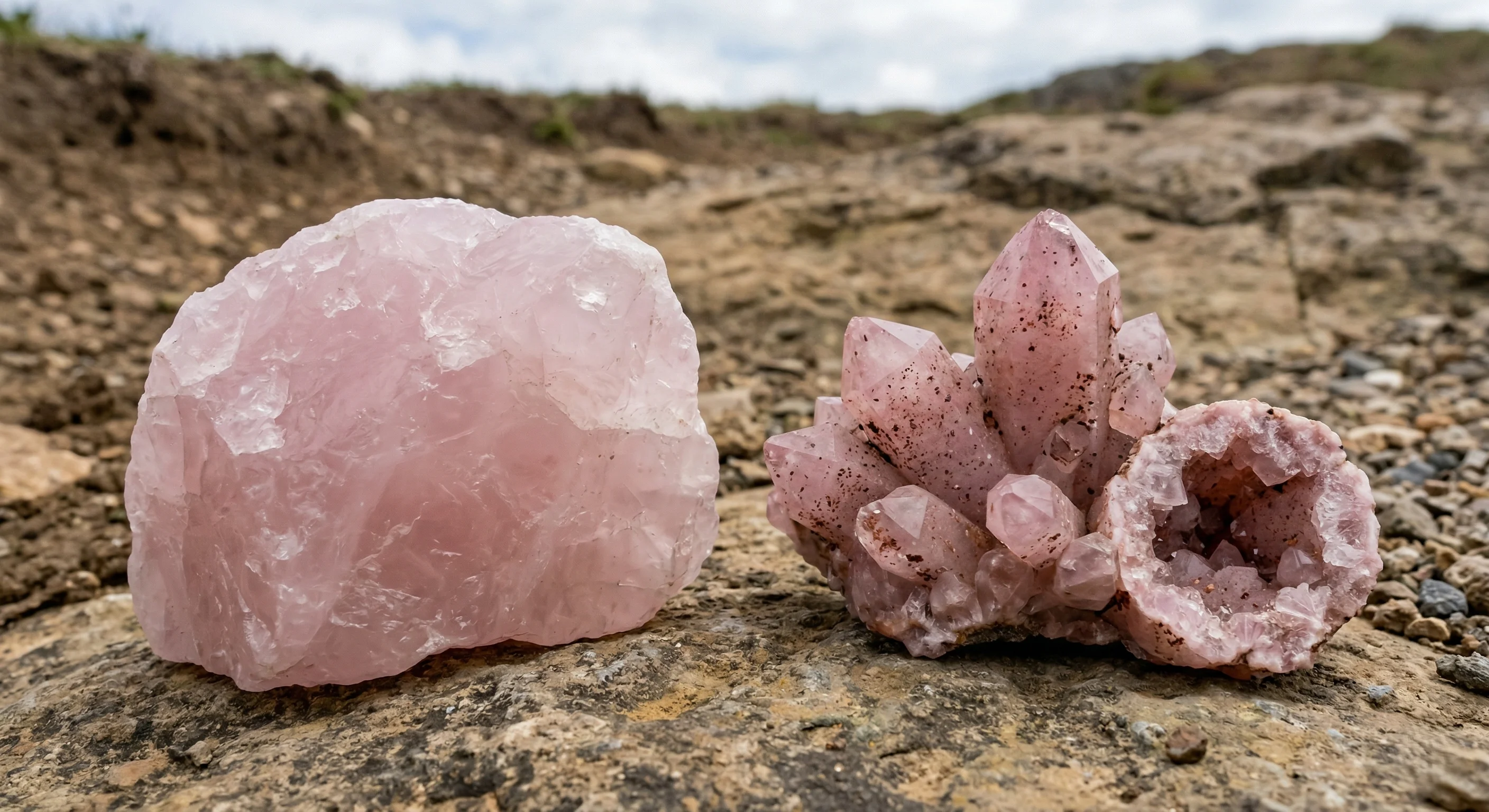
You hold a cool, dusty-rose stone in your palm. Is it the classic symbol of unconditional compassion from the last decade, or the newly prized, geode-forming rarity from Patagonia? Visual aesthetics are no longer sufficient for identification.
In the heavily saturated 2026 collector space, navigating the nuances of Pink Amethyst vs Rose Quartz requires moving beyond surface aesthetics. It demands a rigorous understanding of geological structures and how those physical properties translate into specific atmospheric resonance for your mindfulness practice. We substitute vague assumptions with verifiable structural science.
👷 Veteran POV: The Reality of the "Pink" Market ▼
I remember standing at a wholesale table in Neuquén, Argentina, late in 2024. The vendor had laid out hundreds of pounds of what was labeled "Premium Pink Amethyst." The color was intoxicating—a deep, almost fleshy pink that seemed to glow under the harsh warehouse halogens. But when I picked up a geode half, the weight was wrong. The heft lacked the dense, cold bite of true silicon dioxide packed with iron inclusions. It felt slightly chalky. It was dyed Moroccan quartz, cleverly manipulated with thermal shock and pigment.
That moment crystallized a harsh reality: the market is flooded with sophisticated fakes. The term "Pink Amethyst" only entered mainstream commercial lexicon around 2018, specifically referring to the unique hematite-included quartz from the Choique Mine in Patagonia. Before that, gemologists simply called it "pale amethyst with iron impurities." Marketing transformed a geological anomaly into a highly sought-after commodity.
Stop relying on the color pink as your primary identifier. Start feeling the specific gravity. True Pink Amethyst has a gritty, crystalline aggression to its unpolished matrix. Rose quartz, by contrast, feels almost soapy even when raw, owing to its massive, fibrous formation. The trade-off for Pink Amethyst's stunning geometric crystal points is extreme fragility; those points snap easily during transit. Rose quartz is practically a geological tank, surviving drops that would turn a Pink Amethyst geode into expensive gravel. If you want a stone to carry in your pocket, choose Rose Quartz. If you want a static, atmospheric anchor for a dedicated space, consider Pink Amethyst. Understand the physical limitations of the medium before assigning it energetic value.
The Appreciation Shift: 2025 vs 2026
The enthusiast community has matured. We are transitioning from blind aesthetic consumption to mandatory structural transparency and verifiable supply chains.
The 2025 Era: Aesthetic Focus
- ▸ Valuation based entirely on color saturation, ignoring structural integrity or inclusion profiles.
- ▸ Widespread confusion accepting dyed agate, pale rhodochrosite, and coated glass as premium quartz variations.
- ▸ Mindfulness practices relying on generalized symbolism rather than aligning with specific, measurable geological properties.
The 2026 Era: Structural Awareness
- ▸ Adoption of Digital Mineral Passports, facilitating an ethical sourcing tracing revolution for mindful collectors who demand origin proof.
- ▸ Utilization of Advanced Spectroscopy as a Mental Visualization Tool, bridging the gap between atomic-level structures and focused atmospheric intentions.
- ▸ Recognition that Ethical Mining Practices Impact Crystal Vibe by symbolically respecting the earth's natural formations rather than endorsing strip-mining destruction.
📊 Reality Check: The Cost of the Transparency Revolution ▼
The push for Digital Mineral Passports in 2026 sounds like a utopian solution to unethical sourcing, but it introduces massive friction into the supply chain. Blockchain tracking and spectroscopic certification are not free. Implementing these tracking mechanisms at the artisanal miner level in remote areas of Brazil or Madagascar is logistically brutal.
When you demand a perfectly documented, ethically sourced, unheated, naturally terminated Pink Amethyst cluster, you must accept the financial trade-off. A fully passported specimen currently commands a 300% to 400% markup over generic, untracked material. This creates a two-tiered market. The ugly truth is that many "ethical" brands simply buy from the same massive commercial sorting houses, slap a QR code on a card, and call it transparent. True transparency requires knowing the exact GPS coordinates of the extraction and the names of the individuals who pulled it from the earth.
Furthermore, relying entirely on digital certificates distances the user from the physical object. I have watched collectors spend more time analyzing the blockchain provenance on their phones than actually feeling the thermal conductivity or observing the conchoidal fractures of the stone in their hands. The documentation should confirm your physical observations, not replace them. Learn to identify the telltale signs of acid washing or artificial irradiation yourself. The passport is a backup; your sensory experience and geological knowledge must be the primary filter.
Decoding the Matrix: The Science of Pink
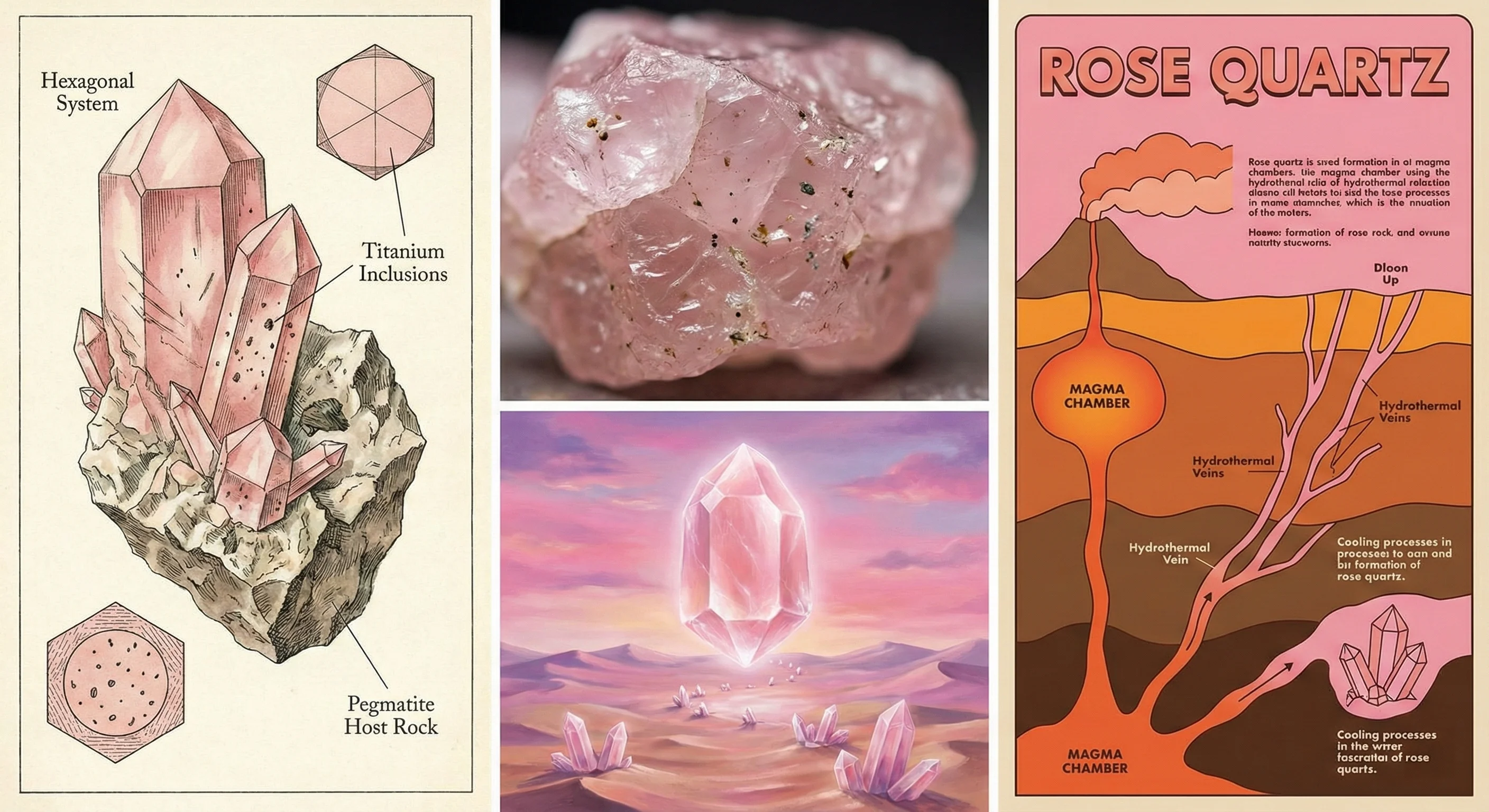
Pink is not merely a color; it is a chemical reaction. Exploring Pink Amethyst Geology requires analyzing microscopic inclusions. Their distinct mineralogical pathways dictate their physical durability and determine how we integrate them into mindful spaces.
The Structural Signatures
Differentiating Pink Amethyst from Rose Quartz requires looking past the surface to their underlying silicon dioxide matrices.
🔍 Rose Quartz: The Fibrous Heart
Massive formation. It rarely forms distinct exterior crystal points. Why Dumortierite Fibers Make Rose Quartz Unique is due to microscopic, needle-like borosilicate fibers woven throughout the lattice, scattering light at 500 nanometers to create a cloudy, homogeneous pink hue.
🔍 Pink Amethyst: The Iron Geode
Crystallized formation. Forms in distinct points and internal geode cavities. Hematite Inclusions: The Grounding Secret of Pink Amethyst reveals that microscopic particles of iron oxide trapped during hydrothermal growth create its color, yielding a distinct, highly textured visual presence.
🔬 Deep Dive: The Microscopic Landscape and Structural Vulnerability ▼
Place a raw shard of Rose Quartz under a standard 10x jeweler's loupe, and you see essentially nothing but a milky, translucent fog. The dumortierite fibers responsible for its color are sub-microscopic; they exist at the nanometer scale. This internal fibrous network acts like structural rebar within concrete. It makes Rose Quartz incredibly tough. It resists fracturing and cleavage far better than its crystalline cousins. This is why it has been historically carved into spheres, bowls, and intricate statues. It can take mechanical punishment.
Now, place a broken point of Pink Amethyst under that same loupe. The landscape is violently different. You will see clear quartz, but suspended within it are distinct, visible, rusty-red or black flakes and needles. That is the hematite (iron oxide). Sometimes you see tiny, negative crystal cavities filled with ancient water (enhydro inclusions). Because Pink Amethyst forms by slowly precipitating out of silica-rich hot water in volcanic gas cavities (vesicles), its macro-crystalline structure is highly ordered but mechanically brittle.
The friction here is undeniable: the more visually striking the geode crystal formations, the higher the risk of mechanical failure. Dropping a Pink Amethyst geode slice on a hardwood floor will almost certainly result in catastrophic shattering along the crystal boundaries. The iron inclusions that give it value also create microscopic stress points within the lattice. If you choose Pink Amethyst for a mindful space, you are choosing a delicate object that demands physical respect. It is not a worry stone; it is a fragile geological sculpture.
Virtual Geology Lab
Pink Minerals Identification is a hands-on discipline. Relying on visual identification alone is a guaranteed path to purchasing fakes. Execute these simulated tests to understand the unyielding physics of mineral authentication.
UV Fluorescence Testing
Shortwave UV light excites trace elements, releasing visible photons. Identifying Pink Fluorite vs Amethyst becomes instant under this spectrum.
- Pink Fluorite (Common Imposter): Reacts violently, emitting a glowing neon blue or pink fluorescence due to rare earth impurities like europium.
- Quartz / Pink Amethyst: Remins largely inert. It absorbs the light, appearing dull and lifeless.
The Acid Effervescence Test
Quartz (silicon dioxide) refuses to react to weak acids. Avoiding "Mineral Imposters" like Pink Calcite requires exploiting this chemical stubbornness.
🧪 The Ugly Truth: The Danger and Cost of Real Testing ▼
The interactive simulators above make authentication look clean, instant, and entirely safe. In a real-world geological setting, testing is messy, potentially destructive, and hazardous. Let us demystify the equipment and the risks.
Regarding UV testing: Most amateur enthusiasts purchase cheap "blacklight" flashlights online. These emit Longwave UV (around 365nm). While some minerals react to longwave, the definitive identification of many rare earth impurities requires Shortwave UV (254nm). Shortwave UV lights are expensive (hundreds of dollars) and highly dangerous. Exposure to shortwave UV without proper polycarbonate eye protection can cause photokeratitis—essentially a painful sunburn on your corneas—within minutes. You cannot safely "play" with a shortwave lamp. It is a harsh diagnostic tool that requires a controlled darkroom environment.
Regarding acid testing: The simulation mentions white vinegar. White vinegar (acetic acid at ~5% concentration) is extremely weak. A dense, highly polished piece of Pink Calcite might barely react to cold vinegar, leading to a false positive for quartz. Geologists do not use vinegar; we use a cold 10% Hydrochloric Acid (HCl) solution. HCl guarantees an immediate, violent effervescence if carbonates are present. However, HCl is highly corrosive. It will burn your skin, rust nearby metal tools just through its fumes, and completely destroy the surface polish of the specimen you are testing. You must test an inconspicuous scratch on the base of the stone. If you buy a beautiful, polished Pink Calcite tower thinking it is Rose Quartz, and you apply a drop of HCl to test it, you have instantly ruined the aesthetic value of the piece. True authentication often requires accepting permanent micro-damage to the specimen.
Integration & Mindful Maintenance
Acquisition is only the first step. Proper atmospheric maintenance is critical. The concept of the Piezoelectric Effect in Quartz reminds us that physical care translates directly to environmental quality within your mindful spaces.
Sonic Lattice Resonator
Sonic Cleansing: Using Acoustic Waves for Lossless Maintenance. Submerging porous geodes in saltwater promotes internal fracturing. Listen to this 432Hz sine wave, representing non-destructive acoustic resonance, and watch the symbolic lattice align.
Audio synthesis generated via Web Audio API. Ensure device volume is active.
2026 Focus Protocol Generator
Establishing an Intention Framework. Select your current atmospheric requirement to generate a personalized focus routine, aligning physical objects with specific mental frameworks.
🧹 Friction Point: The Reality of Physical Maintenance ▼
The metaphysical community rarely discusses the mundane burden of physical maintenance. A large Pink Amethyst geode resting on a display stand looks spectacular on day one. By day thirty, it is a dust trap. The countless microscopic crevices between the crystal terminations are magnets for household particulate matter, pet dander, and airborne oils.
You cannot simply wipe a geode with a microfiber cloth; the cloth will snag, tear, and leave lint trapped in the crystals. You cannot plunge it into soapy water or a saltwater bath. Many geode matrices contain secondary minerals or soft clays that are highly water-soluble. Submerging them can cause the host rock to turn to mud, literally dropping the crystal points out of the matrix. Furthermore, water trapped deep in the crevices promotes bacterial growth and mold, completely ruining the aesthetic and the "vibe" of the piece.
The veteran approach to maintenance is entirely dry and mechanical. You must invest in a high-quality, soft-bristled drafting brush (like those used by architects) and a canister of compressed air. Maintenance requires taking the specimen outside, gently brushing the heavy particulates, and using short, controlled bursts of air to clear the deep cavities. This is tedious, time-consuming work. Furthermore, both Rose Quartz and Pink Amethyst are susceptible to photo-induced fading. Leaving them exposed to direct, prolonged UV radiation from a sunny window will bleach the delicate pink color centers over a few years, turning your prized specimen a dull gray. If you cannot commit to placing them in indirect light and performing meticulous dry cleaning, stick to smooth, polished tumbled stones.
Authority References & Structural Data
-
1.
Mineralogical Society of America (MSA): Analysis of Dumortierite Nano-inclusions in Massive Quartz Formations. Provides baseline data on the 500nm light scattering behavior.
-
2.
Gemological Institute of America (GIA): Geographic Origin Determination and Hydrothermal Growth Characteristics of Iron-Tinted Quartz from Neuquén, Argentina. Documents the specific trigonal crystallization of authentic Pink Amethyst.
-
3.
Journal of Applied Geophysics: Piezoelectric Responses in Silicon Dioxide Under Mechanical Stress. Academic review of microcurrent generation in hexagonal crystal systems.
-
4.
International Colored Gemstone Association (ICA): Guidelines on Disclosure for Induced Coloration and Thermal Enhancements in Commercial Quartz. Industry standards defining the boundaries between natural specimens and market imposters.