The Secret of the 6-Rayed Star: The Hidden Physics Inside Star Rose Quartz
By Luna Harper
Gemology note
The Secret of the 6-Rayed Star: The Hidden Physics Inside Star Rose Quartz
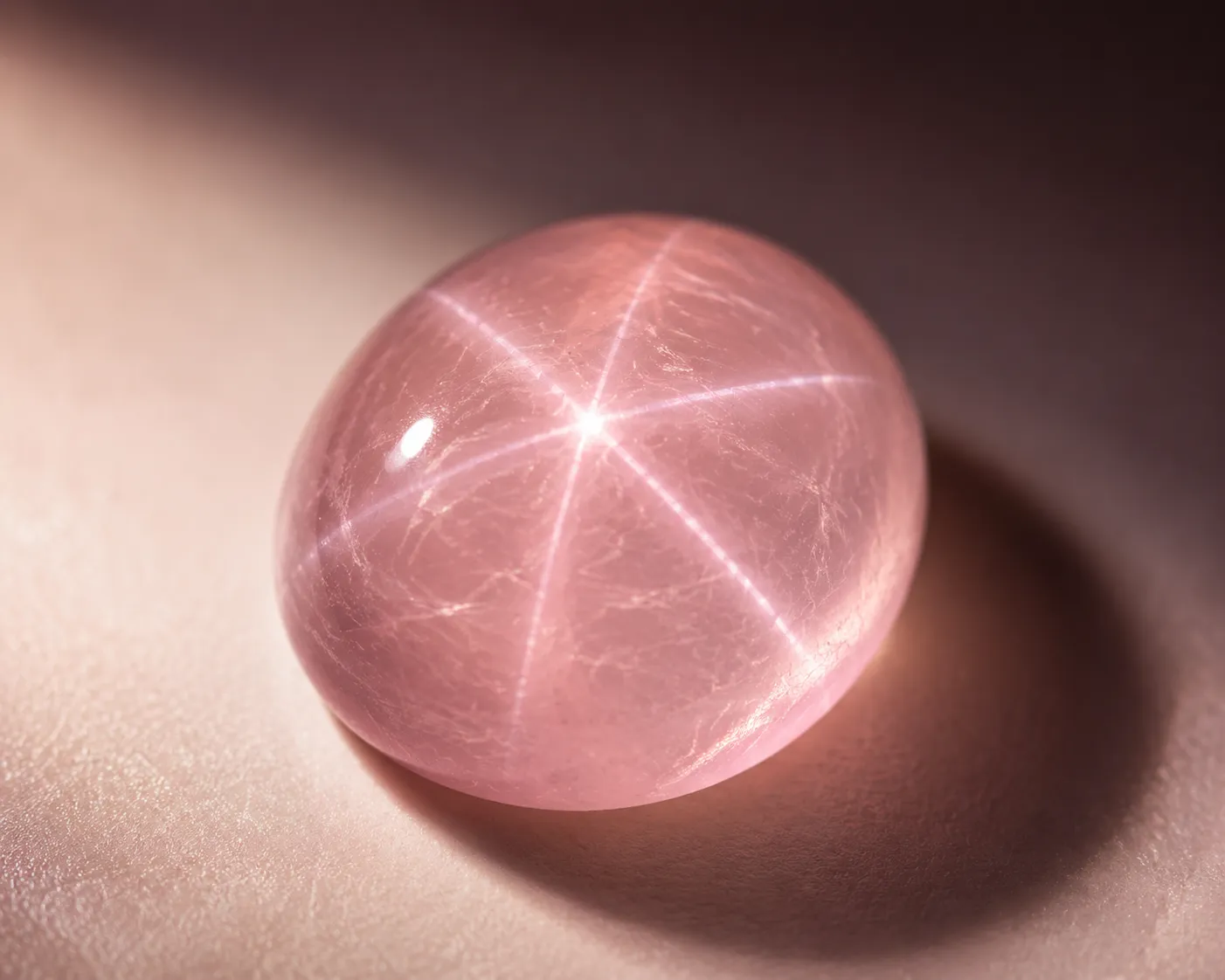
Star rose quartz shows a six-rayed star because light is being shaped by order inside the stone. In gemology, Asterism Physics describes how a star-like pattern appears when a small, bright light source scatters from aligned microscopic features within a gem.
In rose quartz, the star is not a surface symbol or a painted mark. Quartz is silicon dioxide, and some massive rose quartz contains extremely fine internal fibers or needle-like features arranged in related directions. When the stone is cut as a rounded cabochon and viewed under a concentrated light, those hidden directions can create three crossing bands of light. Each band has two ends, so the eye reads them as a six-rayed star.
The short version: star rose quartz needs internal alignment, quartz geometry, the right cabochon orientation, and point-source light.
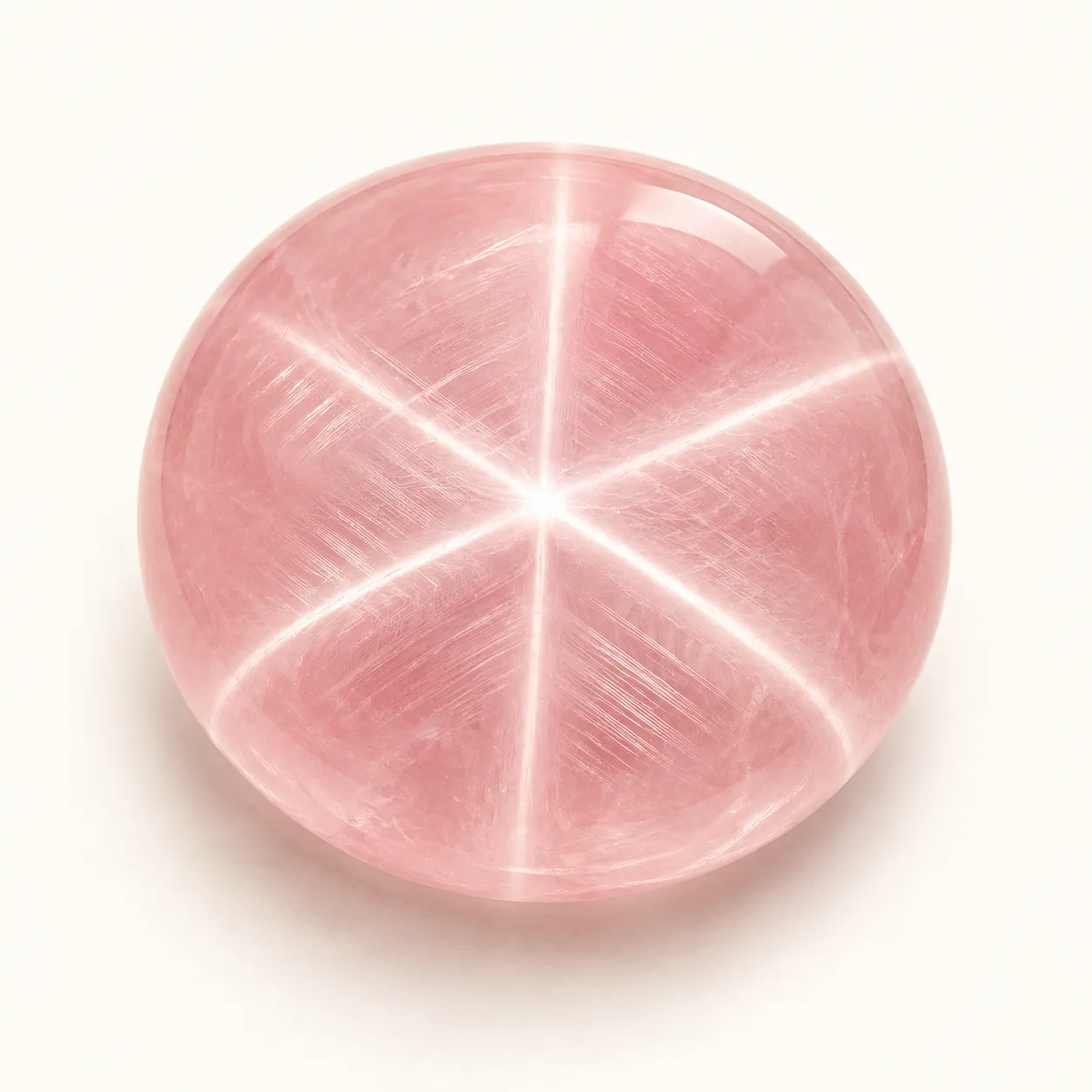
The six rays are really three crossing bands
A six-rayed star can look as if six separate lines are buried inside the quartz. A better way to picture it is this: the visible star is usually made of three bright bands crossing near one center point.
This is why asterism is closely related to chatoyancy, the “cat’s-eye” effect seen in some gems. A cat’s-eye effect comes from many aligned internal features producing one moving band of light. A star effect appears when more than one direction of alignment is present, so several bands intersect.
In star rose quartz, those bands are not fixed physical rays. They are an optical response. As the light, stone, or viewing angle changes, the star may appear to slide across the rounded surface. That floating movement is part of what makes the stone feel mysterious, but it is also exactly what a light-scattering effect should do.
The cabochon shape matters. Star rose quartz is usually cut with a smooth dome rather than flat facets. The dome helps gather and display the scattered light. If the rough material has suitable internal structure but is cut in the wrong orientation, the star may be weak, off-center, or difficult to see.
What inside rose quartz scatters the light?
The host mineral is quartz: silicon dioxide. Rose quartz is not a separate mineral species; it is quartz with a pink appearance. The star effect depends on something more specific than color: fine internal structure.
A common market explanation says star rose quartz gets its star from rutile inclusions. That wording is understandable because famous star gems, especially some star ruby and star sapphire, are often explained through oriented rutile “silk” or other needle-like inclusions. Rutile can also occur in quartz, and “rutile star” is familiar gem language.
For star rose quartz, the better-supported explanation is more careful. Research on massive rose quartz has pointed toward extremely fine fibrous inclusions, often described as dumortierite-like or related to dumortierite, rather than obvious visible rutile needles. These features can be so small that a viewer may not see them with the naked eye or with basic magnification.
That is why a rose quartz cabochon can show a star even when no large needles are visible. The stone may look cloudy, silky, or softly translucent, while the structure responsible for the star remains hidden at a microscopic or nanoscale level.
So “rutile inclusions” should be treated as a simplified phrase, not a complete answer for every star rose quartz. The central idea is aligned fine fibers or needle-like features; in rose quartz, modern mineralogical discussion often points beyond ordinary visible rutile.
Why quartz alignment can produce six rays
The star is not random decoration. It reflects how internal features can align within the quartz body.
Quartz has a crystal structure with a three-fold symmetry relationship along its c-axis. In simplified terms, internal features can be arranged in three related directions. When those directions scatter light across a polished dome, the viewer may see three bright bands crossing. Three bands, two ends each: six rays.
One detail can feel counterintuitive. The bright band seen by the viewer is generally related to the direction of the internal fibers, but it is not simply a picture of those fibers. In many optical descriptions of asterism, the visible light band forms across the alignment direction of the scattering features. What the eye sees as a ray is the light response to hidden internal order.
This also explains why not every piece of rose quartz shows a star. The material needs enough organized internal features, arranged in useful directions, and the cabochon must be cut so the geometry can be displayed. A random tangle of fibers will not create the same clean pattern. One dominant direction may create a cat’s-eye line. Three effective directions can create the familiar six-rayed star.
This discussion mainly applies to massive rose quartz, the compact material commonly used for cabochons and carvings. Rare single-crystal pink quartz is a related but distinct topic in mineralogy and should not automatically be treated as having the same color or star-forming behavior.
Why the star appears in sunlight or a flashlight, then vanishes indoors
Many people notice the star under direct sun, a phone flashlight, or a small bright lamp, then lose it under soft indoor lighting. That does not mean the star was imagined. It means the optical conditions changed.
Asterism is easiest to see with a point-source light: a small, bright source that gives the scattering pattern enough contrast. Direct sunlight, a focused flashlight, or a gemological light can sharpen the bands. Diffuse light from a cloudy sky, shaded room, or broad lamp spreads illumination from too many directions. The star may blur, fade, or disappear into the general glow of the quartz.
This is one of the simplest ways to understand the phenomenon. A surface mark would stay more fixed under changing light. A true asterism-like effect depends on the relationship among light, stone, and viewer.
The dome also affects the result. A well-oriented cabochon can bring the bands into focus. A low dome, uneven polish, poor orientation, or very cloudy material may weaken the star. That is not a buying rule; it is part of the physics. The visible star depends on both the internal structure and the way the quartz has been shaped and lit.
What the star does not prove
A visible six-rayed star answers one narrow question: the stone is showing an asterism-like optical effect. It does not answer every other question people may attach to star rose quartz.
A star does not by itself prove natural origin, untreated status, high value, rarity, or overall quality. In the wider gemstone world, star effects can sometimes be imitated, modified, or influenced by cutting and surface conditions. That does not mean every star rose quartz is suspect. It means the presence of a star should not be stretched into a complete authentication claim. If origin, treatment, or value matters, that is a separate gemological identification question.
The star also does not establish a spiritual, emotional, or health-related outcome. Rose quartz has a long symbolic life in decorative, ritual, and personal settings, and some people find a visible star especially meaningful. That response belongs to culture and personal interpretation. The six-rayed star itself is explained through mineral structure, alignment, cutting, and light scattering.
It also does not mean the stone contains six large needles, six cracks, or six physical rays. The visible order can come from three aligned directions of extremely fine internal features.
Common confusion around “asterism”
The word asterism has more than one meaning. In gemology, it means a star-like optical effect in a stone. In astronomy, an asterism is a recognizable pattern of stars in the sky that may or may not be an official constellation. Search phrases such as “asterism constellation” belong to the sky meaning, not the rose quartz meaning. “Asteroid physics” is unrelated and only sounds similar.
For star rose quartz, asterism is the gemstone term. The useful point is the mechanism: aligned microscopic fibers or needle-like features, quartz crystal alignment, light scattering, cabochon orientation, and a concentrated light source.
A quick way to remember star rose quartz
The hidden physics of a six-rayed star comes down to four conditions:
- Quartz host: rose quartz is silicon dioxide with a pink appearance.
- Internal alignment: fine fibers or needle-like features are organized in more than one direction.
- Cabochon orientation: a rounded, correctly oriented cut helps the light bands cross visibly.
- Point-source light: direct sun or a small bright light makes the star much easier to see than soft room light.
The “secret” of star rose quartz is not that the stone breaks optical rules. It is that the rules are operating at a scale the eye cannot easily inspect. A quiet pink cabochon can hold an internal order of fibers, crystal directions, and scattering paths. Under the right light, that hidden order briefly becomes visible as a six-rayed star.
Sources
Sources and further reading
Reference links are limited to sources considered suitable for public citation in this page.