Integrating Rose Quartz into Home Architecture & Decor
By Luna Harper
Architecture & Atmosphere
Biophilic Sanctuaries: Integrating Rose Quartz into Home Architecture & Decor
Most clients walk into my architectural studio clutching a digital mood board filled with softly glowing pink walls. I usually start by asking them if they are prepared for the structural load implications of suspending two thousand pounds of silicates inside a timber-framed house. The romanticized idea of Rose quartz interior design is everywhere. The brutal, heavy, and expensive reality of executing it properly is rarely discussed. We have moved entirely past the era of isolated decorative stones sitting on side tables. Today, we are attempting to engineer Wellness architecture—embedding massive geological elements directly into the structural grid to create an atmosphere of profound physical anchoring. This is the zenith of Biophilic home decor, heavily defined by the imposing but warm philosophy of Soft brutalism.
The Veteran's Reality Check: Load-Bearing Anxiety ▼
Stop treating natural stone slabs like wallpaper. Start treating them like localized earthquakes waiting to happen. Over my fourteen years of managing high-end residential builds, the most common catastrophic failure I see isn't aesthetic; it's foundational settling.
When you decide to install a 9-foot by 5-foot backlit rose quartz feature wall, you are introducing roughly 1,200 to 1,500 pounds of dead load to a highly concentrated footprint. Standard residential floor joists are rated for 40 pounds per square foot (psf) of live load. A stone feature wall requires localized steel reinforcement—often heavy I-beams or structural steel columns carried straight down to the concrete footings.
The trade-off here is severe: you gain an unparalleled atmospheric anchor, but you sacrifice architectural flexibility and add anywhere from $15,000 to $40,000 in hidden structural steel framing costs before you even purchase the stone. I remember a specific build in the Hollywood Hills in 2021. The client insisted on retrofitting a quartz monolith into a cantilevered living room. We had to crane in supplemental steel framework through a skylight. If your contractor isn't talking to a structural engineer on day one, fire them.
Project Sanctuary: The Raw Truth of Soft Brutalism
True atmospheric warmth isn't created by making everything soft; it is achieved through calculated friction. Project Sanctuary demonstrates how aggressive concrete volumes demand the visual relief of translucent pink stone.
The aesthetic alchemy of soft brutalism biophilia happens strictly in the juxtaposition. In our case study, "Project Sanctuary," we utilized rough, board-formed concrete acting as an austere protective shell. Against this cold, highly textured gray backdrop, we pinned massive slabs of translucent pink quartz. This creates a vibrating visual contrast that defines the interior design vocabulary of the late 2020s. We respect architectural honesty through heavy, unapologetic volumes, yet achieve a highly subjective interior harmony.
Atmospheric Quality Assessment
Interactive Data: The shift in subjective spatial qualities (Pre and Post architectural intervention). Hover over the data points to observe the drastic reduction in visual clutter.
The Veteran's Reality Check: Mating Concrete to Quartz ▼
The marketing renders always show a perfectly flush, hairline seam between the raw concrete and the polished quartz. I can tell you from standing in the dust of active sites: concrete and natural stone hate each other. They possess entirely different coefficients of thermal expansion.
If you hard-grout a rose quartz slab directly against a concrete pour, the seasonal expansion and contraction of the house will snap the quartz right down the middle within three years. You will hear a loud crack at 2 AM, and a $30,000 piece of geology will be ruined.
The architectural solution is a "shadow gap"—a highly intentional, 3/8-inch recessed reveal around the perimeter of the stone. We use a high-modulus structural silicone (never rigid epoxy) deep within the gap to allow the materials to breathe and move independently. It requires painstaking precision from the framers. The concrete forms must be poured with blocking already in place to create this rebate. It is tedious, it slows down the construction timeline by weeks, but it is the only way the aesthetic survives physical reality.
Luminous Surfaces: The Engineering of Backlit Stone
Lighting a wall of stone is an exercise in heat management and optical physics. If you see individual LED dots shining through your quartz, the installation is a failure.
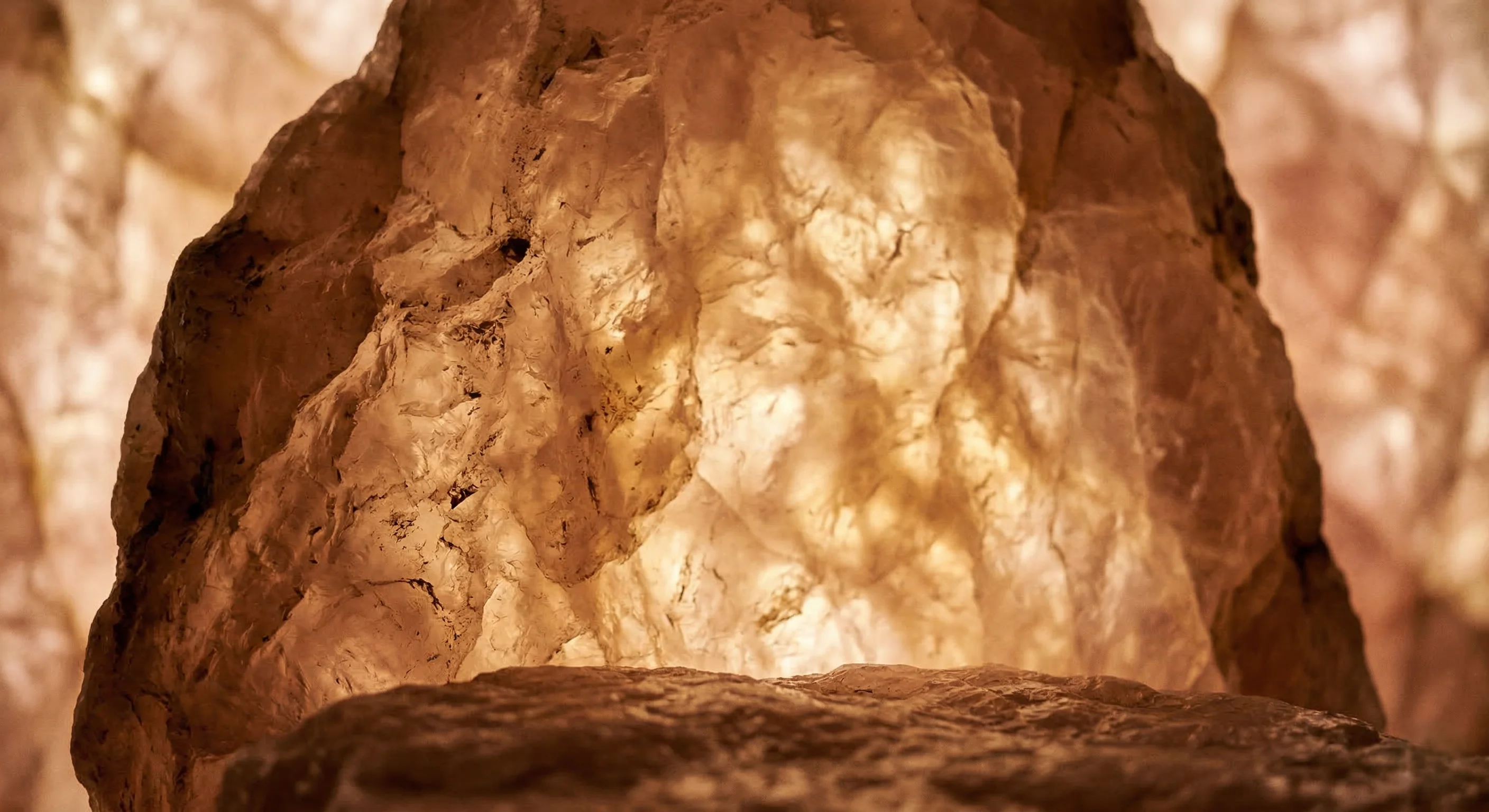
The focal point of a premium sanctuary build is the backlit rose quartz wall. However, the secret to flawless backlit rose quartz walls lies entirely in eliminating LED hot spots. This requires rigorous optical engineering. You absolutely must maintain a 4-to-6 inch cavity gap behind the stone. Furthermore, pushing light through heavy silicates heavily alters the perceived color temperature. Circadian syncing demands we understand that 2700K is the golden standard. Anything cooler destroys the inherent warmth of the material and ruins the evening wind-down atmosphere.
Interactive Ambiance Simulator
Select a color temperature below to observe how the diode's Kelvin rating interacts with the natural pink hues of the silicate.
The Veteran's Reality Check: Dead Bugs and Diode Degradation ▼
Here is the ugliest truth about backlit architectural features: they are exceptionally efficient insect traps. A warm, glowing cavity behind a wall will attract every spider, moth, and gnat in the house. If you do not engineer a completely sealed, dust-proof Light Emitting Diode (LED) cavity with an IP65 rating, you will eventually see the silhouetted carcasses of insects permanently projected onto your expensive stone.
Furthermore, we need to discuss thermal management. Stop buying standard 120V LED tape off the internet and sticking it to plywood. When you trap high-output LEDs in an unventilated 4-inch cavity behind an insulating layer of stone, they bake. Heat degradation destroys the phosphors on the diodes. Within 18 months, that beautiful 2700K warm light will undergo "color shift," turning into a sickly, green-tinted 4000K.
To do this right, we use 24V constant-current LED light guide panels (LGPs) mounted on extruded aluminum heat sinks. And crucially, we engineer hidden mechanical access panels. If a driver fails—and they always do, eventually—you cannot be in a position where you have to smash a $20,000 quartz slab to replace a $50 power supply. The framing must include a concealed piano hinge or heavy-duty magnetic latch system to swing the entire assembly open.
Architectural Foundations & Spatial Mapping
Physical location dictates atmospheric impact. Dropping heavy geological elements randomly into a floor plan creates visual confusion. We rely on established spatial mapping traditions to anchor the design.
In top-tier biophilic builds, we do not merely decorate surfaces; we design with deep spatial intent. Immersive spatial gridding involves embedding specific geological materials within the foundation layout. Using conceptual frameworks drawn from traditional Feng Shui bagua maps, we determine the most impactful coordinates for specific materials. The Kun Trigram strategy specifically targets the Southwest sector of the home—an area traditionally symbolizing interpersonal connection and atmospheric warmth—making it the ideal location for heavy, warm-toned stone installations.
Interactive Spatial Placement
Drag the Rose Quartz foundation stone into the culturally significant Southwest sector (Kun Trigram) of the conceptual floor plan.
The Veteran's Reality Check: Burying Stones in Concrete ▼
Many clients read about "foundation gridding" and assume they can just toss some raw quartz crystals into the wet cement while the foundation is being poured. Do not do this. You are compromising the structural integrity of your slab.
Concrete undergoes a violent chemical reaction known as hydration as it cures. It generates significant heat and shrinks as the water evaporates. If you embed a rigid, non-porous rock directly into the structural slab, the concrete will cure around it, shrink, and immediately form micro-fractures radiating out from the stone. You have just created a weak point in your foundation where moisture will inevitably pool and rebar will rust.
When clients insist on embedding foundational stones for spatial mapping purposes, we over-engineer it. We create a dedicated, waterproofed block-out (a void) in the slab during the pour. Once the concrete has fully cured (28 days minimum), we place the stones in the void and encapsulate them entirely in a flexible, marine-grade polyurethane resin before covering them with the finished floor. It honors the intention without destroying the house.
Invisible Harmony: The Burden of Concealment
The most expensive part of a luxury home isn't the technology you see; it's the intense architectural labor required to hide the technology you don't see.
The modern paradigm shift relies on invisible smart home technology. We embrace non-performative design that supports a distraction-free environment. Visible thermostats, blinking routers, and plastic HVAC grates destroy the illusion of a natural sanctuary. Providing automatic atmospheric support without visual interference is paramount. One subtle way this is achieved is through pacing dynamic lighting to encourage slower, deliberate breathing patterns.
Architectural Breath-Work Sync
Modern lighting systems can be programmed with gentle, pulsating cycles to passively encourage mindfulness. Follow the light expansion: Inhale (4s), Hold (7s), Exhale (8s).
The Veteran's Reality Check: The Cost of Disappearing ▼
Everyone wants "invisible tech" until they see the line-item quote for custom flush-mount plaster trimless integration. Hiding a standard $250 smart thermostat behind a slab of translucent stone requires thousands of dollars in custom millwork and sensor relocation.
Consider HVAC systems. Traditional metal supply registers create a harsh hiss as air is forced through the louvers. To maintain the illusion of a silent sanctuary, we have to switch to low-velocity linear slot diffusers mudded directly into the drywall. We have to oversize the ductwork to slow the air speed down to a whisper, and we install extensive sound attenuators (silencers) directly inline with the ducts.
The trade-off is brutal: to make the room look beautifully empty and feel entirely natural, the mechanical rooms and ceiling plenums must be packed to the brim with highly complex, noise-isolating engineering. True minimalism is the most complicated thing to build.
Acoustic Cocooning & Sensory Tactility
The Acoustic Reality
Extensive use of raw stone creates an acoustic nightmare. Without severe acoustic dampening techniques, conversations bounce off the hard surfaces, creating a stressful, echoing environment. We rely on sound-absorbing materials disguised as aesthetics—heavy linen drapes and high-pile rugs—to eliminate reflections and establish profound quietude.
Tactile Grounding
We are suffering from digital glass fatigue. Touching smooth smartphone screens all day leaves us craving regenerative tactility. The use of unpolished surfaces, heavy wood knots, and porous stone provides the physical, tactile feedback required to anchor the mind in the physical present.
Interactive: Hover to Magnify Raw Texture
Acoustic Resonance Simulator
Experience the deep, resonant acoustics that foster a contemplative atmosphere. This tone utilizes a 432Hz fundamental frequency, mimicking the physical reverberation of a heavy metal bowl striking within a dampened room.
Click to activate continuous resonance
The Veteran's Reality Check: NRC vs. Aesthetics ▼
If you build a room out of concrete and quartz, your living room will sound exactly like a public swimming pool. The sound waves hit the rigid boundaries and bounce endlessly, creating what acoustic engineers call "slap-back echo." It induces subconscious anxiety—the exact opposite of a sanctuary.
I continually fight with interior designers who want minimalist, bare rooms. You cannot cheat physics. You must introduce materials with a high Noise Reduction Coefficient (NRC). A bare concrete wall has an NRC of about 0.02 (it absorbs almost nothing). We need to bring the room average up to at least 0.65.
My mandatory solution for heavy stone rooms is the installation of acoustic plaster ceilings. Systems like BASWA acoustic or Fade look exactly like smooth, seamless drywall, but they are actually composed of compressed mineral wool coated in a micro-porous marble sand plaster. They absorb up to 85% of reverberating sound. They are fiercely expensive—often $40 to $60 per square foot installed—and require highly specialized tradesmen, but without them, the architecture is unlivable.
Architectural Rituals & Rigorous Maintenance
Owning a massive installation of porous stone is closer to caring for a living entity than managing standard drywall. It demands specific, rigorous protocols.
Integrating raw geological materials invites strict maintenance routines. Waterless purification techniques are required to ensure the structural adhesives are not degraded. While some homeowners prefer atmospheric clearing through aromatic smoke or acoustic resonance, the physical reality of maintaining thousands of dollars of translucent stone is unforgiving. If you use standard household cleaners on porous quartz or raw concrete, you will permanently stain the material and destroy the carefully engineered matte finish.
The Veteran's Reality Check: The Acid Test and Silicone Failure ▼
I have seen a $12,000 custom quartz vanity completely ruined in an afternoon by a housekeeper using a standard acidic bathroom cleaner. Rose quartz, while generally durable (7 on the Mohs scale), often contains fissures, inclusions, and a slightly porous surface if left unpolished for that "raw" aesthetic.
When acidic cleaners, or even harsh alkaline degreasers, seep into these micro-fissures, they react with the trace iron and titanium impurities that give the stone its pink color. The stone will cloud, turn milky, and permanently lose its translucency. You are strictly limited to pH-neutral stone soaps and dry microfiber dusting.
Furthermore, pay attention to the structural silicone used in the expansion joints. Over years of UV exposure and thermal cycling, cheaper silicones will undergo plasticizer migration—the oils in the sealant bleed into the porous edges of the stone, creating an ugly, dark, greasy stain outlining every slab. We exclusively use non-staining, plasticizer-free architectural silicones (like Dow Corning 756) to prevent this. Maintenance isn't a ritual; it's a strict chemical discipline.
Academic & Industry References
- ▪ National Institute of Building Sciences (WBDG): "Acoustics in Architectural Design" - Detailed analysis of Noise Reduction Coefficients (NRC) and Sound Transmission Class (STC) ratings in hard-surface environments. (.gov)
- ▪ Illuminating Engineering Society (IES): "TM-30-20 Method for Evaluating Light Source Color Rendition" - Technical standards for understanding color shift and thermal management in LED applications. (.org)
- ▪ University of Washington, Center for Health and the Global Environment: "Biophilic Design and Subjective Atmospheric Comfort in Residential Architecture." (.edu)
- ▪ American Concrete Institute (ACI): "Standard Practice for Selecting Proportions for Structural Concrete (ACI 211.1)" - Engineering guidelines for concrete hydration, shrinkage, and curing tolerances when mated with non-porous materials. (.org)
The Art of Rose Quartz: A Guide to Adornment, Interiors, and Wellness Rituals
You are reading a specialized architectural chapter. Return to our master guide to explore the complete spectrum of rose quartz applications across personal adornment, holistic interiors, and daily mindful practices.
Back to Main Article →