Why Real Rose Quartz Melts Ice Faster Than Glass Imitations
By Luna Harper
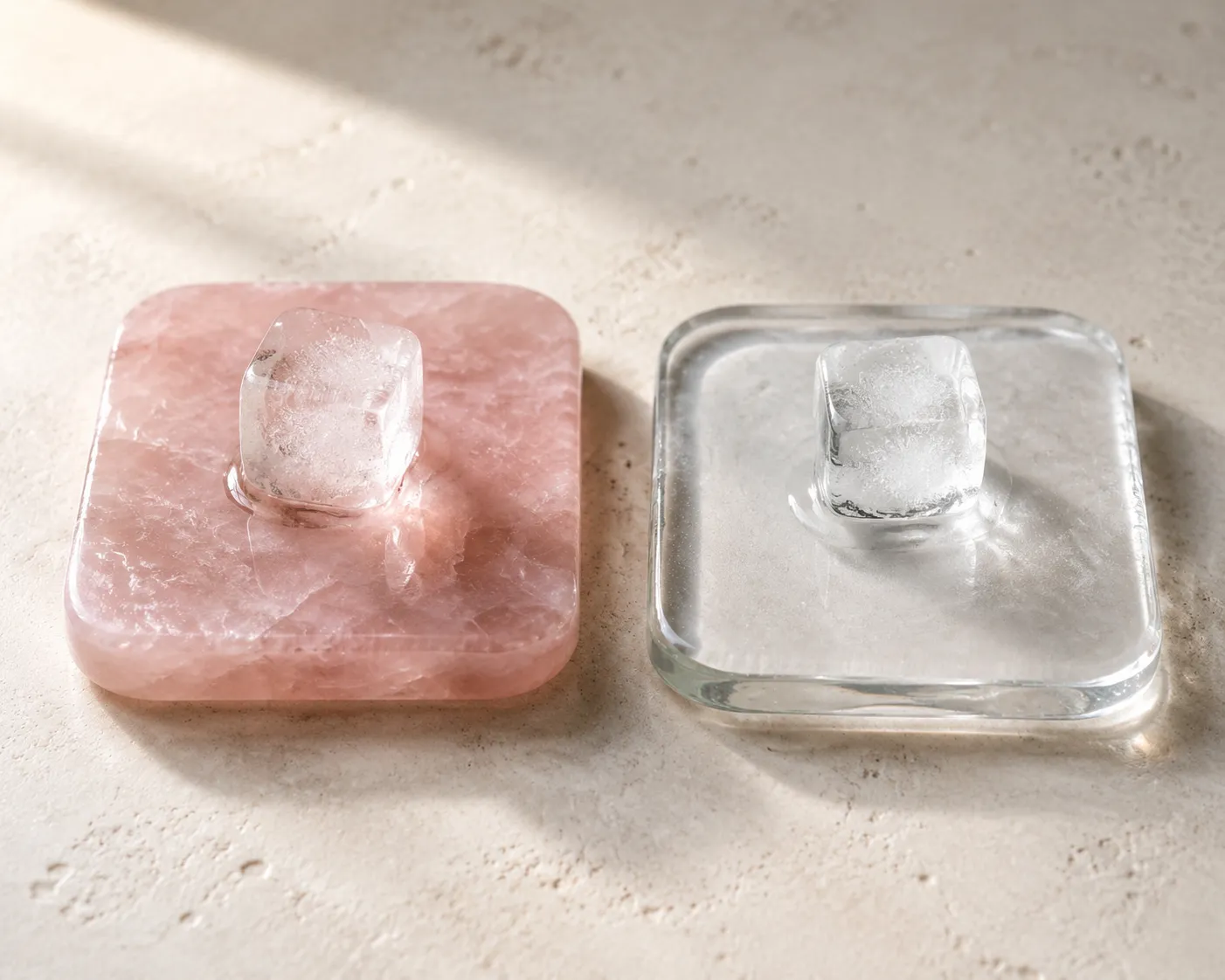
Thermal Conductivity Test
Why Real Rose Quartz Melts Ice Faster Than Glass Imitations
Real rose quartz may appear to melt ice faster than a glass imitation because it can move heat into the ice differently. In a simple Thermal Conductivity Test, the ice is not responding to “crystal energy,” and the result is not a complete authenticity verdict. It is a heat-transfer observation: warmth from the room, the stone, and the contact surface moves into the ice and supplies the energy needed for melting.
Under similar conditions, quartz and some common glass imitations can behave differently enough that the rose quartz piece may wet the ice, create a melt spot, or produce water faster. That result can be useful, but it stays narrow. It does not confirm that a stone is natural, untreated, correctly labeled, high value, or sold accurately.
The Ice Melting Test Is Really About Heat Transfer
The rose quartz ice test is usually simple: place a small piece of ice on a rose quartz sample, place another piece of ice on a suspected glass imitation, and watch which one starts melting sooner.
The useful part is the comparison, not the drama of the melting ice.
Ice melts when enough heat reaches it. A countertop, metal spoon, quartz stone, and glass bead can all transfer heat to ice, but not at the same rate. The visible result depends on several related factors:
- Thermal conductivity: how readily a material conducts heat through itself.
- Thermal diffusivity: how quickly a temperature change moves through the material.
- Heat capacity and mass: how much heat the object can hold and pass into the ice.
- Contact quality: how much of the ice is actually touching the surface.
Rose quartz is a crystalline variety of quartz. Many imitations are amorphous glass rather than crystalline mineral material. That structural difference is one reason their thermal behavior may not match.
A home ice test is much rougher than a laboratory measurement, but it points to the same basic physical idea: how heat moves through a solid and into ice.
This also explains the familiar “cold to the touch” impression. A material can feel colder than another material at the same room temperature if it draws heat from your skin more quickly. It is not necessarily colder on a thermometer. It may simply be moving heat away from your hand more efficiently at first contact.
Why Rose Quartz Can Look Faster Than Glass
When rose quartz has been sitting at room temperature, it holds thermal energy from its surroundings. When ice is placed on it, heat begins moving from the warmer stone and nearby air into the colder ice.
If the quartz surface transfers heat into the contact point more effectively than a particular glass imitation, the ice may start melting faster on the quartz.
The word may is important.
The test is most meaningful as a side-by-side comparison between similar objects. It becomes much less useful when one sample is a thick rose quartz palm stone and the other is a thin glass charm, bead, cabochon, or decorative piece.
A large rose quartz slab can feed heat into the ice differently from a small glass object simply because it has more mass. A flat polished face can create better contact than a curved or uneven surface. A stone warmed in someone’s hand may melt ice faster than a cooler object, no matter what the material is.
So the careful answer is:
Under similar conditions, real rose quartz may melt ice faster than some glass imitations because quartz and glass can differ in heat-transfer behavior. The test shows a material-behavior clue, not a final identification.
Variables That Can Change the Result
A fair rose quartz ice test is harder than it looks. Small differences can create a convincing-looking result even when the material is not the main reason.
The biggest variable is starting temperature. If one piece has been near a sunny window, held in a warm hand, stored in a pocket, or placed near a heater, it may melt ice faster. If the other piece has been in a cool drawer or near an air conditioner, it may look slower.
Contact area also matters. Ice melts faster where it has strong contact with a surface. A flat rose quartz slab may look more responsive than a rounded glass bead because more ice is touching it. Rough or uneven surfaces can trap small air gaps, and air does not transfer heat as well as direct contact.
Size and thickness matter too. A thick carving and a thin glass imitation do not have the same heat reservoir. The larger object may keep feeding heat into the ice contact point for longer. That does not make it more authentic; it only changes the test conditions.
For a cleaner comparison
- Let both samples rest in the same room, away from sun, heat, or drafts.
- Use ice pieces of similar size and shape.
- Start both tests at the same time.
- Avoid touching or warming one sample more than the other.
- Compare similar surfaces when possible, such as two flat polished faces.
- Watch for relative melting, not a pass-or-fail result.
Even with those controls, this remains a household observation. It is not the same as laboratory thermal conductivity testing, where sample dimensions, temperature gradients, instruments, calibration, and uncertainty are controlled.
What the Test Does Not Prove
The main mistake is treating the ice test as a complete rose quartz authenticity test.
In the crystal market, “fake quartz” can mean several different things. It may refer to glass being sold as quartz. It may also refer to dyed material, treated material, lab-grown material, mislabeled material, or a trade name that sounds more geological than it is.
Those are not all the same problem.
A Thermal Conductivity Test may help raise questions about certain glass-like substitutes, especially when compared with a known quartz sample. But it cannot settle every authenticity category.
A piece could be quartz and still be dyed. A piece could be natural quartz but mislabeled by variety, quality, or origin. A piece could perform well in an ice test and still need more evidence before making a strong claim about what it is.
Another common confusion is the difference between ice melting and the melting point of quartz or glass. The Ice Melting Test is not about melting the stone. Ice melts near everyday temperatures; quartz and glass do not. When ice melts on rose quartz, only the ice is changing phase. The stone is simply part of the heat-transfer path.
Social-media demonstrations can add to the confusion. A short video may show one ice cube collapsing faster than another, but it usually does not show whether the samples started at the same temperature, had the same mass, or offered the same contact surface. The visual result can be real without being conclusive.
What to Do With Your Result
If your rose quartz melts ice faster than a glass-like comparison piece, the most grounded reading is:
The rose quartz may be transferring heat into the ice more effectively under those conditions.
That supports the idea that the two objects are not behaving the same way as materials. It does not confirm every claim attached to the stone.
If your rose quartz does not melt ice faster, that also does not automatically mean it is glass. The sample may be smaller, cooler, thinner, curved, rougher, or making poorer contact with the ice. The ice itself may also be uneven, wet, cracked, or already starting to melt.
The best use of the rose quartz ice test is modest: compare similar pieces, control the obvious variables, and treat the outcome as a heat-transfer clue. Real rose quartz may outperform some glass imitations in this test, but the honest explanation stays physical rather than absolute.
For identification that matters financially, sentimentally, or for collection records, the ice test should be only one observation among broader evidence. More reliable assessment usually considers multiple properties together, such as visual features, inclusions, density, hardness, refractive behavior, and examination with suitable tools.
Quick FAQ
Does melting ice prove rose quartz is real?
No. Faster melting can suggest a difference in heat transfer, especially when comparing rose quartz with a glass-like imitation under similar conditions. It does not prove that the stone is natural, untreated, correctly labeled, or valuable.
Why does real quartz feel cold at first touch?
Quartz may feel cold because it can draw heat from your skin quickly at first contact. The stone may be the same temperature as the room, but your hand reads the heat transfer as a cool sensation.
Can glass also melt ice?
Yes. Glass can transfer heat to ice too. The question is not whether glass melts ice at all, but whether two similar samples melt ice at noticeably different rates under controlled conditions.
Is the ice test safe for rose quartz?
A small ice cube on a stable, room-temperature piece is generally a low-impact observation. Avoid sudden temperature extremes, flame, harsh chemicals, or scratch-based experiments, especially on polished, sentimental, or valuable pieces.
What is the best conclusion from a rose quartz ice test?
The safest conclusion is that the sample showed a particular heat-transfer behavior under the conditions you used. That can be a useful clue when comparing real quartz versus glass, but it should not be treated as a final authentication method.
Sources
Sources and further reading
Reference links are limited to sources considered suitable for public citation in this page.