How to Shift from Sympathetic Overdrive to Rest with Rose Quartz
Rose quartz can fit into Sympathetic overdrive regulation only as a cue, not as the force doing the regulating. If the stone feels meaningful to you, hold it as a somatic anchor while you pause, feel contact, look around the room, and let your breathing become less forced.
The useful part is the practice around the object: touch, orientation, lower stimulation, a softer exhale, and the symbolic permission to stop pushing for a moment. Rose quartz is often associated in crystal culture with tenderness, the heart, compassion, meditation, and bedtime calm. Those meanings can be personally valuable, but they should stay in the realm of symbolism and ritual rather than being presented as evidence that the stone changes the autonomic nervous system.
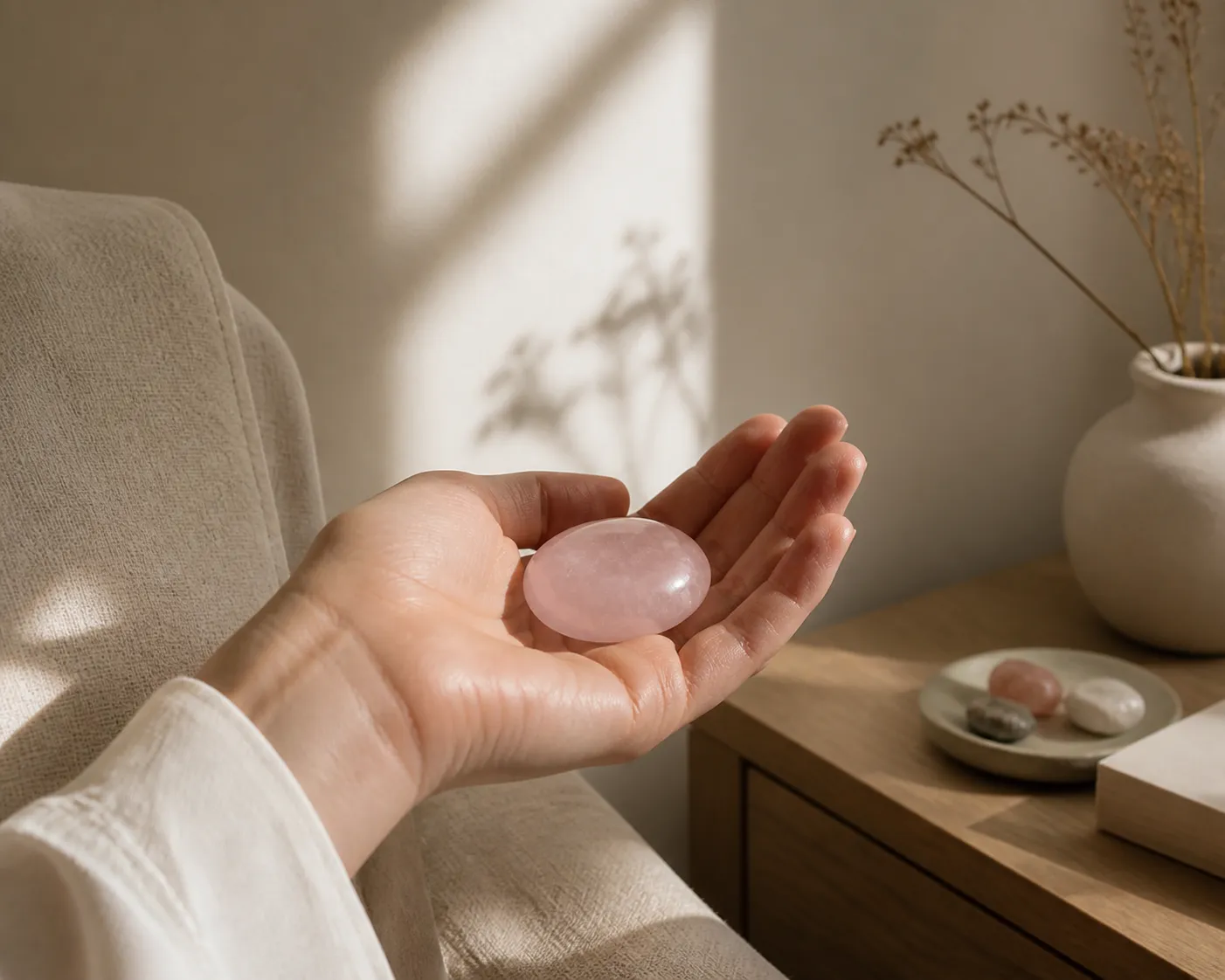
A simple rose quartz pause for shifting toward rest
When people say they are in “sympathetic overdrive,” they usually mean they feel mobilized: tense, alert, rushed, guarded, restless, or unable to settle. In basic physiology, the sympathetic branch of the autonomic nervous system is involved in action and threat-readiness. The parasympathetic system, with the vagus nerve as an important part of that picture, is associated with recovery, digestion, and downshifting. These systems are not light switches, and calm cannot always be commanded on demand.
A rose quartz practice works best when it is treated as a gentle ritual cue. The stone gives the hands something steady to notice while attention moves away from spiraling thought and back toward present sensory information.
Try this as a short pause, not as a medical protocol:
-
Pause before fixing anything.
Sit or stand where you are. Let the rose quartz rest in your palm rather than gripping it tightly.
-
Feel the object clearly.
Notice its weight, temperature, edges, smoothness, and pressure against your skin. If the mind jumps ahead, return to one simple detail: “cool,” “smooth,” “heavy,” or “held.”
-
Orient to the room.
Look around slowly. Name a few neutral details: a wall, a window, a shadow, the floor, the chair. This helps attention register the actual environment instead of only the internal alarm.
-
Let the exhale soften.
Do not strain for a perfect deep breath. A slightly longer, easier exhale is often more usable than trying to perform calmness.
-
Notice support.
Feel the chair, bed, floor, or ground under you. Let the stone remind you that the body has points of contact.
-
Use one plain phrase if it helps.
Try: “I can pause,” “I am here,” “less effort,” or “one breath.” If spiritual language belongs in your practice, you can use it, but it does not need to become a physiology claim.
The practice can last 30 seconds or several minutes. If it helps, the rose quartz is doing something meaningful as a reminder and focus object. The likely support comes from attention, touch, orientation, breathing, and a calmer setting—not from the mineral acting as a nervous-system regulator.
Why rose quartz may feel helpful without being the mechanism
Rose quartz carries strong emotional symbolism in contemporary crystal culture. It is commonly linked with softness, love, compassion, peace, the heart, meditation, and sleep rituals. For many people, those meanings are not trivial. A meaningful object can make a pause feel more intentional than simply being told to “relax.”
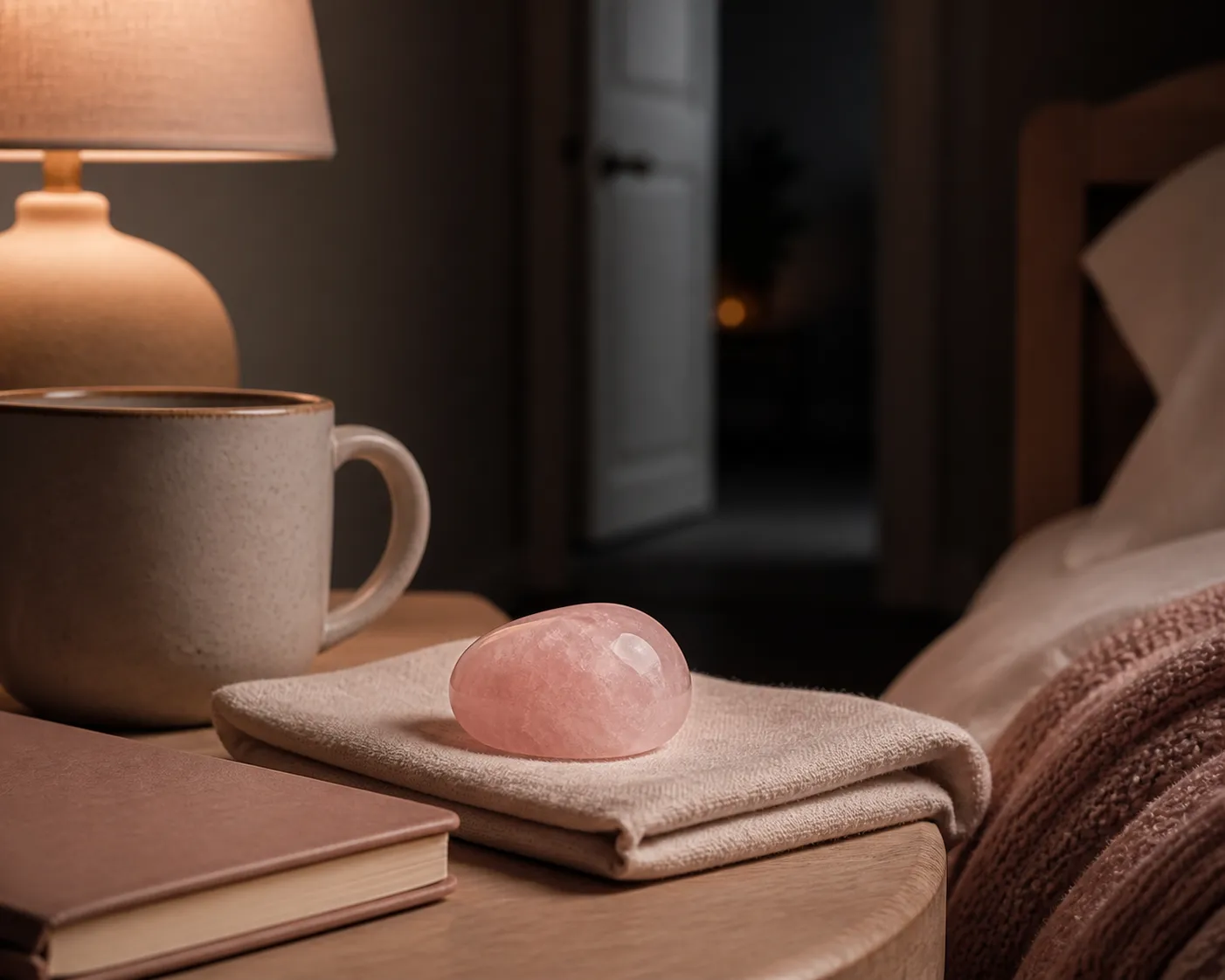
That symbolic layer can matter in practical ways. A physical object can interrupt habit. If you are rushing, reaching for the same stone each time may signal, “This is the moment to stop pushing.” If the stone sits on a bedside table, it can mark the move from stimulation to a quieter evening. If it is used during meditation, it can give wandering attention a tactile place to return.
The nervous-system language needs a firmer edge. The vagus nerve is a real anatomical structure and an important part of parasympathetic physiology. Breath attention, meditation, and some contemplative practices are discussed in research in relation to stress response and autonomic function. That background does not show that rose quartz itself creates a parasympathetic state.
The cleanest answer is: rose quartz may help you remember to practice rest cues; it should not be described as the biological cause of the shift.
That distinction protects the experience. It lets a spiritually or aesthetically meaningful object remain meaningful without turning a personal pause into a health-outcome claim.
What changes whether this works for you
A rose quartz somatic anchor is more likely to feel useful when the situation is mild enough for attention to return to the present moment. It may fit pre-sleep restlessness, a tense work break, a meditation pause, or the first signs of rushing. It may be less useful when the body is in strong panic, the environment still feels unsafe, or symptoms are intense enough that a small self-care cue cannot meet the moment.
Several factors shape the answer:
- Personal meaning: If rose quartz feels comforting, beautiful, or symbolically tender, it may be easier to use as a rest cue. If it feels silly, pressured, or emotionally loaded, choose another object.
- Tactile clarity: Smooth stones, fabric, a mug, a ring, or a blanket can all work as anchors. Rose quartz is optional; the tactile focus is the key feature.
- Breath tolerance: Some people find breath focus calming. Others feel more anxious when monitoring breathing. If breath attention increases discomfort, use visual orientation or contact with the floor instead.
- Level of activation: A small ritual may support a mild shift toward rest. It should not be expected to override danger, severe distress, pain, or ongoing sleep disruption.
- Repetition without pressure: The cue becomes more recognizable when used regularly, but forcing a parasympathetic state can backfire. Rest is usually invited more easily than commanded.
A practice can still be worthwhile even if the body does not settle immediately. Sometimes the useful change is small: one less rushed reply, one softer exhale, one clearer sense of where you are.
Common confusion around rose quartz and the nervous system
One common confusion is treating “heart” symbolism as anatomy. Rose quartz is often described as heart-centered in crystal traditions. That can be a meaningful metaphor for tenderness, grief, affection, or self-compassion. It should not be used to explain chest tightness, breathlessness, palpitations, dizziness, or panic-like symptoms. Those experiences can have many causes, and some need prompt evaluation.
Another confusion is the phrase “reset the nervous system.” It sounds decisive, but it oversimplifies how the autonomic nervous system works. The body shifts through patterns of activation, recovery, vigilance, fatigue, social engagement, and rest depending on context, health, sleep, threat perception, and learned responses. A stone, a breath, or a meditation does not reboot the body like a device.
There is also a difference between grounding and guaranteeing calm. Sensory grounding asks attention to notice present-moment information: texture, sound, color, weight, temperature, support. It may help some people feel more oriented. It does not promise an instant shift.
A final confusion comes from blending spiritual language with physiology. Some people speak about rose quartz energy, the heart center, or emotional balance as part of their worldview. In an evidence-aware article, those can be named as symbolic or cultural meanings. They should not be converted into claims about vagal function or measurable autonomic change.
When rose quartz is not enough
A rose quartz pause is a low-intensity self-care ritual. It belongs in the same broad category as holding a comforting object, lowering stimulation, sitting quietly, or creating a bedtime transition.
Seek urgent medical help for chest pain, severe shortness of breath, fainting, new neurological symptoms, or symptoms that feel dangerous. If panic, trauma responses, severe anxiety, insomnia, palpitations, dizziness, or distress are persistent or interfere with daily life, professional support is more appropriate than relying on a crystal ritual.
This boundary does not make the ritual meaningless. It simply places it where it belongs: a personal cue for pausing, sensing, and softening effort.
A grounded way to use rose quartz without overclaiming
The most balanced approach is to let rose quartz be a doorway into a practice, not the explanation for the practice.
You might keep it on a nightstand as a signal to dim lights and stop scrolling. You might place it in your hand before meditation so attention has a gentle landing point. You might use it during a tense moment as a reminder to orient to the room before responding. You might associate its pink color with compassion or emotional softness while still recognizing that the body’s shift toward rest depends on many factors beyond the stone.
If the phrase “rose quartz somatic anchor” helps, use it in that plain sense: an object with personal meaning that brings attention back to the body. The anchor does not need to be powerful. It needs to be simple, repeatable, and honest.
A careful practice might sound like this:
“I am holding rose quartz because it reminds me to pause. I feel its weight and temperature. I notice the room. I let the exhale soften. I do not have to force calm. I can give my body a cue of safety and see what is possible in this moment.”
That is a respectful role for rose quartz: symbolic, tactile, and supportive of attention. It honors the stone’s emotional meaning without asking it to carry a clinical claim.