Heart Chakra Balancing
Anahata Awakening: Regulating the Nervous System with Rose Quartz
People usually arrive at Heart Chakra Balancing from a mixed place: spiritual curiosity, stress language, and the wish for a simple object that makes inner life feel more manageable. Rose quartz can belong in that space as a symbolic, heart-centered ritual. It can offer a tactile anchor, a quiet focal point, and a way to name an emotional intention.
What it cannot responsibly carry is a claim that the stone changes the nervous system, shifts anxiety outcomes, activates the thymus gland, or produces measurable heart coherence.
The better question is not “Does rose quartz control the body?” It is: “What kind of practice am I doing, and what kind of claim am I attaching to it?”
broader context
Rose quartz context note
This narrower page makes more sense after the broader rose quartz context page.
Where Anahata Practice and Nervous System Language Get Blurred
Anahata is commonly discussed in spiritual-wellness settings as the heart-centered chakra. Rose quartz is commonly associated with softness, affection, emotional openness, and heart-focused ritual. That is why readers often connect the stone with chest space, compassion practices, grief, forgiveness, and gentle calming routines.
The confusion starts when symbolic language gets converted into body-mechanism language too quickly.
“Opening the heart” might mean:
- A spiritual intention to become less guarded.
- A reflective moment around tenderness, grief, or forgiveness.
- A sensory pause using breath, touch, and stillness.
- A market claim implying a measurable physical outcome.
The first three fit this page. The last one needs stronger evidence than is available here.
“Nervous System Regulation” has also become a broad wellness phrase. In casual language, people may use it to mean “I feel less activated,” “I can slow down,” or “I am taking a low-stimulation pause.” In physiology, the phrase points to measurable body processes. Without credible evidence specific to rose quartz and those processes, the cleaner description is this: a rose quartz ritual may feel settling for some people because it creates a reflective, sensory pause. The crystal should not be framed as the mechanism.
The same boundary applies to “Anxiety Relief.” A person may experience a rose quartz ritual as comforting. It may remind them to breathe, journal, dim the lights, step away from a phone, or speak to themselves more gently. That is different from presenting rose quartz as changing anxiety-related health outcomes. If distress is persistent, escalating, tied to panic, trauma symptoms, chest pain, or other serious concerns, the right next step is qualified professional support, not a crystal routine.
What Rose Quartz Can Reasonably Do in a Heart Chakra Balancing Ritual
Rose quartz can serve as an object of attention. That may sound modest, but modest is often where this kind of ritual becomes useful.
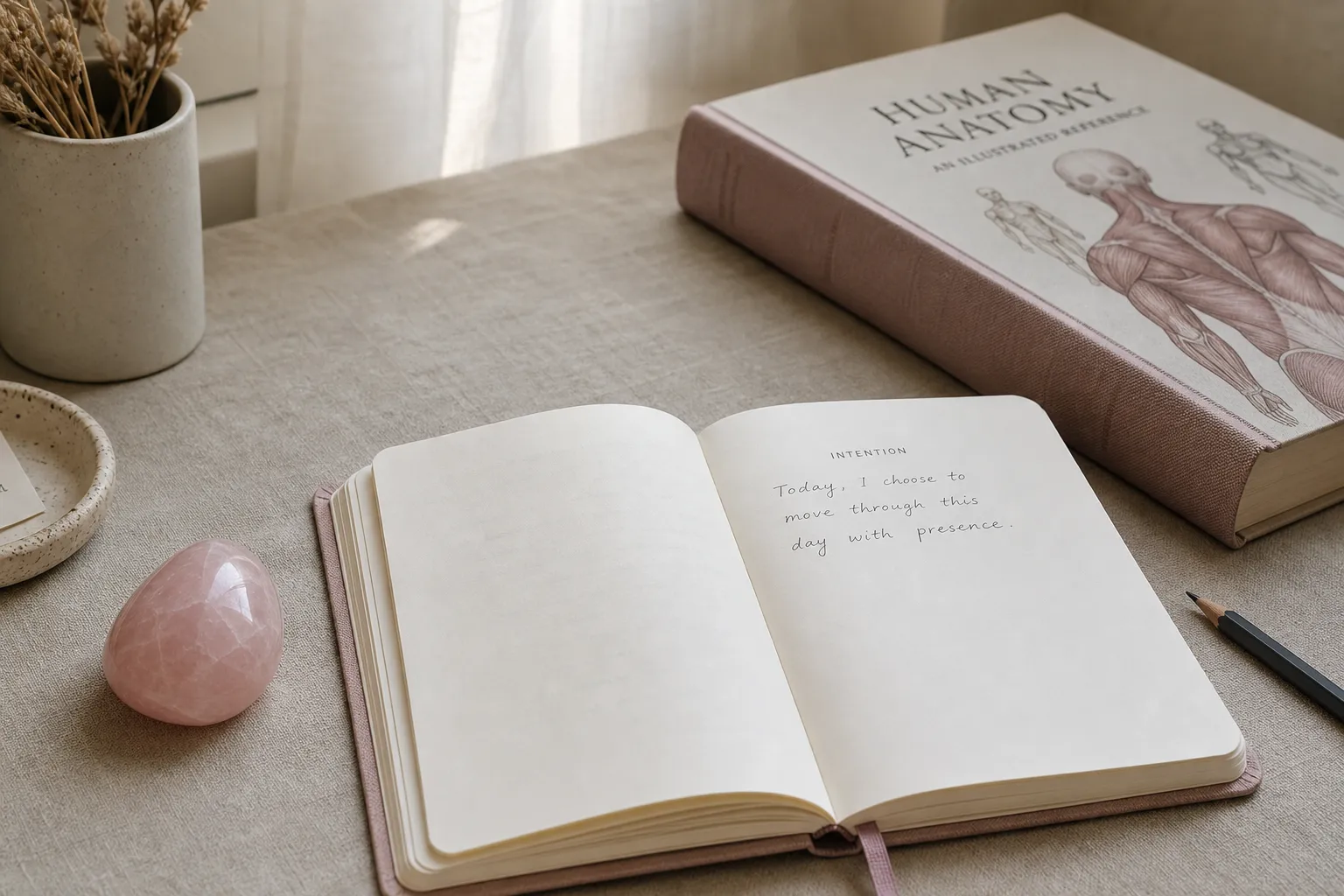
A stone can mark the beginning of a pause. It can sit in the palm while someone chooses a rose quartz ritual intention. It can rest near a journal as a cue for softer self-talk. It can be placed on a table, altar, bedside surface, or meditation cushion to separate the moment from scrolling, rushing, and task-switching.
Those uses do not need inflated language. They work as ritual structure.
A heart chakra balancing ritual with rose quartz might include:
- Holding the stone while naming one emotional quality to practice, such as patience, honesty, or tenderness.
- Taking a few slow, comfortable breaths without forcing a special pattern.
- Writing one sentence about where the chest, shoulders, or jaw feel guarded.
- Placing the stone somewhere visible as a reminder to return to a calmer pace.
- Ending the practice if it feels emotionally overwhelming.
That is Anahata-centered self-care, not anatomical intervention. “I use rose quartz to support a reflective pause around compassion” stays within symbolic and personal language. “Rose quartz changes my nervous system” moves into a claim that needs evidence.
Even “releasing chest tension” needs careful handling. In a ritual context, it can mean noticing tightness, softening posture, or choosing a less defended emotional stance. It should not be used to explain chest symptoms or decide what they mean. Severe, sudden, persistent, or worrying chest discomfort belongs in a higher-stakes care context.
A Grounded Framework: Symbol, Sensation, Story
A useful rose quartz practice has three separate layers. Keeping them separate prevents the ritual from becoming a stack of unsupported health language.
Symbol
Rose quartz as a heart-associated object for love, compassion, softness, or care.
It should not be asked to prove that the stone has measurable biological effects.
Sensation
Coolness, smoothness, weight, texture, and color as sensory focus.
It should not be asked to prove that texture alone changes autonomic function.
Story
A personal intention around Anahata, boundaries, forgiveness, or tenderness.
It should not be asked to prove that the ritual changes a health outcome.
This framework is especially useful with phrases like “How to Shift from Sympathetic Overdrive to Rest with Rose Quartz.” The phrase captures a real desire: to move from feeling keyed-up toward a quieter state. But the wording can overreach. A more grounded reading is that rose quartz may be used as a cue to lower stimulation, slow the pace, and return attention to breath or body sensation. The crystal is part of the ritual container, not evidence of a nervous-system mechanism.
The same applies to a “60-second low-stimulation morning reset.” The useful version is simple: no phone, soft light, one object in hand, one intention for the day. It becomes less credible when it is presented as a measurable health reset.
A balanced ritual might look like this:
- Sit somewhere quiet enough that you are not fighting the room.
- Hold rose quartz in one hand or place it near the center of your space.
- Name the practice plainly: “This is a pause for steadiness.”
- Let the breath become comfortable rather than dramatic.
- Notice one sensation: temperature, weight, surface, or color.
- Write one sentence about what emotional boundary or tenderness needs attention.
- Return the stone to a chosen place to close the ritual.
The structure honors rose quartz symbolism while keeping the claim clean.
Heart Coherence, HRV, and Borrowed Authority
Heart Coherence and HRV language often appears near heart-centered wellness practices. Readers may see phrases such as “heart-brain coherence,” “Tech-Free HRV Regulation,” or “Cultivating Heart-Brain Coherence Naturally.” These terms can sound precise, and in some settings they may relate to measurement tools, breath pacing, or biofeedback discussions. That does not make rose quartz the active mechanism.
A common misread pattern is simple: a technical term gets placed beside a crystal practice, and the combined phrase sounds more evidence-based than it is.
For this page, heart coherence market language is best treated as reader-language. It tells us what people hope the ritual will feel like: calmer, more integrated, emotionally steady, or connected. It does not show that rose quartz creates measurable heart-rate changes.
A “5-second pacing rule” or prolonged exhale practice may appear in broader breathwork conversations. Without specific support here, it should not be turned into a protocol. If a reader wants to hold rose quartz while breathing slowly, the safe description is enough: the stone can be a tactile reminder to breathe at a comfortable pace.
Frequency claims need the same restraint. Phrases like “639Hz for Heart Chakra Tuning” or “432Hz, 528Hz, and 639Hz for Nervous System Repair” may appeal to readers who enjoy sound rituals, chanting, or ambient tones. The grounded version is: some people pair rose quartz with quiet sound to create a heart-focused atmosphere. Claims about body repair should be left out.
The Thymus Gland Is Not a Shortcut
The thymus gland sometimes appears in heart chakra discussions because of its location in the upper chest and its symbolic proximity to the heart area. That makes it tempting to describe the thymus as an anatomical bridge between Anahata, immunity, emotion, and rose quartz. The available material does not support that move.
A thymus tapping ritual may still feel meaningful as a gesture: light, rhythmic touch near the chest used to mark attention, intention, or emotional presence. It should not be framed as activating gland function, changing immunity, improving vagal tone, or creating emotional resilience through a measured pathway.
A cleaner distinction:
- As symbolism: the upper chest can be a focus area for heart-centered reflection.
- As sensation: gentle touch may make a ritual feel more embodied.
- As anatomy: claims about gland function, immunity, vagal tone, or measurable body effects require evidence.
That distinction does not make the ritual empty. It makes the claim more honest.
If someone enjoys a tapping gesture, it can stay gentle, brief, and symbolic. If it feels irritating, emotionally activating, or physically uncomfortable, there is no need to continue. A ritual should not ask the body to override discomfort to fit a spiritual script.

Somatic Language Can Help, but It Can Also Overstate the Practice
Many searches around this topic use somatic language: “Somatic Heart Expansion,” “Somatic Body Neutrality,” “Bypassing the Conscious Brain,” “Burnout Recovery,” “Dismantling Psychological Armor,” and “Discharging Deep Grief.” These phrases point to a real interest in embodied self-awareness. They can also make a gentle ritual sound like a formal intervention.
For a rose quartz article, the grounded middle path is to use body-awareness language without loading it with outcomes.
A reflective self-care practice can include noticing:
- Whether the shoulders are lifted or relaxed.
- Whether the breath feels shallow, forced, or comfortable.
- Whether the hand prefers the stone’s coolness, smoothness, or weight.
- Whether the room feels too bright, loud, cluttered, or stimulating.
- Whether the ritual brings steadiness or increases distress.
That is enough. The practice does not need to become a method for burnout recovery, deep grief release, or nervous system repair. Those phrases carry more weight than a crystal ritual can responsibly hold.
“Sensorial Grounding” works when it stays ordinary. Texture and temperature can support attention: the cool surface of rose quartz, the softness of a cloth, the steadiness of a table, the absence of a phone, the dimming of harsh light. A sensory grounding ritual can be a low-stimulation way to return to the present moment. It should not be dressed up as a guaranteed vagal input system.
The same applies to “low-stimulation living.” In a rose quartz ritual, that might mean placing the stone beside a book instead of a phone, choosing silence over a playlist, or making the practice small enough to repeat. The quieter version is often the more credible one.
Boundaries, Grief, and the Emotional Meaning of Rose Quartz
Rose quartz is often chosen because its symbolic meaning feels emotionally gentle. Readers may bring it into moments of grief, relationship strain, tenderness, regret, or self-judgment. A heart chakra balancing ritual can give those feelings a shape: a beginning, a gesture, a sentence, and an ending.
That structure is different from promising emotional resolution.
A “Rose Quartz Heart String Ritual,” for example, is stronger as a boundary practice than as a polyvagal claim. It can ask:
- What emotional access am I offering too freely?
- What conversation needs a slower pace?
- What kind of care can I give without abandoning myself?
- What symbol will remind me to pause before overextending?
Those questions fit rose quartz because they work through meaning, not measurement.
A bio-spiritual grief practice needs even more restraint. Rose quartz may be part of a quiet memorial corner, a journaling practice, or a moment of tenderness toward oneself. It should not be presented as processing grief on its own or removing stored pain from the body. Grief can be complex, and persistent or destabilizing distress deserves more than symbolic tools.
There is also a useful idea inside “Somatic Body Neutrality.” A heart-centered ritual does not have to demand instant love, forgiveness, gratitude, or emotional release. Sometimes the most grounded intention is neutral: “I can sit with myself for one minute without forcing a feeling.” That can be more respectful than trying to manufacture unconditional love on command.
What Changes the Judgment
Not every rose quartz ritual carries the same risk of overclaiming. The judgment changes with the wording, setting, and expectation.
Low-risk framing
“I use rose quartz as a symbolic focus for a short heart-centered pause.” It is personal, bounded, and honest.
Medium-risk framing
“This ritual helps my nervous system.” It may be trying to describe a felt experience, but it blurs personal perception with body-process language. Softer wording works better: “This ritual helps me feel more settled” or “This gives me a calmer transition.”
High-risk framing
Rose quartz changes anxiety, immune function, vagal tone, heart coherence, thymus activity, or physiological repair. Those claims should not be used here.
The same decision frame applies to ritual design. A grounded Anahata-centered self-care practice is optional, uses rose quartz as a symbol or sensory object, avoids outcome promises, stops if distress increases, leaves room for professional support, and does not turn spiritual language into anatomy.
An overextended practice usually does the opposite: it claims a mechanism, borrows medical-sounding terms, names dramatic results, and treats the crystal as the active agent behind body change.
This is why “The Weaponized Placebo” is not a helpful frame for this page. It makes a delicate distinction combative. A more careful view is that expectation, attention, environment, and personal meaning can shape how a ritual feels. That does not prove a crystal effect, and it does not make the practice fake. It places the value where it can be responsibly discussed: symbolism, sensory focus, emotional intention, and reflective pacing.
A Simple Rose Quartz Ritual That Stays Within the Boundary
This practice is not a medical method, not a nervous-system protocol, and not a claim about the thymus gland or heart coherence. It is a symbolic crystal practice for readers who want a calm, Anahata-centered pause.
Choose a quiet surface and place one piece of rose quartz where you can see or touch it. Let the stone be clean, dry, and simple. Avoid putting crystals directly into drinking water unless material safety and preparation have been properly verified. If you want an “elixir” feeling, use the symbolic version: place the stone near a closed glass of water, and let the water represent a slower pace.
Sit comfortably. If your chest or shoulders feel tense, notice that without interpreting it as a chakra blockage or health sign. Let the stone’s color, temperature, or weight become the point of attention.
Use one sentence as the ritual intention:
- “I am practicing a softer pace.”
- “I can care without overextending.”
- “I can pause before reacting.”
- “I can let tenderness and boundaries exist together.”
Take a few natural breaths. If counting creates pressure, do not count. If sound helps, use a quiet tone or mantra-like phrase for atmosphere, not as a claim about acoustic frequency. If silence feels better, keep silence.
Close by placing the rose quartz somewhere visible. The closing matters because it tells the mind that the ritual is complete. You are not trying to force a breakthrough. You are practicing a small return.
The Cleanest Way to Understand Anahata Awakening with Rose Quartz
Anahata Awakening with rose quartz is strongest when it is understood as symbolic, sensory, and reflective. It can organize a pause around compassion, boundaries, grief, softness, or emotional steadiness. It can make a routine feel more intentional. It can give the hand something quiet to hold while the mind stops performing urgency for a moment.
It becomes weaker when it tries to sound clinically certain.
Rose quartz does not need to be presented as controlling the nervous system to have a place in Heart Chakra Balancing. Anahata language does not need to become biomedical anatomy to be meaningful. Heart coherence, thymus gland, vagal tone, HRV, and frequency language should not be borrowed as decoration for claims the practice cannot support.
The durable version is simple: rose quartz as a heart-associated symbol; breath as a gentle pacing cue; touch as sensory attention; journaling as reflection; boundaries as emotional clarity. That keeps the ritual usable without turning it into a promise.
For readers drawn to both spirituality and evidence boundaries, that may be the most respectful form of the practice: open-hearted, but not overclaimed.