Tech-free regulation
Tech-Free HRV Regulation: Cultivating Heart-Brain Coherence Naturally
Tech-free HRV regulation is a gentle way to borrow from HRV biofeedback without pretending you can measure HRV by feel. You use slow, comfortable breathing, body awareness, and simple cues—such as jaw tension, breath smoothness, or how easily attention returns—to practice steadier regulation without an app, sensor, or score.
The key boundary is simple: this is subjective practice, not HRV measurement. It may help you notice how breath, heart rhythm, muscle tone, and attention seem to interact, but it cannot confirm that your HRV increased, that you found your resonance frequency, or that you produced “coherence” in a measurable sense.
Held carefully, heart-brain coherence can be a useful image. The heart is not a metronome, the body is not a spreadsheet, and regulation is not the same as control.

What “HRV without wearables” can actually mean
Heart rate variability, or HRV, refers to natural variation in the timing between heartbeats. A perfectly even beat is not the goal. Healthy heart rhythm is dynamic and influenced by breathing, movement, stress, posture, sleep, and autonomic nervous system activity.
Formal HRV biofeedback usually uses sensors, software, and real-time displays. In many protocols, a person watches heart-rate and breathing patterns while practicing a rhythm that increases certain heart-rate oscillations. Research often discusses paced breathing, resonance breathing, respiratory sinus arrhythmia, baroreflex mechanisms, and autonomic regulation. A commonly mentioned rhythm is around 0.1 Hz, often described as roughly 6 breaths per minute, though individual resonance rates can vary.
Tech-free practice is different. Without a sensor, you cannot know which HRV metric changed, whether your HRV changed at all, or whether your breathing matched your own resonance frequency. What you can do is practice a low-tech form of body awareness: noticing whether the breath becomes smoother, whether the jaw or shoulders soften, whether the chest or belly feels less braced, and whether attention returns more easily after stress.
That is the honest promise of wearable-free biofeedback: internal feedback, not physiological data.
A gentle rhythm for natural autonomic flexibility
A useful starting point is not a rigid breathing protocol. It is a comfortable rhythm that makes the breath slower, steadier, and less effortful.
You might sit or lie down with support, let the first few breaths happen naturally, and then gradually lengthen the breath without forcing it. Some people find a rhythm near five seconds in and five seconds out approachable. Others need something shorter, less counted, or more intuitive. The number matters less than the absence of strain.
A simple frame
- Let the inhale arrive rather than pulling it in.
- Let the exhale complete without pushing it out.
- Notice the turning point between inhale and exhale.
- Keep the face, throat, ribs, belly, and hands as unforced as possible.
- If counting creates pressure, follow a phrase, a hand on the body, or the felt movement of breath instead.
This is where somatic perception matters. The body gives imperfect but useful signals: softening, bracing, warmth, restlessness, ease, pressure, agitation, return. These signals do not equal HRV data, but they can show whether the practice is becoming supportive or turning into another performance task.
Autonomic flexibility is a helpful phrase because it does not imply permanent calm. It points to the body’s ability to shift between activation and settling as conditions change. In tech-free HRV regulation, the aim is not to stay relaxed all day. It is to notice early signs of strain and rehearse a gentler return.
Using body cues as wearable-free biofeedback
Biofeedback usually means information from the body is measured and shown back to you through a device. In a tech-free context, the feedback is internal and subjective. That makes it less precise, but it may also reduce HRV score anxiety.
Breath feels smoother
It may help you notice that the rhythm is easier to sustain.
It does not prove that HRV has increased.
Jaw, shoulders, or belly soften
It may help you notice that bracing is reducing.
It does not prove that the nervous system has changed in a lasting way.
Exhale becomes less forced
It may help you notice that the breath is less effortful.
It does not prove that you found your resonance frequency.
Attention returns from looping thoughts
It may help you notice that regulation feels easier subjectively.
It does not prove that a specific HRV metric changed.
Recovery after a stressor feels gentler
It may help you notice more flexibility.
It does not prove that the practice produced a measured health outcome.
Keep the observation simple. Before practice, ask: “What is my body doing right now?” After a few minutes, ask: “Is anything even slightly easier?” The answer may be yes, no, or mixed. All three are usable information.
A quiet room, a hand over the sternum, a familiar chair, or a small object nearby can serve as an anchor if it helps you slow down and pay attention. It does not need to be framed as producing a physiological change. In a grounded ritual context, an object can simply mark the moment: this is where I stop optimizing and listen.
The most important distinction is this: body awareness can guide practice, but it cannot audit the heart. If you want measured HRV, you need appropriate measurement. If you want a tech-free regulation ritual, you can work with breath, posture, attention, and felt sense.
What changes the answer
The same breathing rhythm will not feel the same in every body or every situation. A few variables matter.
Effort changes everything
Slow breathing that becomes forced is no longer gentle regulation. If you are trying to hit a perfect count, inflate the belly dramatically, or make the heart feel a certain way, the practice can become tense. A slightly faster but easier rhythm is often more useful than a slower rhythm that creates strain.
Six breaths per minute is not a universal rule
Research often uses approximately 6 breaths per minute because it sits near a commonly studied resonance range for adults. Formal resonance-frequency assessment usually compares responses across breathing rates and relies on measurement. Without sensors, treat this as a loose reference point, not a target you must achieve.
Subjective calm and measured HRV are not interchangeable
You may feel calmer without knowing what happened to HRV. You may also have a wearable score that does not match your felt experience. HRV is influenced by many variables, and no single sensation should be treated as a full nervous-system report.
The practice should fit ordinary life
Tech-free HRV regulation is most useful as a small return point: before opening email, after a difficult conversation, while sitting in the car before going inside, or near bedtime. It does not need to become a long routine. A few careful minutes can be enough to practice noticing.
Know when to stop
Gentle breathing should not include breath-holding, air hunger, forceful manipulation, or chasing intense sensations. If dizziness, chest tightness, panic, tingling, numbness, shortness of breath, or distress appears, stop and return to natural breathing. People with cardiovascular, respiratory, panic-related, trauma-related, pregnancy-related, or other medical concerns should seek qualified guidance before structured breathwork.
Common confusion around heart-brain coherence
“Heart-brain coherence” can be meaningful when it stays modest. In a careful sense, it points toward coordination among breathing rhythm, heart-rate patterns, attention, and autonomic regulation. HRV biofeedback research gives real reasons to discuss breath-heart-autonomic coupling. That does not mean every calm feeling confirms coherence or that every coherence practice creates measurable change.
Three confusions are especially common.
HRV is not the same as relaxation
HRV is a measurement category, not a mood label. Relaxation may accompany certain breathing practices, but feeling relaxed does not tell you which HRV metric changed.
Higher HRV is not always a simple “better” score in every context
HRV varies with age, sleep, exertion, illness, stress, measurement method, and timing. The tech-free path is not to maximize a number you cannot see. It is to build a more responsive relationship with your body.
Being device-free does not make the practice more mystical or more accurate
It simply changes the frame. You trade precision for intimacy. You stop outsourcing every signal to an app, but you also accept that perception is approximate.
That trade can be healthy when held honestly. Wearables can be useful for some people, but they can also feed score-checking and self-surveillance. Tech-free practice offers a different question: not “What is my HRV right now?” but “Can I meet this moment with a little less force?”
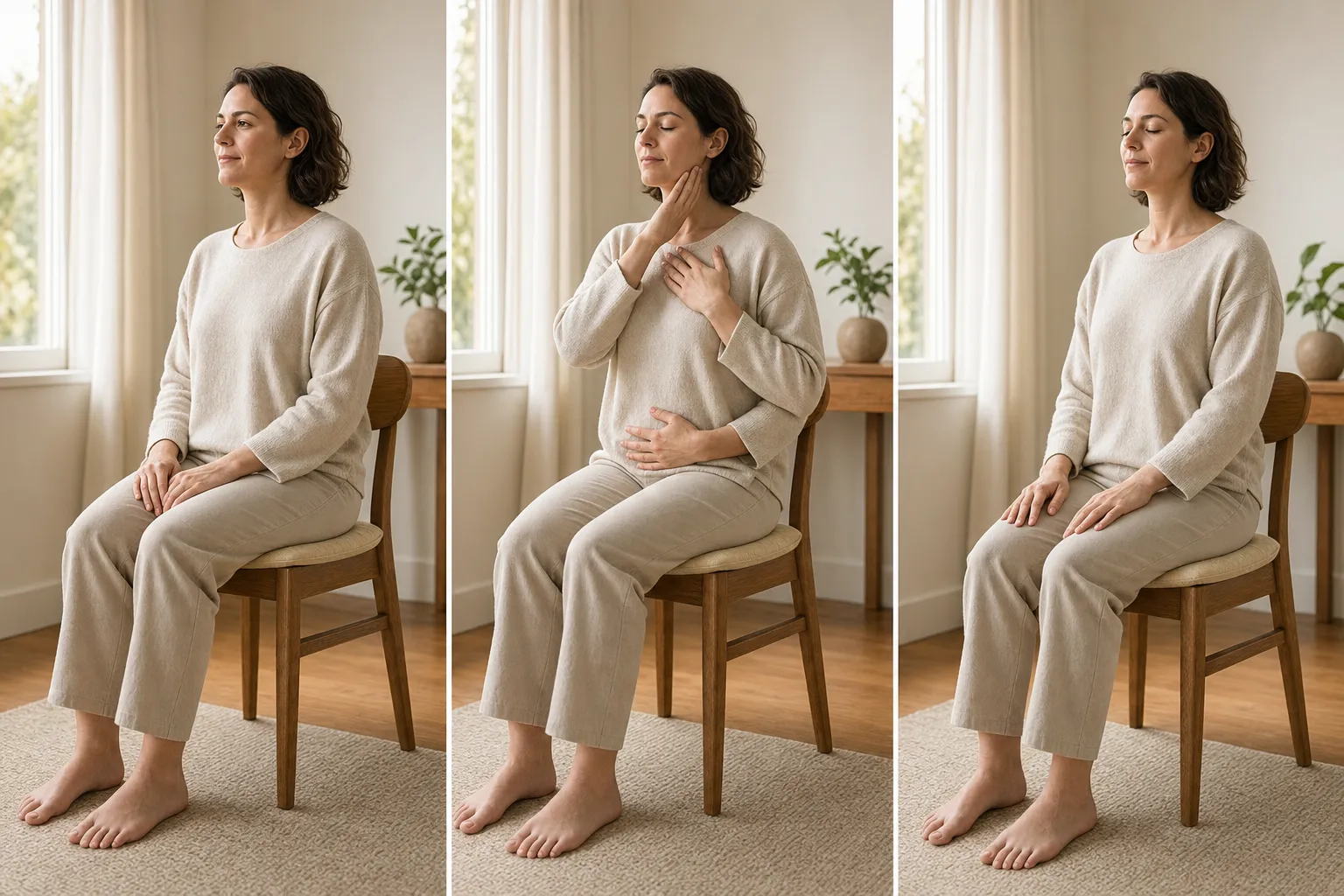
A modest practice to repeat
If you want a simple, non-clinical way to begin, keep it brief and gentle:
- Arrive. Sit or lie down with enough support that you do not have to hold yourself rigidly.
- Notice first. Before changing anything, sense the jaw, throat, chest, belly, shoulders, and hands.
- Invite rhythm. Let the breath become slightly slower and smoother. If counting helps, try an even inhale and exhale; if it creates pressure, drop the count.
- Track ease, not performance. Look for small signs: less bracing, easier transitions, a quieter exhale, attention returning.
- Close naturally. Let the breath return to its own rhythm before standing or moving on.
This is not clinical HRV biofeedback and not a disease-specific protocol. It is a grounded way to explore breathing and autonomic regulation without apps, sensors, or score anxiety.
The clearest answer is also the most restrained: tech-free HRV regulation can support a more attentive relationship with breath, body cues, and recovery, but it cannot tell you your HRV. Its value is not in proving a number. Its value is in practicing a gentler return toward steadiness, one breath at a time.