Grounded ritual note
The Thymus Tapping Ritual for Vagal Tone and Emotional Resilience
A thymus tapping ritual is best understood as a gentle upper-sternum grounding practice: light rhythmic tapping over the center of the upper chest while breathing slowly and noticing the body.
Some people find it steadying because it combines four simple things: rhythm, breath, attention, and touch. What the available evidence does not establish is that sternum tapping directly activates the thymus, improves immune function, reliably changes vagal tone, or works like clinical vagus nerve stimulation.
So the most grounded answer is this: use thymus tapping as a brief self-soothing ritual, not as a guaranteed physiological intervention.
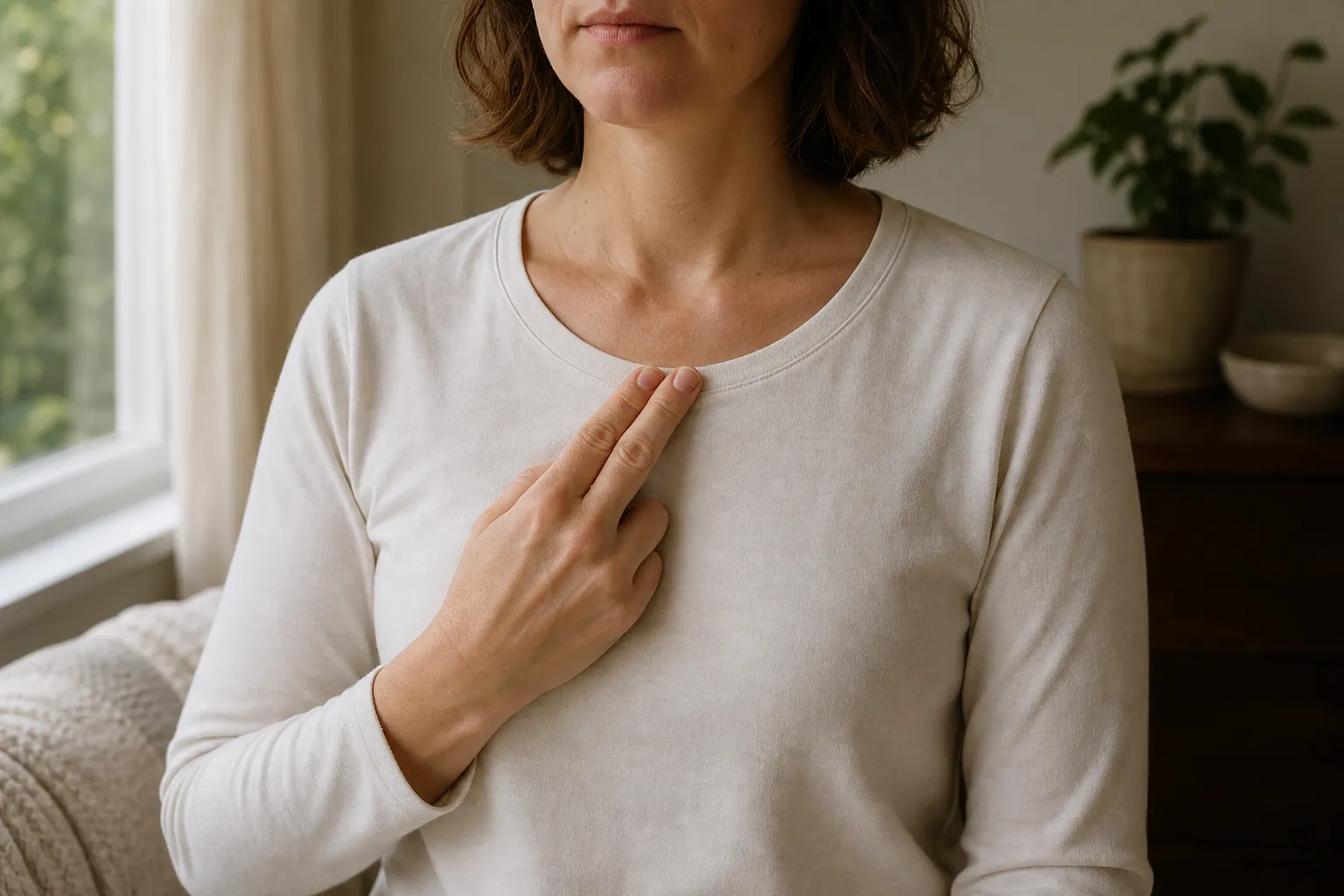
How to practice gentle sternum tapping
The usual placement is the upper sternum, the flat bone in the center of the chest. In wellness language, this area is often called the “thymus point” because the thymus sits deeper in the upper chest region behind the sternum. That explains the name of the ritual, but it does not show that tapping the skin or bone surface changes thymus function.
A careful version can stay very simple:
- Sit or stand steadily. Let your shoulders soften without forcing posture.
- Place two or three fingertips on the upper center chest. Stay on the sternum, not the throat, ribs, or breast tissue.
- Tap lightly. The pressure should feel like a cue, not a percussion exercise.
- Breathe slowly without strain. A comfortable inhale and slightly longer exhale is enough.
- Keep attention plain. Notice contact, rhythm, breath, and the chest rising and settling.
- Continue for 30 seconds to two minutes. Longer is not automatically better.
- Pause afterward. Notice whether you feel steadier, unchanged, or more activated.
Some people add a quiet phrase, such as “I am here,” “slow down,” or “soften.” Others count breaths or taps. Either way, the practice stays in the territory of an upper sternum grounding ritual rather than becoming a claim about gland activation or measured nervous-system change.
What the ritual may be doing
The most reasonable explanation is not that your hand is “switching on” the thymus or the vagus nerve. A more careful explanation is that gentle sternum tapping can act as a body-based pause cue.
A few ordinary features may matter:
- Rhythm: repeated sensation gives attention something steady to follow.
- Breath pacing: slower breathing is often discussed in relation to autonomic regulation and heart-rate variability, though that does not mean this exact ritual reliably changes vagal tone.
- Touch: light self-contact can make the body feel more present during stress.
- Interoceptive awareness: noticing the chest, breath, and internal state may shift attention toward bodily signals.
- Ritual framing: a repeated small action can mark a transition from reactivity into a slower moment.
This is why people often search for “thymus tapping and vagal tone” or “thymus tapping and emotional resilience.” The language is understandable, but it needs careful translation.
Vagal tone is a physiological term often discussed through heart-rate variability and parasympathetic regulation. It is not something most people can confirm just because they feel calmer after tapping for a minute.
Emotional resilience is also broad. A short tapping ritual may help some people interrupt a spiral, reorient to the body, or create a calmer transition. That is different from showing a durable emotional outcome.
Immune resilience is the most easily overstated phrase. The vagus nerve is relevant in research on neuroimmune communication, and the thymus is an immune-related organ. But the evidence available here does not show that tapping the sternum improves immune function. It is better to treat “immune resilience” as wellness language unless a specific claim is supported by stronger evidence.
Thymus tapping is not clinical vagus nerve stimulation
This distinction matters because “vagus nerve stimulation” is often used loosely in wellness spaces.
Clinical vagus nerve stimulation, or VNS, refers to medical neuromodulation methods that use implanted or surface electrical devices to target vagal pathways with defined parameters. Research on VNS and transcutaneous VNS discusses stimulation sites, electrical settings, devices, and clinical contexts. Even in that field, researchers continue to study placement, parameters, mechanisms, and appropriate uses.
Thymus tapping is not that.
A hand tapping the sternum is not an implanted VNS device. It is not auricular electrical stimulation at the ear. It is not cervical electrical stimulation at the neck. It does not use controlled current, pulse width, frequency, electrode placement, or clinical monitoring.
Careful wording
- “This ritual may feel steadying because it combines touch, rhythm, breath, and attention.”
- “It is sometimes used as a calming self-care pause.”
- “The tapping location is associated with the upper sternum area, where the thymus lies deeper in the chest.”
Too strong
- “This stimulates the vagus nerve.”
- “It improves vagal tone.”
- “It activates the thymus.”
That does not make the ritual meaningless. It simply places it where it belongs: gentle self-soothing, sensory awareness, and intentional pause rather than medical neuromodulation.
Where “afferent pathways” fit
“Afferent pathways” are signals traveling from the body toward the central nervous system. In vagus nerve research, afferent fibers matter because the vagus carries body-to-brain information. That is one reason vagal pathways are discussed in relation to interoception, emotion, and autonomic regulation.
But that does not mean every calming touch practice meaningfully engages vagal afferent pathways in a specific or measurable way.
With thymus tapping, the practical point is simpler: tapping the skin and sternum creates sensory input. The brain can notice that input. When paired with slower breathing and attention, the practice may help some people feel more oriented to the body.
That is a modest explanation—and it is enough for a small ritual.
When thymus tapping fits best
Thymus tapping is most appropriate as a brief reset in low-risk everyday moments:
- before sending a difficult message;
- after reading something unsettling;
- during a transition from work to rest;
- when you want a quiet cue to breathe;
- when you need a small embodied pause.
It fits best when the goal is modest: pause before reacting, soften the breath, feel the center of the chest, or mark an emotional transition.
It fits poorly when it becomes a health-outcome claim. Do not use a tapping ritual as your response to chest pain, cardiac symptoms, immune concerns, trauma symptoms, panic, depression, dysautonomia, or any serious medical or mental health issue.
The practice also may not suit everyone. Some people dislike chest-focused exercises. Some become more aware of heartbeat or breath in a way that feels uncomfortable. Some may associate touch on the chest with distress.
If that happens, choose another grounding cue: place a hand on your thigh, hold an object, feel your feet on the floor, or orient to the room. A grounding ritual should not require pushing through discomfort.
Safety considerations for sternum tapping
Keep the pressure light. The sternum is bone, but harder tapping is not better. There is no evidence-based reason to use force, and painful pressure defeats the purpose of a calming pause.
Stop if you notice:
- pain or tenderness;
- chest discomfort;
- dizziness;
- shortness of breath;
- panic or emotional escalation;
- worsening symptoms;
- a sense that the practice feels unsafe or intrusive.
If you have chest pain, cardiac symptoms, an implanted medical device, recent chest surgery, a chest injury, serious health concerns, or acute mental health distress, seek appropriate professional care rather than relying on a tapping ritual.
For ordinary self-care, the safest version is brief, light, and optional. You can also describe it plainly: “I am tapping lightly on the upper sternum while breathing slowly.” That wording keeps the practice honest.
A grounded way to think about the thymus tapping ritual
The thymus tapping ritual can be meaningful without being overstated. It can be a small embodied ceremony: fingertips at the upper sternum, breath slowing, attention returning, the body receiving a clear signal that this is a pause.
For readers drawn to heart-centered symbolism, crystals, or quiet ritual objects, thymus tapping may sit naturally beside other gentle forms of reflection. A stone in the hand, a repeated phrase, or a quiet room can make the moment feel more intentional.
The value of the practice does not need a stronger claim than the evidence can carry. The most responsible answer is also the most usable one: thymus tapping is a gentle sternum-based self-soothing practice. Use it lightly, notice honestly, and keep the claims smaller than the feeling.