Stealth Sensory Jewelry: Managing Overload Without the Stigma
Stealth sensory jewelry can be useful for some people because it gives the hands a private, repeatable touch cue: a ring to turn, a pendant to press, a bead to slide, or a smooth stone to rub. In that modest sense, somatic adornment for sensory overload can work as a low-stigma support.
The important limit is that the jewelry is not clinical care, not an accommodation substitute, and not evidence that an object changes autism, ADHD, anxiety, or dopamine levels. Its value is practical: if tactile input already helps you orient yourself, discreet jewelry can make that input available without pulling out a visible fidget tool or explaining your sensory needs in every room.
Why discretion matters
“Stealth” does not have to mean hiding who you are. Often it means choosing when, where, and how much to disclose.
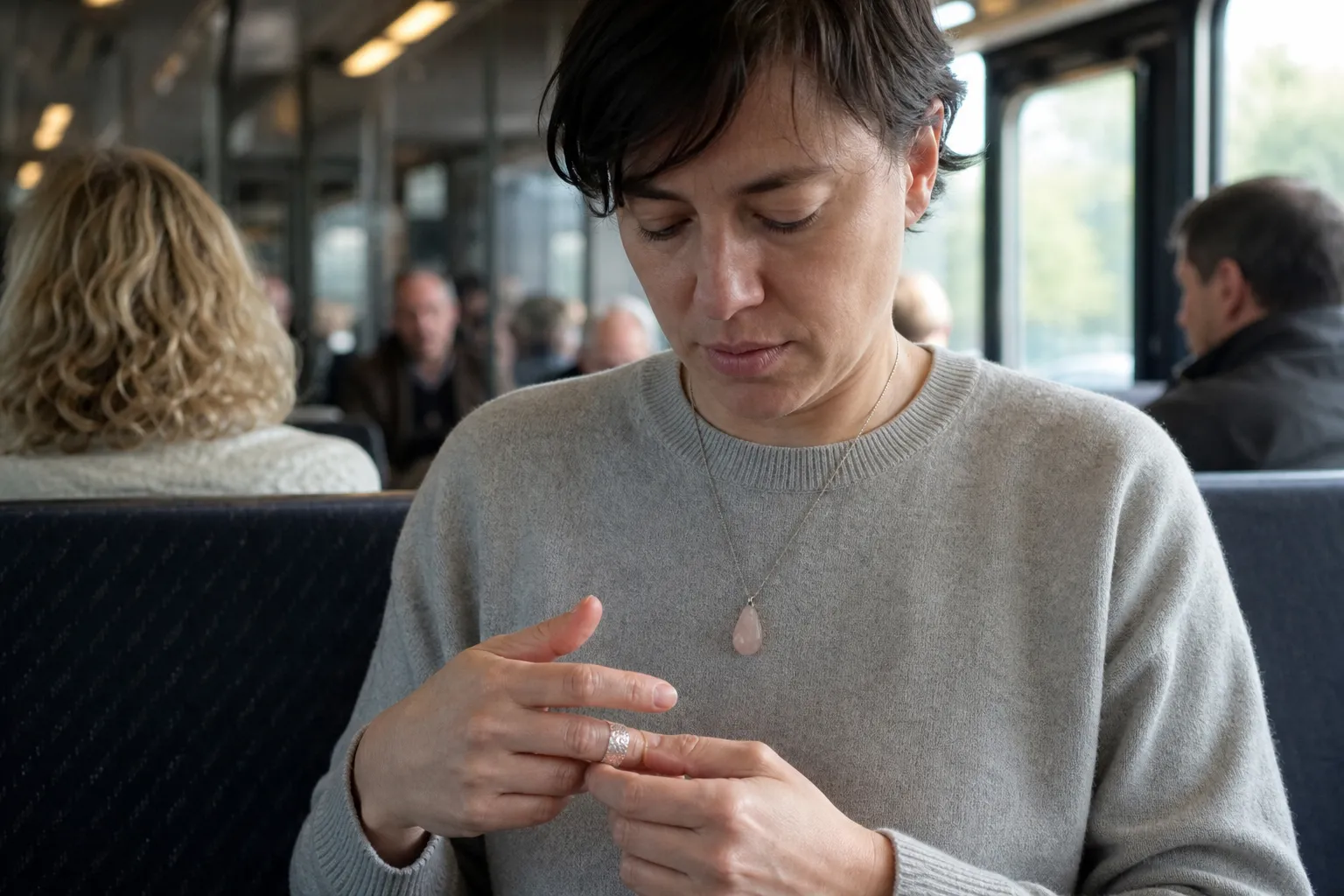
Many sensory tools are useful because they are obvious, sturdy, and easy to handle. But visible tools can also invite questions, teasing, workplace scrutiny, classroom attention, or the familiar discomfort of being treated as childish. A textured ring, slider bead, smooth pendant, spinner band, worry-stone necklace, or tactile bracelet can look like ordinary adornment while still offering covert tactile feedback.
That matters in everyday places: meetings, trains, queues, family dinners, bright shops, waiting rooms, classrooms, or open offices. The wearer can use the piece as a wearable grounding prompt without making the support the center of the room.
This also leaves room for neurodivergent autonomy. Sensory sensitivity can be part of autism for some people, but sensory preferences are not limited to autism and are not the same for every neurodivergent person. One person may want repetitive motion. Another may want pressure. Another may prefer a cool polished surface. Another may find jewelry irritating, noisy, or distracting.
The point is not that neurodivergent inclusive jewelry works for everyone. The point is that adult, aesthetic, non-clinical sensory support can exist without apology.
What discreet tactile jewelry can realistically do
A useful piece gives the body something predictable to return to. That might be:
- a smooth pendant rubbed between the thumb and forefinger;
- a ring edge used as a quiet fidget surface;
- a bracelet bead that slides with little sound;
- a pendant with a shallow groove, ridge, or curve;
- a slightly heavier charm that creates a small point of body awareness.
Occupational therapy language often discusses sensory processing, sensory integration, and sensory modulation as ways people receive, organize, and respond to sensory input. That vocabulary can help explain why tactile cue jewelry appeals to some people. It does not make a necklace or ring the same thing as occupational therapy.
The more grounded question is not “Which jewelry fixes overload?” It is:
Which small, wearable object gives me a touch cue I can use consistently, quietly, and safely in the contexts where I need it?
Design research around fidget objects supports this practical frame. A recent smart fidget toy design paper discussed tactile feedback, ergonomics, visibility, stigma around noticeable fidget devices, and reports of people using everyday objects, including jewelry, as fidget supports. That kind of research does not establish a clinical effect for stealth sensory jewelry. It does, however, reinforce a common-sense design point: hand feel, noise, visibility, and social acceptability affect whether someone will actually use an object.
The details that decide whether it helps
A piece can be beautiful and still fail as sensory support. The useful features are usually physical, not symbolic.
Texture matters.
Some people want a polished surface they can stroke without catching skin. Others need a ridge, carved line, bead edge, hammered surface, or rotating element. Very sharp texture can become irritating with repeated use, especially during stress.
Motion matters.
Spinner rings, sliding beads, rotating pendants, and hinged elements can be satisfying, but they may click, rattle, or draw attention. If the goal is low-stigma sensory support, quiet movement matters as much as appearance.
Placement matters.
A ring is always available to the fingers but may distract during typing. A pendant is discreet but may be hard to reach under layers. A bracelet offers repeated tactile contact but may interfere with desks, sleeves, or wrist sensitivity.
Weight matters.
A slightly heavier pendant can work as a small body-based reminder. Too much weight can strain the neck, swing into objects, or become annoying during movement.
Cleanability matters.
Jewelry handled often collects skin oils, lotion, dust, and residue. Simple surfaces are easier to wipe than intricate settings, rough cavities, porous cords, or clustered charms.
Aesthetic fit matters.
If the piece does not match the wearer’s style, it may stay in a drawer. Stealth is not only about hiding function. It is also about letting the support belong to the wearer’s adult visual language: minimalist, ornate, gothic, polished, soft, bright, romantic, or quietly plain.
Common confusion: calming, dopamine, and “therapy” language
Search results and product pages often use phrases such as calming jewelry, anxiety necklace, ADHD fidget jewelry, dopamine jewelry, sensory therapy jewelry, and grounding jewelry. These terms may help people find what they are looking for, but they can also imply more than the object can support.
A more careful translation looks like this:
“Dopamine regulation” is especially easy to overstate. A bright color, pleasing texture, or playful charm may feel rewarding to the wearer. That is different from saying the object changes dopamine in a biological or clinical sense.
The same caution applies to phrases such as “somatic sensory processing” or “sensory somatic therapy.” Touch-based prompts can be part of a personal body-awareness routine. Jewelry sold online should still be understood as jewelry unless a qualified professional has placed it within a specific care plan.
For this page, the grounded category is simple: discreet tactile jewelry as non-clinical sensory support.
Material and safety limits worth checking
Because sensory jewelry is touched often, material choice is more than decorative. Nickel allergy and contact dermatitis are known concerns with jewelry and repeated skin contact. For someone who rubs, spins, or presses a piece many times a day, even mild irritation can become a reason to stop using it.
Before relying on a piece, check:
- whether the metal contains nickel or an unknown alloy;
- whether plating could wear down with repeated handling;
- whether there are rough seams, exposed edges, cracked coatings, or glue points;
- whether the surface can be cleaned without damage;
- whether the cord, chain, jump rings, clasp, or setting can tolerate repeated movement.
“Hypoallergenic” can be a useful shopping clue, but it is not a universal guarantee. Sensitive skin varies, and finishes change with wear. If a piece causes itching, redness, soreness, or a burning feeling, stop wearing it and reassess the material. Persistent skin symptoms should be discussed with a qualified professional.
Small parts are another boundary. Jewelry with detachable beads, charms, magnets, clasps, or breakable pieces can create choking or breakage concerns, especially around young children. A sensory necklace or bracelet should not be assumed suitable for children, chewing, pulling, sleeping, or heavy repetitive use just because it is marketed as sensory jewelry.
Chewing needs separate caution. A pendant that feels good to hold is not automatically appropriate to chew. Unless a product is specifically designed and tested for oral use, treat it as hand-contact jewelry, not chew jewelry.
A quick test before wearing it into an overload-prone setting
Try the piece in a low-pressure context before depending on it in public. You are not running a formal experiment; you are noticing whether the object actually supports you.
Ask:
-
Can I find the tactile feature without looking?
If you have to search for the usable surface, it may not help when the room is already too much.
-
Is it quiet enough for the setting?
A spinner that feels good at home may be too audible in a meeting, classroom, or waiting room.
-
Does it still feel good after several minutes?
Some textures are satisfying for ten seconds and irritating after repeated use.
-
Does it stay secure?
Loose stones, weak clasps, open jump rings, and fragile charms are poor choices for repetitive handling.
-
Does it preserve choice?
If it draws more attention than you want, it may fail the stealth part even if the tactile part is useful.
-
Is it only one support, not the whole plan?
A wearable fidget surface may help in a moment, but inaccessible environments may still require breaks, lighting changes, ear protection, seating choices, communication plans, or formal accommodations.
That last point matters. Somatic adornment for overload should not be used to make a difficult environment look easier than it is.
Where rose quartz fits
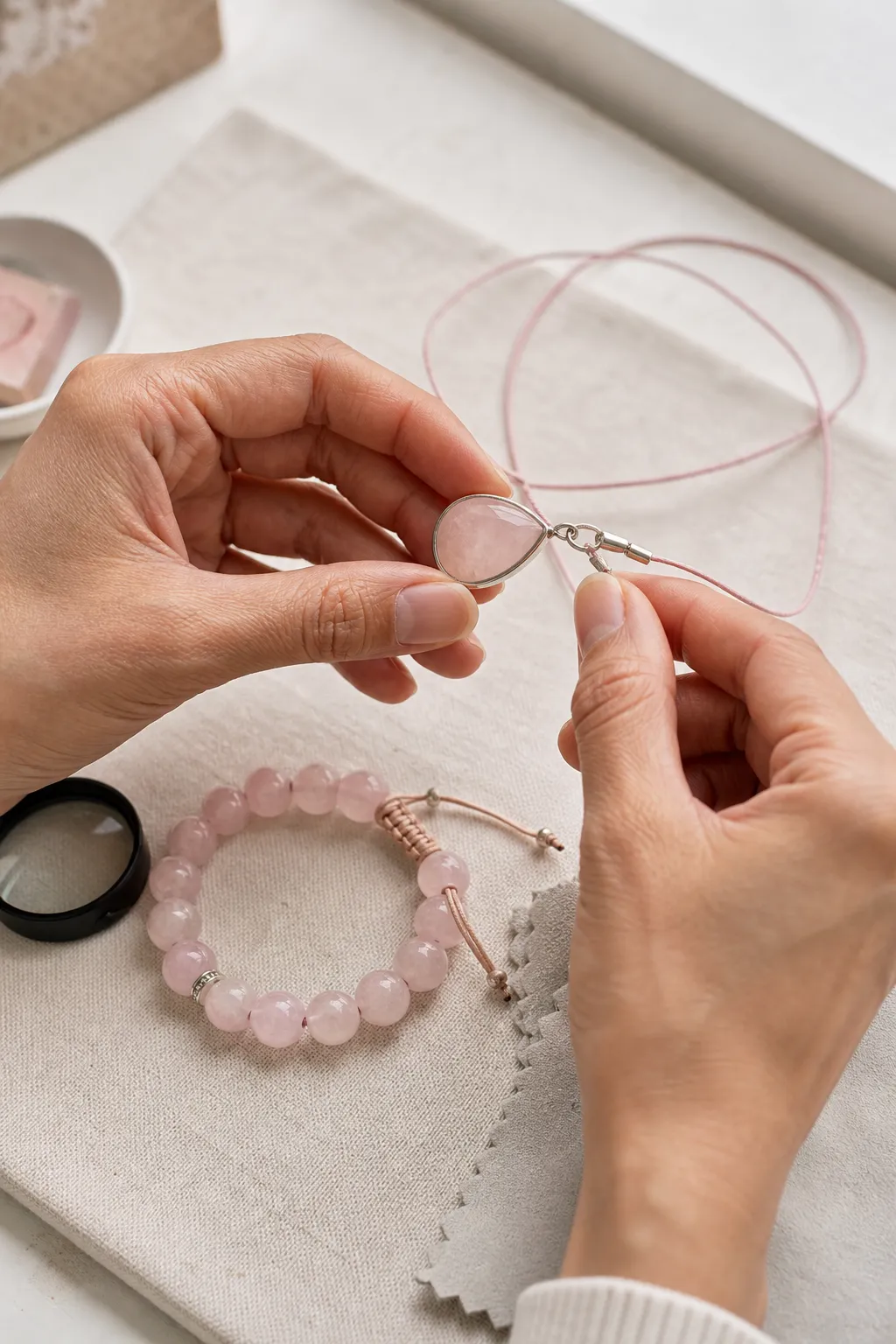
Rose quartz is often chosen for its soft color, smooth polish, and emotional symbolism. Those qualities can make it appealing as sensory processing adornment: a pendant, bead, cabochon ring, or palm-sized charm can offer a cool, smooth surface that still looks socially ordinary as jewelry.
The material should stay in reality. Rose quartz is a mineral, not a clinical tool. Its associations with tenderness or emotional steadiness may be meaningful to the wearer, but symbolism is not evidence of a health outcome.
If rose quartz is used in stealth sensory jewelry, its strongest grounded advantages are visual softness, tactile polish, familiar jewelry form, and private ritual meaning. The same practical checks still apply: settings, cords, clasps, bead holes, coatings, and metal components matter. A stone can be smooth while the metal holding it is irritating. A pendant can be beautiful while the chain is noisy or fragile.
The most grounded answer
Stealth sensory jewelry is best understood as a preference-based, non-clinical tool: a discreet object that can give some people a repeatable tactile cue during overload-prone moments. It may be especially useful for readers who already know that touch, fidgeting, pressure, or hand movement helps them stay oriented, but who want an adult and aesthetically acceptable option.
Its limits are just as clear. It does not establish sensory regulation, replace accommodations, guarantee a specific outcome, or support dopamine claims. It also is not automatically suitable for sensitive skin, chewing, children, or heavy repetitive use.
The strongest version is modest: choose a piece that feels good to touch, makes little noise, stays secure, suits your style, avoids known skin irritants, and does not require you to disclose more than you want to disclose. In that narrow space, somatic adornment can be both beautiful and useful—not because it promises transformation, but because it gives the body a small, private place to return to.