The Tactile Grounding Trick to Disrupt Panic in Seconds
A rose quartz spinner ring can work as a private tactile cue when panic starts to rise: find the ring with your thumb, turn it slowly, count a few rotations, lengthen your exhale, and bring your attention back to the ring’s texture, temperature, edge, and movement.
The “in seconds” part means you can start the interruption quickly. It does not mean the ring can make panic disappear on command.
Used honestly, this is a low-risk self-soothing ritual—not medical care, not proof that rose quartz changes anxiety, and not a replacement for support when symptoms are severe or concerning. Its modest value is practical: your hand has something concrete to do, your attention has something specific to follow, and your body gets a small cue to pause before the spiral takes over.
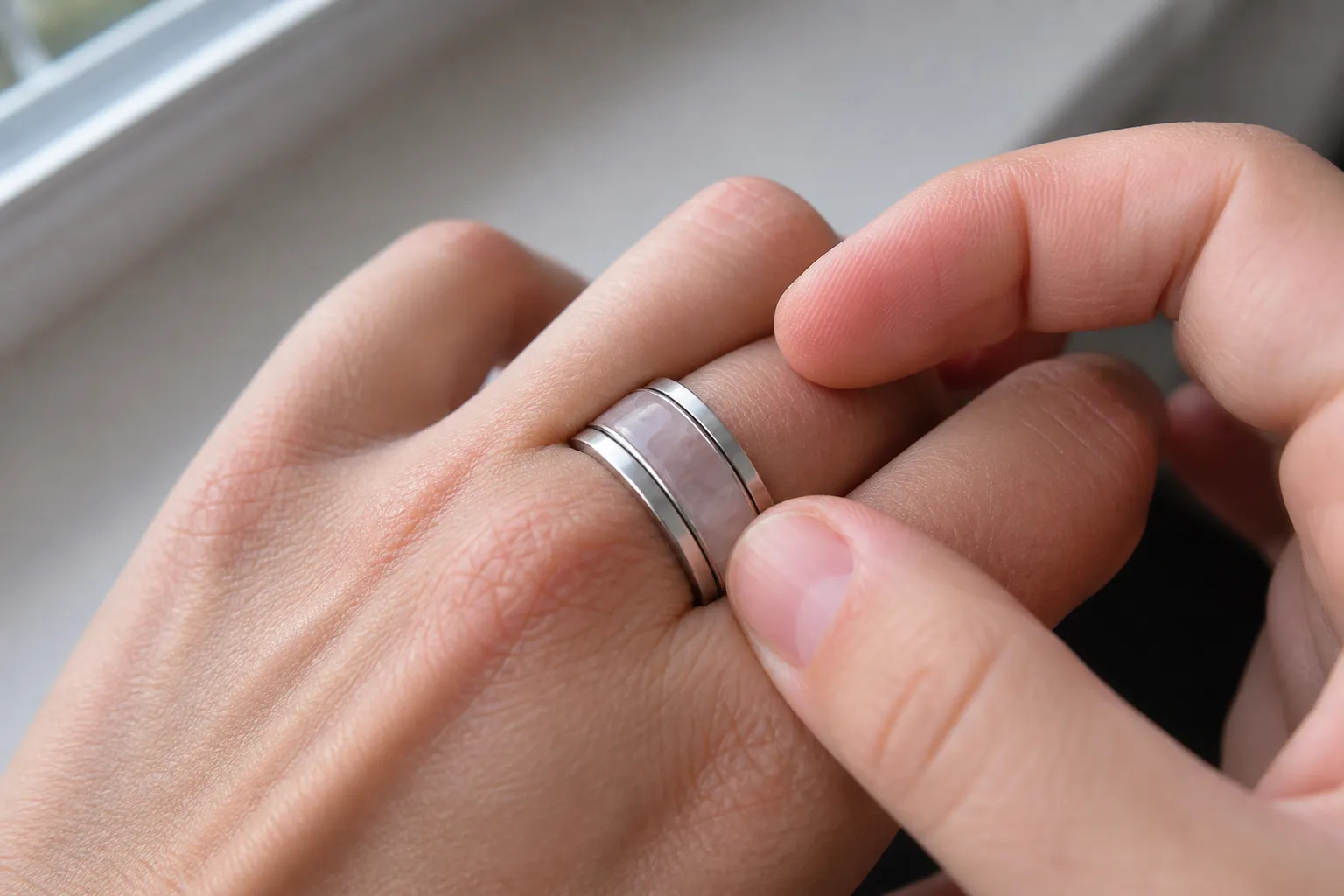
The quick ring ritual: touch, turn, exhale, orient
When panic-like sensations begin, deep analysis is not always the most useful first move. A narrow physical task can be easier to follow.
A spinner ring suits that moment because it is already on your hand, does not require an app or object from a bag, and can be used without drawing attention.
-
1. Find the ring with your thumb.
Notice where the rose quartz or metal meets your skin. Is it cool, warm, smooth, raised, flat, or slightly edged?
-
2. Turn the band once, slowly.
The goal is not speed. The turning motion is simply a steady tactile cue.
-
3. Count three rotations.
Count silently: one, two, three. If counting feels like too much, use simpler words: “touching, turning, stopping.”
-
4. Let the exhale be longer than the inhale.
Breathe in normally. As the ring turns, breathe out a little more slowly. Do not force calm; just give the breath a rhythm.
-
5. Name three immediate details.
One detail from the ring, one thing you can see, and one sound nearby. For example: “cool stone, blue wall, traffic.”
-
6. Choose the next safe step.
Sit down, step away from a crowd, text someone, drink water, or follow a plan you already have with a qualified professional.
That is tactile grounding with a ring at its simplest: touch replaces argument. Instead of debating every sensation, you give attention a small, repeatable place to land.
Why a rose quartz spinner ring can feel different from a generic fidget object
A spinner ring is not magic, but it has useful design advantages. It is wearable, quiet, discreet, and available at the exact moment when reaching for something else might feel like too much. Unlike a larger fidget object, it does not announce itself in a meeting, on public transport, in a classroom, or at a dinner table.
The rose quartz part adds a personal layer. In cultural and market language, rose quartz is often associated with softness, affection, tenderness, and emotional comfort. Those associations may make the ring feel more meaningful to use. The pale color, cool surface, and contrast between stone and metal can also make the object more pleasant to touch repeatedly.
That does not turn rose quartz into health evidence. In this ritual, the ring’s meaning works more like a personal cue: a reminder to come back gently, soften the next breath, or speak to yourself less harshly. The practical action is still touch, attention, breathing, and orientation—not gemstone power.
A rose quartz spinner ring meaning can be intimate and useful without being framed as a health-outcome claim. The ring becomes a portable tactile grounding anchor because you have chosen it as one, not because the stone guarantees a result.
What the ring is doing: a small attention task
The most cautious explanation is simple: spinning the ring gives attention a concrete sensory job.
You feel pressure, texture, temperature, movement, and contact against the skin. You count rotations. You coordinate the motion with a slower exhale. Those small actions may reduce, for a moment, the space available for spiraling thoughts.
That is different from saying an ordinary ring has been shown to change panic symptoms. The available evidence does not directly study rose quartz spinner rings for panic episodes. Research on fidget objects and tangible interaction is adjacent: it can show that handling a rotating object involves sensorimotor activity, and that designed objects can be paired with breathing exercises. But those studies are not the same as wearing a jewelry ring in everyday life.
It is also easy to overuse terms like cognitive load or neuroplasticity effect. A small counting task can occupy attention, but that does not make the ritual a formal brain-training method. If the sequence becomes too elaborate—counting too many rotations, checking whether it is “working,” monitoring every body sensation—it can become one more thing to worry about.
Keep it small:
- one ring;
- one tactile detail;
- one slow exhale;
- one nearby object;
- one next step.
The ring should simplify the moment, not become a test you can fail.
When this trick is most likely to help
This kind of discreet grounding ritual makes the most sense near the beginning of a panic spiral, when you first notice the shift: racing thoughts, sudden fear, heat, restlessness, shakiness, or the urge to escape.
It may also help after the peak, when you are trying to reorient and feel less swept away.
It is less realistic to wait until you are fully overwhelmed and expect the ring to reverse the whole experience. A tactile cue works best as a practiced interruption, not an emergency guarantee.
If you like the ring, practice during ordinary moments: while waiting for a kettle, sitting in a parked car, or standing in a quiet line. That way, the motion is familiar before you need it.
A few conditions make the ritual more workable:
- The ring should be comfortable. If it pinches, scratches, or catches on clothing, it may add irritation.
- The spin should be quiet. A loud or gritty movement can make public use feel self-conscious.
- The motion should be slow enough to follow. Fast spinning can become stimulation rather than grounding.
- The practice should stay flexible. Some days, counting helps. Other days, simply feeling the ring’s temperature is enough.
- The ring should not replace a support plan. It is a cue, not a complete system.
A rose gold spinner ring, a sterling silver band with rose quartz, or another smooth ring can serve the same basic role if it gives you a clear tactile focus. The material matters most when it affects comfort, texture, temperature, durability, and personal resonance.
Common confusion: “disrupt” does not mean “stop”
The phrase “disrupt panic” can sound stronger than it should. Here, disrupt means “interrupt the escalation pattern for a moment.”
It means your hand finds the ring before your thoughts run five steps ahead. It means your exhale gets a cue. It means attention has something immediate to touch.
It does not mean:
- the ring ends panic in seconds;
- rose quartz has been shown to change panic symptoms;
- a spinner ring can replace professional support;
- counting rotations proves a neurological change;
- grounding is always the right response to physical symptoms.
Public health sources describe panic attacks as intense episodes that can include frightening physical sensations. They also note that panic-like symptoms can overlap with medical concerns. That matters because not every racing heart, chest sensation, breathing difficulty, faint feeling, or sudden severe symptom should be interpreted as “just panic.”
If symptoms are new, severe, recurring, medically alarming, or different from what you have experienced before, do not rely on a ring as the next step. Seek appropriate medical or professional help, especially for chest pain, trouble breathing, faintness, or fear of a medical emergency.
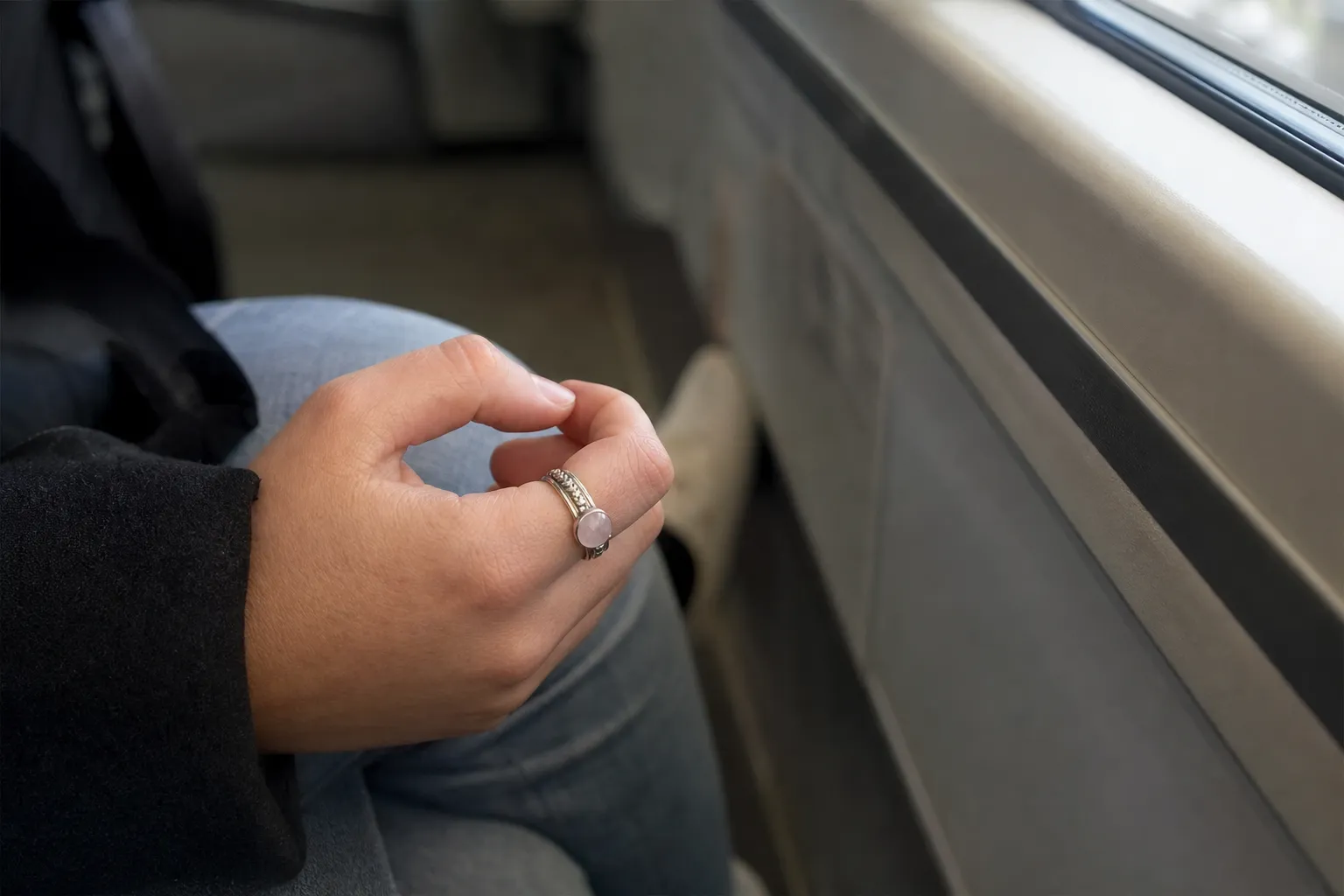
A discreet version for public places
The best grounding rituals are often the least visible. If you are in a meeting, on a train, in a shop, or with people who do not need to know what is happening, use a reduced version:
- Press thumb to ring.
- Notice: cool, smooth, edge.
- Turn once.
- Exhale slowly.
- Look at one stable object nearby.
- Place both feet on the ground if possible.
That is enough. You do not need to close your eyes, perform a visible ritual, or explain the ring to anyone. Privacy is part of why a spinner ring sensory cue can be appealing: it lets you respond early without turning the moment into a public event.
At home, you can make the same ritual more intentional. Sit down, rest the ring hand on your lap, spin the band three times, and name the details out loud if that feels natural. The object stays the same; the setting changes how visible or ceremonial the practice feels.
Where rose quartz symbolism fits
For many people, rose quartz is not chosen only because it is pink. It may represent tenderness, self-kindness, remembrance, grief, affection, or a softer way of returning to the body. That symbolic layer can matter in a ritual.
The safe way to hold that meaning is personal rather than absolute. You might use the ring as a reminder: “come back gently,” “soften the next breath,” or “touch something real.” These are symbolic prompts, not clinical claims.
This also keeps the ritual from becoming a burden. If the ring does not help on a particular day, that does not mean you failed, used it incorrectly, or lacked belief. It may simply mean the moment needed more support than a tactile cue could provide.
The honest boundary
A rose quartz spinner ring can be a beautiful, portable, discreet grounding object. It can help structure a small action: touch, turn, count, exhale, orient. For some people, that tiny sequence may create enough pause to choose the next safe step.
The strongest responsible claim is narrow: a familiar tactile cue may help redirect attention for a moment, especially when paired with slow breathing and orientation to the room.
Use the ring as a gentle interrupting tool, not as proof that you should handle everything alone. Its best role is modest and practical: a cool surface under the thumb, a turning band, a counted breath, and a private reminder that you can return to the present one sensation at a time.