Rose quartz, attention, and digital boundaries
Frequency Hygiene: Rose Quartz for Biofield Protection & Digital Detox
If you searched for rose quartz and Biofield Energy Protection, you may not be looking for a technical lecture on radiofrequency limits. More likely, you are trying to name a felt problem: too many screens, too much incoming information, a sense of being “open” all day, and a wish for a softer boundary between your attention and the digital world.
Rose quartz can belong in that search when it is used as a tactile ritual object, a visual pause point, or a personal reminder to step away from devices. Its strongest role here is symbolic, sensory, and behavioral. It should not be framed as an EMF shield, a medical protective tool, or a measurable frequency regulator.
broader context
Rose quartz context note
This narrower page makes more sense after the broader rose quartz context page.
The three conversations people often blend together
Frequency hygiene with rose quartz gets confusing because three different conversations are often folded into one phrase.
Technical EMF and RF exposure
This is the world of electromagnetic fields, radiofrequency exposure, device standards, exposure limits, and public-health guidance. In that layer, terms such as shielding, exposure reduction, and safety limits have technical meanings. A crystal placed near a router, laptop, or phone should not be described as changing the device’s emissions or managing RF exposure.
Digital fatigue
This is less about invisible fields and more about the lived experience of screens: attention fragmentation, constant checking, alert overload, video-call depletion, late-night scrolling, and the feeling that the day never fully switches off. Digital fatigue is a useful everyday phrase, but it should not automatically become a technical exposure claim. For many readers, the practical question is not “Can a stone change the physics of my device?” but “Can I build a better pause before the next tap?”
Ritual and energetic self-regulation
This is where phrases such as Biofield Energy Protection, Vibrational Hygiene, Energy Clearing, digital detox, and analog reset ritual make the most sense. They describe how some people make meaning around attention, boundaries, and emotional atmosphere. In this layer, rose quartz may serve as a contemplative object: something held in the hand, placed near a journal, kept on a bedside table, or used as a cue to breathe before opening an app.
The mistake is not using spiritual language. The mistake is asking spiritual language to do technical work it cannot support.
What Biofield Energy Protection can mean here
In complementary and integrative health language, “biofield” and “energy medicine” are used to describe approaches that work with subtle-energy concepts. That does not make every claim under those words established as a measurable effect, and it does not show that rose quartz has protective power.
For this page, the most useful meaning of Biofield Energy Protection is a personal boundary practice: choosing what enters your attention, how quickly you respond, and what rituals help you feel less scattered.
Rose quartz has a natural symbolic fit because it is commonly associated with softness, emotional gentleness, care, and inward attention. Mineralogically, it is a real variety of quartz with a pink color; that physical identity matters because it keeps the conversation anchored in an actual object. But mineral identity is not the same as a mechanism for biofield shielding. The fact that rose quartz is crystalline does not, by itself, support claims that it regulates personal frequency or changes device exposure.
A grounded biofield practice with rose quartz might sound like this
- “I use this stone as a pause point before I check my phone.”
- “When I hold it, I remember to breathe and decide whether I actually want to keep scrolling.”
- “It marks a device-free corner of my room.”
- “It helps me make energy clearing feel concrete, while I understand the effect as symbolic and personal.”
That language keeps the practice meaningful without turning it into a scientific claim. It also respects the reason people use words like energetic overload: the experience may feel real even when the explanation should stay modest.
Rose quartz is a tactile reminder, not a router shield
“Crystals are not router shields” is blunt, but useful.
A router, phone, tablet, laptop, or smart device belongs to a technical environment. If someone wants to understand RF exposure, the relevant materials are safety standards, manufacturer information, public-health guidance, and recognized engineering concepts. A rose quartz palm stone beside the router may be visually calming, but it should not be presented as changing the router’s emissions.
This distinction matters because EMF Protection is an overloaded phrase. In a wellness context, people may use it to mean, “I want to feel less drained around devices.” In a technical context, it suggests measurable shielding or exposure management. Those are not the same claim.
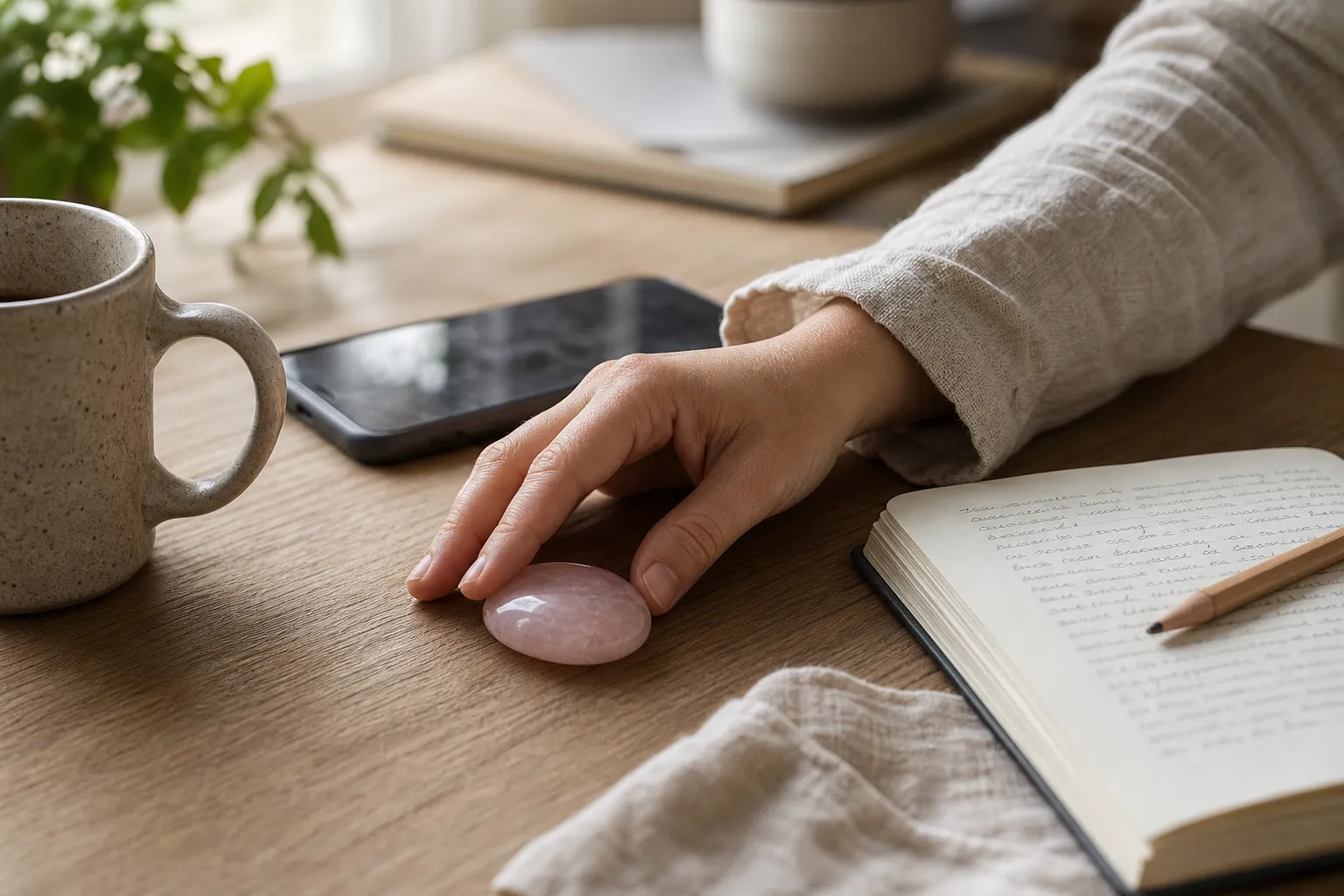
A better phrase for rose quartz is tactile reminder for screen breaks. The stone gives your hand something non-digital to touch. It creates friction before automatic use. It can sit on top of a closed journal, beside a charger, or at the edge of a desk as a quiet marker: pause first, then choose.
That is different from calling rose quartz a Frequency Regulator. If the phrase is used at all, it works best as symbolic language: regulating the rhythm of your own attention, not electromagnetic fields or bodily frequencies in a measurable way. The “frequency” in frequency hygiene can mean the cadence of your habits: how often you check, how quickly you react, how long you remain online after you meant to stop.
The useful question becomes: what behavior does the object help you remember?
A practical rose quartz digital detox framework
A rose quartz digital detox does not need to be dramatic. It works best as a small, repeatable ritual that makes device boundaries visible. The stone is not the active technical agent; the practice is the boundary.
1. Choose one digital threshold
Start with one moment that tends to pull you into automatic use. Common thresholds include:
- before opening social apps;
- after closing a work call;
- the first ten minutes after waking;
- the last hour before sleep;
- the transition from work time to personal time;
- moments when you reach for your phone without a clear reason.
Place rose quartz at that threshold. If the problem is morning checking, keep it near your phone but not under the phone. If the issue is remote-work spillover, put it beside your keyboard and touch it only when ending the work session. The point is not to charge the device environment. The point is to interrupt the loop.
2. Use a short analog reset ritual
An analog reset should be simple enough to repeat when tired:
- Put the device face down.
- Hold the rose quartz in one hand.
- Take three slow breaths.
- Name the next intentional action: continue, stop, reply later, or leave the room.
- If stopping, move the device out of reach and do one non-screen action.
The non-screen action can be opening a window, stretching, washing a cup, writing one sentence, or stepping outside. If you prefer the language of Energy Clearing, you might imagine the mental residue of notifications leaving with the exhale. If you prefer plain language, you might call it an attention reset. Both versions can coexist as long as the claim stays with attention, habit, and atmosphere.
3. Keep a conscious technology use journal
Conscious technology use journaling moves the practice from vague discomfort to observable pattern. Keep it brief; a full diary is not required.
Try three prompts:
- “What did I reach for automatically today?”
- “Which screen moment left me feeling most scattered?”
- “Where did the rose quartz pause help me choose more deliberately?”
The journal is not proof that rose quartz produced a measurable effect. It is a way to notice whether the ritual is helping you build a clearer relationship with your devices. If it becomes another task that creates pressure, simplify it to one line.
4. Build zero-device zones without fear language
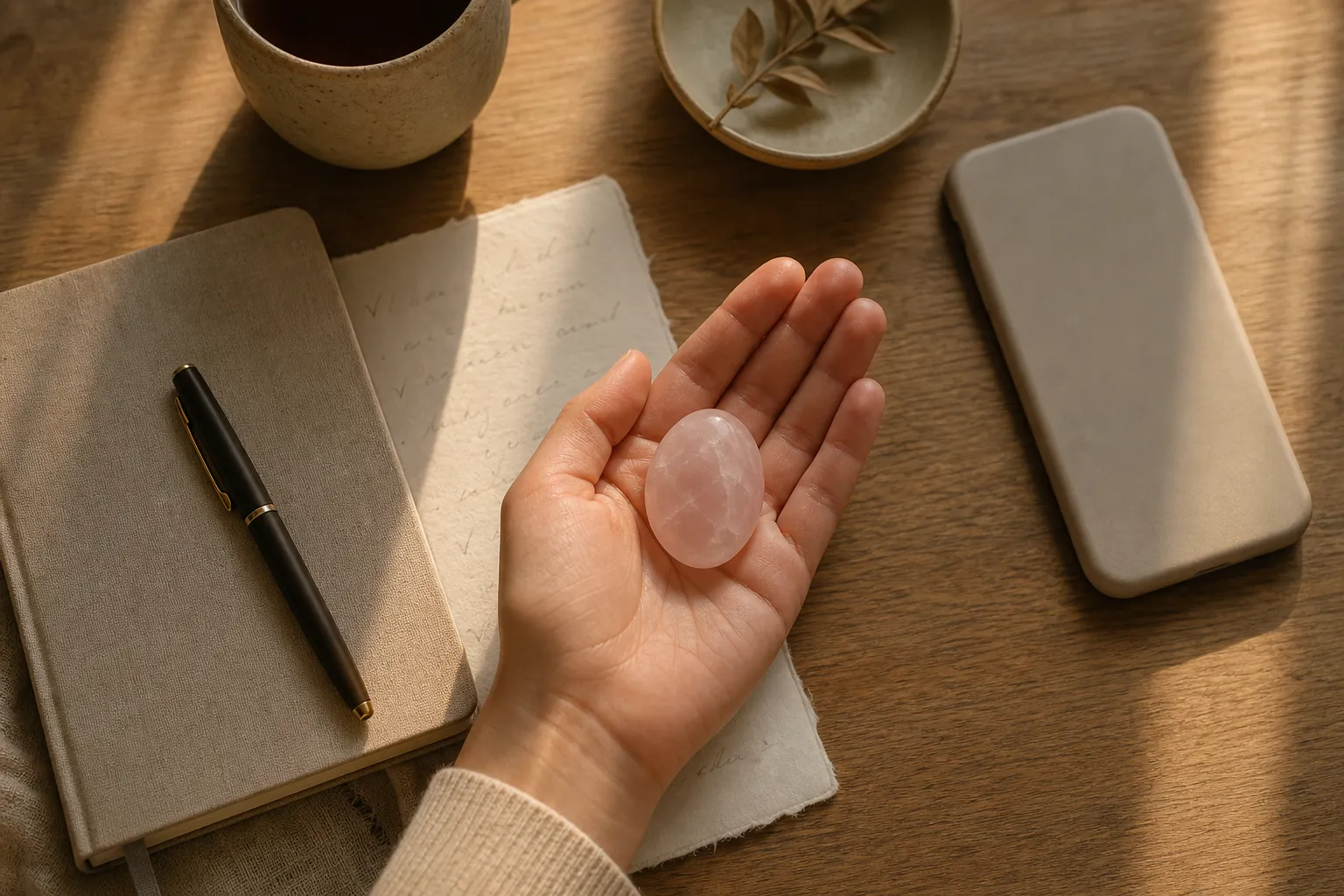
A zero-device zone is an architectural choice, not a crystal claim. It may mean keeping the phone outside the bedroom, charging devices across the room, or placing a book and rose quartz where the phone used to sit. Rose quartz can mark the intention: this part of the room is for quiet, not for feeds.
Some readers search for an “EMF recovery sleep grid” or similar language. A more grounded version is practical: fewer devices by the bed, fewer alerts at night, less late checking, and a calmer visual field. If you arrange rose quartz, selenite plates, or other stones around a bedside area, treat the arrangement as symbolic design and ritual atmosphere, not as a verified protective grid.
Where Vibrational Hygiene becomes useful
Vibrational Hygiene is most useful when it describes the quality of attention you allow into your day. It becomes less useful when it tries to sound like a technical measurement system.
A practical routine might include
- clearing the desk after intense screen work;
- placing rose quartz where the hand naturally rests during breaks;
- taking a short observation walk without headphones;
- using sound, breath, or silence to mark the end of a digital task;
- keeping a written list of firm digital boundaries;
- turning off nonessential alerts during deep work;
- creating a closing ritual after online conflict or emotionally charged messages.
This is where ideas such as acoustic clearing, tactile transition, logging off mentally, and conscious analog observation walks can be reframed into grounded behavior. If you ring a bell, play a soft tone, or sit with rose quartz after a long video call, the useful part is the transition: your body and attention receive a signal that the call is over. The crystal is part of the cue system, not a device-cleaning instrument.
The same applies to the “tensegrity biofield framework,” a phrase some readers use to imagine body, posture, attention, and environment as an interconnected field. That can be a meaningful metaphor for remote workers who feel collapsed into the screen all day. A grounded version would focus on posture changes, breath, tactile objects, room layout, and analog pauses. It should not be inflated into a claim that rose quartz mechanically reorganizes the body’s energy structure.
Misread patterns that lead to overclaiming
Most overclaims in this topic follow predictable patterns. Spotting them helps you keep the ritual without accepting unsupported certainty.
“Rose quartz is EMF Protection.”
Why it is tempting: The phrase feels reassuring in a device-heavy home.
A grounded reframe: “Rose quartz can remind me to reduce unnecessary screen time and set device boundaries.”
“It is a Frequency Regulator.”
Why it is tempting: It makes emotional overwhelm sound measurable and controllable.
A grounded reframe: “It helps me regulate the frequency of checking, scrolling, and reacting.”
“A crystal grid creates an EMF recovery zone.”
Why it is tempting: It turns a bedroom ritual into protective architecture.
A grounded reframe: “A device-free sleep area and calming objects can support a quieter routine.”
“Digital fatigue is the same as RF exposure.”
Why it is tempting: It gives a concrete cause to a diffuse experience.
A grounded reframe: “Digital fatigue can describe screen-related overload without making a technical exposure claim.”
“Mineral structure proves biofield shielding.”
Why it is tempting: Crystals look ordered and stable.
A grounded reframe: “Mineral facts identify the object; they do not establish spiritual or technical effects.”
This is not a rejection of ritual. It is a way to keep ritual honest. The more precise the language, the more durable the practice becomes.
A gentle frequency hygiene protocol with rose quartz
Use this as a starting structure, not as a promise of outcome.
Morning: before the first scroll
Place rose quartz on top of a notebook or beside your phone. Before touching the screen, hold the stone and ask: “What do I need before I receive input?” Write one word if helpful: water, quiet, movement, light, food, stillness, reply later. This turns the first digital act into a choice.
Work block: after alert overload
When notifications or messages start to fragment your attention, set the device down and touch the rose quartz for one minute. Look away from the screen. Let your eyes rest on something with texture: fabric, wood, a plant, paper, the stone itself. Then choose one next task.
Video-call transition
After a call, close the laptop if possible. Hold the stone, or simply rest both hands on the desk. Take a breath and name what stays with work and what comes with you into the next part of the day. The value is in separating remote work from personal time.
Evening: zero-device boundary
Set a physical place where the phone stops traveling with you. Put rose quartz in the place where the phone used to land, or beside a book, lamp, or journal. This creates a visible swap: screen habit out, analog cue in.
Weekly: energy clearing routine
Once a week, clean the surface where your devices gather. Wipe the desk, coil cables, remove old notes, and place the rose quartz back intentionally. If your language is Energy Clearing, this can feel like clearing digital smog. In plain terms, it is environmental resetting. Both are valid as personal meaning when the claim stays with attention and atmosphere rather than physics.
How to judge a claim before you adopt it
A simple decision frame helps when a phrase sounds appealing but uncertain.
First ask: Is this claim about physics, health outcomes, or personal ritual?
If it is about physics—RF exposure, router emissions, technical shielding, radiation language—it needs technical evidence. Rose quartz should not be treated as evidence for that.
If it is about health outcomes, keep the language careful and avoid promises. A calming ritual may be personally meaningful, but that is not the same as a verified protective intervention.
If it is about personal ritual—pausing, breathing, journaling, setting boundaries, creating a zero-device zone, softening the emotional tone of a room—rose quartz can be used thoughtfully. The claim is modest: the object helps you remember the practice.
Second ask: Would the practice still make sense if the stone were described as symbolic rather than powerful?
If yes, it is probably on firmer ground. A rose quartz digital detox can still be beautiful, tactile, and meaningful without claiming that the stone performs hidden technical work.
Third ask: Does the wording create fear?
Be cautious with language that makes ordinary device use sound universally dangerous or implies that only a special object can keep you safe. Frequency hygiene should reduce pressure, not add another layer of worry.
The most grounded role for rose quartz
Rose quartz belongs in this topic as an analog anchor. It gives form to an intention that otherwise remains abstract: check less automatically, return to the body more often, create cleaner thresholds between work and rest, and let the digital world stop at the edge of a chosen boundary.
For Biofield Energy Protection, that means treating the “field” as a lived boundary around attention, mood, and receptivity—not as a measurable shield produced by the stone. For digital fatigue, it means working with habits and environments rather than blaming every discomfort on EMF. For Vibrational Hygiene, it means noticing the tone of what you consume, the pace at which you respond, and the rituals that help you come back to yourself.
Rose quartz does not need to be a router shield to be useful. It can be a small, quiet object that asks you to pause before the next signal reaches you.