Don't Be Fooled: The 3-Second Single Light Test for Authentic Star Quartz
By Luna Harper
Don't Be Fooled: The 3-Second Single Light Test for Authentic Star Quartz
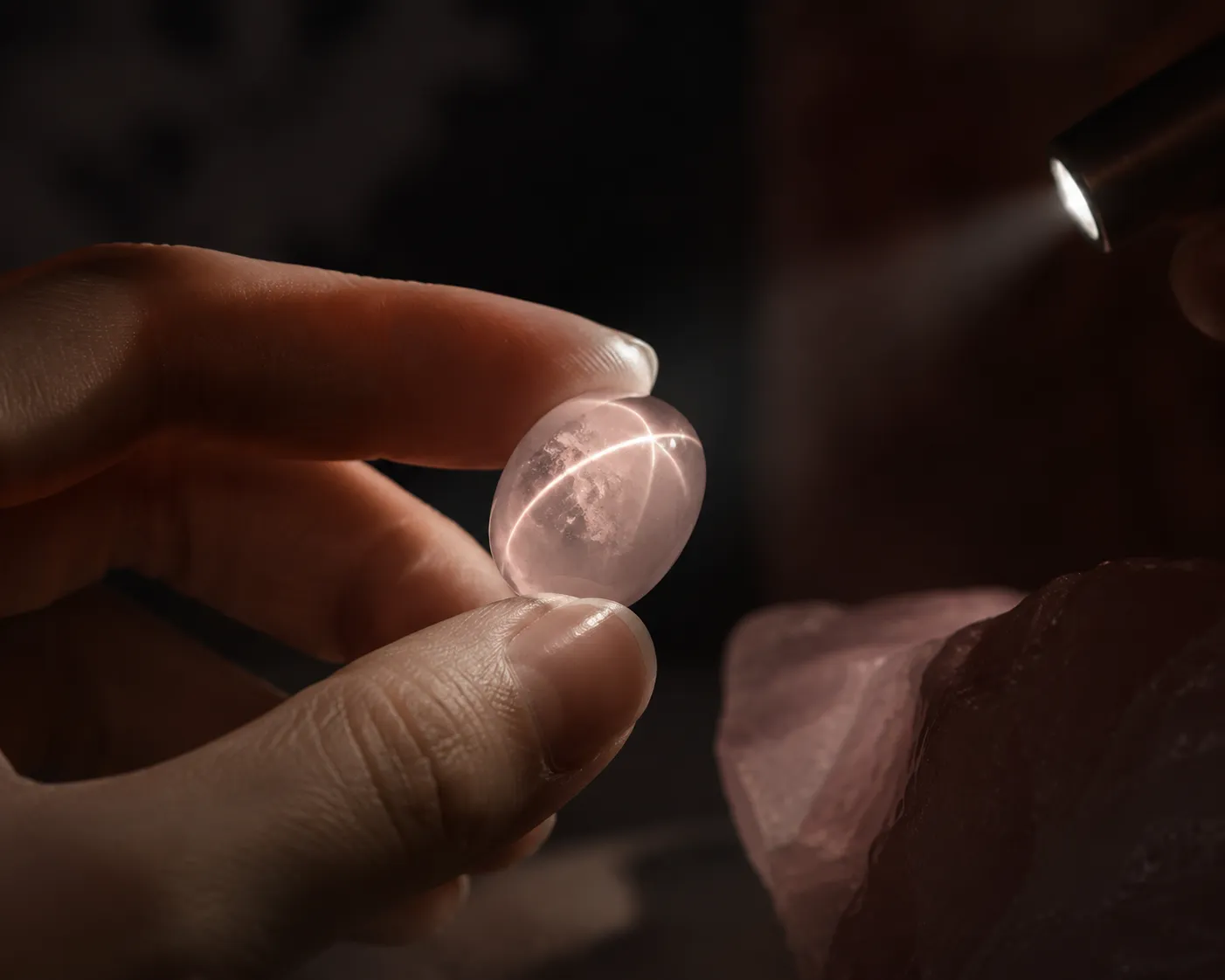
If a stone is being sold as star quartz, the safest quick screen is simple: use one small direct light source, reduce soft room light, and move either the light or the stone slightly. A plausible star quartz effect should show a star or chatoyant band that sharpens and shifts as the viewing angle changes.
For Star Quartz Authenticity, that movement matters more than a seller photo, a dramatic display lamp, or a broad “real crystal” claim.
This is not a full gemological authentication. It cannot confirm natural origin, treatment history, value, mining source, or every part of quartz identity. But in a shop, at home, or during a return window, it can quickly tell you whether the stone behaves like a star-effect material or only shows a fixed mark, surface shine, or lighting trick.
The 3-second single light test
Use this as a non-destructive screening step, not as a certificate.
-
Use one small direct light source.
A phone flashlight, penlight, or focused desk light works better than soft window light or a broad ceiling fixture. The key is one concentrated point of light. -
Lower the competing light.
Diffuse lighting can wash out the star. Turn away from large windows, cloudy daylight, bright ceiling lights, and large LED panels if possible. -
Move the light or stone slightly.
Hold the stone steady and sweep the light from side to side, or rotate the stone slowly under the light. Do not judge it from one frozen angle. -
Watch the star or band, not just surface shine.
A plausible star quartz response should appear as a star-like crossing or a chatoyant band that moves across the curved surface as the light, observer, or stone changes position. -
Look for depth and behavior.
The effect should behave like light interacting with the stone, not like a flat sticker, painted line, etched symbol, or scratch locked in place.
Once the light is ready, the test is quick: point, move, observe. If the star sharpens under one direct light and shifts with movement, the result is consistent with a star-effect or chatoyant optical response. If the “star” stays fixed like a drawn pattern, appears only in a seller’s staged image, or does not respond to light movement, treat that as a red flag.
What you should actually see
“Star quartz” is a marketplace description built around a visible star effect. The important feature is not that the stone looks dramatic in a photo. It is that light behaves in a specific way.
Asterism is the star-like optical phenomenon seen in some gem materials. It is related to chatoyancy, the narrow moving band of light often called a cat’s-eye effect. These effects are commonly associated with oriented needle-like or fibrous inclusions, channels, or internal structures that scatter and reflect light. One band may look like a bright line. Multiple crossing bands may form a star.
For a shopper, the practical signs are:
- a band or star appears best under a direct point of light;
- the line shifts when the light or stone moves;
- soft diffuse lighting may weaken or hide the effect;
- a fixed star shape is more suspicious than a moving optical response.
The star does not have to look perfect. Quartz star effects can be weak, broad, uneven, or complicated by inclusions, cut, transparency, and orientation. A soft or imperfect star is not automatically a fake star quartz sign. The question is whether the effect behaves like moving light, not whether it looks like a flawless graphic.
Why one direct light matters
Many real-vs-fake crystal checks fail because they judge the wrong feature under the wrong light.
Asterism and chatoyancy are easiest to see with a small direct light. Broad light spreads illumination across the surface and can blur the contrast that makes the star visible. Diffuse ceiling light, cloudy daylight, and large soft lamps may make a stone look evenly lit instead of showing a clear star or band.
Two common mistakes follow from that:
-
Calling a stone fake because no star appears in soft room light.
That is too quick. The correct viewing condition is one small direct light. -
Trusting a seller photo because the star looks bright in a staged image.
A photo captures one controlled angle. The better question is whether the star shifts when the light or stone moves.
In a store, ask to see the stone under one small direct light. If the seller only shows it under a display case, a ring of LEDs, or flattering broad light, that does not prove anything by itself. It simply leaves the most important observation unanswered.
At home, repeat the test in a dimmer setting with one focused light. Avoid using multiple flashlights at once. Several light sources can create confusing reflections that look like extra rays, false stars, or scattered highlights.
Red flags during the light test
These signs do not prove a stone is fake by themselves, but they are good reasons to slow down, ask more questions, or seek a qualified opinion.
The star stays fixed like a surface mark
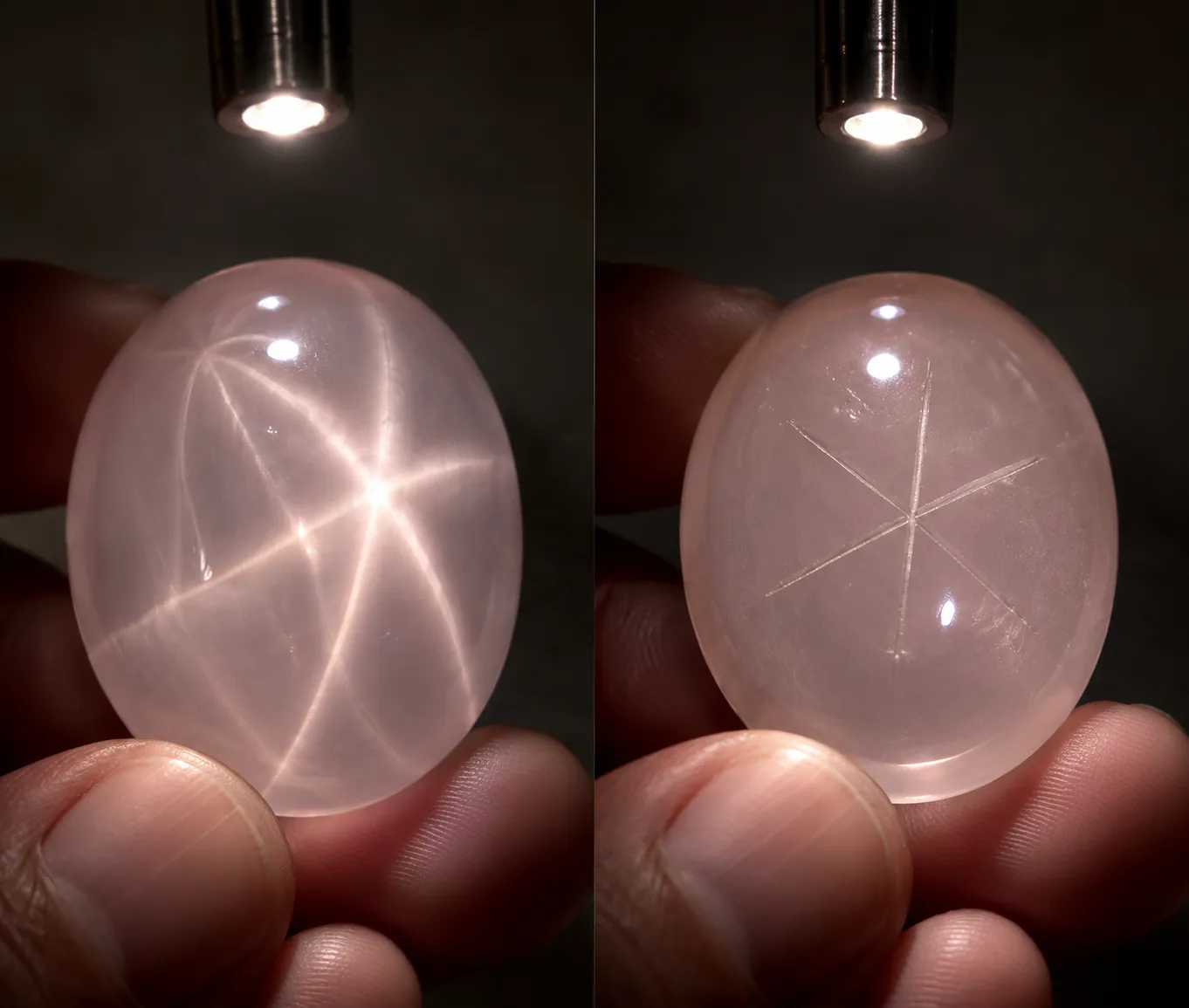
If the star remains in exactly the same place no matter how the light moves, it may not be a true star-effect response. A real chatoyant band or star-like effect should shift with the viewing setup. A fixed mark can suggest a surface feature, engraving, polish line, printed effect, or another non-asterism source.
The rays look too graphic or too regular
A star that looks like a printed logo, sharp decal, or flat symbol deserves caution. Natural optical effects can be sharp, but they should still behave like light interacting with the stone. If the “star” looks designed rather than responsive, do not treat it as proof of authenticity.
The effect appears only under one seller setup
A real optical effect may vary with lighting, but it should not require a mysterious or highly staged setup to appear at all. If a listing photo shows a dramatic star and the stone shows nothing under a small direct light, that gap needs an explanation.
Surface scratches seem to create the rays
A polished cabochon can have normal wear or polish marks. But coarse, deliberate-looking parallel surface lines are a warning sign when they line up with the alleged star. A home viewer cannot always separate wear, polishing, and treatment, but visible surface-made rays should lower confidence.
The seller relies on labels instead of behavior
Words like “real,” “natural,” “rare,” “certified,” or “not glass” do not replace observation. For star quartz, the first useful question is narrower: does the star or band move under one direct light?
Common fake-crystal tests that do not answer this question
People searching for real vs fake star quartz often arrive with a checklist: bubbles, cold touch, weight, price, scratch resistance, flame, UV glow, or whether the stone looks “too perfect.” Some of these clues may raise questions in other contexts, but they are not the center of star quartz screening.
Air bubbles
Air bubbles can be a warning sign in some glass imitations, but bubble-spotting is not enough to authenticate star quartz. Natural stones can have inclusions, fractures, veils, and other internal features that a non-specialist may misread. A lack of bubbles does not confirm quartz, and visible internal features do not confirm authenticity.
Inclusions
Inclusions matter because star effects are often related to internal structures. But “it has inclusions” is not a final answer. Some natural quartz may show many internal features; some imitations or altered materials may also look irregular. For this question, the useful observation is whether the stone produces a moving star or band under direct light.
UV glow
Fluorescence is not a universal proof of real quartz or real star quartz. A UV reaction can vary by material and conditions. It should not be used as the deciding test for star quartz authenticity.
Temperature, weight, and price
A stone feeling cool or heavy may influence a buyer’s impression, but these are weak clues. Size, setting, room temperature, and expectation can all affect judgment. Price can also be misleading in both directions. None of these tests the star effect.
Scratch, flame, heat, and chemical tests
Do not use destructive tests on a polished stone, cabochon, sphere, pendant, or ring. Scratch testing can damage the surface. Heat, flame, and chemicals can harm stones, settings, coatings, adhesives, or finishes. They are unnecessary for this narrow question.
The safer first step is optical: one small direct light, slight movement, and careful observation.
What the test can and cannot tell you
A passed light test means the stone shows behavior consistent with a star or chatoyant optical response. That is useful. It tells you more than a still photo, a sales label, or a generic “real quartz” checklist.
The test can help screen for:
- a movable star or band under direct light;
- an optical response rather than a fixed graphic mark;
- lighting conditions that hide or exaggerate the effect;
- mismatch between seller images and real movement;
- red flags that justify a return, second opinion, or more careful purchase decision.
The test cannot confirm:
- whether the material is fully natural quartz;
- whether it has been treated, assembled, coated, dyed, or altered;
- where it was mined;
- whether a seller’s origin story is true;
- market value or rarity;
- laboratory-grade identity;
- symbolic or metaphysical claims attached to the stone.
That boundary matters because “star quartz” is often used as retail language for a visual effect. Quartz identity and star-effect behavior are related, but they are not the same question. A stone can show a star-like effect and still need professional evaluation if it is expensive, disputed, mounted in jewelry, or sold with high-value claims.
When to get a formal opinion
For an inexpensive decorative piece, the single-light screen may be enough to decide whether you trust the purchase. For a costly stone, inherited object, return-sensitive order, or claim involving rarity or origin, do not keep escalating home tests.
A qualified gemologist or gemological lab can examine properties and structures that a phone flashlight cannot. The point is not that every star quartz needs a report. It is that a home light test has a narrow job: to help you avoid the simplest problems, such as a star that only exists in a photo, a fixed surface mark presented as a natural effect, or a stone that never shows a moving band under the right light.
Quick buyer checklist
Before buying or keeping claimed star quartz, ask:
- Can I view it under one small direct light source?
- Does the star or chatoyant band appear or sharpen under that light?
- Does the effect shift when the light or stone moves?
- Is the star separate from obvious surface scratches, paint, print, or etching?
- Does the seller’s photo match what the stone does in real movement?
- Is the price or claim high enough that a professional opinion would be sensible?
If the movement answer is yes, the stone has passed a useful first screen. If the answer is no, do not let dramatic sales language do the work that the light test could not.
Sources
Sources and further reading
Reference links are limited to sources considered suitable for public citation in this page.