Crystalline pink quartz chemistry
Aluminum and Phosphorus: The Rare Chemistry of Euhedral Pink Quartz
Crystalline Pink Quartz Chemistry is different from ordinary massive rose quartz because the rare euhedral material is usually described as a lattice-defect and color-center case, not simply as “rose quartz that grew into a crystal.”
The short version: euhedral pink quartz is reported to owe its pink to pale red color to aluminum- and phosphorus-related substitution in the quartz framework, followed by natural geological irradiation that creates color centers. Massive rose quartz, the familiar material used for beads, carvings, slabs, and decorative objects, is generally treated as a different material category with a different color explanation, often involving very fine internal inclusions or nanofibrous features.
That is why the label can feel confusing. Both materials may look pink. They are not necessarily pink for the same mineralogical reason.
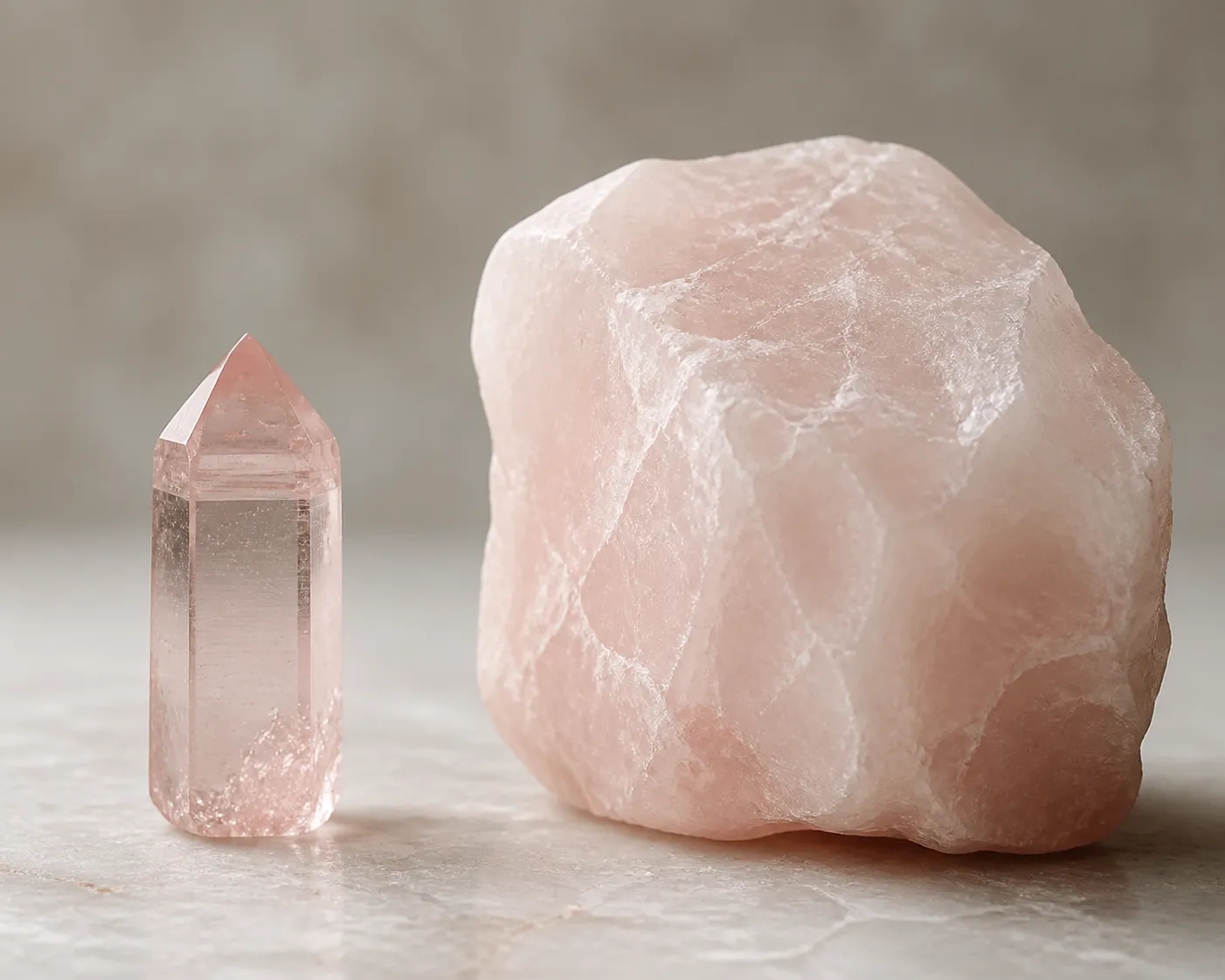
The direct distinction: pink color is not enough
Quartz is silicon dioxide, SiO₂. In an ideal diagram, its structure is built from silicon and oxygen. Natural quartz, however, is rarely a perfect diagram. Trace elements, defects, vacancies, and charge-balancing features can enter the structure during growth or be modified later by geological conditions.
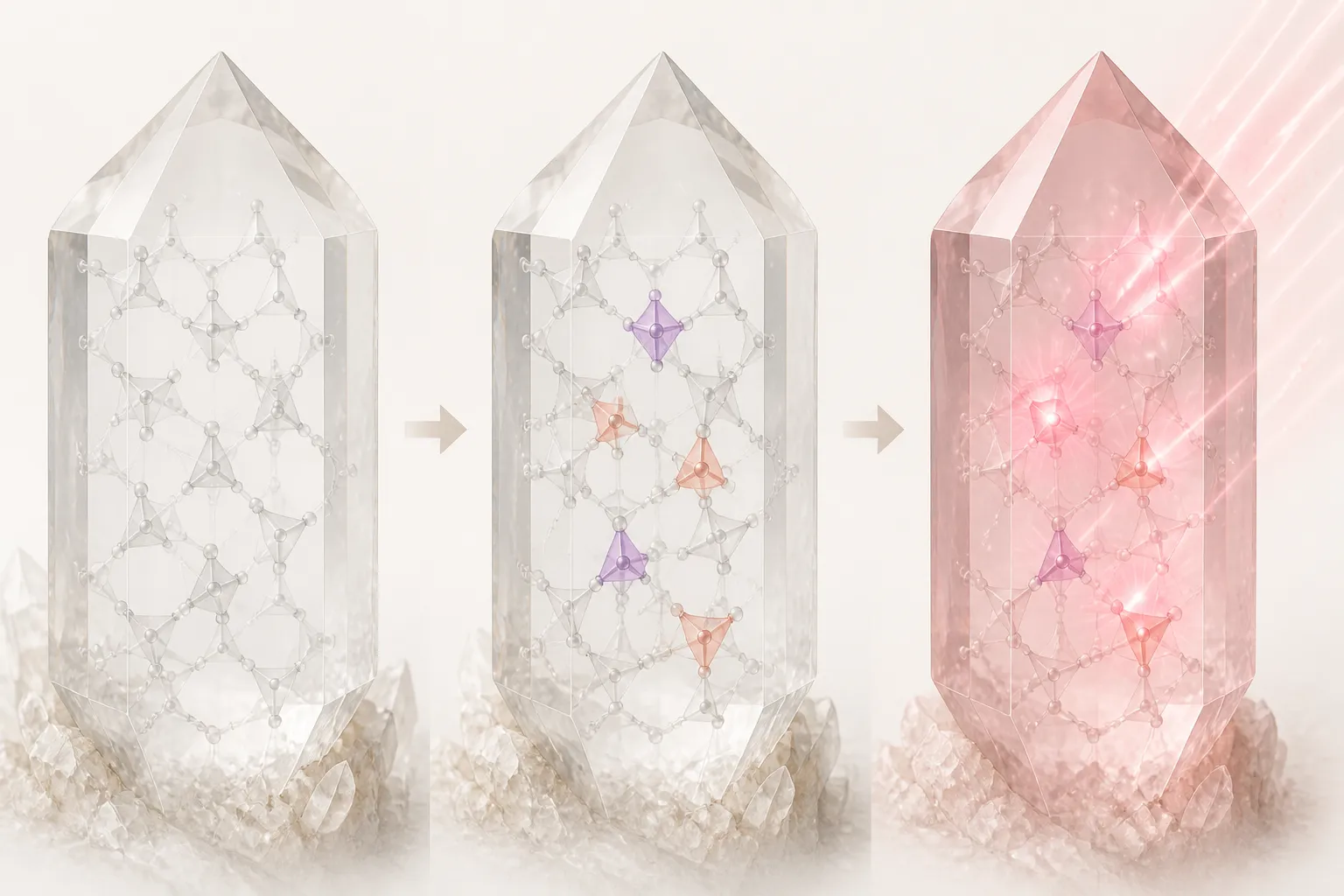
For euhedral pink quartz, the commonly cited model involves paired substitution. Aluminum has a 3+ charge, phosphorus has a 5+ charge, and both are described as replacing silicon positions in a way that helps maintain charge balance. In simplified terms, two silicon sites with 4+ charges can be replaced by one aluminum-related and one phosphorus-related site, averaging the charge back toward the original framework balance.
“Ionic replacement” can make this sound looser than it is. It does not mean free aluminum and phosphorus ions are drifting through a finished crystal. A better mental image is substitution within the crystal framework. Specialist descriptions discuss bonded structural groups such as AlO₄ and PO₄ in the quartz lattice.
The color is then linked to quartz radiation color centers. Natural geological irradiation can alter electron states around defects in the lattice. Those changed defect sites absorb some visible light, so the crystal appears pink, rose-pink, or pale red. Here, “radiation” is a color-formation term in mineralogy, not a statement that a specimen is currently unsafe.
Massive rose quartz usually belongs to a separate explanation. It may share the broad visual family of pink quartz, but its color has often been linked to fine inclusions or nanofibrous material rather than the same Al/P color-center model.
What “euhedral” changes
“Euhedral” means a crystal grew with its own natural faces. In quartz, that usually means recognizable prism faces and natural terminations formed because the crystal had enough open space to express its shape.
That distinction matters. Massive rose quartz can be cut into points, towers, beads, cabochons, and hexagonal-looking forms, but those are human-made shapes. A carved rose quartz tower may imitate a crystal outline; it is not the same thing as a natural euhedral pink quartz crystal.
Euhedral pink quartz is rare because several conditions have to line up:
- Open space for crystal growth. Natural faces and terminations need room to form.
- The right trace-element chemistry. The reported model depends on aluminum- and phosphorus-related substitution.
- A workable charge balance. Quartz substitution is constrained by ion charge, size, and bonding relationships.
- Color-center formation. Defects must be affected in a way that produces visible pink coloration.
- Color preservation. Some crystalline pink quartz is described as light-sensitive, so strong direct light may weaken the color in certain specimens.
A pink appearance alone does not show that all of this happened. It only explains why euhedral pink quartz is treated as a narrow mineralogical case rather than a common form of ordinary rose quartz.
The Al/P substitution and quartz radiation model, in plain language
The chemistry is easier to follow if structure and color are separated.
- First, the quartz grows. A mostly silicon-and-oxygen framework forms. Under unusual conditions, small amounts of other elements can be incorporated into that framework. Aluminum is a well-known impurity in natural quartz studies, and phosphorus is also discussed in quartz trace chemistry, though paired Al/P substitution is not presented as an everyday pattern in ordinary quartz.
- Second, those substitutions or related defects create sites where electron behavior can later change. Many quartz colors depend on defects, impurities, and electron states rather than on a large change in the bulk chemical formula. Other quartz varieties are also discussed through color-center chemistry, but their mechanisms should not be merged into the pink quartz explanation.
- Third, natural irradiation modifies defect sites. In the pink quartz model, this produces a trapped-hole or color-center effect associated with the Al/P-related structures. The result is selective light absorption, and the remaining transmitted or reflected light is perceived as pink.
This is why crystalline pink quartz may show features that feel different from massive rose quartz: small natural crystals, transparent to translucent interiors, delicate color, color zoning, stronger color near some terminations, and sometimes weak dichroism. Dichroism means the crystal may show a slightly different color intensity depending on viewing direction under suitable optical conditions. It is a clue consistent with structure-related color, not an at-home chemical test.
Why rose quartz labels cause confusion
Most people meet the term “rose quartz” before they ever hear “euhedral pink quartz.” That makes sense. Massive rose quartz is common in jewelry, interiors, tumbled stones, carved points, and symbolic settings.
The label problem begins when retail and collector language collapse several things into one name. A listing may say “rose quartz crystal” when it means a carved massive rose quartz point. A mineral-show label may use “rose quartz” for a natural pink crystal because the color looks rose-like. Some sellers use “pink quartz” simply as a color phrase.
| Reader-facing phrase | What it may mean | Mineralogical caution |
|---|---|---|
| Rose quartz crystal | Often massive rose quartz cut or polished into a point | Shape alone does not make it euhedral |
| Pink quartz point | Could be carved material or a natural terminated crystal | Natural faces and terminations matter |
| Euhedral pink quartz | Natural crystal with its own faces and pink coloration | Closest to the rare crystalline pink quartz question |
| Crystalline pink quartz | Usually the relevant term for the Al/P plus color-center discussion | Appearance alone still does not confirm chemistry |
| Massive rose quartz | Common non-euhedral pink quartz material | Generally explained by a different color mechanism |
The conflict disappears once natural crystal habit is separated from manufactured shape. A polished rose quartz obelisk can be attractive and meaningful as an object. It simply does not show that the material grew as a natural euhedral pink quartz crystal.
Visual clues that help, without proving the chemistry
Visual clues can narrow the question, but they should not be treated as final identification.
Euhedral pink quartz is often described as small, transparent to translucent, and naturally terminated. Its color may be delicate rather than saturated. Some crystals show zoning, with pink concentrated in certain growth sectors or near terminations. Natural faces may show growth relationships rather than the uniform polish and repeated angles of a carved object.
Massive rose quartz usually looks more cloudy, blocky, or evenly massive. It may be translucent at thin edges, but it does not normally show natural prism faces and terminations. When cut into a point, the planes, edges, and tip usually reveal lapidary shaping.
Context can help too. Crystalline pink quartz is often discussed in pegmatite-related settings and in open-space growth environments. That supports the connection between crystal habit, chemistry, and formation conditions. Still, locality or associated minerals should not be used as shortcuts for identity. They are context clues, not proof.
Light sensitivity is another limited clue. Some crystalline pink quartz is reported to fade in strong direct light, which fits a color-center explanation. If preserving color matters, it is sensible to display delicate pink crystal specimens away from prolonged direct sunlight. But fading is not consistent enough to use as a clean test, and deliberately exposing a specimen to strong sunlight may damage the color.
What the evidence can and cannot support
The broad science is well established: natural quartz can contain structural impurities, lattice defects, charge-balancing features, and radiation-related color centers. Aluminum-related centers in quartz are widely studied, and defect-focused methods have long been used to investigate crystalline quartz.
The narrower pink-quartz explanation needs careful wording. The specific model for euhedral pink quartz — paired aluminum and phosphorus substitution followed by irradiation — is repeated in specialist mineral summaries and connected to earlier work on a trapped-hole center associated with rose coloration in natural quartz. Publicly accessible coverage for this exact pink-quartz-specific mechanism is thinner than the broader literature on quartz defects.
So the strongest responsible summary is this: crystalline pink quartz is commonly described as a rare quartz variety whose color is apparently linked to Al/P-related lattice substitution and radiation-induced color centers, while massive rose quartz is generally explained through a different inclusion-related mechanism.
That keeps the distinction clear without turning a mineralogical model into an overclaim.
A concise way to judge the label
If you are trying to decide whether a pink object belongs in the euhedral pink quartz discussion, ask four questions:
- Did it grow as a natural crystal? Look for natural faces and terminations, not just a polished point shape.
- Is it transparent to translucent and crystal-like rather than massive and cloudy? This is only a clue, but a useful one.
- Is the color delicate, zoned, or stronger in growth sectors? That pattern fits crystalline pink quartz better than many carved rose quartz objects.
- Is the label relying on retail wording? Phrases such as “rose quartz crystal” or “pink quartz tower” may describe color and shape, not mineral chemistry.
The rare chemistry of euhedral pink quartz is not just “pinkness.” It is the intersection of framework substitution, radiation color centers, and natural crystal growth. Massive rose quartz belongs to the wider rose-colored quartz world, but it usually does not answer the same chemical question.