The Secret Behind the Glow: How Nano-Fibers Create the Pink in Massive Rose Quartz
By Luna Harper
The Secret Behind the Glow: How Nano-Fibers Create the Pink in Massive Rose Quartz
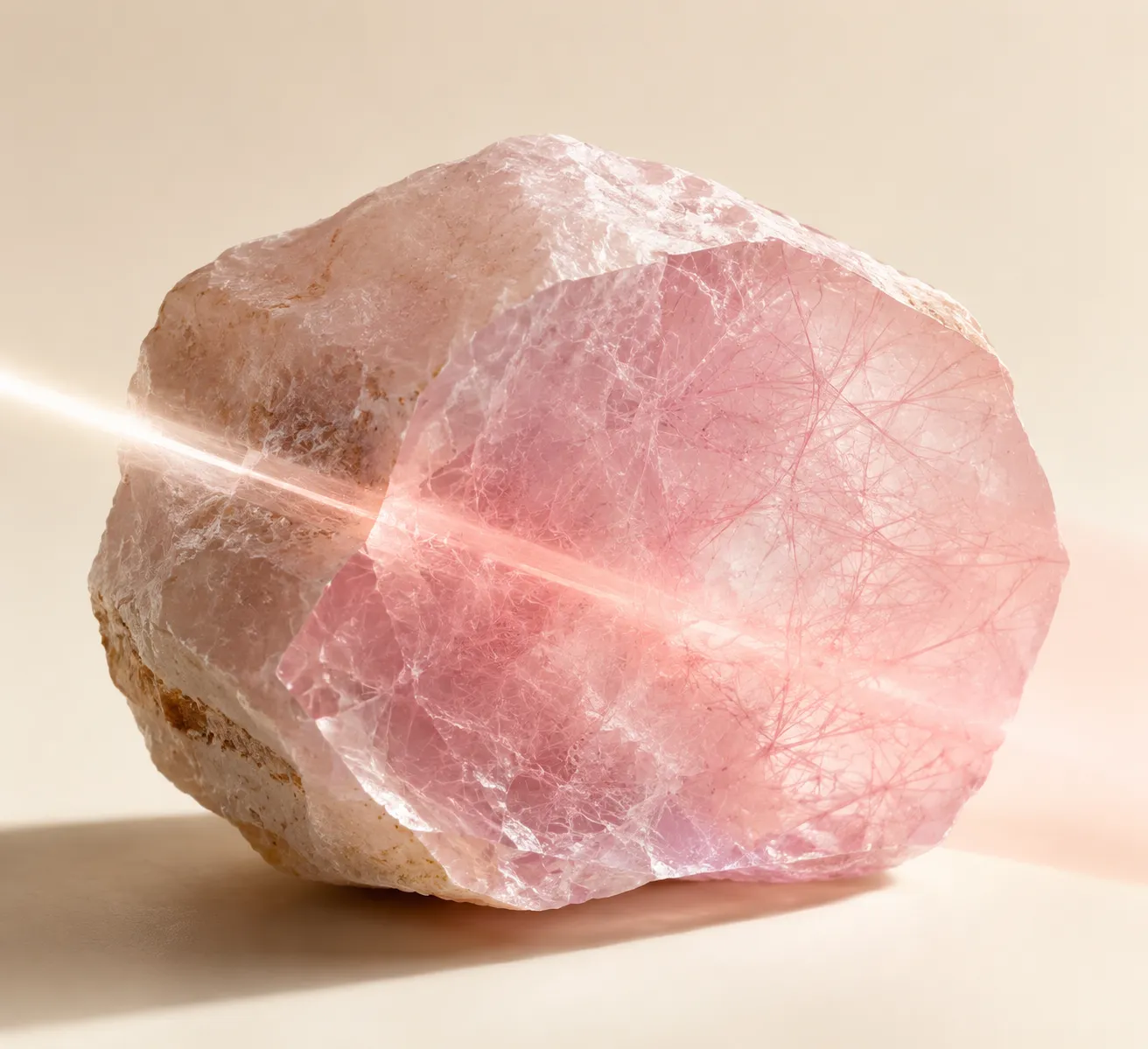
Common massive rose quartz gets its soft pink color mainly from extremely fine fibrous inclusions inside the quartz, not from a pink ingredient evenly dissolved through the whole crystal. The careful wording is Dumortierite Nano-fibers—or, more precisely, dumortierite-like nanofibers.
These tiny pink fibers are present in very small amounts, but they are distributed through the quartz body. They absorb parts of visible light, especially in the green region, so the light that returns to the eye reads as pink. The familiar soft “glow” of rose quartz comes from that color plus the cloudy, inclusion-rich texture of massive quartz, which scatters light and gives the stone its milky, luminous look.
Rose quartz is not simply pink all the way through its quartz lattice
A useful way to picture common massive rose quartz is as clear quartz carrying an extremely fine pink mist of mineral fibers. The host is still quartz. The pink appearance is strongly linked to what is included within it.
That distinction matters because older explanations often treated rose quartz color as if it came mainly from atoms or defects inside the quartz lattice itself, such as titanium, manganese, iron-related centers, or other trace-element effects. Those ideas were not unreasonable; many mineral colors do involve trace elements and structural defects. But for the familiar cloudy material used in beads, carvings, tumbled stones, spheres, slabs, and many jewelry pieces, the strongest evidence points to included pink fibers rather than a uniformly pink quartz structure.
Mineralogical studies found pink fibrous residues in massive rose quartz samples from several localities. The fibers were extremely small—far below what a casual viewer could identify by eye—and present only in tiny amounts. Even so, because the fibers are colored and spread through the quartz, they can strongly influence the overall appearance of the stone.
So when a piece of massive rose quartz looks softly pink instead of sharply transparent and saturated, that is not just a surface effect. It is a body color created by fine fibrous inclusions interacting with light inside a cloudy quartz mass.
What the fibers do to light
The pink color is an optical effect. In the studied massive rose quartz, the extracted pink fibers and the original rose quartz showed related absorption behavior. For a reader, the important point is not the instrument work behind that observation, but the pattern: the fibers absorb certain wavelengths in a way that matches the pink appearance of the stone.
The color of the fibrous phase has been linked to Fe-Ti intervalence charge transfer. In plain language, iron and titanium in the fibrous material are involved in an electron-transfer process that affects which wavelengths of light are absorbed. The research connects this behavior to absorption around the green part of the visible spectrum. When greenish wavelengths are reduced, the remaining transmitted and scattered light shifts toward pink.
That is why “iron makes rose quartz pink” is too blunt. Iron may be part of the mechanism, but not as a simple stain spread evenly through quartz. The better explanation is that a dumortierite-related fibrous phase contains iron and titanium in a structure that produces the relevant absorption.
The stone is not literally emitting light in ordinary viewing conditions. The glow is an appearance caused by absorption, scattering, translucency, and the way light moves through an inclusion-rich quartz body.
The “glow” adds another layer. Common massive rose quartz is often milky, hazy, or cloudy rather than glass-clear. That turbidity comes from inclusions, internal boundaries, and microscopic features that scatter light. Scattering softens contrast and spreads light through the stone. Combined with the pink absorption from the fibers, it creates the gentle glow people associate with rose quartz.
Why “dumortierite-like” is the safer term
Dumortierite is a boron-bearing aluminum silicate mineral that can occur in fibrous or columnar forms. It may be blue, violet, pink, or other colors depending on composition. Because the rose quartz fibers resemble dumortierite in important ways, it is understandable to call them dumortierite fibers. But the more careful phrase is dumortierite-like nanofibers or dumortierite-related fibrous nanoinclusions.
The match is strong, but not perfect. X-ray diffraction patterns and pleochroism made dumortierite the closest mineral match for the inclusions. Later high-resolution work also supported a dumortierite-related structure. At the same time, infrared and Raman results did not match standard dumortierite in every detail. That is why careful descriptions avoid saying the fibers are simply ordinary dumortierite in all respects.
Follow-up work described the fibers as compositionally similar to dumortierite, with more iron substituting for aluminum in certain structural positions. Boron was also detected, which fits the broader dumortierite-related interpretation. In other words, the inclusions are not vague pink dust, but they are also not safely reduced to ordinary specimen-grade dumortierite.
For a non-specialist, the takeaway is simple: “dumortierite-like” is not cautious wording for its own sake. It reflects the evidence. Something very close to dumortierite is involved in the coloration of common massive rose quartz, while the exact mineral identity remains more delicate than a retail label can capture.
Massive rose quartz is not the same as rare pink quartz crystals
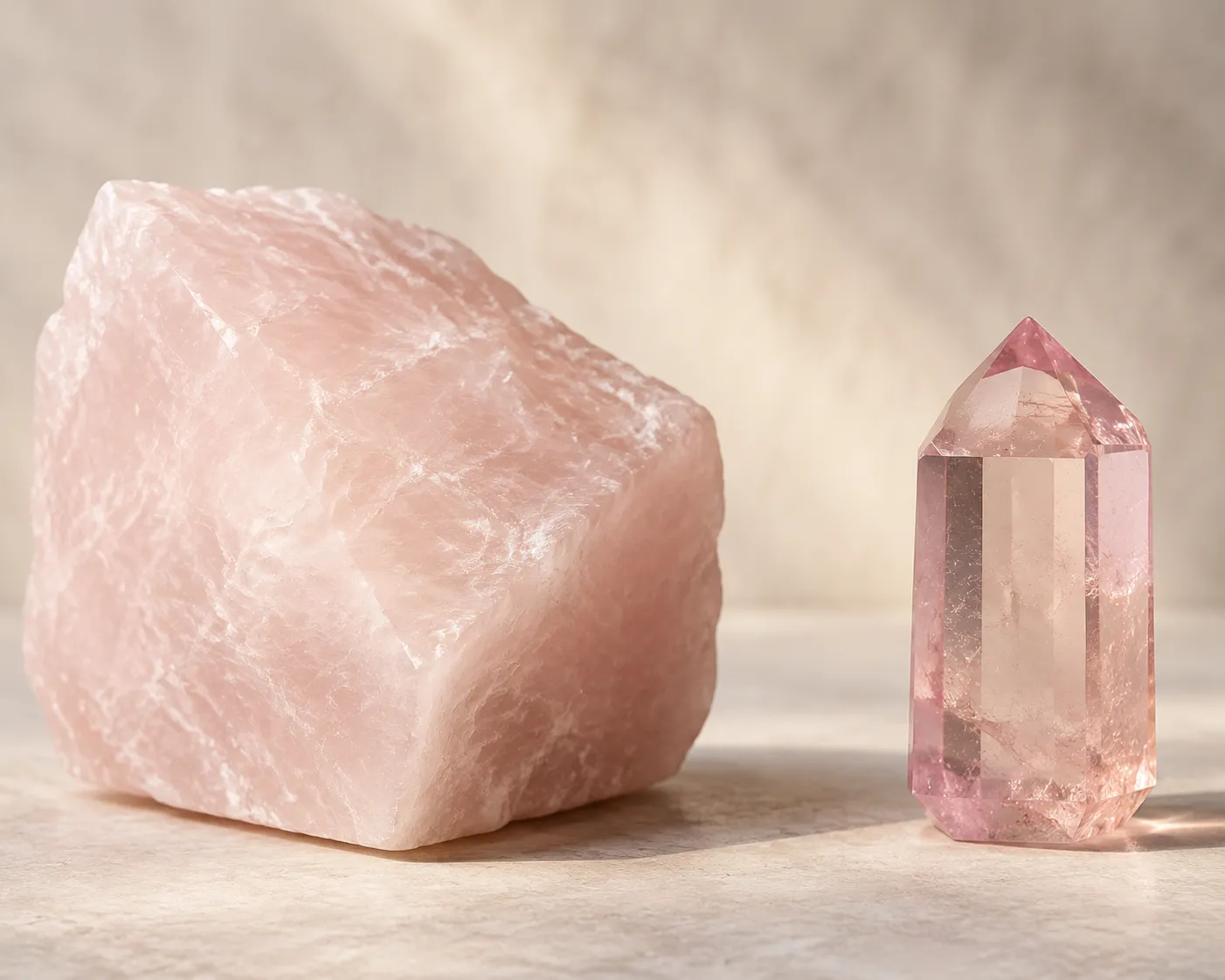
The nanofiber explanation applies most strongly to common massive rose quartz. This is the cloudy, non-euhedral material most people know from decorative objects and jewelry. It forms as masses rather than as distinct transparent quartz crystals with well-developed faces.
Rare euhedral pink quartz is a different category. In that material, pink color can involve radiation-related color centers in the quartz lattice, including centers associated with aluminum, oxygen, and phosphorus. Those crystals may also respond differently to light exposure.
The point is not to turn this into a separate lesson on rare pink quartz. The useful boundary is simpler: not every pink quartz specimen should be explained by the same dumortierite-like nanofiber mechanism.
This also helps with authenticity questions. A cloudy rose quartz bead and a rare transparent pink quartz crystal may both be called “pink quartz” in everyday language, but their color mechanisms are not necessarily the same. Growth form, transparency, texture, and mineralogical category matter.
If the stone is typical massive rose quartz, dumortierite-like fibrous inclusions are the best-supported explanation. If it is a rare, well-formed pink quartz crystal, the answer changes.
Common misunderstandings about the pink glow
“Iron-colored quartz” is too simple
One common misunderstanding is that rose quartz is simply “iron-colored quartz.” That misses the inclusion-based mechanism. Iron matters in the current explanation, but as part of an iron-titanium charge-transfer process in the fibrous material, not as a simple pink dye inside the quartz lattice.
Cloudiness is not proof by itself
Another misunderstanding is that cloudiness proves the presence of dumortierite-like nanofibers. It does not. Many stones can be cloudy for different reasons. The nanofiber conclusion comes from mineralogical evidence, not from visual inspection alone. A milky appearance may fit what people expect from rose quartz, but it cannot identify the fibers by itself.
“Glow” is an optical appearance
A third misunderstanding comes from the word “glow.” In decorative and symbolic language, glow can sound mysterious. In mineral terms, the soft glow is an optical appearance: pink absorption plus internal scattering in a translucent, inclusion-bearing quartz mass. No symbolic or outcome-based claim is needed to explain the visual effect.
What can change the answer for a specific stone
The answer changes first with the type of quartz. Common massive rose quartz and rare euhedral pink quartz should not be treated as one material category. The familiar cloudy material is best explained by dumortierite-like fibrous inclusions. A transparent, well-formed pink crystal may involve quartz lattice color centers instead.
The answer can also be blurred by market language. Sellers may use “rose quartz,” “pink quartz,” and “pink crystal” loosely. A pale bead strand, a soft pink carving, a star rose quartz cabochon, and a rare pink quartz crystal may sit under similar everyday labels while raising different evidence questions.
Color strength is another variable. Some rose quartz is very pale; some is more saturated. The studies support the role of fibrous inclusions in massive rose quartz, but they do not let anyone predict every individual stone’s exact shade from appearance alone. Fiber abundance, distribution, turbidity, cut thickness, and lighting all affect what the eye sees.
The fibers are also not a home-test feature. They are nanoscale to microscale inclusions that require specialized analysis to identify confidently. Laboratory extraction, heat treatment, irradiation, and advanced spectroscopy belong in trained research settings, not casual gem testing.
The clean answer
The pink glow of common massive rose quartz comes from a quartz body filled with extremely fine pink dumortierite-like fibrous inclusions. Those inclusions are present in tiny amounts, but they absorb light in a way linked to iron-titanium charge transfer. The cloudy quartz host scatters that colored light, giving rose quartz its gentle, milky, luminous look.
That is more accurate than saying rose quartz is simply “pink quartz,” “iron-colored quartz,” or “dumortierite inside quartz” without qualification. The important boundaries are: common massive rose quartz is not the same as rare euhedral pink quartz; the fibers are dumortierite-related rather than necessarily ordinary dumortierite; and the glow is optical, not proof of any promised effect.
For most readers looking at a rose quartz bead, palm stone, carving, or interior object, the answer is wonderfully small in scale: the softness comes from the stone’s cloudy quartz body, and the pink comes from a hidden world of fibrous mineral inclusions too fine for the eye to see.
Sources
Sources and further reading
Reference links are limited to sources considered suitable for public citation in this page.