Tactile breathing practice
Sync Your Breath: How to Use Jewelry as an External Metronome
You can use jewelry for 4-7-8 breathing tactile cues by turning a familiar piece into a quiet counting path: touch four beads, links, facets, or edges while inhaling; rest on one point during the seven-count pause; then trace eight points while exhaling.
The jewelry is not doing the breathing for you, reading your body, or changing your physiology on its own. It simply gives your fingers a repeatable route so your attention has somewhere to return when the count slips.
This works best with jewelry you can touch without fuss: a beaded bracelet, a chain with distinct links, a pendant edge, a charm, a ring with facets, or a smooth stone held in the palm.
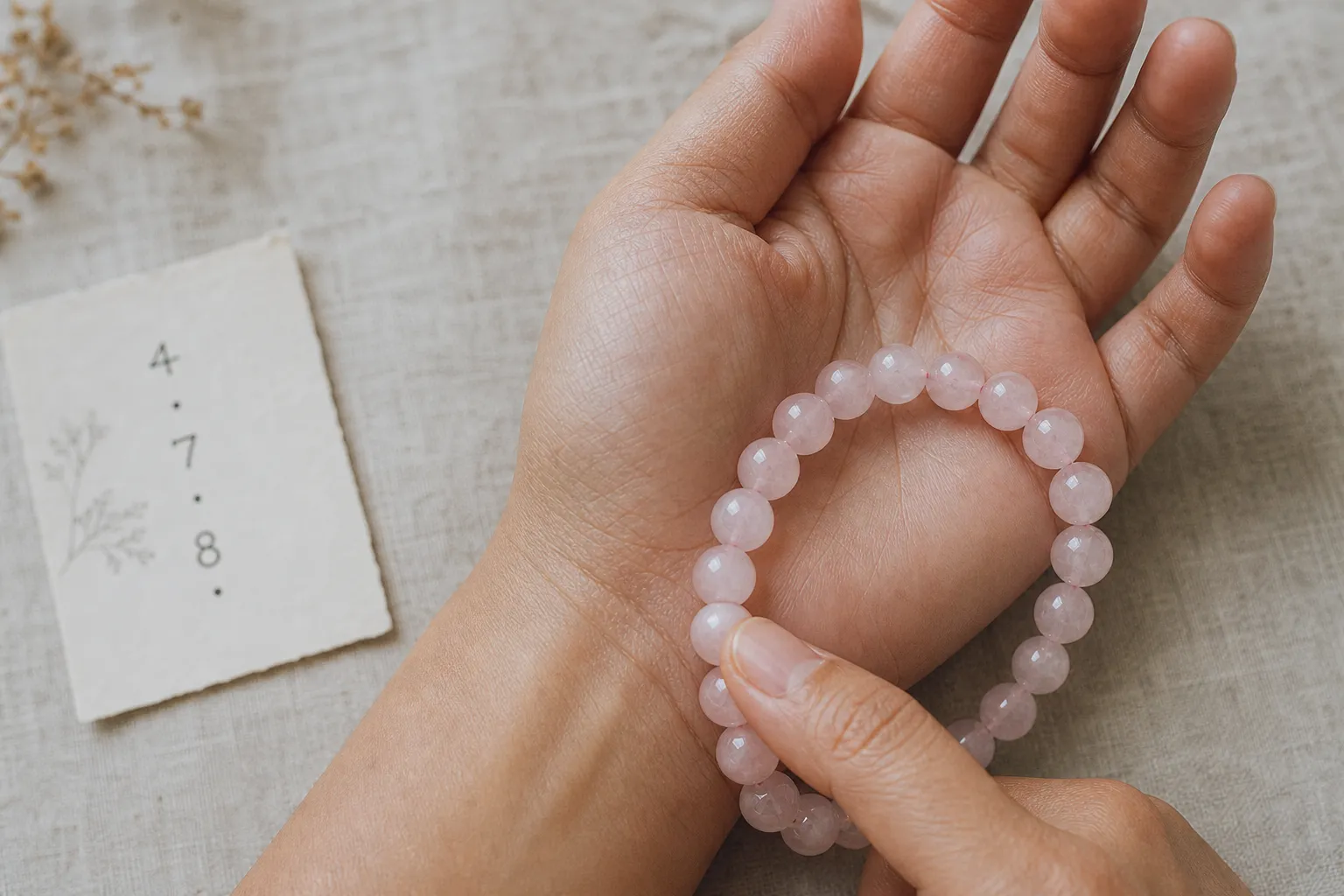
Make the 4-7-8 count touchable
The commonly taught 4-7-8 breathing pattern is:
- inhale for 4 counts
- hold for 7 counts
- exhale for 8 counts
- repeat only while it feels comfortable
A piece of jewelry can act as an external metronome for breathing because it moves part of the counting work out of your head and into your hand. Instead of silently repeating numbers with no physical reference, you give each phase a tactile cue.
Try this first
-
Choose one small path.
Use four to eight touch points: beads, links, knots, charm edges, pendant corners, ring facets, or the edge of a stone.
-
Inhale across four points.
Move your thumb slowly across four markers.
-
Hold on one resting point.
For the seven-count pause, keep your thumb on one bead, the back of a pendant, the top of a ring, or the same stone surface.
-
Exhale across eight points.
Trace eight markers, or move across the same four markers twice.
-
Stop after a few rounds.
This is a short relaxation practice, not an endurance exercise.
If the count starts to feel strained, the jewelry has still helped: it has shown you that the pattern needs to be shortened or simplified.
Jewelry layouts that work well
The best piece is not the most expensive or symbolic one. It is the one your fingers can read easily without looking.
Beaded bracelet
A bracelet beads breathing cue is the most straightforward option because the markers are already separated.
Use it in one of three ways:
- Four-bead inhale, still hold, eight-bead exhale. Move across four beads on the inhale, pause on one bead for the hold, then move across eight beads on the exhale.
- Four beads twice for the exhale. If the beads are small or irregular, use the same four-bead section twice.
- One larger bead as the reset point. If the bracelet has a focal bead or charm bead, let that mark the start of each round.
This can be discreet at a desk, on a commute, or before a transition. The motion can be tiny: thumb against bead, bead against thumb.
Pendant or charm
A pendant breathing count cue works differently because it may not have many separate markers. Instead of counting points, count along surfaces.
For example:
- inhale while tracing one side of the pendant for four counts
- hold while resting your thumb on the center or back
- exhale while tracing the outside edge for eight counts
A rose quartz pendant, locket, metal charm, carved stone, or simple disc can all work. If the piece has personal meaning, that meaning may make the practice feel more familiar. The practical role is still modest: the pendant gives your hand a place to settle and your mind a rhythm to follow.
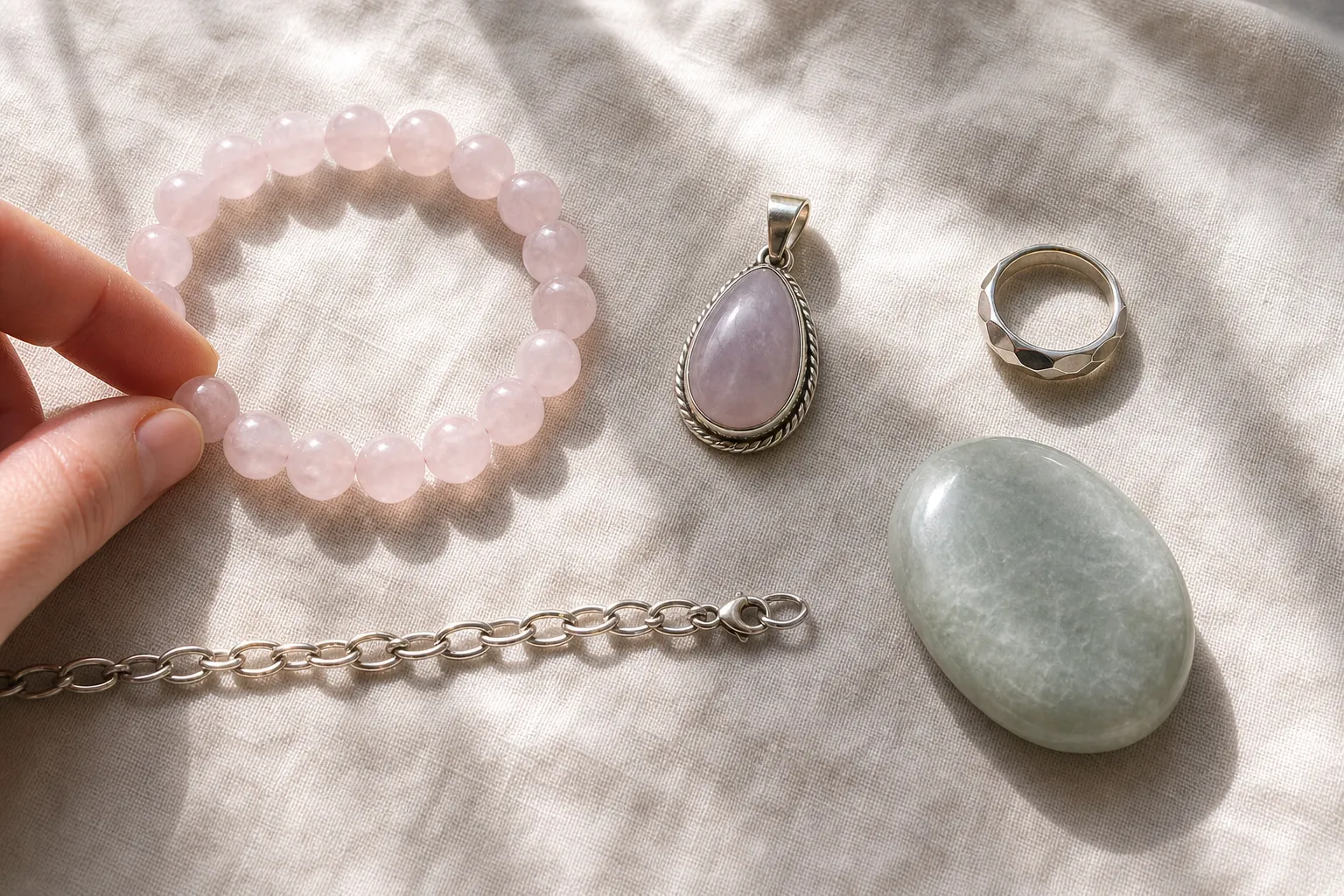
Ring edge
A ring is often the easiest option to use without drawing attention.
You might:
- press the pad of your thumb against the ring for the inhale count
- hold the ring lightly during the seven-count pause
- trace around the band for the eight-count exhale
Faceted rings, ridged bands, signet rings, and textured settings are easier to count on than very smooth bands. If the ring is smooth, use pressure instead of points: four gentle presses for the inhale, stillness for the hold, eight lighter presses for the exhale.
Keep the touch light. Avoid twisting the ring forcefully or pulling at a setting.
Chain links
A necklace chain or bracelet chain can work if the links are large enough to distinguish by touch.
A simple version:
- touch four links for the inhale
- hold the pendant or clasp area for the pause
- touch eight links for the exhale
The limitation is that tiny chain links blur together, especially when your attention is already scattered. If you cannot feel the links clearly, use the pendant, clasp, or charm instead.
Loose stone or pocket charm
A loose stone is not always jewelry, but many people use small stones in the same tactile way.
For a smooth stone:
- inhale while moving from one edge to another for four counts
- hold while enclosing it in the palm for seven counts
- exhale while tracing the perimeter for eight counts
For a rougher or faceted stone, use corners, planes, or texture changes as count points.
With rose quartz or any other stone, it is reasonable to treat the object as personally meaningful, sentimental, or aesthetically calming. In this method, though, the stone is a counting aid and comfort object. The mineral itself is not what makes the 4-7-8 breathing count work.
Adjust the count if the hold feels uncomfortable
The 4-7-8 pattern is often taught as inhale-hold-exhale, but not every body likes breath holds. That matters more than keeping the numbers perfect.
For this jewelry method, the count should serve the breath, not the other way around.
Adjust or stop if you notice:
- dizziness
- breathlessness
- pressure in the chest or throat
- rising discomfort
- a feeling of forcing the hold
- lightheadedness after one or two rounds
Possible adjustments include:
- Shorten the pattern: try 3-4-5 or 4-4-6.
- Skip the hold: inhale for 4, exhale for 6 or 8.
- Use only the exhale cue: touch the jewelry only during the longer exhale.
- Count more gently: let each count be natural, not dramatic.
- Stop and breathe normally: sometimes that is the best correction.
If you have respiratory, cardiovascular, neurological, pregnancy-related, panic-related, trauma-related, or other health concerns, ask an appropriate professional before using breath-hold practices as part of your routine.
The jewelry can make counting easier, but it cannot tell you whether a breathing pattern is right for your situation.
Common misunderstanding: jewelry cue, biofeedback device, or vagus nerve tool?
Searches around breathing often include phrases like parasympathetic nervous system, vagus nerve stimulation, breath control, nervous-system regulation, grounding jewelry, and bracelets marketed with calming claims. These ideas can get blurred together.
A bracelet, pendant, ring, charm, bead strand, or stone used this way is best understood as a tactile counting aid.
It is not:
- a biofeedback device
- a clinical stimulation tool
- a heart-rate or HRV monitor
- a medical breathing pacer
- a sleep device
- evidence that a gemstone changes health outcomes
There is research on paced breathing and on active haptic devices that use vibration, movement, light, sensors, or app feedback to guide breathing. That research is relevant only in a narrow way: it shows that external cues can help guide attention and timing in some designed systems.
Passive jewelry is much simpler. It does not vibrate, expand, measure heart rate, calculate breathing rhythm, or provide feedback. Its value is practical and personal: it gives your fingers a familiar route for the inhale-hold-exhale count.
A clean way to say it is: “This ring helps me remember my breathing count.” That is different from claiming the ring changes the nervous system by itself.
A one-minute practice with a bracelet, pendant, or ring
Use this as a starting point, then shorten it if needed.
Settle the object.
Let your thumb find the first bead, link, pendant edge, ring facet, or stone surface. Sit or stand in a safe, comfortable position.
Round one:
Inhale across four tactile points. Hold on one resting point for seven counts. Exhale across eight points, or across four points twice.
Round two:
Use the same path. Make the finger motion smaller. Let the object carry the count so you do not need to watch a screen or follow a visual timer.
Round three, optional:
Repeat only if the breath still feels easy. If the hold feels tight, change the next round to inhale for four and exhale for six or eight without holding.
Close the cue.
Stop touching the count points and let the jewelry return to being ordinary jewelry. This small ending keeps the practice contained, rather than making the object feel like something you must rely on.
The useful boundary
Using jewelry as a breathing metronome is a practical adaptation of a familiar relaxation count. It may help some people keep track, slow down enough to notice the breath, or make a brief ritual feel more concrete.
The strongest claim is also the cleanest one: jewelry can be a discreet tactile cue for breath control, rhythm, and attention.
If the object is beautiful, sentimental, devotional, or calming to you, that can be part of the practice. Let the meaning stay personal. Let the count stay adjustable. Let the jewelry remain the external metronome: a touchable path back to the breath, not a promise.