Daily-wear reflection practice
The A.N.C.H.O.R. Method: Rewiring Self-Worth With Daily Wear
The A.N.C.H.O.R. method can be used with jewelry as a daily tactile cue: when you see or touch the piece, you pause, breathe, name what is happening, return to a chosen value, and repeat a short self-worth phrase. In that grounded sense, A.N.C.H.O.R method jewelry is not a device that changes your mind for you. It is a symbolic object that helps you remember the response you chose in advance.
Here, “rewiring” is metaphor. The practice is closer to rehearsal: a repeated moment of contact, attention, language, and values-based reflection. For readers drawn to frequency jewelry, somatic anchoring, or imposter syndrome language, the better question is not “Can this jewelry fix me?” but “Can this object help me interrupt a familiar self-doubt loop and return to something steadier?”
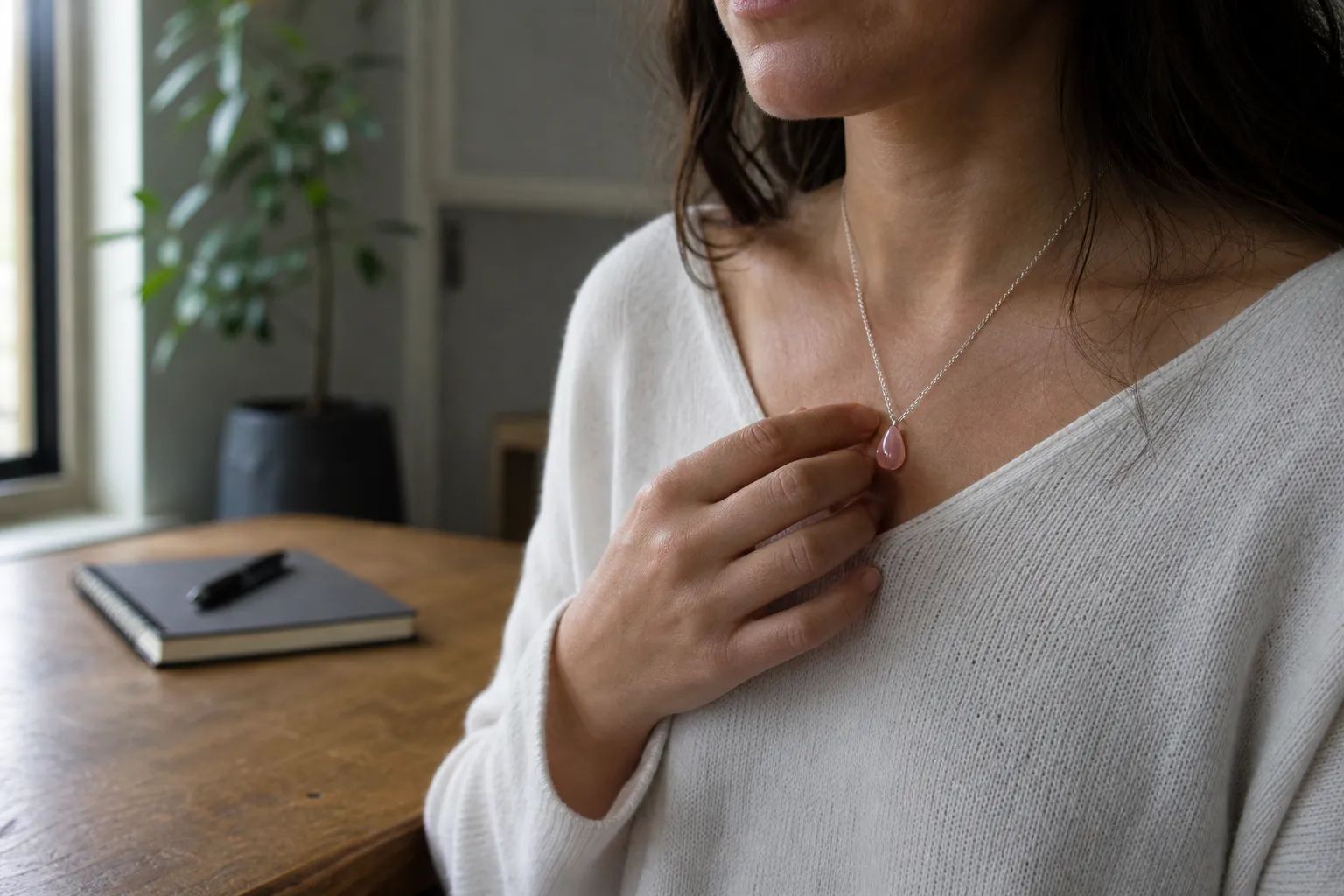
What A.N.C.H.O.R. means when attached to jewelry
For this page, A.N.C.H.O.R. is a personal reflection sequence paired with a worn object. The jewelry gives the practice a physical doorway. The method gives that doorway a repeatable order.
A simple version looks like this:
A — Attend
Notice the moment you reached for the jewelry. Was it before a meeting, after praise, during comparison, or when you felt exposed?
N — Name
Use neutral words: “I am having a self-doubt reaction,” or “I am worried I will be seen as not enough.”
C — Contact
Touch the ring, pendant, bracelet, or bead. Notice texture, temperature, weight, edge, or surface.
H — Hold a value
Choose one value that matters more than the fear: honesty, learning, steadiness, courage, craft, kindness, presence.
O — Offer a phrase
Repeat a short self-worth reminder that feels believable enough to use.
R — Return
Re-enter the task with one small action: send the message, open the document, ask the question, breathe before speaking, or accept the compliment without arguing.
That is the heart of the practice. The jewelry is not doing the self-reflection. It is holding the place where self-reflection can begin.
This is why daily wear matters. A necklace rests near the breath. A bracelet enters the field of vision. A ring is easy to touch under a table. Those details do not prove a psychological outcome, but they explain why jewelry can become a useful cue: it is present, repeatable, personal, and close to the body.
Why jewelry can work as a cue without proving frequency claims
The clearest explanation is cue plus prechosen response. In psychology, implementation intentions are often described as “if this happens, then I will do that” plans. The relevant point here is modest: a clear cue paired with a simple action can make a response easier to remember.
That does not validate a specific bracelet, stone, metal, crystal, frequency label, or product claim. It only supports the idea that cues can help prompt chosen behavior.
Daily-wear jewelry fits that structure naturally:
- If I touch my pendant before a hard conversation, then I will take one breath and name the value I want to bring.
- If I twist my ring after receiving praise, then I will say, “I can let this land.”
- If I notice my bracelet while comparing myself to someone else, then I will return to one sentence: “Their path is not evidence against mine.”
- If I reach for my rose quartz bead during a self-doubt spiral, then I will ask, “What is one honest next step?”
This is where frequency jewelry needs careful language. Some readers use “frequency” to mean energy, mood, intention, or spiritual resonance. As personal symbolism, that vocabulary may be meaningful. But the available material does not show that frequency jewelry emits measurable effects that change self-worth or resolve impostor feelings.
A grounded version is this: frequency jewelry may function as a symbolic frequency of attention. It can remind you what you want to tune back toward. That is different from claiming the object produces a verified effect in the body or mind.
Jewelry also has a long design logic as a memory object. Lockets, rings, charms, and inherited pieces often carry private meaning because they link touch, sight, memory, and identity. Design research has explored jewelry as a cue for autobiographical memory, especially when the object and the remembered content feel inseparable. That supports the everyday observation that a worn object can carry personal associations. It does not make jewelry a mental-health intervention.
A useful caution also appears in bracelet research on self-signaling: in one experimental context, bracelets increased the salience or anticipated memory of a prior action, but did not produce the expected change in giving behavior. For this topic, that is a helpful boundary. A bracelet can make something more memorable without guaranteeing a deeper self-image shift.
Using the method when imposter syndrome language fits
Many readers arrive at this practice because they relate to imposter syndrome language: feeling like success does not count, fearing exposure, attributing achievement to luck, or discounting competence even when outside evidence suggests otherwise. Academic sources often use “impostor phenomenon,” while everyday writing often says “imposter syndrome.”
The phrase should still be used carefully. This article cannot diagnose a reader, and the sources for this page do not support jewelry as a clinical answer to impostor phenomenon. A systematic review notes that the topic is widely discussed while also pointing to gaps in evidence around interventions specific to impostor symptoms.
That does not make your experience unreal. It simply means a ring, bracelet, or pendant should not be asked to carry more than it can responsibly hold.
The A.N.C.H.O.R. method is most useful here as a small interruption ritual. It gives you a way to catch a moment of self-doubt before it becomes the whole story.
For example:
- Before presenting work, you touch your necklace and name: “I am afraid they will discover I do not belong.”
- You hold a value: “Clarity.”
- You offer a phrase: “I am allowed to contribute while still learning.”
- You return with one action: begin the first sentence, ask the prepared question, or show the work without apologizing for it.
The value of the ritual is not that it proves you are confident. It is that it gives you a practiced alternative to automatic self-erasure.
A phrase works best when it is believable enough to repeat. “I am perfect and unstoppable” may feel false in a real self-doubt moment. A steadier phrase might be:
- “I can be new and still be capable.”
- “Evidence matters more than the fear story.”
- “I do not need to shrink before I begin.”
- “I can receive this compliment without cross-examining it.”
- “My worth is not being decided in this one room.”
These are not clinical scripts. They are chosen reminders. The jewelry gives them a place to live.
What makes the practice feel grounded
The A.N.C.H.O.R. method depends less on the category of jewelry and more on the relationship between object, cue, and phrase. A rose quartz pendant, a plain band, a charm bracelet, or a bead strand can all serve the same basic function if the cue is clear.
The object should be easy to notice.
If the piece disappears completely from awareness, it may still be beautiful, but it will not function well as a daily wear jewelry cue. Rings and bracelets are often easier to touch discreetly. Pendants may connect more naturally to breath or posture. Earrings may be meaningful but less tactile during the day.
The phrase should be chosen before the hard moment.
Cue-based practice works best when the response is already selected. If you wait until the moment of shame, comparison, or pressure to invent a self-worth statement, the practice may become another task. Choose one phrase in advance and keep it simple.
The value should be yours, not decorative.
Values-based reflection jewelry becomes weaker when the value is chosen only because it sounds nice. “Courage” may be right for one person; “Precision,” “gentleness,” or “truth” may be better for another. The value should point to how you want to act, not how you want to be perceived.
The touch should interrupt autopilot.
Somatic anchoring, in this non-clinical context, means using body contact as a reminder. You might press the bead once, feel the edge of a ring, rest a thumb on the clasp, or notice the weight of a pendant. The point is not to force a body change. It is to bring attention back to the present moment.
The ritual should remain small.
If the sequence takes ten minutes, you may stop using it. If it takes ten seconds, it can fit into ordinary life: before opening an email, while waiting outside a room, after a difficult comment, or when you feel the urge to deflect praise.
A compact version is enough: Touch. Breathe. Name. Value. Phrase. Next step.
Common confusion: symbolic meaning is not the same as proof
The most common misunderstanding is assuming there are only two options: either frequency jewelry produces a confirmed self-worth effect, or the whole practice is meaningless. Real life is more nuanced.
A symbolic jewelry ritual can be meaningful without being validated as an outcome-producing tool. A ring can remind you of a promise. A pendant can connect you to a person, season, prayer, boundary, or intention. A rose quartz piece can carry cultural associations of tenderness, love, and emotional softness. Those meanings can matter in daily life.
But meaning is not the same as proof of a measurable mechanism.
This distinction protects both the reader and the practice. When jewelry is asked to do too much, disappointment often follows. When it is allowed to be a symbol, cue, and reminder, it can become part of a realistic self-reflection routine.
The same boundary applies to “rewiring.” In this article, rewiring self-worth means rehearsing a different response often enough that it becomes more available. It does not mean a measured neurological change, a guaranteed identity shift, or a replacement for qualified support when distress is persistent or interfering with daily life.
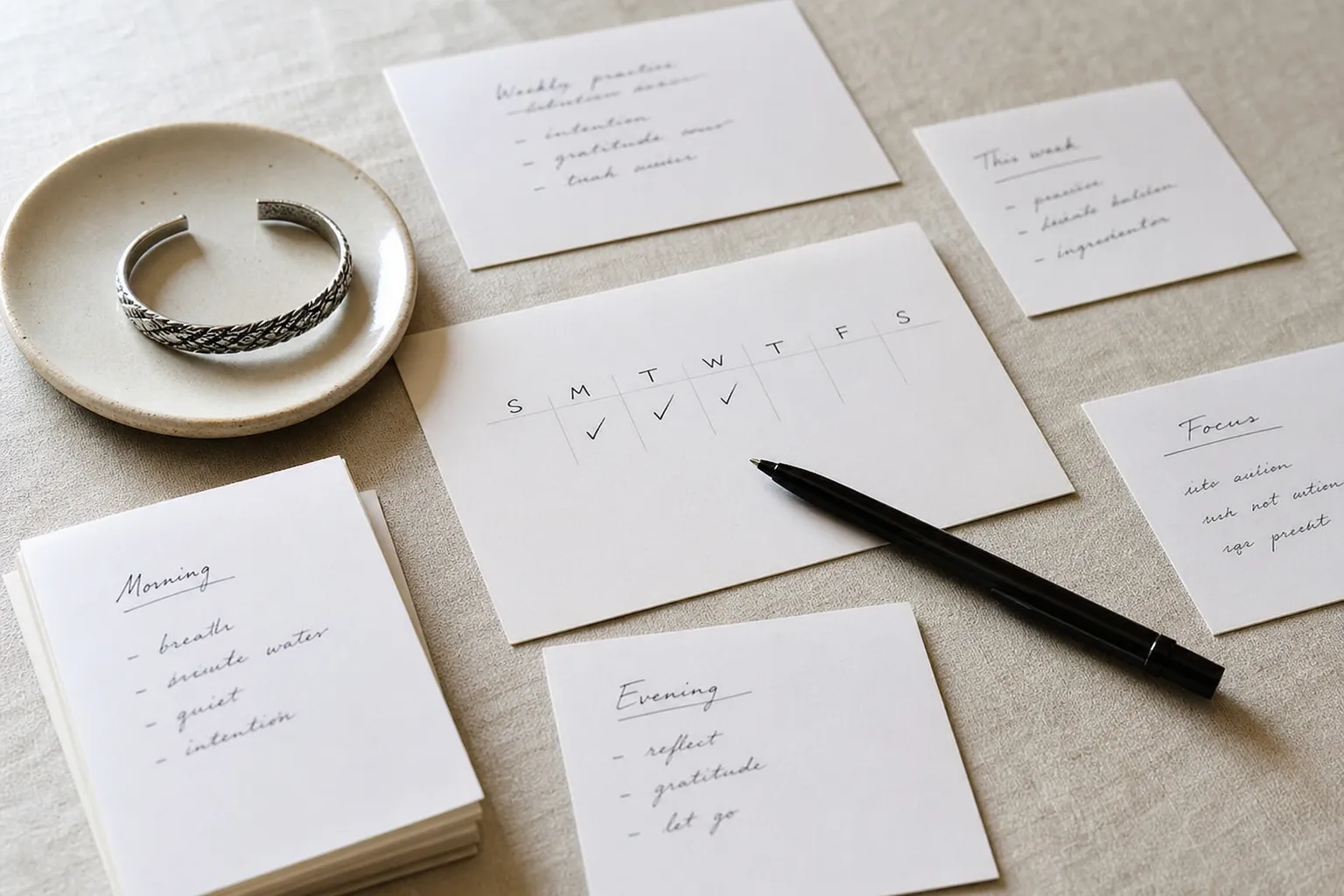
A practical A.N.C.H.O.R. setup for one piece of jewelry
Choose one piece, not your whole jewelry box. The practice works better when the object has one clear job.
-
1. Pick the piece.
Choose something comfortable enough for regular wear and easy enough to touch without drawing attention. It can be rose quartz, metal, pearl, glass, cord, or another material. The method does not depend on a product claim.
-
2. Choose the self-doubt moment.
Name the situation where you want the cue: presenting work, receiving praise, entering a room, posting creative work, setting a boundary, or beginning a difficult task.
-
3. Write the if–then cue.
Example: “If I touch this ring before speaking, then I will breathe once and remember: I can be clear without being flawless.”
-
4. Select one value.
Keep it concrete. “Presence” may guide you to slow down. “Craft” may guide you back to the work. “Honesty” may help you stop performing certainty you do not feel.
-
5. Choose one phrase.
Make it believable, short, and repeatable. A chosen affirmation reminder should feel like a handrail, not a performance.
-
6. Use the cue for one week without judging the outcome too quickly.
The goal is not to prove transformation. The goal is to see whether the object reliably reminds you to pause and return.
If it starts to feel forced, simplify it. If the phrase feels false, soften it. If the jewelry becomes a pressure object — something you feel you must wear or else the day will go badly — step back. A cue should support agency, not create dependence.
The honest limit of A.N.C.H.O.R method jewelry
The honest answer is that A.N.C.H.O.R method jewelry can support a personal self-worth reflection practice when it is used as a visible, tactile, symbolic cue. It can help you remember a phrase, return to a value, and interrupt a familiar moment of self-doubt. That is a worthwhile role.
It is not validated as a named clinical protocol. It is not evidence that frequency jewelry creates psychological outcomes. And it should not be used to avoid professional support if self-worth struggles are persistent, severe, or interfering with daily life, especially alongside panic, depression, trauma symptoms, or major impairment.
The best version is humble and repeatable: a chosen object, a chosen touch, a chosen phrase, and a chosen return.
That may be enough for what jewelry can responsibly hold — not a promise that the object will change you, but a small daily invitation to remember the self you are practicing becoming.