Specimen form notes
Anhedral vs. Euhedral: Decoding the Physical Forms of Pink Minerals
A pink mineral specimen can look crystalline without telling the whole story. In Anhedral vs Euhedral Quartz, the first useful difference is visual: an anhedral-looking piece has irregular, interrupted, or massive surfaces, while a euhedral-looking piece shows clearer flat faces and possible terminations. These words help describe form in pink quartz-like minerals often sold as rose quartz, raw chunks, points, or towers.
The boundary is part of the answer. Appearance alone cannot confirm mineral identity, origin, authenticity, value, treatment history, or any symbolic effect. Anhedral and euhedral are best used as descriptive mineral labels: words for visible crystal form, not proof of what the specimen is.
upward
Start with the broader guide
Use the broader guide first if you need the full scope before this page.
First comparison
- Anhedral-looking: irregular, massive, crowded, broken, or interrupted surfaces.
- Euhedral-looking: clearer flat faces, sharper meeting edges, and possible termination-like ends.
- Limit: form language cannot prove identity, origin, authenticity, value, treatment, or effects.
Start With the Surface
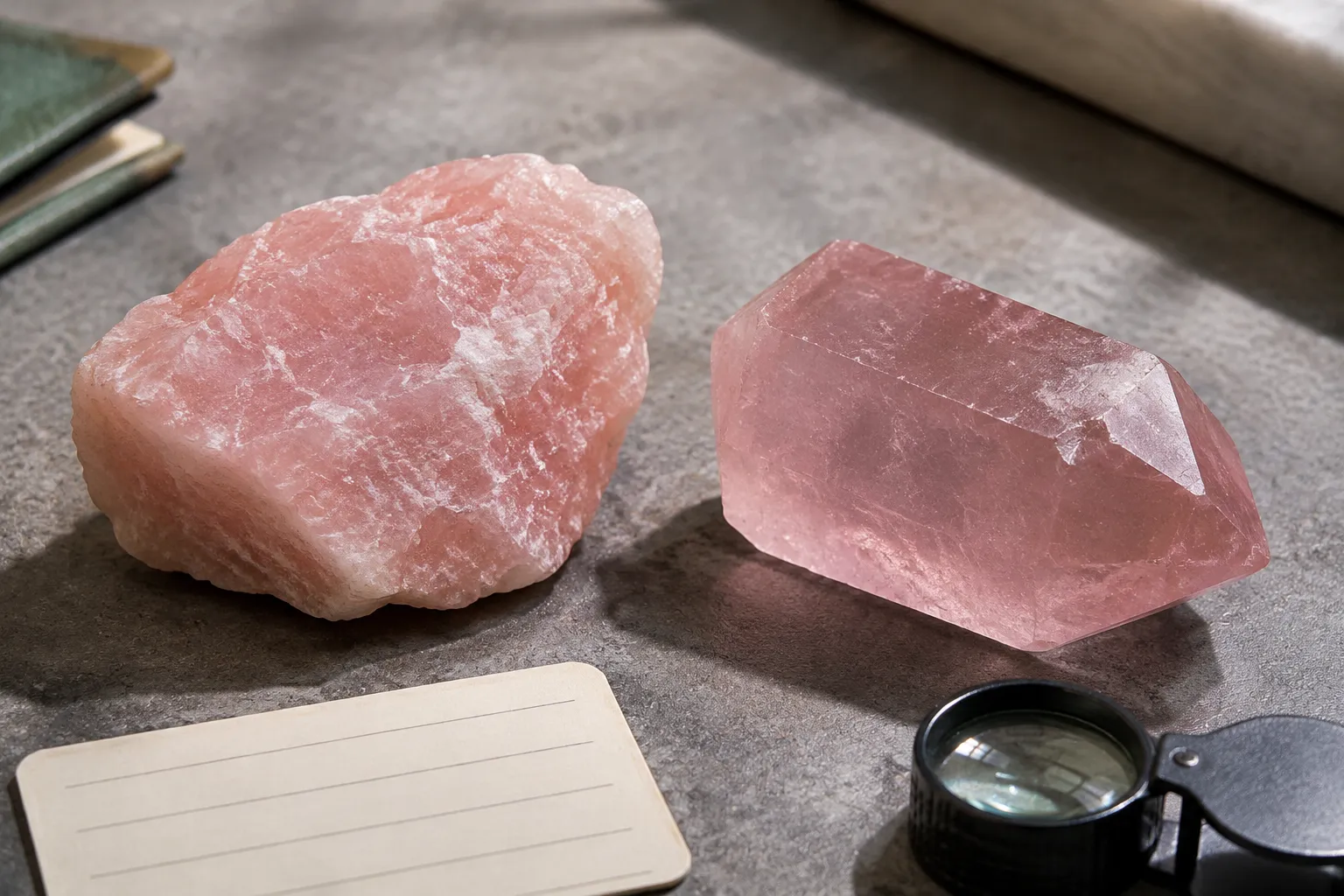
Hold the specimen where light can move across it. The first question is not “Is this real rose quartz?” but “What kind of form can I actually see?” A piece with uneven bulges, broken-looking boundaries, sugary texture, or no repeated flat planes may be described as anhedral-looking. It reads as a mineral mass or fragment rather than a clean individual crystal.
A euhedral-looking specimen gives the eye more geometry. You may see flat mineral faces meeting at edges, a repeated outline, or a pointed end that resembles a crystal termination. In quartz-like material, shoppers and collectors often notice these features on pieces labeled as points, clusters, or terminated crystals. The careful wording is important: visible faces may suggest a more complete crystal form, but they do not prove quartz identity by themselves.
Market shape can blur the comparison. A polished tower may have sharp planes because it was cut that way. A raw piece may look naturally irregular because it broke from a larger mass. A pale pink crystal may show faces, but color and shape still need stronger context before anyone can responsibly call it a confirmed rose quartz specimen.
The Cues That Matter Most
The cleanest comparison begins with three visible clues: faces, terminations, and interruption. None is a final answer, but each helps you describe what is in front of you.
| Visible clue | More anhedral-looking | More euhedral-looking | What it cannot prove |
|---|---|---|---|
| Mineral faces | No obvious flat crystal faces; surfaces look uneven, granular, or broken | Several flat planes meet along sharper edges | Mineral identity, authenticity, or source |
| Crystal terminations | No clear end point; the piece looks like a mass or fragment | One or more pointed or shaped ends appear to close the crystal | That the point is natural rather than shaped |
| Growth interruption | Boundaries look crowded, fused, or cut off by surrounding material | Outline appears more complete and self-defined | Exact formation history or value |
| Pink color | Color is present but form is irregular | Color appears in a more crystal-like body | That the material is rose quartz |
Anhedral-looking clues
Anhedral quartz visible clues are usually about absence or interruption: no clear faces, no obvious termination, no self-contained crystal outline. The surface may still be translucent, milky, pink, or visually interesting, but the form does not give a complete crystal shape. In a shop or collection tray, this may be called rough rose quartz, raw quartz, or a massive piece. Those phrases are descriptive, not guarantees.
Euhedral-looking clues
Euhedral quartz crystal faces are about visible order. If planes meet in a repeated way and the specimen has a more complete outline, the form may be described as euhedral-looking. Quartz crystal terminations, when present, are among the easiest features for beginners to notice. Still, a visible point is only a form clue. It cannot tell you whether the specimen was naturally terminated, polished into shape, repaired, treated, or correctly named.
Why Pink Quartz-Like Specimens Confuse the Eye
Pink color encourages quick labeling. Many readers arrive at a specimen already thinking “rose quartz,” then try to use form as confirmation. That is where the comparison can mislead. A pink, irregular, anhedral-looking stone may be quartz-like, but the visible form does not prove it. A pink, euhedral-looking crystal may appear more diagnostic, but appearance alone still cannot confirm the mineral name.
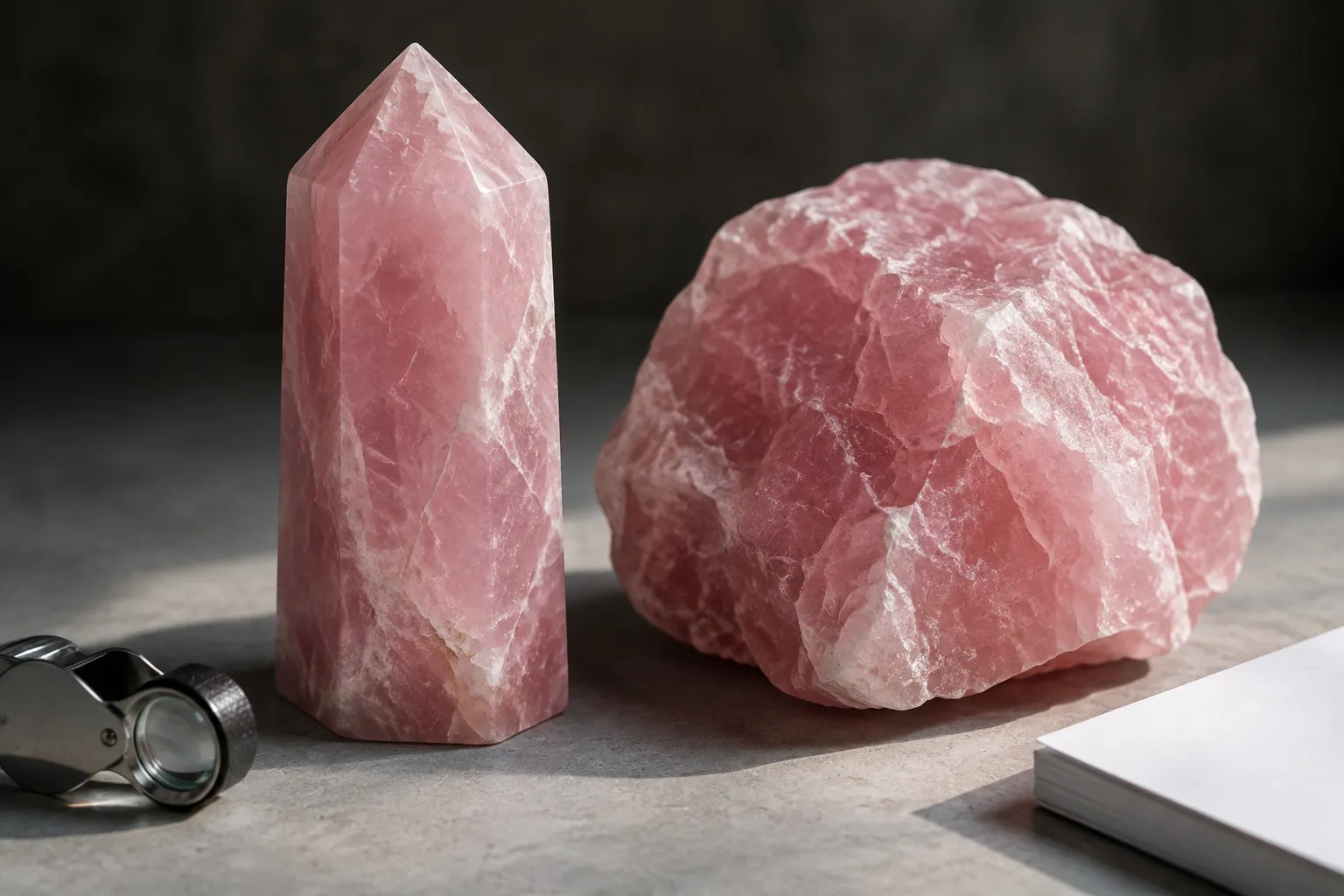
Polished pieces deserve a separate look. Towers, points, spheres, hearts, and display stones may borrow crystal language while showing human-made geometry. A carved point can have faces and a termination-like tip without being a natural euhedral crystal. In that case, the correct observation is simple: the object has shaped faces. The form label should not be stretched into a claim about origin.
Raw pieces create the opposite confusion. A rough pink chunk with no clear faces may still be sold as rose quartz, and it may be meaningful as decor or symbolic material to its owner. But an anhedral-looking surface should not be treated as lower value, fake, or geologically unimportant by appearance alone. Irregular form only says that the visible crystal shape is incomplete or not clearly expressed from the outside.
Collector mineral terminology can compress several ideas into one label. “Massive,” “raw,” “natural,” “point,” “terminated,” and “crystal” are often used in casual or commercial settings with different levels of precision. For this page, the narrow reading is the useful one: anhedral and euhedral describe visible crystal form. They do not settle authenticity, price, provenance, or personal meaning.
Where Granite Pegmatite Cores Fit
Some rose quartz discussions mention granite pegmatite cores because rose quartz is often discussed in relation to pegmatitic environments. That context has to stay limited here. Without a usable public source tied to the specimen in hand, the phrase should not be used as proof for a loose pink stone on a shelf.
If a specimen comes with credible geological context from a reliable source, formation setting may help explain why some quartz occurs as massive material while other quartz shows clearer crystal faces. Without that context, “granite pegmatite cores” is not a visual identification tool.
You can note that a specimen looks massive, broken, face-rich, or termination-like. You cannot look at a pink stone and confirm its original pocket, host rock, mining source, or formation sequence from shape alone. The visible object gives clues; it does not give a full geological record.
A Practical Comparison Method
- 1. Compare the outline. Place two pieces side by side under steady light and describe only what is visible. Does one piece have a more complete crystal body, or do both look like fragments from larger material?
- 2. Read the surface. Are there flat mineral faces that meet in a repeated pattern, or are the planes mostly broken, rounded, polished, or irregular?
- 3. Look for terminations. A natural-looking termination may appear as the closing end of a crystal form, but polished points and towers need caution. If the faces are unusually smooth, symmetrical, or decorative, the piece may have been shaped for display. That does not make it uninteresting; it simply changes what the form can tell you.
- 4. Separate form from identity. A useful note might read: “pale pink, translucent areas, irregular massive surface, no visible termination,” or “pink quartz-like crystal with several flat faces and one termination-like end.” These specimen observation clues are more accurate than forcing a yes-or-no verdict. They leave room for better evidence later.
Keep symbolic use in its own lane. Rose quartz is commonly associated with softness, affection, emotional reflection, and gentle interior warmth, but those meanings are better treated as symbolic language. A euhedral-looking point is not more effective than an anhedral-looking chunk in any provable way from appearance. A room placement or ritual use can be personally meaningful without becoming a mineral identification claim.
What This Comparison Can and Cannot Tell You
What form language can do
Anhedral versus euhedral form can help you speak more precisely about a pink mineral object. It points attention toward mineral faces in quartz-like material, crystal terminations, interrupted growth clues, and the difference between a natural-looking surface and a shaped display object. That is useful mineral literacy.
What it cannot do
It cannot do the heavier work. Appearance alone cannot confirm that the piece is quartz, that it is rose quartz, that it came from a particular origin, that it has a certain value, that it is untreated, or that it will produce a personal outcome. Those questions require better evidence than casual viewing can provide.
The most reliable habit is to write what you see before naming what you believe. “Anhedral-looking pink quartz-like mass” and “euhedral-looking pink crystal with visible faces” are cautious descriptions. They help you compare specimens without turning surface clues into certainty.
Quick FAQ
Is anhedral rose quartz less real than euhedral rose quartz?
No conclusion like that can be made from form alone. An anhedral-looking piece may simply show irregular or incomplete visible crystal form. It does not prove or disprove rose quartz authenticity.
Do crystal terminations prove a pink specimen is quartz?
No. A termination-like shape is a visible form clue, not a mineral identification result. It may help describe the specimen, but appearance alone cannot confirm the mineral name.
Are polished pink towers euhedral crystals?
Not necessarily. A polished tower may have faces and a point because it was shaped for display. It can be described as having geometric surfaces, but that is different from confirming a natural euhedral crystal form.
The practical answer is modest: use anhedral and euhedral as form language first. Let visible faces, terminations, and irregular surfaces guide your description, then stop before claiming identity, origin, value, authenticity, or effects. That keeps the specimen before the symbol, and it keeps pink quartz comparison grounded in what the object can actually show.