Material note
The Return of Raw: Why Unpolished Anhedral Quartz Dominates 2026 Aesthetics
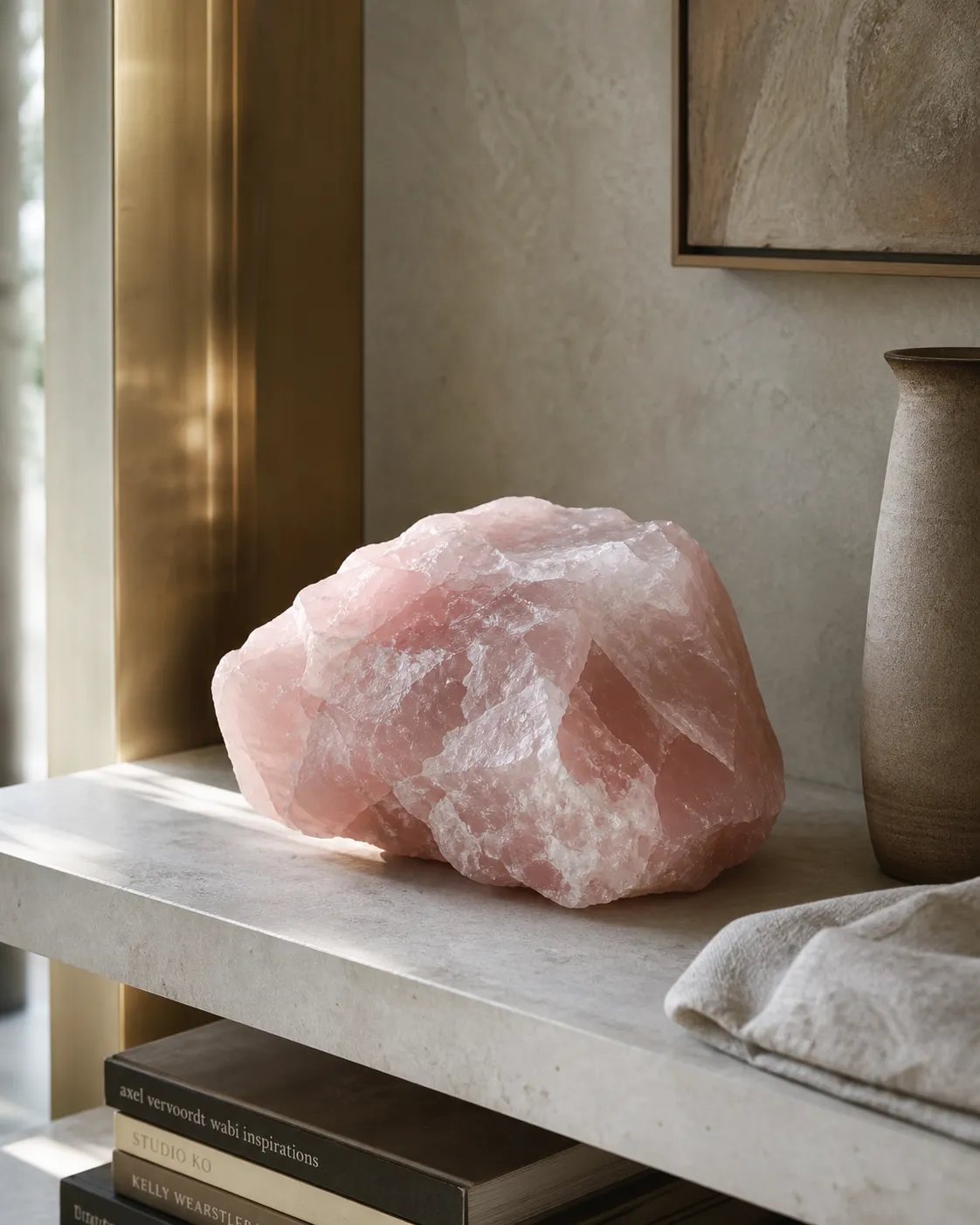
A raw rose quartz chunk does not behave like a polished object. Its cloudy pink body, uneven edges, and broken planes hold the eye because they look less manufactured and more mineral. That is why Raw Quartz Aesthetics feels so current for 2026: unpolished anhedral quartz gives a room interruption, tactility, and geologic irregularity at a time when many interiors are already full of smooth engineered surfaces.
“Dominates” is best read as aesthetic shorthand, not as a proven market statistic. The firmer evidence sits in the material itself: quartz can break with curved, shell-like fracture surfaces, and rose quartz is often described as occurring in massive material rather than perfect individual points. The decor argument grows from that material reality.
broader context
Broader rose quartz guide
This narrower page makes more sense after the broader rose quartz context page.
Why anhedral quartz feels more current than perfect points
Anhedral quartz has no clean, self-formed crystal outline. Instead of a textbook point or neatly terminated cluster, it appears as a mass, broken lump, cloudy body, or fragment with irregular edges. For rose quartz, that matters because gemological descriptions often distinguish its massive, chunk-like occurrence from the public image of quartz as sharp, transparent crystals.
That difference gives unpolished anhedral quartz its visual force. A polished sphere, heart, tower, or palm stone turns the mineral into a designed object. A raw chunk keeps more of the specimen’s interruption: cloudy translucence, uneven color, internal veils, rough planes, bruised-looking edges, and asymmetry that does not look molded.
In a room, that asymmetry reads as grounded mineral decor. A palm-sized rose quartz mass on a stone shelf can soften a hard surface because the pink is muted and the form is unfinished. A larger raw piece near linen, unglazed ceramic, wood, or brushed metal can act as a visual stop; the eye pauses because the object refuses perfect geometry.
This is also where the quartz points misconception matters. Many people imagine quartz as clear, pointed crystals, then treat rose quartz points as the default ideal. But much rose quartz is encountered as massive material. The raw aesthetic is not a failed version of a point; it is closer to how rose quartz often appears as material.
The texture comes from fracture, not styling
The most persuasive surface feature in raw quartz decor is not trend language. It is fracture behavior. Quartz is a brittle mineral and does not split into smooth repeated planes the way minerals with strong cleavage can. When it breaks, the surface may be conchoidal: curved, shell-like, scooped, or ripple-marked rather than flat and orderly.
Conchoidal fractures in quartz create the texture many design objects try to imitate: broken light, shallow arcs, uneven reflectivity, and movement across a still surface. On rose quartz, fractured areas may look waxy, matte, glassy in small flashes, or clouded depending on the piece and lighting. A polished finish usually reduces that conflict. It turns roughness into a more controlled shine.
That is the quiet appeal of tactile rough quartz. One edge may be granular and dull; another may show a curved fracture; another may reveal clouded translucence where light enters but does not pass cleanly through. The piece looks still, but its surface stays visually active.
This does not mean raw is automatically more authentic. A raw-looking surface can still be sold with vague marketplace language, and a polished piece can still be natural quartz. The narrower distinction is more useful: unpolished mineral surfaces leave more visible evidence of breakage, mass, opacity, and internal clouding. Polished surfaces emphasize finish, contour, and reflection.
Why 2026 decor language favors the unfinished
The available source set does not prove a formal, independent 2026 trend in raw anhedral quartz. What it does show is a useful contrast. Adjacent surface industries often speak in terms of warmth, veining, softness, durability, hygiene, and refined engineered performance. Those words mostly belong to countertops, solid surfaces, and manufactured design materials, not to raw mineral specimens.
Raw quartz moves in the opposite direction. It does not simulate veining across a slab. It presents actual mineral irregularity. It does not promise seamless performance. It sits as a fragment. It does not need a flawless surface to look intentional.
That is why the return of raw feels plausible as an aesthetic mood, even without strong trend-reporting evidence. Interiors often swing between refinement and resistance to refinement. After years of glossy stone looks, porcelain imitations, engineered quartz patterns, and smooth sculptural accessories, an unpolished anhedral piece can feel more immediate. It is not warmer because it produces measured effects; it reads warmer because its surface is visibly less perfected.
Rose quartz adds another layer because its color is culturally read as soft, intimate, and emotionally warm. Those are symbolic associations, not scientific properties. Still, in interiors, symbolism shapes perception. A raw rose quartz chunk can look gentler than smoky quartz or clear quartz while still retaining mineral weight. The pink is not the whole story; the unfinished body keeps it from becoming sugary.
Where “grounding” belongs
Grounding decor is an aesthetic description here: weight, stillness, roughness, low shine, visible material age, and a sense of contact with stone. It should not be stretched into claims about measurable emotional or bodily outcomes. The object can support a room’s mood without being framed as an intervention.
Raw versus polished quartz: the useful difference
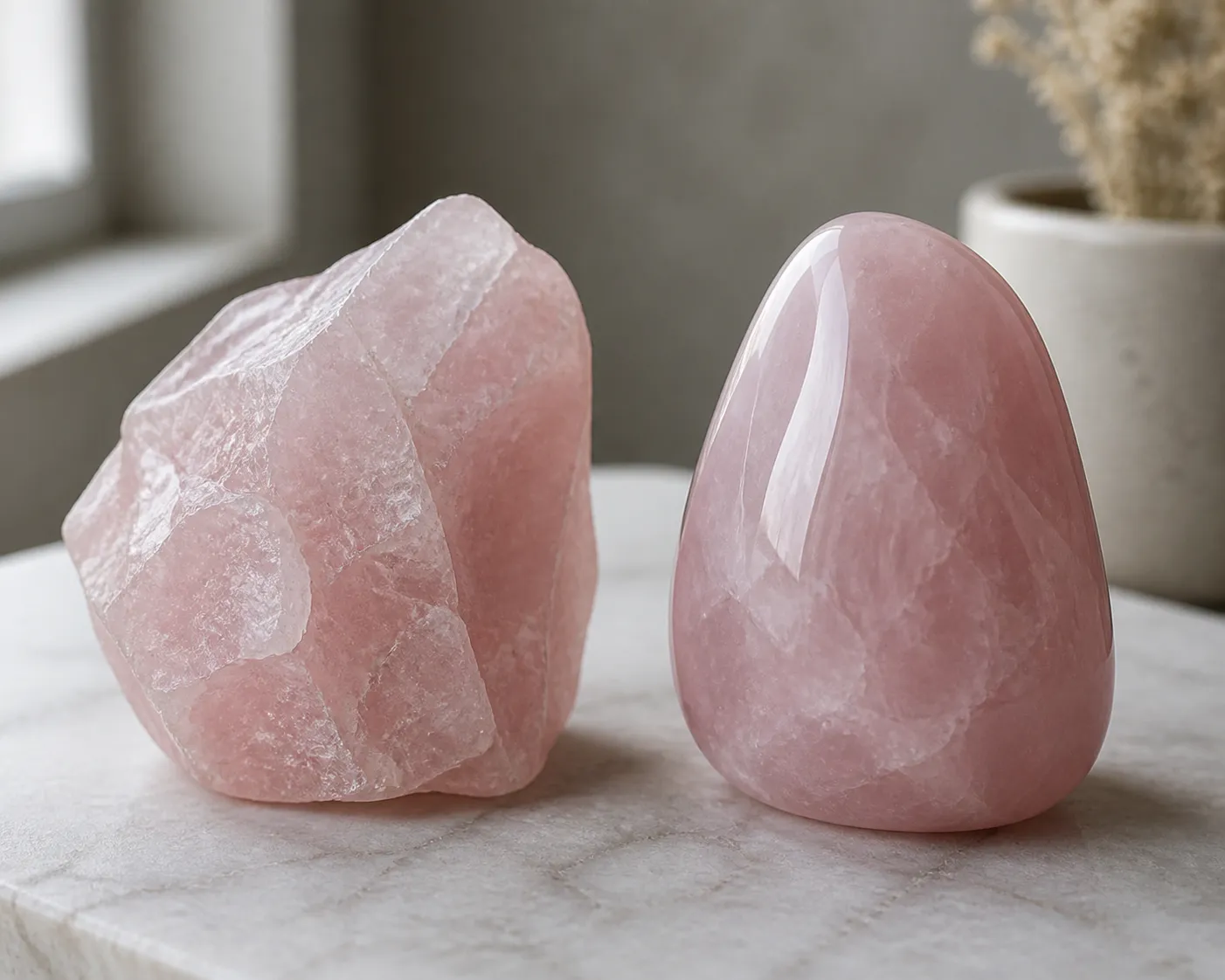
The simplest comparison is surface control. Polished quartz has been cut, tumbled, ground, or finished so it appears smoother and more refined. Raw or unpolished quartz keeps rougher planes, broken edges, pits, cloudy zones, and irregular profiles. Neither category automatically proves value, purity, or origin.
Raw anhedral quartz
- Shape: irregular, mass-like, often asymmetrical.
- Surface: rough, fractured, cloudy, uneven.
- Visual mood: mineral, grounded, interrupted.
- Best use: texture contrast, shelf weight, natural interruption.
- Common confusion: mistaken for lower quality because it is unfinished.
Polished quartz
- Shape: controlled, rounded, carved, or geometric.
- Surface: smooth, glossy, reflective, refined.
- Visual mood: decorative, finished, intentional.
- Best use: soft shine, handled objects, symmetrical styling.
- Common confusion: mistaken as automatically more authentic or valuable.
The raw form is strongest when a room already has too much smoothness. Place it near clean planes: a plaster ledge, a simple table, a neutral stone tray, a matte black shelf, or a pale wood cabinet. The quartz then becomes the exception. Its unevenness has a job.
Polished quartz works differently. A rose quartz sphere, carved heart, or smooth tower can be useful where the interior already has many rough textures and needs a calmer object. Polishing can also make color feel more legible because the surface catches light more evenly. The point is not that raw defeats polished. The point is that raw quartz fits the current taste for visible material tension more directly.
Common confusion around raw quartz decor
“Natural” is not verification
Sellers may use natural, rare, museum, raw, clear, point, and cluster language loosely, especially in marketplace settings. Those words can intensify desirability, but they do not verify provenance, quality, or authenticity by themselves. For a decor reader, the safer question is visual and material: does the piece show the form, surface, translucence, and irregularity you actually want?
Engineered quartz is a different category
Engineered quartz surfaces are manufactured materials used in countertops and interior applications; they may contain quartz, resins, pigments, and designed patterns depending on the product. Raw quartz specimens are mineral pieces. Quartzite is a different natural rock. Solid surface products are another category again. These terms should not be collapsed just because they appear in the same design search environment.
Energy language belongs to belief and ritual vocabulary
Some readers ask whether raw crystals have stronger energy than polished ones. That belongs to belief, ritual, and cultural vocabulary, not mineralogical evidence. If a raw rose quartz piece feels more suitable for a quiet shelf, bedside ritual object, or symbolic arrangement, the supportable explanation is visual and contextual: rougher form, softer color, tactile presence, and personal association. The page evidence does not support outcome claims.
Display decor is not fabrication work
Intact quartz used as display decor is different from dust-generating fabrication. Silica dust concern belongs to cutting, drilling, grinding, dry polishing, or similar work that can create respirable particles. This article is not a fabrication guide; altering quartz moves outside ordinary decor use and into occupational-safety guidance and professional controls.
When raw anhedral quartz does not fit
Raw unpolished quartz is not automatically the right choice for every room. If the space depends on high polish, symmetry, reflective light, or easy-to-clean decorative objects, a rough chunk can look accidental. Its edges may visually snag against glossy acrylic, mirrored finishes, or formal arrangements unless the contrast is deliberate.
It can also feel visually heavy. Even pale rose quartz has mineral weight because the form is irregular and dense-looking. In a small arrangement, one raw chunk may be enough. Several pieces together can shift from grounded to cluttered, especially if each specimen has a different base color, fracture pattern, or opacity.
The aesthetic also weakens when rawness is treated as a label rather than observed. A piece marketed as raw may still be partly cut, cleaned, stabilized, or shaped. Conversely, a polished piece is not fake simply because it is smooth. The useful decor decision is not “raw equals real.” It is whether the visible surface supports the room’s intended balance between softness and mineral interruption.
For rose quartz specifically, do not expect every specimen to be vivid pink or sharply crystalline. Many pieces are pale, cloudy, milky, unevenly colored, or more translucent at the edges than through the body. Those qualities are not failures in the raw aesthetic; they are often the reason the piece feels less commercial and more materially present.
The short answer, with the boundary kept
Unpolished anhedral quartz fits 2026 aesthetics because it brings irregular form, conchoidal fracture texture, cloudy translucence, and tactile mineral presence into rooms that have grown fluent in smooth engineered surfaces. Rose quartz makes that rawness softer without removing the geology; its massive chunk form can sit between material reality and symbolic warmth.
The limit is important. The sources support quartz fracture behavior, raw-versus-polished surface differences, and the common massive occurrence of rose quartz better than they support sweeping trend claims. So the strongest reading is not that raw quartz is proven to dominate every 2026 interior. It is that raw anhedral quartz gives the year’s decor language a convincing mineral counterweight: unfinished, grounded, pink quartz without promise language.