Crystal care note
Lunar Bathing Unveiled: The Only Safe Way to Charge Photosensitive Quartz in 2026
For Lunar Quartz Cleansing with photosensitive quartz, the lowest-risk method is simple: keep the stone dry, indoors, and away from direct sun. Place it on a clean cloth, tray, or dish near a window at night, treat the “charging” as ritual language, and move it back before morning light reaches it.
That is the safest useful answer. Moonlight is chosen here because it is a low-light alternative to sun exposure, not because there is solid evidence that moonlight physically resets quartz. If the piece is dyed, coated, cracked, included, set in jewelry, unusually valuable, or of unknown treatment history, stay even more conservative: dry surface, low handling, no water, no salt, no soil, no outdoor dew.
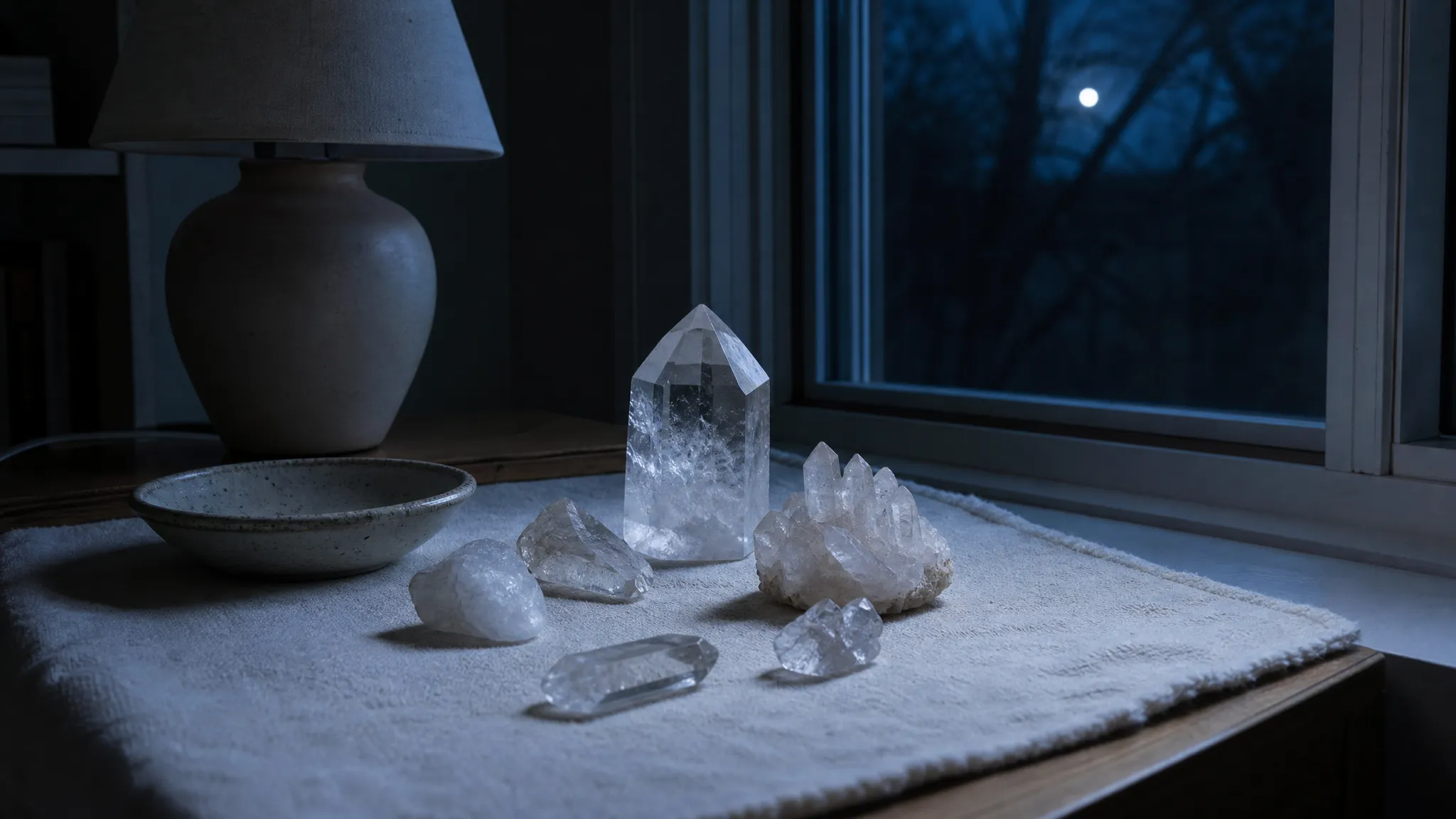
The lowest-risk lunar bathing setup
A careful lunar bathing ritual does not need a dramatic outdoor altar. For photosensitive quartz care, boring is usually better.
Use this version:
- Choose indoor moonlight or night ambience.
A windowsill, shelf, or small table near a window is enough. The ritual meaning can come from timing and intention; the stone does not need intense exposure. - Place the quartz on a dry, soft surface.
Cotton cloth, felt, a ceramic dish, or a clean tray helps avoid scratches and keeps the piece away from damp ledges, soil, or rough stone. - Keep it away from sunrise.
If it stays out overnight, set a reminder. The bigger care risk is often accidental morning sun, not the moonlit part of the ritual. - Skip misting, soaking, salt, burial, and open-sky exposure when the specimen history is unclear.
Clear quartz, rose quartz, amethyst, smoky quartz, included quartz, aura-coated quartz, dyed quartz, and jewelry-mounted quartz may have very different surfaces, treatments, or weak points. - Use short exposure as a ritual boundary, not a technical requirement.
A few hours beside a window can be enough for the symbolic act. Longer moon exposure should not be presented as creating a stronger measurable result.
So “the only safe way” means this: the most conservative version is dry, low-light, shaded from sun, and reversible. It should not require heat, water, chemicals, abrasion, or prolonged display.
Why moonlight is the gentler choice
Quartz is not one practical care category. A stone’s behavior can be shaped by impurities, defects, inclusions, treatments, heating, irradiation, coatings, and previous handling. Technical quartz research does not turn into a home charging recipe, but it does support caution around broad claims such as “all quartz can sit in sunlight” or “all quartz resets the same way.”
The care boundary is narrower and more useful: strong light and UV exposure can matter for light-sensitive minerals, and some quartz specimens or quartz sold in crystal markets may be more complex than they look. Research on light-sensitive minerals under accelerated UVA exposure has reported color changes in tested mineral phases, while also noting that accelerated testing is not a direct prediction of normal home display. That is enough to support a cautious habit: avoid unnecessary UV when color, treatment history, or value matters.
Moonlight is attractive because it avoids the obvious problems of direct sun: brighter light, stronger UV, heat, and long daytime exposure. It does not prove that moonlight “charges” quartz in a measurable way.
Many crystal keepers use moonlight as a low-light ritual alternative to sun exposure, and that choice fits conservative care for stones where UV, heat, treatment history, or color stability are concerns.
That keeps the ritual language intact without turning it into a material-science claim.
When to be extra conservative
The lowest-risk method becomes stricter when the quartz is not a plain, untreated, durable specimen. In everyday collections, the label “quartz” can hide a lot.
Be more careful if your piece is:
Dyed or color-enhanced
Dye may be more vulnerable than the quartz itself. If color gathers in cracks, looks unusually saturated, or transfers slightly onto cloth, avoid water, salt, sun, and outdoor exposure.
Coated or “aura” treated
Metallic or iridescent coatings are surface features. The quartz underneath may be hard, but the coating can be the fragile part.
Irradiated or heat-treated
Some quartz on the market owes its appearance to treatment. Without reliable history, do not assume it behaves like an untreated crystal.
Included, fractured, or heavily veiled
Cracks and inclusions can trap moisture or residue. A dry indoor tray is safer than soil, dew, salt, or running water.
Set in jewelry or mixed with metal, glue, cord, or backing material
The non-quartz parts may be more sensitive than the stone. Metal can tarnish, adhesives can weaken, and cords can hold dampness.
Valuable, sentimental, antique, or hard to replace
When the piece matters, avoid experiments. Use the least invasive ritual possible.
“Photosensitive quartz” also needs careful wording. In strict mineral terms, not every quartz specimen is meaningfully photosensitive in the same way. In collector language, the concern often includes fading, treatments, coatings, and uncertainty. Since most home keepers do not know the full history of a specimen, it is sensible to treat strong light, heat, moisture, and chemicals as unnecessary risks.
Night dew is the quiet risk in outdoor moon rituals
Outdoor lunar bathing looks beautiful, but night dew is the variable many instructions skip.
For a plain, solid quartz piece, brief contact with clean water may not automatically damage the mineral. But that is different from saying outdoor dew is harmless for every quartz object sold as a crystal. Dew can settle into fractures, under coatings, around glued areas, inside bead holes, beneath metal settings, or along dusty outdoor surfaces.
If your goal is low-risk moonlight quartz cleansing, do not make dew part of the method. Use one of these safer versions:
- place the quartz indoors near a window;
- use a covered dry tray only if the stone stays protected from condensation;
- bring the piece in before moisture forms;
- skip outdoor exposure for jewelry, coated stones, dyed stones, and cracked specimens.
The point is not that dew is always damaging. The point is that dew adds a risk the ritual does not need.
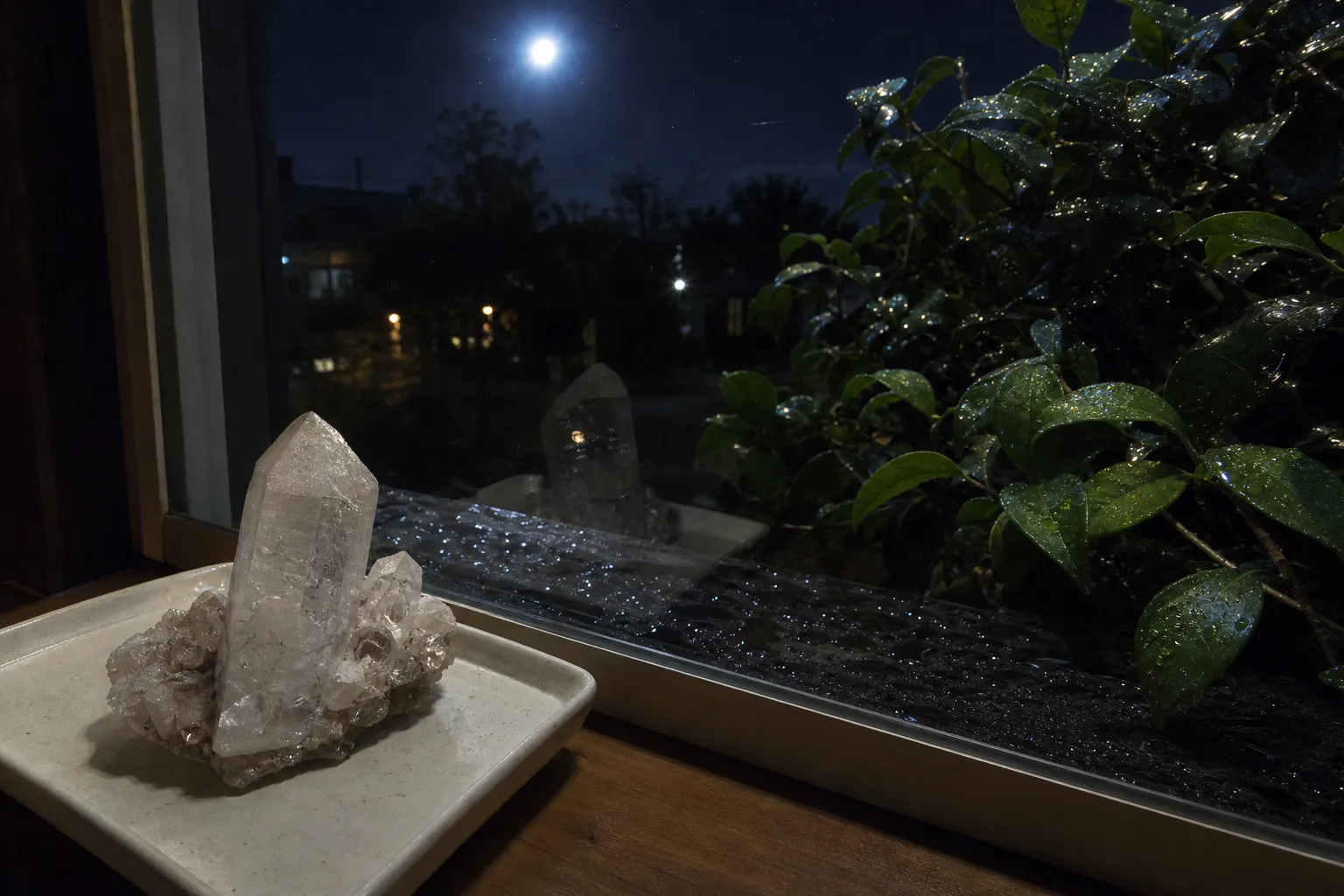
“Passive Radiation Resetting” is not a care claim to rely on
Some quartz language borrows the sound of technical mineral science. “Passive Radiation Resetting” is one of those phrases. It can imply that moonlight clears stored radiation, resets internal defects, or changes the stone’s physical state in a predictable way.
That is not a supported household-care claim.
Quartz is important in luminescence dating and dosimetry because crystal defects can record aspects of radiation exposure. In laboratory and geoscience contexts, light exposure, heat, irradiation, impurities, and thermal history can affect signals measured from quartz grains. Those controlled technical uses do not show that a moonlight ritual resets a crystal on a windowsill.
For this page’s practical question:
- it is reasonable to call lunar bathing a ritual cleansing or symbolic charging practice if that matches your tradition or personal language;
- it is not reasonable to present it as a proven physical reset, radiation-clearing method, or measurable energy restoration;
- technical terms from luminescence, radiation, or defect physics should not be used as proof for crystal-charging instructions.
A moonlight ritual can be meaningful without pretending to be a laboratory process.
A concise care rule for 2026
If the quartz may be light-sensitive, treated, coated, dyed, cracked, included, metal-set, valuable, or historically uncertain, choose dry indoor moonlight over direct sun, water, salt, soil, heat, or outdoor dew.
That rule does not prove the quartz has been charged. It simply aligns the ritual with conservative material care: low light, low moisture, low handling, and no unnecessary stress.
If you want the practice to feel complete without increasing risk, add symbolic actions that do not physically alter the stone: write an intention on paper, place the quartz on a clean cloth, use a covered dish, or return it to storage before sunrise.
Common points of confusion
Can I put rose quartz or amethyst in full moonlight?
The lower-risk version is indoor full moonlight near a window, not outdoor exposure. Rose quartz and amethyst are often discussed around color and light sensitivity, but specimen history matters. Avoid direct sun, especially for repeated charging rituals or long display.
Is moonlight safe for every quartz?
No method should be described as safe for every quartz object. A plain quartz point, dyed tumbled stone, aura-coated crystal, cracked included specimen, and quartz ring all have different care concerns. When in doubt, keep it dry and indoors.
Does lunar bathing cleanse quartz scientifically?
The available material does not support that as a measurable material claim. “Cleansing” and “charging” are best treated as cultural, spiritual, or personal ritual language. The evidence-based care point is narrower: a dry moonlight-style practice can reduce avoidable exposure to direct sun, UV, heat, water, and dew.