Coherent breathing pacing
The 5-Second Pacing Rule: Breathing for Heart-Brain Coherence
Coherent breathing pacing usually means a simple rhythm: breathe in for about 5 seconds, breathe out for about 5 seconds, and repeat without forcing it. One full inhale-exhale cycle takes about 10 seconds, which works out to roughly six breaths per minute, often described as 0.1 Hz breathing.
That timing is why the 5-second breathing rule is often connected with HRV coherence breathing, resonance-frequency breathing, and “heart-brain coherence” language. The grounded version is much simpler than the language around it: keep the breath slow, smooth, and comfortable. It is a pacing method, not a lung-capacity test, not the same as formal HRV biofeedback, and not proof that every person has entered a measurable coherence state.
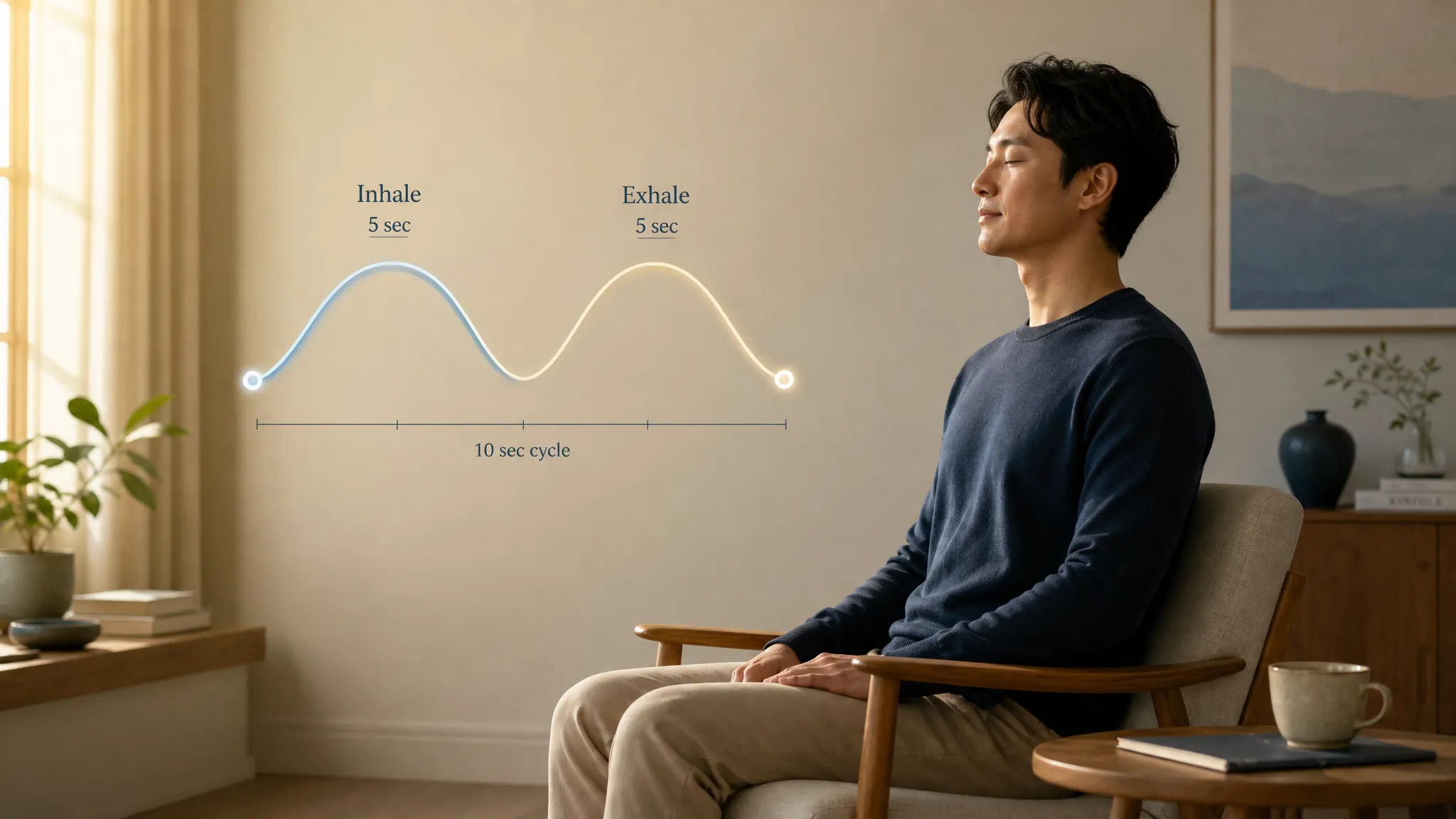
The 5-second inhale-exhale rule
The basic pattern is:
- Inhale gently for about 5 seconds.
- Exhale gently for about 5 seconds.
- Move between inhale and exhale without holding the breath.
- Repeat for a short window, such as one to three minutes at first.
The breath should not feel dramatic. A useful image is a sine-wave breath: the inhale rises gradually, crests without strain, and the exhale falls gradually again. If you are pulling in air, pushing it out, or waiting tensely for the count to finish, the rhythm is too effortful.
A simple pacing table looks like this:
Phase
Count
Practical cue
Inhale
5 seconds
Easy, gradual, not pulled in
Exhale
5 seconds
Smooth, unforced, not pushed out
Full respiratory cycle
10 seconds
One slow inhale-exhale pattern
Breathing rate
About 6 breaths per minute
A common slow-paced rhythm
A timer, visual pacer, or breathing app can help, but the display is not the practice. The useful question is whether the rhythm stays steady and comfortable enough to continue.
Why this rhythm is linked with HRV and coherence
The 5-second inhale / 5-second exhale pattern matters because of its timing. A 10-second respiratory cycle equals about six breaths per minute, close to the 0.1 Hz rhythm often discussed in HRV and resonance-frequency literature.
During slow, regular breathing, respiration, heart rate, and blood pressure rhythms can become more visibly patterned. One related term is respiratory sinus arrhythmia. In this context, it refers to the natural tendency for heart rate to speed up and slow down across the breathing cycle. The word “arrhythmia” can sound alarming, but this specific phrase describes a normal breathing-linked pattern.
Another related term is baroreflex, a pressure-regulating reflex involved in cardiovascular rhythm. In formal HRV biofeedback, practitioners may test breathing rates around a slow range—often near 4.5 to 6.5 breaths per minute—to find an individual’s resonance frequency. The familiar six-breaths-per-minute rhythm is a practical approximation within that broader field.
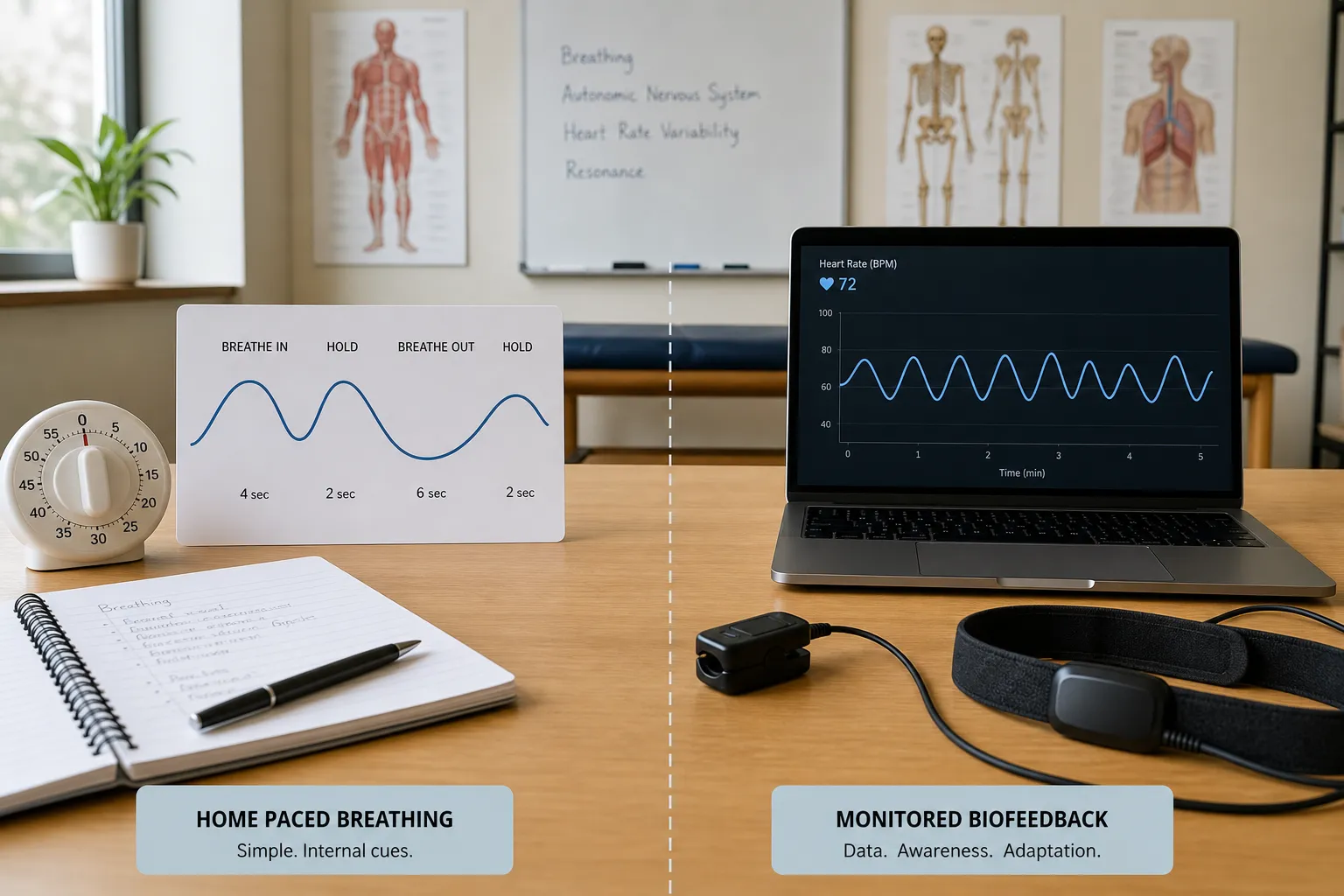
This is where “heart-brain coherence breathing” can be useful but easy to overstate. It is useful when it points to slow, coordinated breath pacing and HRV-related context. It becomes misleading when it is presented as a guaranteed state, a universal biological switch, or a personal measurement you can assume without sensors.
For ordinary practice, the clean distinction is:
- the breath is being paced slowly and regularly;
- the rhythm overlaps with common HRV and resonance-frequency discussions;
- physiology research gives a framework for why breath rhythm may interact with cardiovascular patterns;
- home practice without monitoring cannot confirm a precise HRV state for every person.
Coherent breathing pacing is therefore not the same as a full HRV biofeedback protocol. Biofeedback may involve sensors, individualized pacing, respiration monitoring, and interpretation of HRV patterns. The 5-second rule is only the simplified breath rhythm.
How the breath should feel
Comfort is the main practical cue. A good session should feel sustainable, quiet, and easy to stop. The breath may be slower than usual, but it should not create air hunger.
You can practice sitting upright, standing calmly, or lying down if that feels appropriate. Let the shoulders soften. Keep the jaw loose. Breathe through the nose if that is comfortable, or use another easy route if it is not. Avoid bracing the ribs, locking the belly, or trying to fill the lungs to their maximum.
Try one short round like this:
- Take two or three natural breaths.
- Inhale gently for 5 seconds.
- Exhale gently for 5 seconds.
- Continue for 6 to 12 cycles.
- Stop and let the breath return to normal.
That gives you about one to two minutes of coherent breathing pacing. Longer sessions exist in breathwork and biofeedback settings, but a short round is a better first test. If it feels steady, you can repeat it later. If it feels awkward or unpleasant, shorten the count.
When 5 seconds is not the right count
The 5-second pattern is an entry point, not a rule every body has to obey. Resonance-frequency discussions often treat the best-fitting rate as individual. Some people feel better slightly faster or slower than six breaths per minute.
If 5 seconds in and 5 seconds out feels too slow, try:
- 4 seconds in / 4 seconds out;
- 4 seconds in / 5 seconds out;
- 4 seconds in / 6 seconds out, only if it feels natural;
- a slower-than-usual breath without exact counting.
Longer exhalations are often used in relaxation settings, and research has examined whether inhale-to-exhale ratios affect HRV measures. The practical takeaway is not “longer is always better.” For this single pacing question, the better rule is: slow, smooth, and comfortable beats exact.
Do not add breath holds to this pattern. The 5-second pacing rule does not require pausing after the inhale or after the exhale.
Stop and return to natural breathing if you feel dizzy, short of breath, tingly, panicky, unusually warm, chest tight, or uncomfortable. Those signs do not mean you did it wrong. They mean the depth, timing, posture, or duration may not suit you in that moment.
People with heart or lung conditions, fainting history, severe panic symptoms, pregnancy-related concerns, or an active care plan should be conservative and seek qualified guidance when needed. Slow breathing practices overlap with cardiovascular and stress-response physiology, so personal context matters.
The common misunderstanding: “parasympathetic” as an on-switch
The word parasympathetic is often used as if breathing can flip the nervous system into one desired mode on command. That is too neat.
Slow-paced breathing is discussed in relation to parasympathetic activity, vagally mediated HRV, and autonomic regulation, but those are physiological contexts, not guaranteed instant outcomes. Some people find the rhythm settling. Others feel neutral. Some may feel uncomfortable if they breathe too deeply or count too rigidly.
A more careful translation is:
- “Heart-brain coherence breathing” usually points to slow, regular breath pacing within a coherence tradition.
- “0.1 Hz breathing” means roughly one full breath every 10 seconds.
- “HRV coherence breathing” refers to breath rhythms discussed in relation to heart rate variability.
- “Sine-wave breath” means a smooth rise and fall, not a forced deep breath.
- “Resonance-frequency breathing” is the more technical area where individual rates may be assessed with monitoring.
Keeping those meanings separate prevents the main confusion. The 5-second rule is a practical rhythm. It is not a universal proof of what is happening inside the body.
A grounded way to try it once
If you want to try coherent breathing pacing now, keep it modest:
- Sit comfortably and let your eyes rest on one point.
- Take two or three natural breaths first.
- Inhale gently for 5 seconds.
- Exhale gently for 5 seconds.
- Repeat for one minute.
- Stop before the breath becomes effortful.
Afterward, do not judge the session by whether something dramatic happened. A useful session may feel slightly steadier, neutral, or simply easier than normal breathing. If the count made you strain, shorten it.
The best verification point is not a special sensation. It is whether the breathing stayed smooth, easy, and repeatable. The 5-second pacing rule works best when it stays plain: a 10-second respiratory cycle, about six breaths per minute, used as a gentle rhythm. Its connection to HRV, cardiovascular rhythm, respiratory sinus arrhythmia, and coherence language gives it context. Its limits keep it honest.