Device-free attention
Ditch the Devices: The Science Behind Conscious Analog Observation Walks
Conscious analog observation walks are device-free walks built around slow, sensory noticing instead of tracking, photographing, or optimizing the experience. The science behind them is not that leaving your phone behind guarantees a better mind. It is quieter than that: environmental psychology and nature-cognition research suggest that natural and semi-natural settings can place gentler demands on attention than screen-mediated tasks often do.
When notifications, metrics, route apps, camera framing, and posting pressure are removed, there is less competition for directed attention. That leaves more room for texture, sound, color, temperature, movement, and spatial change to become the main things you notice.
The “analog” part matters because the walk is not anti-technology as a life rule. It is a temporary choice to observe without turning the outing into data.
broader context
Start with the main rose quartz page
This narrower page makes more sense after the broader rose quartz context page.
What Makes an Observation Walk Analog
An analog observation walk is not just an ordinary walk where the phone stays in a pocket. It has a different intention: to let the world be noticed directly, without using a screen as the frame that makes the walk meaningful.
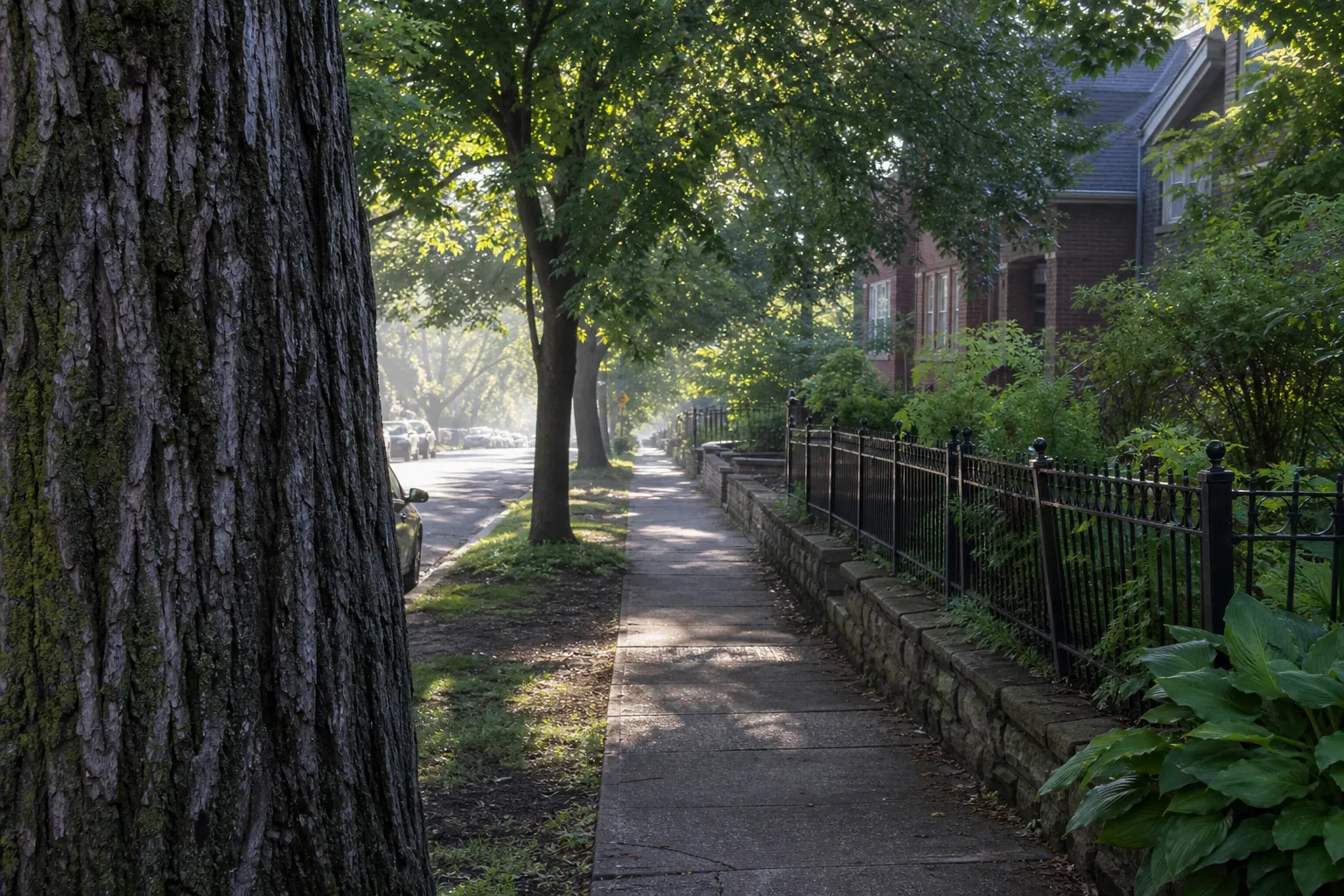
It does not require a forest, a remote trail, or a ritualized setting. A residential street, courtyard, city park, riverside path, garden edge, or familiar block can work if there is something to attend to. Leaves moving in wind, sun-warmed brick, worn stone steps, fence lines, bark, street shadows, bird movement, damp soil, pavement cracks, and changing light can all become part of the walk.
The practice is “conscious” because attention is chosen rather than passively pulled. It is “analog” because the main tools are the senses, the body, and the surrounding place. Someone might leave a phone at home, switch it off, or carry it for safety while deciding not to check, photograph, map, time, post, or log the walk.
That boundary keeps the walk from becoming another wellness task. Once the outing is measured and judged by output, attention can slide back toward performance: How many steps? Was the route scenic enough? Did it improve anything? Did it count?
A conscious analog walk asks a smaller question: what is actually here when I stop outsourcing the noticing?
Why Device-Free Sensory Attention Feels Different
The useful scientific frame is attention, not dramatic outcome. Attention restoration theory, often discussed in environmental psychology, distinguishes between effortful directed attention and the more gently held attention that certain environments may invite. Natural settings are commonly described as offering “soft fascination”: they can draw attention without requiring the same forceful concentration as a demanding task.
A screen often asks for directed attention even when the use feels casual. Messages, maps, camera choices, music selection, step counts, social feeds, and route decisions all compete for limited attentional space. Even pleasant device use can break a walk into small management loops: check, swipe, capture, compare, respond, save.
A device-free observation walk reduces some of that competition. Without the repeated invitation to manage information, the environment has a better chance to come forward. A person may notice the irregular rhythm of footsteps, the temperature difference between sun and shade, the way a tree canopy breaks up light, or how a familiar street feels after rain.
This does not mean natural environments automatically restore attention for everyone. Noise, safety concerns, pain, time pressure, weather, accessibility barriers, social stress, or an overstimulating route can all change the experience. A busy road with fast traffic may not feel spacious just because a tree is nearby.
The stronger claim is narrower: removing the device can reduce attentional load, and natural or everyday sensory detail may support a less effortful form of noticing. That is enough to explain why analog observation walking can feel calmer and less performative without turning it into a clinical claim.
Tactile Anchoring Without Making It a Protocol
Tactile anchoring is one practical way to keep the walk from becoming abstract. Instead of trying to empty the mind, the walker returns attention to physical contact: feet meeting the ground, air on skin, the weight of a coat, the texture of a stone wall touched briefly, the coolness of a railing, the grain of a fallen leaf, or the pressure of a small object held in the hand.
A small piece of rose quartz, for example, can be used as an ordinary tactile object: cool at first, smooth or slightly uneven depending on its finish, and weighty enough to remind the hand where it is. That use does not need an inflated claim. The stone is not doing the observing for the walker. It simply gives the hand a stable sensory reference.
The same role could be played by a key, wooden bead, shell, scarf edge, or jacket cuff. The important part is not the object’s story but its ability to bring attention back to immediate sensation.
A simple pattern might look like this
- Notice one point of contact with the ground.
- Notice one texture within reach or sight.
- Notice one sound that is not made by a device.
- Notice one change in light, air, or temperature.
- Continue walking without recording the observation.
The supplied research does not establish tactile anchoring outdoors as a validated method. It is better described as a gentle attention cue: a concrete place for attention to return when the mind starts planning, judging, rehearsing, or reaching for a phone.

The Role of Place: Soft Fascination Without the Wilderness Fantasy
“Biophilic immersion” can sound grand, but here it should stay simple. It means entering a living or life-adjacent environment with enough attention to notice its patterns: branching forms, seasonal color, irregular surfaces, wind movement, water reflection, birdsong, moss, mineral, soil, leaf litter, shadow, and weather.
The careful point is not that nature guarantees a result. It is that natural environments often contain layered stimuli that can interest attention without demanding constant decisions. A leaf edge, a changing cloud, or the sound of moving water does not ask to be answered. It can be noticed without requiring a reply.
Everyday places can participate in this too. A city walk may include plane trees, rain-darkened stone, reflected sky in windows, weeds in pavement seams, ironwork, lichen, planted balconies, and the color temperature of evening light. An analog observation walk does not require untouched wilderness. It asks the walker to let the real place be sufficient.
That distinction matters. If a “valid” observation walk requires a perfect landscape, special gear, and a photogenic route, the practice has already drifted away from its purpose. The quieter version works with what is available.
What Changes the Answer
The absence of a phone is one condition, not the whole practice. A device-free walk through a calm park may feel different from a device-free walk along a loud road where the walker must stay highly alert.
Several factors shape how well analog observation works:
Setting
Natural and semi-natural environments may better support soft fascination, but built environments can still offer meaningful sensory detail.
Safety
If the route requires constant vigilance, directed attention remains high.
Intention
The walk changes when the goal becomes recording, proving, timing, or producing a result.
Accessibility
Seated observation, short routes, adapted movement, or different sensory cues can preserve the core idea.
Device boundary
A phone carried for emergency use but not checked is different from a phone used to track and document the walk.
Expectation
The practice is more coherent when treated as noticing, not as a test of whether one feels improved afterward.
So “device-free observation walks” should not be read too rigidly. The deeper point is reduced attentional competition. For some people, that may mean no device at all. For others, it may mean a device present for safety but absent from the attention field.
Common Confusions About Conscious Analog Observation Walks
One common confusion is to treat the walk as a productivity hack. That shifts the center of gravity. If the walk becomes a way to force better output afterward, the mind is still working under performance pressure. The walk may still be pleasant, but it is no longer primarily observation.
Another confusion is to treat it as a substitute for formal mindfulness or health support. Mindfulness and attention research can offer useful background, but it does not show that casual analog walks reliably change mental health outcomes or resolve attention difficulties. This page’s evidence base supports a mechanism-level explanation, not a health-outcome promise.
A third confusion is the idea that device-free must mean anti-device. That is too blunt. Technology can support navigation, safety, accessibility, photography, communication, and learning. The analog walk simply sets a boundary for one period of time so the device does not become the main interpreter of the world.
There is also a subtler misunderstanding: assuming that observation must be profound. It does not. The walk can be ordinary. The noticed things can be small. A crack in a path, a branch shadow, the warmth of a stone step, the rhythm of a crossing signal, the muted color of winter grass—these are enough.
The point is not to manufacture meaning. It is to stop rushing past available detail.
The Evidence Limit Is Part of the Answer
The available research supports a careful explanation: nature exposure, soft fascination, directed attention demands, and reduced attentional competition can help explain why conscious analog observation walks may feel different from screen-mediated walking. Greenspace research gives broader context that natural environments have been studied in relation to health-related outcomes, but that does not mean one walk produces a measurable personal effect.
There is also no supplied firsthand evidence here: no curated field reports, long-term user accounts, practitioner testing, or formal comparisons of analog observation walking as a named practice. “Conscious analog observation walks” should therefore be understood as an editorial name for a low-tech observation habit, not an established scientific intervention.
That limit is not a flaw if the practice is kept modest. The walk does not need to promise transformation. Its value is more grounded: it creates a small container in which attention is not immediately converted into content, data, or achievement.
A useful test is simple: after the walk, ask whether you noticed something directly that you might otherwise have filtered through a device. If yes, the walk did what it was meant to do.
A Short Way to Try It
Choose a route that feels safe enough not to require constant monitoring. Set a device boundary before starting: leave the phone behind, turn it off, or carry it without checking it. Walk at a pace that allows observation rather than exercise performance.
For the first few minutes, notice contact: feet, air, clothing, ground, temperature. Then widen attention to the environment. Look for texture, color, shadow, sound, plant form, stone, weather, or movement. If the mind reaches for a metric or a photo, treat that as information rather than failure. Return to one sensory detail.
End without needing proof. No post, no score, no perfect insight. The walk can remain private.
That is the quiet science behind the practice: fewer competing signals, more room for soft attention, and a direct relationship with the place being walked through. Conscious analog observation walks are not a performance, a medical substitute, or a lifestyle badge. They are a deliberate pause in the habit of recording the world before fully seeing it.