Home office design note
Designing for Calm: Integrating Biophilic Shapes into the Home Office
A calmer-feeling home office usually starts with three choices: soften the shapes you see most often, give the eye more breathing room, and use natural references with restraint. In this article, Biophilic spatial energetics for home offices is treated as a design phrase, not a scientific or health claim. It describes how curved edges, organic outlines, softened transitions, and grounded materials can make a workspace feel more visually restful for some people.
The practical answer is simple: begin with your main sightline, reduce the harshest visual clutter, then add one or two organic forms where they support the room instead of competing with your work.
broader context
Broader rose quartz guide
This narrower page makes more sense after the broader rose quartz context page.
What biophilic shapes mean in a home office
Biophilic shapes are forms that loosely echo the natural world: curves, asymmetry, layered edges, rounded stones, leaves, branching lines, soft waves, imperfect ovals, and surfaces that do not feel mechanically sharp. In a home office, they can shift the room away from a strict grid and toward a softer, more composed atmosphere.
That does not mean every desk, shelf, lamp, and frame needs to become curved. A workspace still has to support writing, reading, video calls, storage, screen use, and clear movement. If the room feels calmer, it is usually because the shapes are balanced with the rest of the space.
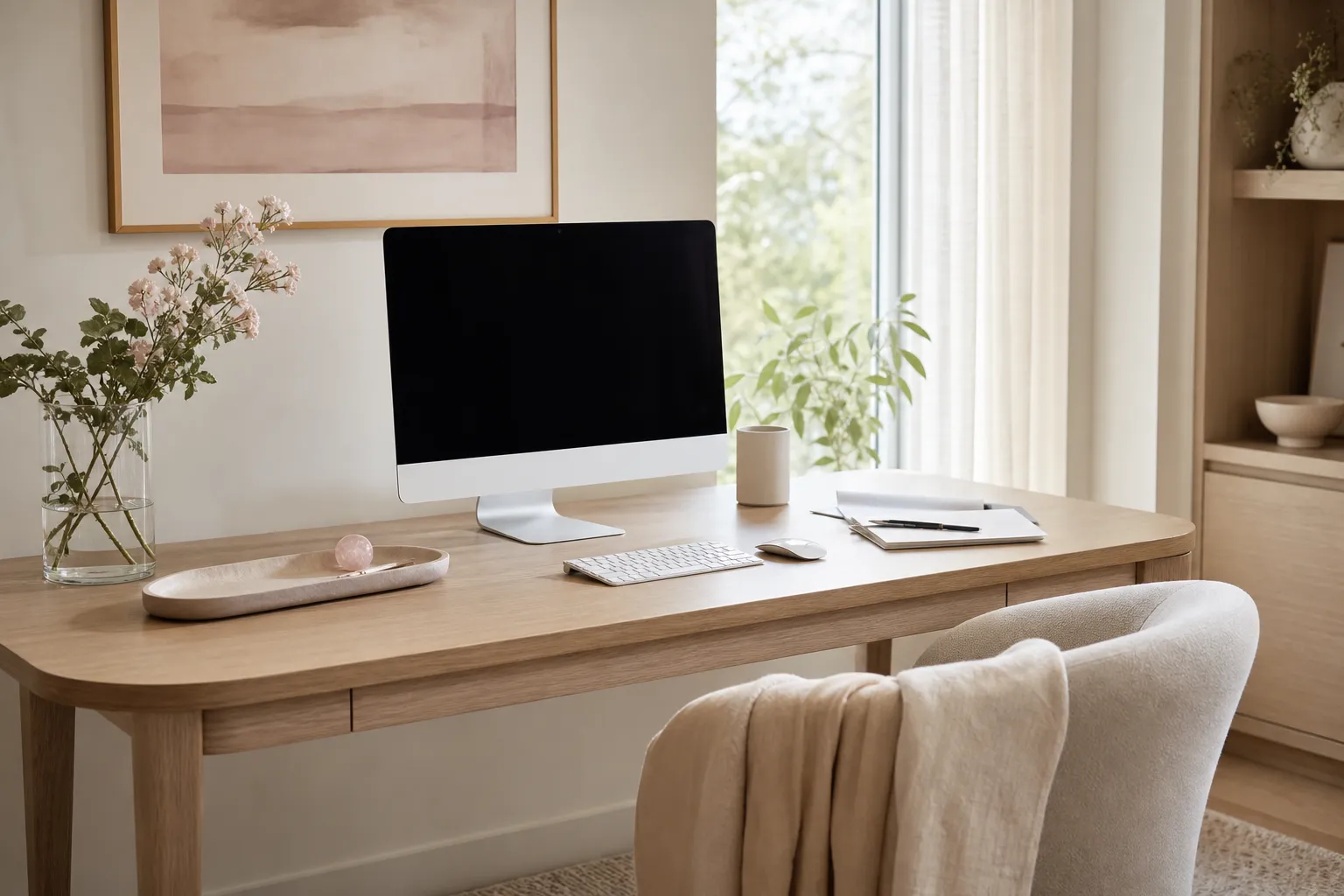
One rounded lamp on a severe desk may do more than several decorative objects. A curved chair back, oval tray, soft-edged rug, or small stone-like paperweight can change the room’s tone without making it harder to use.
The useful idea is not “nature decoration.” It is spatial softness. Ask where the eye lands, which edges feel tense, which areas feel crowded, and where the room feels boxed in. Organic geometry works best when it interrupts stiffness in a deliberate way.
For a rose quartz-minded interior, this can feel natural because the material already brings soft color, mineral irregularity, and symbolic tenderness in decorative contexts. The design value still comes from placement, scale, surface, color, and whether the object gives the eye a quiet pause.
Start with the working field
The most important zone is the part of the office you see while working: the desk surface, the wall or window beyond the screen, the objects near your keyboard, and the storage edges in your peripheral view. If that field is crowded, adding more organic forms may make the room feel busier rather than calmer.
Begin by removing or relocating objects that do not belong to the day’s work. This is not a rule about minimalism. It is a composition choice. Calm home office design often depends less on buying something new and more on reducing the number of shapes asking for attention.
Once the working field is clearer, add one or two softer forms where they can be seen without becoming obstacles:
- A rounded task lamp instead of a hard angular one.
- An oval or irregular tray for pens, notes, or small stones.
- A softly edged desk mat that breaks up a rectangular desktop.
- A plant with arching or trailing lines, if it suits your care habits.
- A curved chair silhouette when the desk and storage are very linear.
- A small rose quartz piece used as a visual rest point, not as a claim-making object.
The point is not to remove all straight lines. Home offices rely on useful rectangles: desks, screens, books, notebooks, drawers, and windows. Straight lines provide order. Curved and irregular forms can soften how that order feels.
A quick test helps. Sit in your chair and look at the room as if you were about to begin work. If the first impression is a grid of hard corners, introduce one organic shape near the center or lower edge of your view. If the first impression is clutter, remove objects before adding softness. If the room already feels restful, you may not need to change it.
Make organic geometry earn its place
Organic geometry works best when it has a job. In a workspace, that job might be to soften a transition, hold small items, interrupt a rigid line, or create a quieter focal point. When curved and irregular shapes are scattered everywhere, they can become another kind of visual noise.
Think in small groups rather than isolated purchases. A curved desk lamp, oval tray, and rounded stone can form one soft cluster on a desk. A wavy mirror, arched shelf, and trailing plant can make a wall feel less rigid. A round rug under a rectangular desk can change the room’s geometry from the floor upward.
Scale matters. A tiny curved object may disappear on a large, heavy desk. A large irregular object may feel intrusive in a narrow office. In a compact room, choose quieter forms: a rounded lampshade, curved bookends, soft-edged mouse pad, or one natural object with a calm outline. In a larger room, a curved chair, rounded cabinet edge, or organic wall shape can carry more visual weight.
Color changes how a shape reads. A bright, high-contrast curved object may feel energetic rather than restful. Softer tones such as blush, clay, sand, cream, warm gray, muted green, or mineral pink may feel quieter, depending on the surrounding palette. Rose quartz can belong here as a subtle color and material note. A polished piece may feel more refined; a rougher piece may feel more geological. Neither is automatically better.
Irregular shapes need space. An asymmetrical vase, freeform stone, or uneven wall object can feel natural and expressive, but too many irregular outlines may make a workspace feel restless. Let one uneven form be visible rather than burying it among many competing objects.
Soften screens, shelves, and corners
Many home offices feel tense because of abrupt transitions: a screen against a blank wall, a desk pushed into a sharp corner, shelves packed to the edge, cable lines cutting across the floor, or storage boxes stacked in hard blocks. Biophilic design language is most useful when it softens these joins.
Around a screen, the goal is not to decorate the monitor. It is to reduce the starkness of the view surrounding it. A curved lamp to one side, a small plant outside the main working zone, a low rounded tray, or a soft-toned object near the monitor base can make the desk composition feel less severe. Keep the central work area clear so the shape reads as a pause, not a distraction.
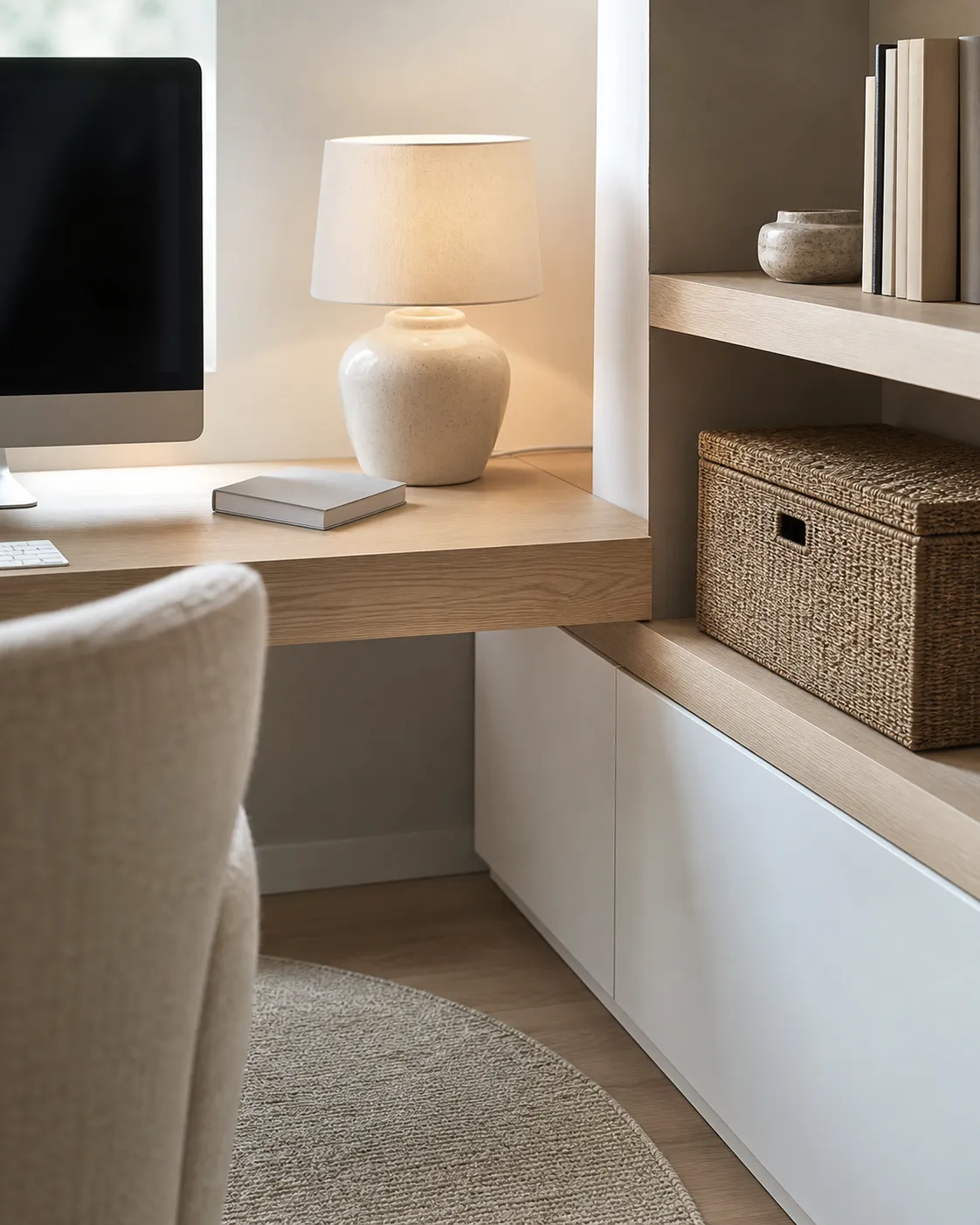
Shelves often need editing before styling. A shelf filled edge to edge becomes a strong rectangular block. Leaving negative space, stacking books in varied orientations, or placing one rounded object among linear books can soften the shelf without making it look staged. If you use crystals, stones, shells, ceramics, or carved wood, keep them sparse enough that each object can be seen.
Corners are another useful place for spatial softness in offices. A tall plant, rounded floor lamp, arched object, textile, or curved-back chair can make a hard corner feel less abrupt. This is especially useful in small home offices where the desk has to sit against a wall.
Textiles can also carry organic geometry. A rug with an uneven border, woven texture, soft wave pattern, or low-contrast botanical form can reduce the rigid feeling of a floor plan. Curtains, cushions, and nearby fabrics should still be practical. A workspace that looks calm but is annoying to clean, reach around, or maintain will not feel calm for long.
What changes the answer
The best way to integrate biophilic shapes depends on the room, the work, and the person using it. A calm-looking office in a photograph may not suit someone who needs visible tools, stronger contrast, or a highly structured desk. Personal preference is central, not secondary.
When work brings many objects
If your work involves many papers, samples, tools, or devices, prioritize containment before softness. Rounded trays, shallow baskets, lidded boxes with softened corners, or curved bowls can hold small objects while still contributing to the room’s shape language.
When the room is already soft
If the room is already visually soft, with warm colors, plants, textiles, and natural materials, the better move may be adding one or two straight lines for clarity. Calm does not always mean more curves. Sometimes a clean rectangular desk, sharper shelf line, or more defined task zone helps the softer elements feel intentional.
When the office is shared
If you share the office, avoid designing only around your own symbolism or taste. A rose quartz object, curved mirror, or irregular sculptural form may feel meaningful to one person and unnecessary to another. Shared workspaces usually benefit from quieter functional softness: rounded lighting, breathable shelf spacing, natural textures, and shapes that do not require agreement about their meaning.
When video calls matter
If the office is used for video calls, check the background separately. Organic geometry behind you should look calm at camera scale. A large wavy object, busy plant silhouette, or reflective stone surface may feel pleasant in person but distracting on screen. Sit where you normally sit, open the camera preview, and adjust the background as its own composition.
Common misunderstanding: calm design is not a promise
The main confusion is treating biophilic spatial energetics as a mechanism that automatically changes mood, focus, health, or performance. The source material available for this page does not support those claims. Here, the term is used only as a design phrase for perceived atmosphere.
Another confusion is assuming that “biophilic” means filling the room with plants or natural objects. A home office can use biophilic shapes without becoming heavily botanical. A curved chair, mineral-toned palette, rounded storage, irregular ceramic cup, arched lamp, or softly layered shelf can all refer to natural form in a quieter way.
A third confusion is believing calm design must be pale, empty, or delicate. Some people feel more settled with darker colors, stronger materials, or visible tools. Organic geometry can still work there: a dark rounded lamp, a walnut desk with softened corners, a charcoal wool rug, a rough stone object, or a deep green wall can feel grounded without looking airy or minimal.
The better question is not “Is this shape calming?” but “Does this shape make this workspace feel easier for me to enter, use, and return to?” That keeps the decision practical.
A simple placement check
Before buying new pieces, test the room with what you already own. Move one curved or natural-form object into your sightline, remove three visually noisy items, and sit with the arrangement for a work session. Notice design-level responses only: whether the desk feels more open, whether the view feels less sharp, whether the object supports the composition, and whether you still have enough working space.
Check three points:
- Sightline: Does the soft form sit where the eye can rest without blocking work?
- Function: Does it organize, light, hold, frame, or soften something useful?
- Restraint: Does the room feel calmer, or just more decorated?
If the answer is unclear, subtraction is usually the safer adjustment. Fewer objects, more breathing room, and one well-placed curve often do more than a collection of small symbolic items.
For a rose quartz piece, treat it as a material accent. It may work well on a tray, beside a lamp, near a notebook, or on a shelf where its color and form can soften the composition. If it becomes clutter, move it. If it makes the desk feel more personal and visually gentle, it has done enough.
The useful limit
Designing with biophilic shapes in a home office is most useful as an aesthetic and spatial practice. It can help you make decisions about edges, rhythm, visual rest, natural references, and personal atmosphere. It should not carry stronger claims than the available material can support.
The strongest approach is modest: keep the workspace functional, soften the most rigid visual moments, use organic geometry where it earns its place, and let personal preference decide the final balance. A calmer-feeling office is not created by one shape or one object. It is usually the result of many small visual decisions becoming quieter together.