Workplace micro-regulation habits
Covert Coping Mechanisms for High-Stress, Zero-Privacy Offices
The most useful covert coping mechanisms in a high-stress, zero-privacy office are quiet, non-injuring micro-actions that buy a small pause before you answer, react, freeze, cry, or leave abruptly. Good workplace micro-regulation habits are socially neutral, easy to stop if someone interrupts, and safe for the body: a slower exhale while reading, feet pressed into the floor, light thumb-to-finger pressure, a sip of water, one plain draft sentence before replying, or a factual double-check from someone you trust.
They are not proof that you should quietly survive impossible conditions. They are a short bridge between “I am close to losing control” and “I can choose the next safer step.”

broader context
Start with the main rose quartz page
This narrower page makes more sense after the broader rose quartz context page.
What covert regulation can realistically do
A zero-privacy office changes the shape of stress. You may not be able to step outside, close a door, cry privately, pace, call someone, or visibly use a calming object. The room itself becomes part of the pressure: noise, interruption, being watched, unclear expectations, constant availability, and little control over recovery time.
Work-stress frameworks from NIOSH, HSE, and the American Psychological Association describe workplace stress as more than a personal resilience problem. HSE’s stressor categories — demands, control, support, relationships, role, and change — fit many exposed office settings closely. High demands with low control and little support can make self-regulation harder, even for people who usually cope well.
A covert habit can help with one narrow moment. It may give your body something ordinary to do, slow visible escalation, or interrupt a reactive reply. It cannot remove the workload, create privacy, repair poor management, resolve harassment, or replace appropriate health or workplace support when that is needed.
The useful question is not, “Which habit will make me calm?” A better question is: “Which small action can help me avoid harm and make the next minute more manageable?”
Low-visibility habits that do not require leaving your desk
The safest office habits are boring on purpose. They look like ordinary desk behavior, not a performance of wellness. They should not involve injury, intense pain, obvious tools, or anything that would be hard to stop if your manager appears beside you.
Choose two or three. An elaborate routine is harder to use when the room is watching.
| Moment at work | Covert habit | What it may help you do |
|---|---|---|
| You are reading a difficult message | Lengthen one exhale while your eyes stay on the screen | Delay the immediate reply |
| Your body feels charged or shaky | Press both feet into the floor for five to ten seconds | Add stable physical contact without attracting attention |
| You want sharp sensation | Use light thumb-to-finger pressure, not pain | Redirect toward non-injuring sensory input |
| You are about to send a reactive message | Write one plain sentence in a draft first | Separate the feeling from the action |
| You cannot think clearly | Take a sip of water and silently name the next task | Create a tiny reset point |
| You feel watched | Drop your shoulders under the desk and unclench your jaw | Release tension without visible drama |
| You doubt your judgment | Ask a trusted person to double-check a fact, email, or decision | Bring in support without making a scene |
These are not special techniques with guaranteed outcomes. They are low-visibility regulation habits that may create a one-minute pause at work. Their value is partly in their interruptibility: if someone speaks to you, you can stop without explanation.
Slow exhale while reading
A slow exhale while reading is often the least noticeable option. Keep your gaze on the email, spreadsheet, ticket, or message; breathe out a little longer than usual, then continue reading before deciding what to do. Do not force deep breathing if it feels uncomfortable or makes you more aware of being observed.
The point is not to perform a breathing exercise. It is to avoid answering from the first spike of stress.
Foot pressure grounding
Foot pressure grounding works because it is hidden by the desk and does not require equipment. Press the soles of your feet evenly into the floor, notice the contact, then release. If you are standing, shift weight gently through both feet rather than locking your knees.
Keep it mild. This is contact, not strain.
Thumb-to-finger pressure
Light thumb-to-finger pressure can replace riskier forms of tactile distraction at work. Press the pad of your thumb to the pad of each finger slowly, or hold a pen with slightly more attention than usual. The pressure should stay ordinary and non-damaging.
If you find yourself increasing pressure until it hurts, change strategy and seek more support. Do not intensify the habit.
Factual double-check before replying
A factual double-check is useful when distress is pushing you toward a sharp message, a rushed decision, or a visible conflict. Send a neutral request: “Can you check whether I’m reading this correctly?” or “Before I reply, can you confirm the timeline?”
That turns the moment from emotional exposure into ordinary work verification. In a zero-privacy office, a check-in may need to look like a work-quality step, not a personal disclosure.
Pain substitution: what to avoid, and what to use instead
Pain substitution needs a firm boundary. Do not use cutting, burning, bruising, skin picking, digging nails into skin, hard snapping, or any action that turns workplace distress into bodily damage. Public-health guidance on self-injury treats it as a reason to seek support, not as a normal workplace coping tool.
If your search for tactile distraction at work really means “I need pain so I do not break down,” move to the safer category, not the painful one.
Non-injuring sensory alternatives include:
- light thumb-to-finger pressure;
- pressing feet into the floor;
- touching a safe texture such as paper, fabric, a pen grip, or a smooth object already on your desk;
- a sip of cool water within ordinary comfort limits;
- gently rolling the shoulders once under the desk;
- changing posture slowly without stretching into pain.
The difference is simple: safe pressure gives the body information; pain-based coping raises risk. A covert habit should never require hiding an injury afterward.
If you feel unable to stay safe, have urges to hurt yourself or someone else, or feel in immediate crisis, use urgent local support: emergency services, a crisis line, a trusted person nearby, or a qualified mental-health professional. A desk habit is not the right level of help for that moment.
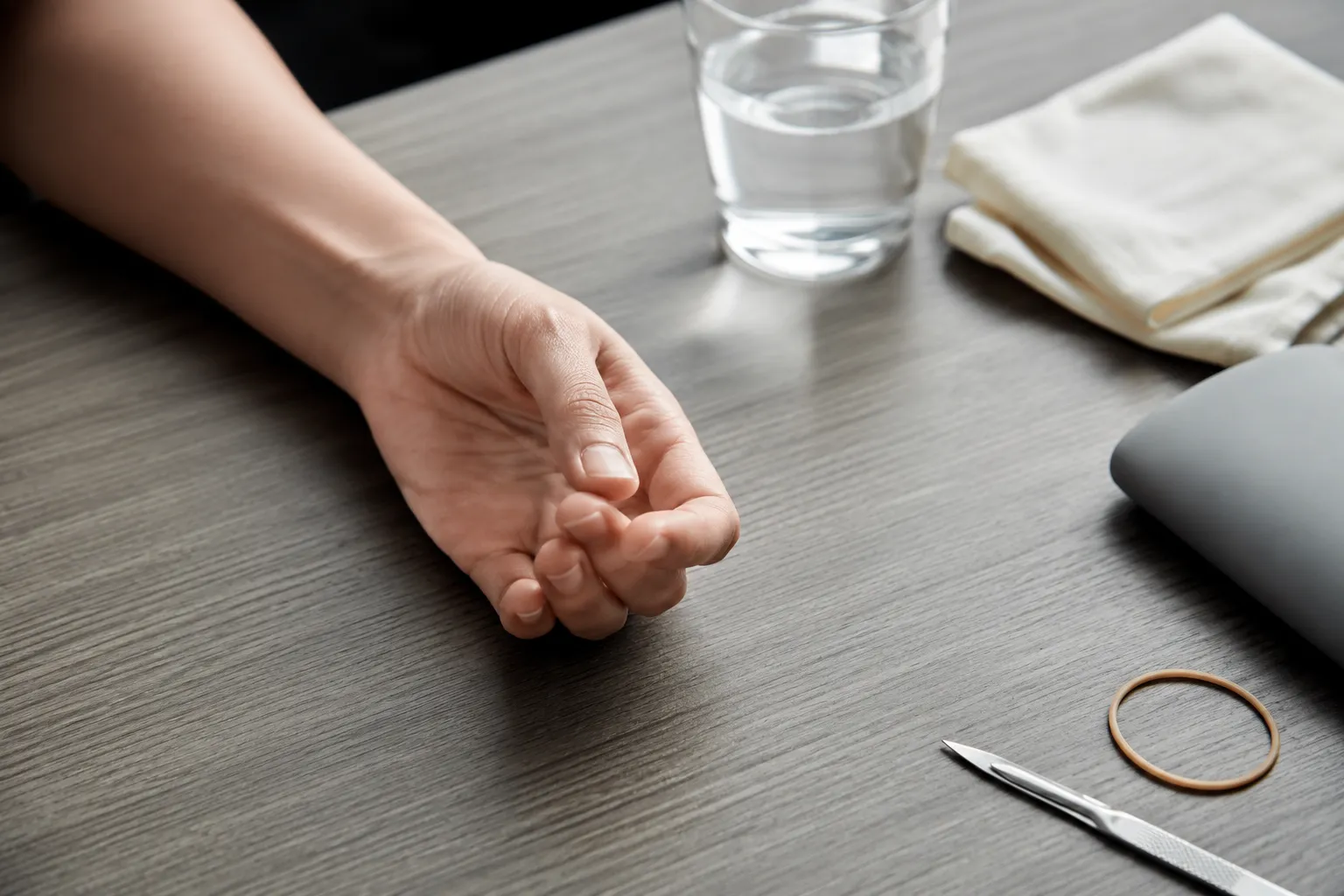
Signs that a micro-pause is needed before the situation gets louder
Workplace dysregulation signs are not moral failures. They are signals that the next action needs more care. In office terms, those signs may look like:
- rereading the same sentence without understanding it;
- typing a reply much faster than usual;
- feeling heat in the face, a clenched jaw, tight chest, or shaking hands;
- wanting to disappear, snap, cry, or walk out without a plan;
- losing track of what is public and what is private;
- feeling certain you must answer immediately, even when the task can wait one minute.
That is the moment for a low-visibility pause. Put both feet on the floor. Take one sip of water. Draft one sentence and do not send it yet. Ask for a factual double-check. These actions do not solve the underlying stressor; they reduce the chance that the next minute becomes more damaging.
Emotional regulation is not the same as suppressing emotion. Here, it means noticing what is happening soon enough to choose a less harmful next response.
After-incident recovery when privacy becomes possible
A covert habit is for the exposed moment. After-incident workplace recovery needs a different shape once you have privacy, a break, or the end of the workday.
Keep the recovery step small and concrete:
- Name what happened without drama. “I got overloaded after that meeting,” or “The email thread pushed me into a high-alert state.”
- Separate the trigger from the whole day. One bad exchange does not need to become the entire work story.
- Record any practical detail. Note the demand, unclear role, conflict, noise, lack of break, or sudden change that contributed.
- Choose the next support route. That might be a manager conversation, HR or safety channel, workload discussion, accommodation request, trusted colleague check-in, occupational health route, or professional care.
This matters because zero-privacy office stress can become invisible if the only record is “I kept it together.” If the pattern is chronic, private notes can help you describe the work conditions later: too many demands, too little control, poor support, strained relationships, unclear role, or constant change.
The point is not to build a formal record in every case. It is to stop translating every stress response into personal weakness.
When the answer changes: privacy, power, and safety
The right covert coping mechanism depends on the risk around you.
If your workplace is busy and visible, a one-minute pause may be enough to avoid a rough reply or visible escalation. If the workplace is abusive, discriminatory, unsafe, or chronically overwhelming, micro-regulation should be treated only as a temporary bridge while you seek appropriate support or change. Quiet coping should not become a way to make unacceptable conditions look acceptable.
If your distress is tied to a health condition, disability, trauma history, panic symptoms, depression, self-harm urges, or severe burnout, this page cannot give clinical advice. The safer next step is support from a qualified professional, workplace accommodation route, or urgent service, depending on the level of risk.
If you are afraid of being punished for showing emotion, that is also part of the workplace picture. A discreet habit may protect you in the moment, but the larger issue may involve management culture, privacy norms, workload design, or interpersonal safety.
Common confusion about covert workplace coping
“Is this emotional breakdown prevention?”
Only in a limited, everyday sense. These habits may help some people create a pause before visible escalation, but the available public material does not show that specific covert tactile habits reliably stop emotional breakdowns in zero-privacy offices. It is more accurate to call them small interruption tools, not a guarantee.
“Should the habit be completely invisible?”
Not at any cost. A good habit is low-visibility, safe, and interruptible. If invisibility pushes you toward pain, secrecy, or hiding urgent distress, it is no longer the better option.
“Are open offices just annoying, or can they really affect stress?”
They can be a legitimate stress context, especially when openness comes with noise, low control, frequent interruption, and little recovery space. Still, this page is not an office-design research review. The practical question here is how to get through the next exposed minute without treating the workplace problem as only your personal failure.
A small, bounded answer
For high-stress office coping under constant visibility, choose habits that look ordinary: slow exhale while reading, foot pressure, light thumb-to-finger contact, water, a draft-before-send pause, shoulder release, and factual double-checks. Avoid pain and injury. Use the pause to choose the next safer step, not to convince yourself the larger conditions are fine.
The evidence supports the workplace-stress context and the safety boundary more strongly than it proves any one covert habit. That is enough for a modest use: a small pause, in a hard room, without turning harm into a coping method.