Moon phase ritual guide
Sacred Cycles: Rose Quartz Rituals for Moon Phases & Manifestation
If you are searching for Crystal Manifestation Rituals, you are probably not looking for a geology lecture or a promise that one stone can change your life overnight. You are trying to shape a practice: when to set an intention, how to hold it through a moon cycle, what rose quartz adds symbolically, and where reflection turns into overclaiming.
A grounded rose quartz moon ritual can be beautiful, steady, and personal without pretending that lunar timing or a mineral object guarantees emotional, romantic, financial, or spiritual results. The cleaner frame is this: use the moon phase as a calendar language, rose quartz as a tactile focus object, and manifestation as reflective self-guidance.
broader context
Start with the main rose quartz page
This narrower page makes more sense after the broader rose quartz context page.
What the Moon Phase Actually Changes
The moon cycle is often used in contemporary spiritual practice as a rhythm of beginning, growth, fullness, release, and quiet integration. Astronomically, lunar phases describe the changing appearance of the Moon as seen from Earth. That factual sequence can help you time a ritual clearly, but it does not prove that a ritual will produce a specific outcome.
For rose quartz manifestation rituals, the phase changes the tone of the practice more than the “power” of the stone.
| Moon phase | Symbolic ritual use | Rose quartz role | Better question to ask |
|---|---|---|---|
| New moon | Intention setting, quiet beginning | Anchor for a written intention | What am I ready to begin with care? |
| Waxing moon | Nurturing, repetition, small action | Object held during affirmations | What needs attention, not pressure? |
| Full moon | Reflection, gratitude, visibility | Focus for review or release preparation | What is now clear enough to name? |
| Waning moon | Release, shadow work, simplification | Reminder to soften, forgive, or let go | What can I stop carrying symbolically? |
This framework keeps the practice flexible. A new moon ritual does not have to be dramatic. A full moon reflection does not need to become an emotional performance. A waning moon release does not require forced closure. The phase gives the ritual a shape.
Rose quartz fits this structure because many practitioners associate it with tenderness, affection, forgiveness, and self-compassion. Materially, rose quartz is a quartz variety recognized in gemological and mineralogical references. Symbolically, its meaning belongs to interpretive practice. The stone can help focus attention, but the available evidence does not support claims that it causes manifestation, repairs relationships, resolves grief, or changes health outcomes.
The 48-Hour New Moon Protocol for Intention Setting
A new moon is often treated as the beginning point of a cycle. The phrase “48-hour new moon protocol” sounds precise, but it works better as a practical window than a cosmic deadline. If the exact new moon time helps you feel organized, use it. If your schedule is ordinary and human, the evening before, the day of, or the following evening can still serve as a meaningful beginning.
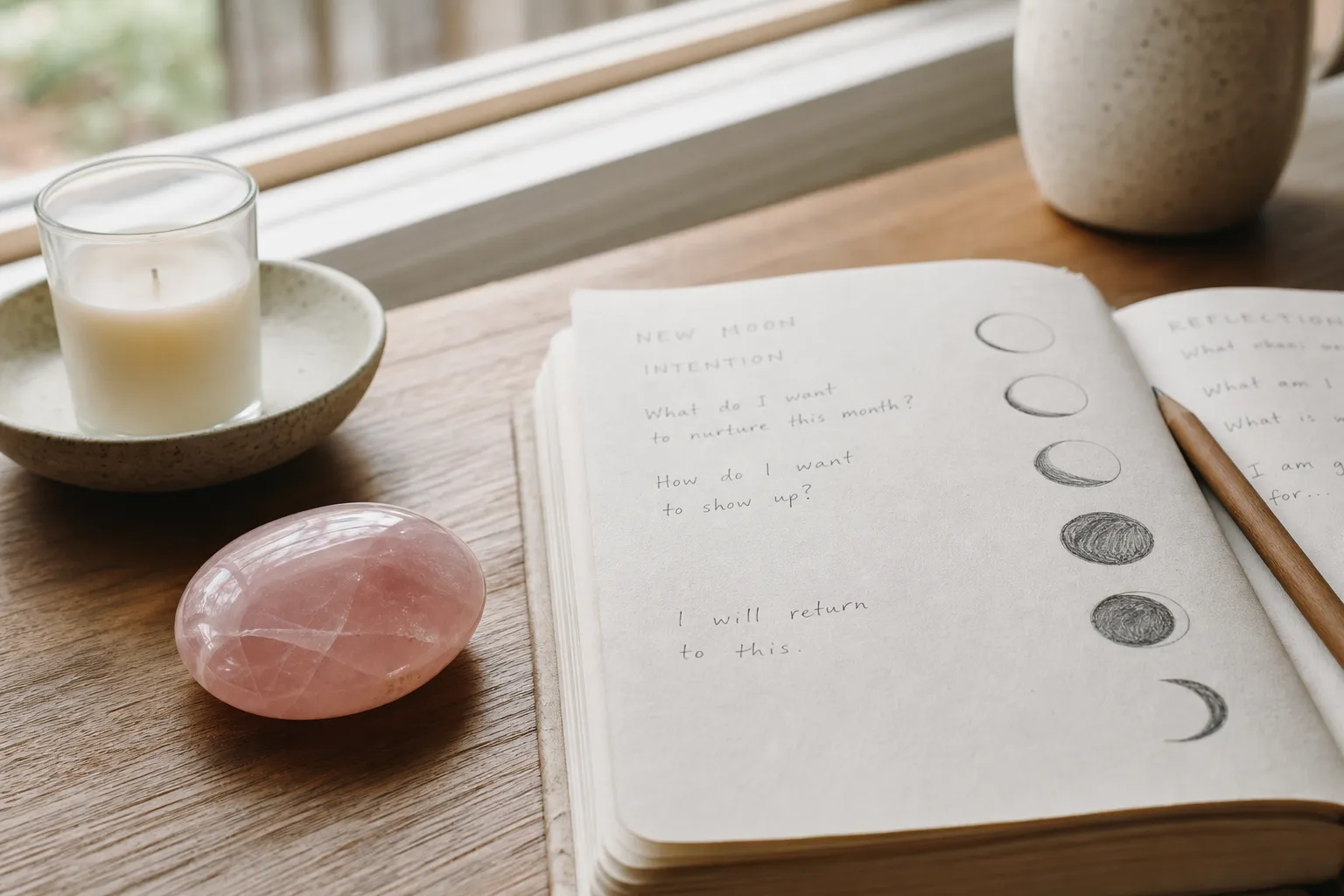
A simple rose quartz new moon practice
- Clear the space in an ordinary way. Use a desk, bedside table, floor cushion, or small tray. Do not make the setup so complicated that preparing becomes avoidance.
- Hold the rose quartz before writing. Notice its temperature, weight, color, and texture. Let the stone interrupt urgency and bring the ritual back into the body.
- Write one intention in plain language. Avoid phrasing that tries to command another person, force a result, or guarantee a timeline. Try “I am willing to practice…” or “This cycle, I will give attention to…”
- Add one visible action. Manifestation language becomes more useful when paired with behavior. If the intention is self-trust, the action might be keeping one small promise to yourself. If the intention is relational clarity, the action might be writing down what you need before a conversation.
- Close with a short affirmation. The affirmation should support your participation, not pretend the outcome is already secured: “I can meet this intention with patience and honesty.”
This is where many new moon rituals get muddy. “Programming” rose quartz is often described as placing an intention into the stone. A more careful frame is that you are assigning the stone a symbolic role. Each time you see or hold it, it reminds you of the intention you chose. That can be meaningful without being treated as a demonstrated mechanism.
Waxing Moon Affirmations Without Pressure
The waxing moon is the period between the new moon and full moon, when the illuminated portion appears to grow. In moon phase intention setting, this stage is commonly used for encouragement, repetition, and small forms of tending.
Affirmations work better here when they stay honest. Overinflated wording can create pressure, especially when it implies that certainty should arrive before life has changed. Rose quartz is more useful as a gentle anchor than as a demand for instant confidence.
For the waxing phase, phrases like “I am practicing openness,” “I am tending this with patience,” or “I am taking one kind action today” usually fit better than outcome-heavy statements.
If you use a 369 manifestation method with rose quartz anchoring, keep the structure simple: write the same intention three times in the morning, six times later, and nine times in the evening, while treating the rose quartz as a consistency cue. The number pattern can be personally meaningful, but the available sources do not establish that it causes results.
The left hand versus right hand placement question belongs in the same category. Some practitioners use the left hand symbolically for receiving and the right hand for sending or acting. You can adopt that language if it resonates, but it should not become a universal rule. Choose intentionally: hold rose quartz in the hand that helps you slow down, or place it near the journal, candle, or meditation seat where it will actually be seen.
Full Moon Reflection Without Turning It Into a Guarantee
The full moon is visually striking, so it often receives the most ritual attention. In contemporary practice, it is commonly used for reflection, gratitude, visibility, and release preparation. With rose quartz, the full moon can become a moment to ask what your intention has revealed about care, attachment, avoidance, tenderness, or personal boundaries.
A full moon reflection can include
- the intention you wrote at the new moon;
- the actions you actually took;
- what felt easy, forced, or unclear;
- one gratitude line that does not deny difficulty;
- one release sentence for what no longer fits.
Cord-cutting language often appears here. If you use a full moon cord-cutting ritual, keep it symbolic: you are naming a pattern, attachment, habit of thought, or emotional loop that you no longer want to feed. Avoid framing the ritual as controlling another person, erasing a serious life issue, or replacing higher-stakes care.
Rose quartz can sit beside the page, be held during a short meditation, or mark the close of the ritual. Its role is not to make the release happen. It gives the moment a sensory boundary: before, during, after.
For readers drawn to heart-breathing or 4-7-8 breathing with crystals, the cleaner framing is meditative rather than clinical. Slow breathing can be part of a calming ritual, but this page is not making claims about measurable body-system outcomes. If counting the breath feels supportive, pair each exhale with a phrase such as “soften the grip” or “return to myself.” If the count feels uncomfortable, breathe normally and shorten the practice.
Waning Moon Release and Shadow Work
The waning moon is the period after the full moon, when the visible illuminated portion decreases. Symbolically, many practitioners use it for release, simplification, forgiveness, and shadow work. This is where rose quartz rituals can become emotionally rich, and where language needs the most care.
In a reflective ritual context, shadow work means looking at avoided feelings, repeated patterns, protective reactions, or unspoken needs. It should not be inflated into a claim that a crystal ritual resolves deep personal history or replaces formal support when that is needed. A rose quartz shadow work practice can stay modest and still be meaningful.
| Prompt | What to write |
|---|---|
| What am I avoiding naming? | A feeling, pattern, or truth you can safely acknowledge |
| What was this trying to protect? | The softer need beneath the reaction |
| What can I release this cycle? | One symbolic burden, expectation, or old phrase |
For eclipse season shadow work, be even gentler. Eclipses are sometimes treated in spiritual communities as intensified turning points, but the factual sources here support astronomical timing, not heightened ritual effects. Instead of turning “never charge rose quartz during a lunar eclipse” into a universal rule, treat it as a belief-based practice choice. Some practitioners avoid eclipse charging because they view eclipse periods as symbolically unstable. If that fits your practice, skip charging and choose reflection. If it does not, there is no factual source here showing that eclipse moonlight spiritually damages rose quartz.
A dark moon self-forgiveness ritual can be simple: hold the stone, name one thing you are ready to stop rehearsing, write a kinder replacement sentence, and put the page away. The point is symbolic self-guidance, not forced emotional completion.
Rose Quartz Grids, Moon Water, and Cleansing Boundaries
Some readers want more physical ritual design: a rose quartz grid, moon water, dry moonlight cleansing, candles, bowls, essential oils, or a bath. These can make a ritual feel embodied, but each one has a different boundary.
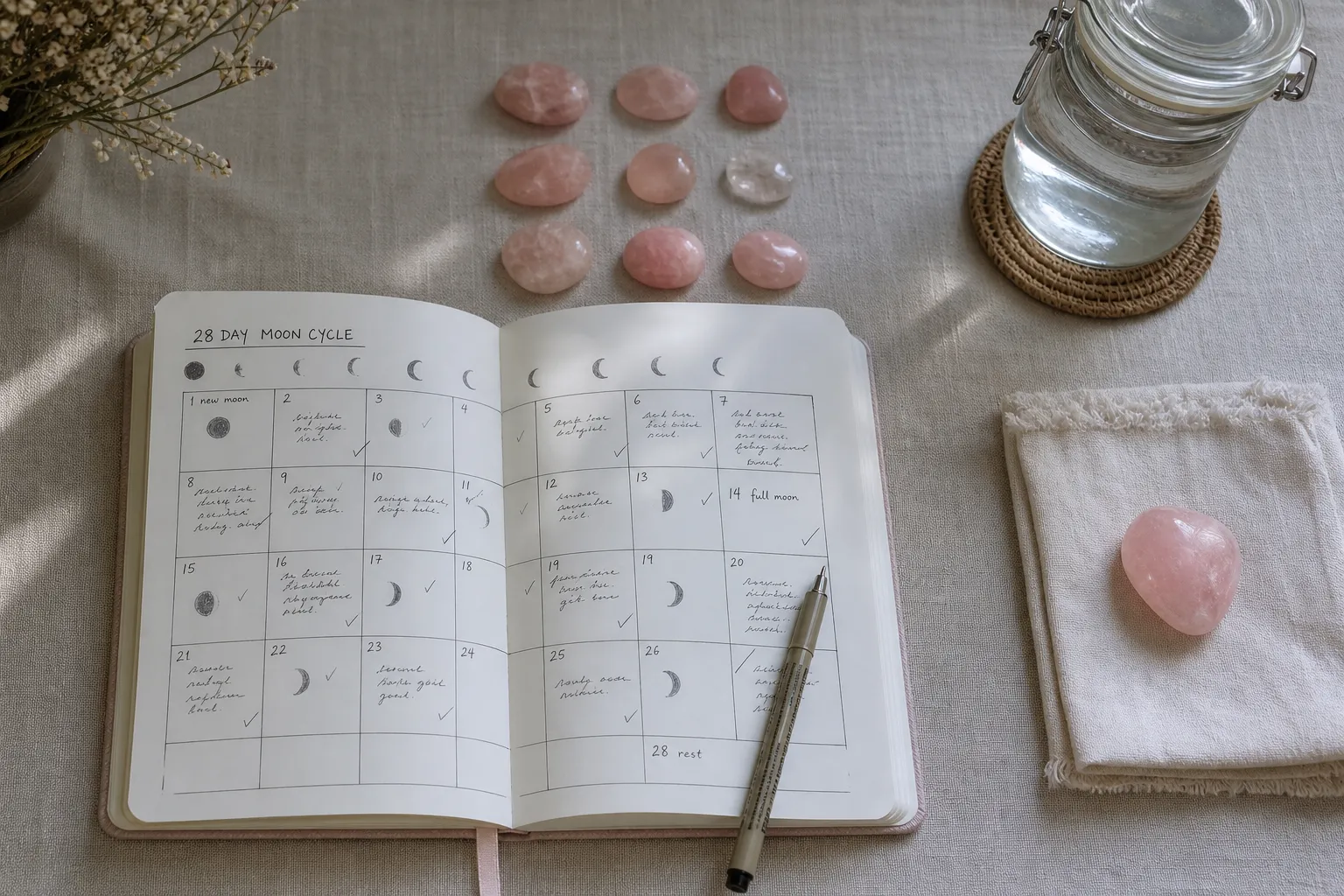
A rose quartz grid is mainly a visual arrangement. You might place one stone at the center with a written intention beneath it, then add smaller stones around it to represent support, patience, clarity, and action. Clear quartz, citrine, or other stones are sometimes added in sacred geometry layouts, but those combinations are symbolic design choices rather than measurable energy circuits. A 28-day rose quartz grid can work as a reminder system: revisit it at each phase, update the intention, and remove anything that no longer belongs.
Dry moonlight cleansing is the safer default for fragile or sentimental pieces. Place the rose quartz on a clean cloth near a window or in a protected outdoor spot where it will not be rained on, dropped, scratched, or forgotten. Whether you call this cleansing, resting, or resetting, the observable action is simple: you are giving the stone a ritual pause and returning it to use with renewed attention.
Moon water needs a firmer boundary. Rose quartz and moonlight do not make unsafe water safe to drink. If a ritual involves water you may consume, use potable water and hygienic containers. The most careful crystal approach is indirect: place rose quartz beside a sealed container of safe water, not inside it. Use the water symbolically for anointing an object, watering a plant when appropriate, or marking a ritual space rather than making health or energy-support claims.
If you use a bath ritual, keep rose quartz out of harsh products, extreme temperatures, and slippery areas where it can chip or become a hazard. Essential oil pairings with Venus or heart symbolism may feel poetic, but oils require their own safety knowledge and should not be added casually to bathwater or skin. The ritual does not become more meaningful by adding more materials than you can handle responsibly.
A 28-Day Rose Quartz Moon Cycle You Can Maintain
The best ritual plan is the one you can repeat without turning it into another source of pressure. A full lunar cycle is about rhythm, not perfection. If you miss a night, return at the next natural checkpoint.
| Timing | Practice | Rose quartz use |
|---|---|---|
| New moon window | Write one intention and one action | Hold while choosing the wording |
| Early waxing moon | Repeat a short affirmation | Keep near journal or workspace |
| Late waxing moon | Take one concrete supportive step | Carry or place where you will see it |
| Full moon | Reflect on what became visible | Set beside the written review |
| Early waning moon | Name what feels excessive | Hold during a release sentence |
| Late waning moon | Simplify the space or practice | Rest the stone on a clean cloth |
| Dark moon | Pause, forgive, reset | Put the stone away until the next cycle |
This structure also helps explain why a manifestation practice may feel like it is not working. Often, the issue is not that the stone is wrong or the moon phase was missed. The intention may be too vague, too dependent on another person’s choices, too detached from action, or too loaded with urgency. Sometimes the ritual is being asked to carry emotional weight it cannot responsibly carry. In those cases, make the practice smaller and more honest.
More honest revisions
- Instead of “I will attract perfect love,” try “I will notice where I abandon my own needs.”
- Instead of “Everything will change this month,” try “I will take one clear step before the full moon.”
- Instead of “I release all pain,” try “I am willing to loosen one old sentence I keep repeating.”
Rose quartz fits these revisions because its symbolic language is soft, relational, and reflective. It is less suited to aggressive certainty. If your ritual language starts sounding like pressure, let the stone pull the practice back toward care.
How to Keep the Practice Sacred Without Overclaiming
A rose quartz moon ritual does not need inflated claims to feel sacred. Its strength comes from repetition, attention, chosen symbols, and the honesty of the questions you bring to it.
Keep these distinctions clear
- Astronomy can tell you what phase the Moon is in; it does not validate spiritual outcomes.
- Gemology and mineralogy can identify rose quartz as a real material; they do not prove manifestation effects.
- Ritual language can carry personal meaning; it should not be presented as a guarantee.
- Moon water can be symbolic; it is not made drinkable by moonlight or a crystal.
- Shadow work can be reflective; it should not be framed as a substitute for higher-stakes care when life requires more support.
The most grounded form of moon phase intention setting is not passive wishing. It is a cycle of choosing, tending, noticing, and releasing. Rose quartz gives that cycle a physical center: something to hold, place, revisit, and return to when the mind gets abstract.
A concise practice
At the new moon, write the intention.
During the waxing moon, repeat the affirmation and take one action.
At the full moon, review what became visible.
During the waning moon, release one phrase, object, expectation, or pattern that no longer supports the intention.
Before the next new moon, let the rose quartz rest.
That is enough. Sacred does not have to mean elaborate. A well-held ritual is not measured by how many tools it uses, how dramatic the wording sounds, or whether it promises a result. It is measured by whether it helps you return to your own attention with more clarity, restraint, and care.