Pre-ritual documentation boundary
Why Digital Mineral Passports are Essential for Pre-Ritual Energy Verification in 2026
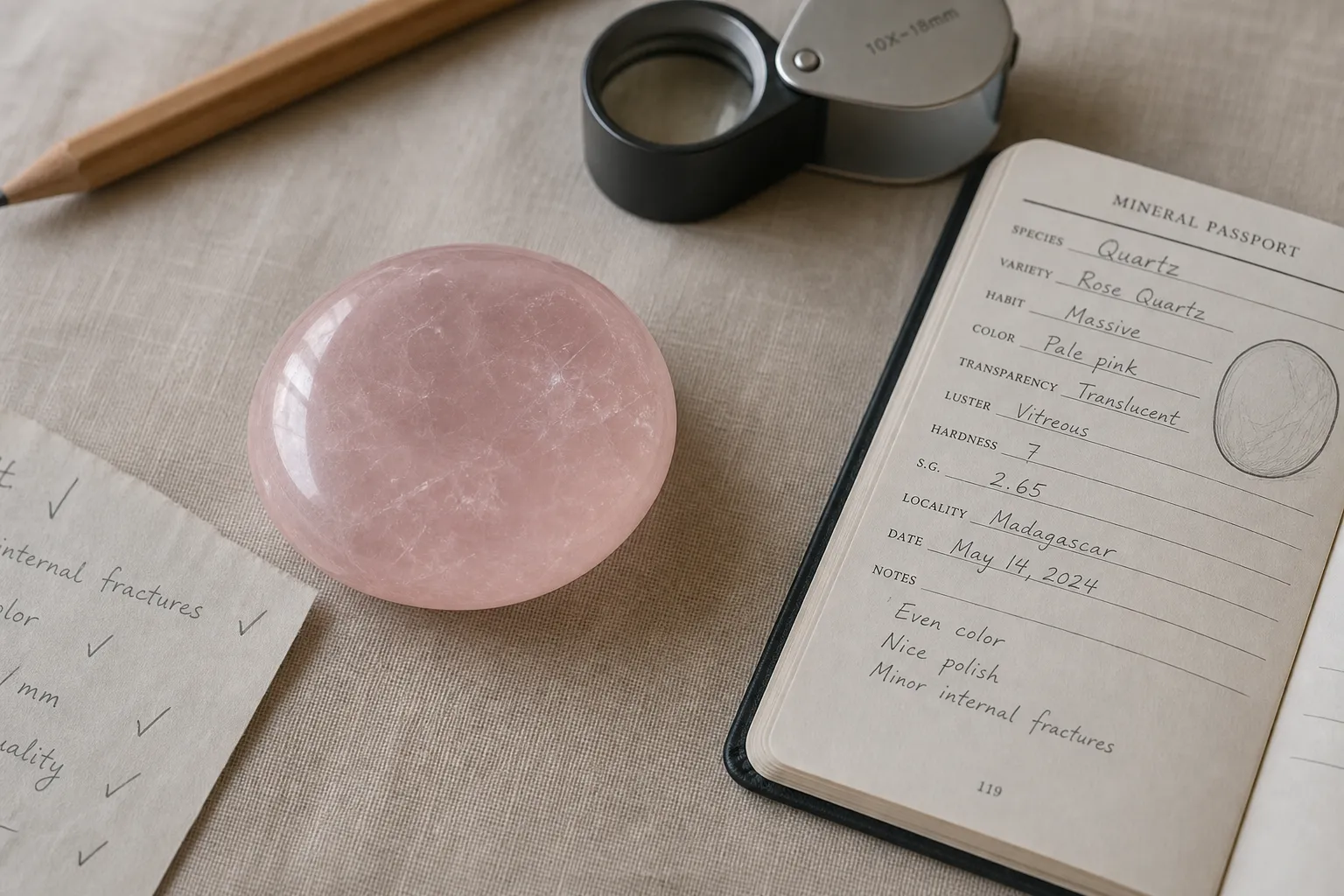
A rose quartz piece set on cloth before ritual use carries two readings at once: the visible mineral in front of you, and the meaning you are preparing to place around it. Digital Mineral Passports matter in 2026 because they may help organize the visible side before the symbolic side becomes louder.
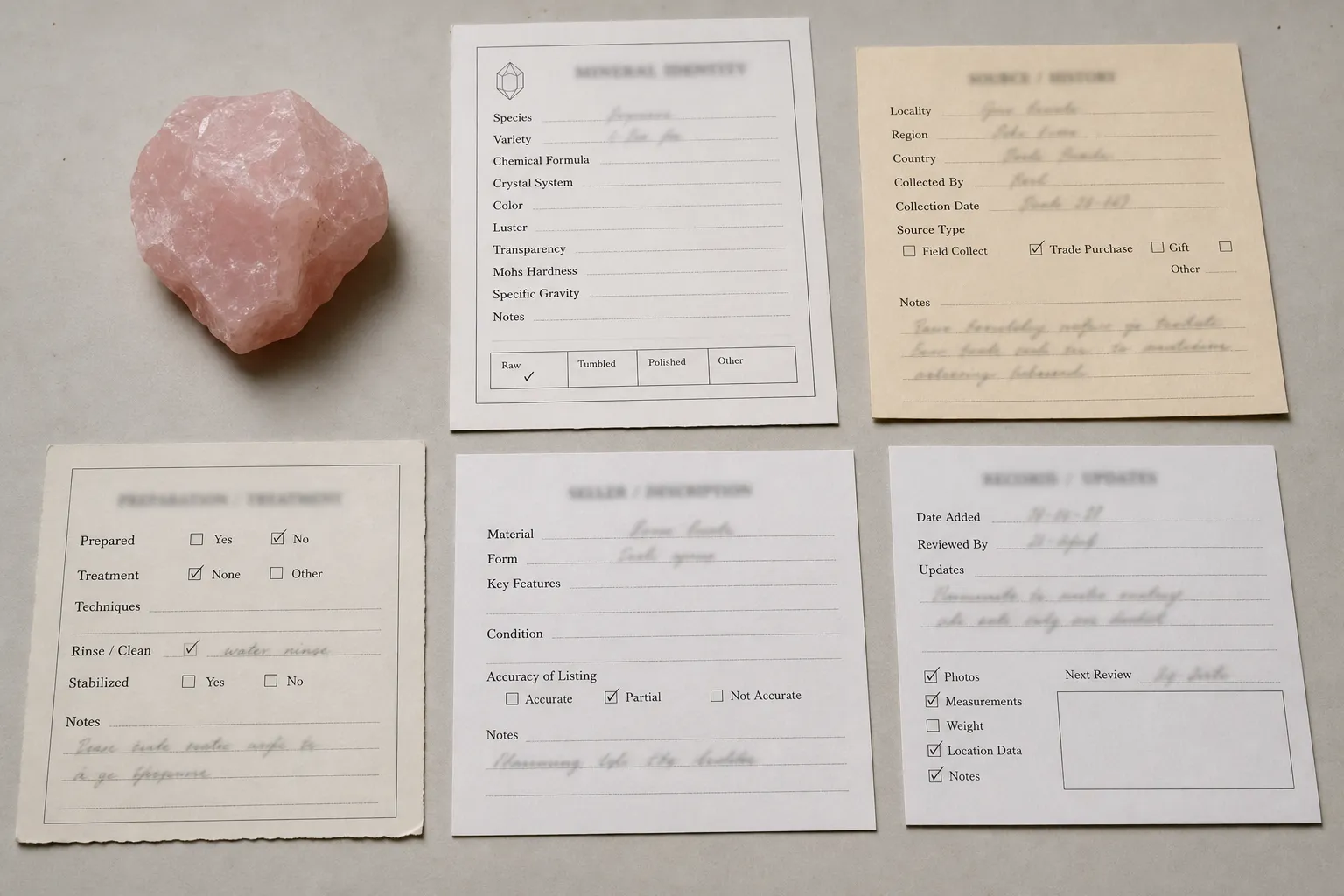
A passport-style record can gather mineral identity records, seller claims, claimed provenance, preparation notes, and sourcing information in one place. That does not mean it proves energy, purity, “pure frequency,” or ritual outcome. It means the reader has a clearer way to review what can be documented before treating the piece as ritually ready.
broader context
Rose quartz context note
This narrower page makes more sense after the broader rose quartz context page.
The Direct Answer: Documentation Supports Confidence, Not Ritual Proof
Digital Mineral Passports are essential only in a bounded sense: they can support pre ritual verification by separating reviewable information from claims that cannot be checked from the document alone. For a crystal reader, that distinction is useful. It keeps the specimen before the symbol.
A passport-style record may help answer practical questions:
- What mineral is the object claimed to be?
- Who is making that identity claim?
- Is any credible testing record or inspection note attached?
- What mineral provenance information is offered?
- Are sourcing claims specific, vague, or missing?
- Are preparation notes factual handling records, ritual language, or seller wording?
Those questions do not measure a crystal’s spiritual effect. They give the reader a calmer basis for deciding whether the object’s story is coherent enough for personal ritual use. If a rose quartz palm stone is described as natural, ethically sourced, energetically prepared, and connected to a particular origin, the passport should not be treated as proof of all those things. It can show which parts are documented, which parts are asserted, and which parts remain unknown.
That is the core value. The document does not make the ritual work. It helps the reader avoid beginning the ritual inside a fog of unsupported material claims.
What a Mineral Passport Can Reasonably Contain
Because no publicly displayable authoritative source set was available for this topic, Digital Mineral Passports should be treated here as a documentation concept, not as a confirmed industry standard for crystals. In that careful sense, a useful passport is less like a mystical seal and more like an organized record.
Mineral identity
Clarifies the name under which the specimen is sold or catalogued.
Cannot prove alone that every identity claim is correct.
Testing or review notes
Clarifies whether any testing or inspection record is attached.
Cannot prove alone that the piece has a spiritual quality.
Claimed source
Clarifies the origin, mine, region, supplier, or chain stated by the seller.
Cannot prove alone that the source claim is independently confirmed.
Handling and preparation
Clarifies cleaning, storage, packaging, or ritual preparation notes.
Cannot prove alone that the object has changed energetically.
Seller claims
Clarifies the exact wording around authenticity, sourcing, or purity.
Cannot prove alone that the wording is complete or reliable.
Record history
Clarifies dates, edits, transfers, or attached documents.
Cannot prove alone that no earlier information was missing.
This kind of record is most useful when it shows its own limits. A blank field, an uncertain origin, or a note that a claim is seller-provided can be more honest than polished certainty. For pre-ritual confidence, uncertainty is not always the problem. Hidden uncertainty is the larger problem.
A documentation-style passport also improves the language around the object. Instead of saying a crystal is confirmed for energy, the record can say that its identity claim, sourcing statement, and preparation history have been recorded for review. One is ritual or marketing language; the other is a documentation practice.
Why This Matters Before Ritual Use
Pre-ritual energy verification is often used by readers as a phrase for readiness: Is this piece aligned with the intention? Does its material story feel clear enough? Has it been handled in a way the reader can accept? Those are personal and symbolic questions, not laboratory conclusions.
Digital documentation can still matter because ritual use often begins with trust. A reader may not want a rose quartz piece whose origin story is vague, whose seller claims feel inflated, or whose preparation language blends authenticity verification with energetic certainty. A passport-style record can make those layers visible before the object is placed on an altar, carried, arranged in a room, or used in private practice.
The strongest use is not to turn the record into an authority over the ritual. The stronger use is to slow the decision down:
- Is the mineral identity stated clearly, or only implied by appearance?
- Are authenticity claims linked to any testing or review record?
- Is ethical mineral sourcing described with specifics, or only with reassuring words?
- Are preparation records factual, symbolic, or both?
- Does the document distinguish a seller claim from a checked record?
- Does any wording feel stronger than the evidence shown?
For rose quartz, this matters because appearance and meaning are easy to blend. A soft pink surface can invite tenderness, memory, interior calm, or ritual symbolism; those interpretations belong to the reader’s practice. The material record belongs beside them, not underneath them as a hidden assumption.
A passport can serve as a pause point. It lets the reader decide whether the documented story is sufficient for the role they want the object to play.
What Changes the Value of the Passport
Not every digital record deserves the same trust. A Digital Mineral Passport is only as useful as the quality, specificity, and reviewability of the information inside it. A polished interface can still contain weak claims.
The value rises when the record is specific. “Rose quartz, seller-stated origin, no independent test attached” is limited, but clear. “High vibration ethically sourced crystal” may sound more appealing, yet it gives the reader less to examine. For pre-ritual use, clarity is more useful than decoration.
The value also rises when the passport keeps categories separate. Mineral authenticity verification is not the same as ethical sourcing. Ethical sourcing is not the same as preparation. Preparation is not the same as spiritual effect. A record that keeps those lanes apart gives the reader a better chance to make a grounded decision.
The value falls when the passport uses ritual vocabulary as if it were documentation. Terms such as pure frequency, energetic purity, or pre-ritual energy verification may appear in crystal spaces, but the supplied research material does not support treating them as measurable proof. They can be acknowledged as reader language or symbolic intent. They should not be presented as documented results.
The value also falls when the passport relies only on the seller’s own claims. Seller claims review is still useful, because it preserves what was said and lets the reader notice vague wording. But a seller-provided statement is not the same as independent confirmation. Without stronger records, the passport remains a container for claims rather than proof that the claims are true.
A passport helps most when it records evidence and uncertainty with equal care.
Common Confusion: Passport, Certificate, and Energy Claim
The most common confusion is treating a digital mineral passport as if it automatically proves authenticity, ethical sourcing, and ritual readiness at once. Those are separate questions.
A certificate-style document may name a mineral, attach a seller note, or preserve a transaction record. A passport-style document may organize a broader history. Neither format, by itself, shows that a rose quartz piece has a particular energetic effect. The format is not the evidence. The contents still need to be examined.
Another confusion is assuming that a digital format is stronger than a paper note simply because it looks modern. Digital documentation can be easier to store, update, share, and compare. It may also make missing information easier to notice. But digital documentation limits still apply. A weak claim does not become stronger because it appears on a screen.
Ethical sourcing language needs the same care. Readers may care deeply about the human and environmental story behind a mineral, and that concern can be part of the decision. Still, a passport should not be read as proof of ethical mineral sourcing unless it contains specific, reviewable sourcing records and the reader understands who supplied them. Without that, the phrase remains a claim to evaluate.
The same boundary applies to “pure frequency.” If the phrase appears in a ritual context, it can be treated as symbolic vocabulary about intention or preference. It should not be treated as a documented mineral property.
A Short Pre-Ritual Review Before You Use the Record
A reader does not need to turn a private ritual into an audit. The point is simply to notice what the document can and cannot support before assigning meaning to the object.
A concise review might look like this:
- Read the identity field first. Check whether the specimen is clearly named and whether any mineral identity records or testing notes are attached.
- Look for the source of each claim. Separate seller-provided language from any attached review, receipt, provenance note, or testing record.
- Check sourcing language carefully. Treat ethical sourcing as a claim that needs specifics, not as a mood created by warm wording.
- Read preparation records as context. Cleaning, storage, packaging, or ritual handling notes may matter to the reader, but they do not prove an energetic result.
- Name what remains unknown. Unknown origin, missing test records, or vague preparation history may not disqualify a piece, but they should remain visible.
- Decide symbolically after reviewing materially. Let the ritual choice come after the document review, not in place of it.
This keeps the process proportionate. The passport informs the ritual context; it does not control the reader’s meaning.
The Evidence Limit in 2026
For this page, the evidence boundary is unusually important. The supplied research record contained no public candidate sources, no authoritative references, no source URLs, no standards documents, no firsthand reports, and no visible documentation that would support strong factual claims about Digital Mineral Passports as an established mineral system.
So the safest answer is conditional. Digital Mineral Passports may be essential for pre-ritual confidence when they help readers organize mineral identity, claimed provenance, sourcing statements, preparation records, and seller claims in a reviewable form. They are not evidence that a crystal has a confirmed energy, guaranteed purity, confirmed ethical history, or reliable ritual effect.
If stronger sources become available later, the most useful support would come from mineral or gemstone identification references, documentation practices for testing records, supply-chain traceability standards, ethical sourcing guidance, and consumer verification limits. Until then, the phrase should stay modest.
For a rose quartz reader, that modesty is not a weakness. It is the point. The passport can help place meaning beside material reality, so the ritual begins with clearer information rather than louder claims.