Spotting Fake Quartz: Why Perfectly Round Bubbles Are a Red Flag
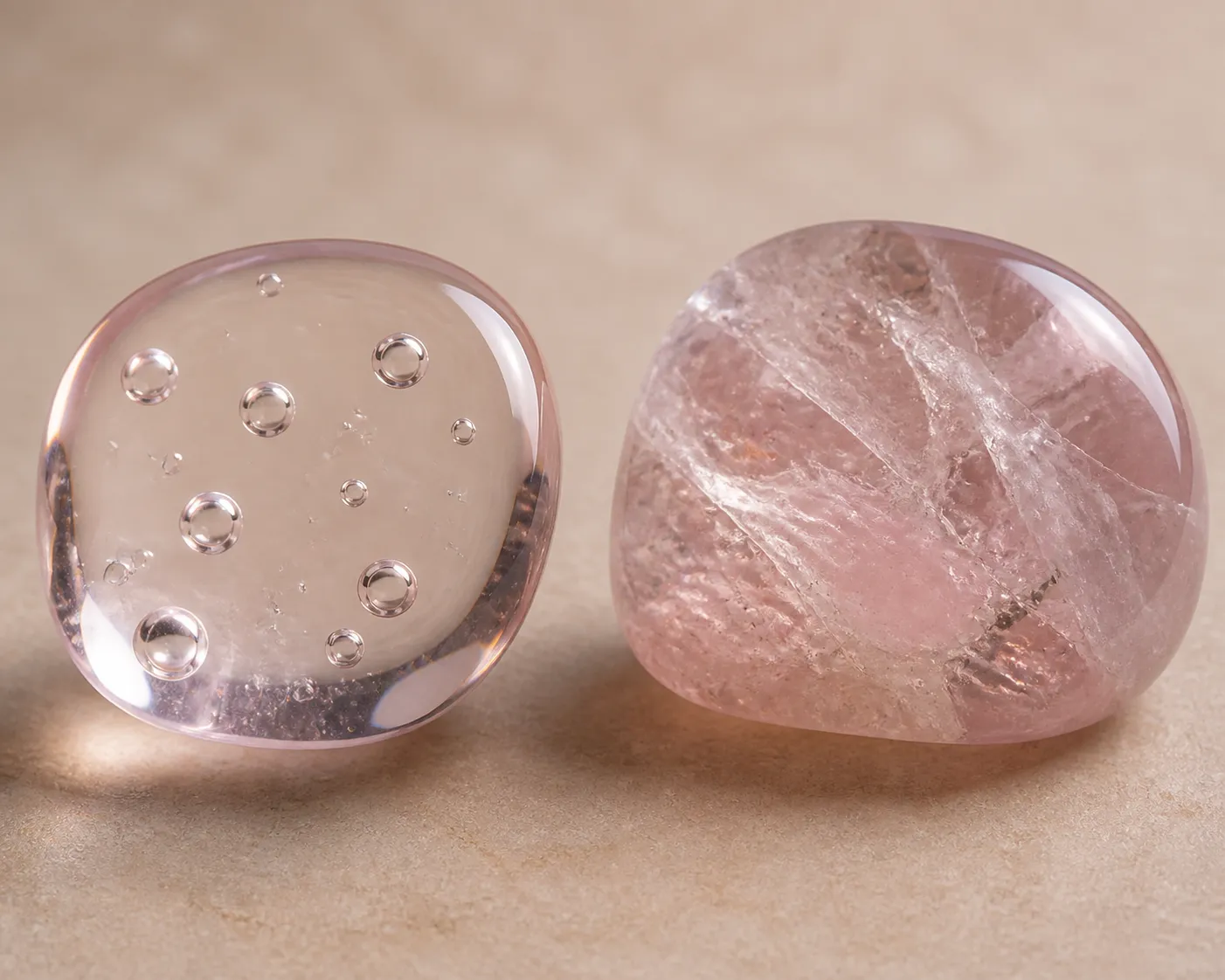
If you see “bubbles” in a piece sold as quartz, the useful first answer is simple: smooth, perfectly round, glass-like air bubbles are a red flag for glass imitation, but they are not proof by themselves.
Quartz can contain natural internal features, including quartz inclusions such as tiny fluid pockets, cloudy zones, veils, fractures, mineral specks, and misty areas. The concern rises when the marks look like clean little spheres suspended in a transparent, glassy body—especially when several of them repeat in the same style.
In other words: not every internal mark means fake quartz. But repeated, perfectly round bubbles are worth pausing over.
Why “bubbles” are not all the same thing
In everyday crystal buying, people often use the word “bubble” for any small dot, circle, pocket, or bright spot inside a stone. In gem and mineral language, those features can be quite different.
In natural quartz, an internal feature might be:
- a healed fracture;
- a veil-like internal sheet;
- a cloudy or flocculant-looking zone;
- a mineral inclusion;
- a tiny cavity;
- a fluid inclusion containing liquid, gas, or both;
- a cluster of microscopic inclusions that makes the quartz look milky.
In glass, a bubble is more likely to be a trapped gas bubble from the making or cooling of the material. These bubbles can look smooth, rounded, and clean-edged. When they appear repeatedly in a clear, glass-like object, they point more strongly toward glass imitation.
A better rule than “bubble equals fake” is this:
Shape matters because natural quartz records geological growth, stress, trapped fluids, and other mineral material. Its inclusions often look varied: misty, angular, stretched, clustered, threadlike, or connected to internal planes. A scatter of identical clean spheres looks less like natural quartz and more like gas trapped in manufactured glass.
What natural quartz inclusions can look like
Quartz inclusions are internal features within quartz. They are not automatically signs that the piece is fake, damaged, or low quality. In many quartz varieties, inclusions are part of the stone’s visual character.
Common natural-looking patterns include:
- Cloudy inclusions: misty white zones that can soften the appearance of clear or rose quartz.
- Veil-like inclusions: fine sheets, wisps, or internal curtains, often related to healed fractures.
- Mineral specks: dark, red, golden, greenish, or pale particles trapped inside the quartz.
- Needle-like inclusions: slender crystals, such as those seen in rutilated quartz.
- Irregular fluid inclusions: tiny pockets that may contain liquid and/or gas.
- Flocculant-looking areas: soft, suspended, cloudlike patches rather than crisp round bubbles.
This is especially relevant with rose quartz, which is often translucent rather than sharply transparent. A hazy body, milky interior, or cloudy patch is not suspicious on its own. Milky quartz can look soft and opaque because of abundant microscopic inclusions. Garden quartz may show scenic mineral inclusions. Clear quartz can be very transparent and still be natural.
The red flag is narrower: round, smooth, repeated, glass-like bubbles without the surrounding messiness or structure often seen in natural quartz inclusions.
How to inspect air bubbles in quartz without damaging it
A careful visual check can help you decide whether a piece deserves more caution. It will not give laboratory certainty, but it can separate a casual worry from a stronger glass-imitation concern.
Try this non-destructive inspection:
- Use bright, indirect light.
Harsh glare can make scratches, dust, chips, and reflections look like internal bubbles. A window or diffused lamp is usually better than pressing a flashlight directly against the stone. - Rotate the piece slowly.
A real internal feature stays inside the material as surface reflections move. A surface pit or polish mark may appear and disappear from different angles. - Look at the shape.
Perfect spheres are more suspicious than irregular pockets, cloudy areas, wisps, or fracture-linked marks. - Look for repetition.
One odd feature is hard to judge. Several smooth round bubbles of similar size and style create a stronger warning sign. - Use a 10X loupe if you have one.
A standard 10X magnifier can help distinguish surface marks from internal features. It may also show whether a “bubble” is actually a fracture reflection, tiny crystal, cloudy inclusion, or rounded gas pocket. - Check the surrounding context.
Is the mark part of a veil, crack, growth zone, or cloudy inclusion area? Or is it sitting alone in a clear, glass-like mass? The second pattern is more concerning.
A useful summary is: roundness plus smoothness plus repetition plus a glassy host raises suspicion. One trait alone is weaker. Together, they make the piece worth questioning.
Common mistakes when judging fake quartz bubbles
“Any bubble means the quartz is fake”
That is too broad. Natural quartz can contain fluid inclusions and cavities. Some may look bubble-like, especially under magnification.
The better distinction is between natural quartz inclusions and glass-like spherical air bubbles. Natural inclusions often have irregular shapes or appear with other internal structures. Glass bubbles tend to look smoother and more perfectly rounded.
“Quartz never has bubbles”
This is also too simple. Quartz can trap fluids and other internal features during growth or later geological changes. Some of those features may be casually called bubbles even when “fluid inclusion” or “cavity” would be more accurate.
So the real question is not whether quartz can ever have bubble-like features. It can. The question is whether the feature looks like a natural inclusion or like a manufactured gas bubble in glass.
“If it is too clear, it must be fake”
Clarity alone is not a reliable test. Natural quartz can be very clear. Glass imitations can also be clear. A transparent piece may deserve closer inspection, but transparency by itself does not identify the material.
The reverse is also true: flaws do not prove authenticity. Glass can contain bubbles, swirls, and defects. Natural quartz can be nearly clean.
“If it magnifies text, it is glass”
This shortcut is unreliable. A curved polished quartz piece can magnify or distort text because of its shape. Glass can do the same. Magnification tells you more about the object’s form and surface than its mineral identity.
“A scratch test will settle it”
Quartz is harder than common glass on the Mohs scale, but casual scratch testing can damage polished stones, jewelry, sentimental pieces, and specimens with resale value. It can also produce confusing results if coatings, surface wear, or the wrong test surface are involved. For a valued piece, a careful visual inspection and professional identification are safer than trying to force a result at home.
When perfectly round bubbles should make you pause
You do not need to worry about every cloudy patch or internal line. A rose quartz palm stone with hazy zones, a clear quartz point with veils, or a smoky quartz crystal with tiny irregular inclusions may be completely ordinary.
Pause and inspect more carefully when you see:
- bubbles that are nearly perfect spheres;
- smooth, bright, glassy bubble edges;
- several bubbles that look repeated or manufactured;
- round bubbles floating in an otherwise glass-like body;
- little visible growth texture, fracture connection, mineral specks, or natural-looking inclusion pattern;
- a vague seller description, especially when the presentation or price does not fit the claimed material.
This does not make the object definitely fake quartz. It means the visual clue is strong enough that the seller label should not be your only evidence.
Mounted jewelry is harder to judge. Settings can hide edges, glue, backing, or assembled construction. Curved cabochons and beads can also create reflections that mimic internal marks. If the piece is expensive, sentimental, or intended for resale, a qualified gemologist or gem lab is the better next step.
What visual inspection can and cannot prove
Visual inspection is useful because some glass imitations leave visible clues. Smooth round air bubbles are one of them. Good light, slow rotation, and a 10X loupe can help you compare bubble-like marks with natural quartz inclusions.
But visual inspection has limits. It cannot separate every natural quartz inclusion from every manufactured defect. It cannot confirm every treated, synthetic, assembled, or imitation object. It also cannot turn one clue into certainty.
A careful conclusion looks like this:
- Irregular, cloudy, veil-like, fracture-associated, or mineral-like marks may be natural quartz inclusions.
- Smooth, perfectly round, repeated air bubbles in a glassy-looking piece make glass imitation a serious possibility.
- If the value or decision matters, seek professional identification rather than relying on one home observation.
That balance matters. It keeps you from rejecting natural quartz just because it has inclusions, while still taking a classic glass warning sign seriously.
Short answer: are bubbles in quartz fake?
Bubbles in quartz are not automatically fake. Natural quartz can contain inclusions, including fluid inclusions and cavities that may look bubble-like.
But perfectly round bubbles, especially when they are smooth, repeated, and suspended in a glass-like body, are a meaningful red flag for glass imitation. For a casual decorative piece, that may be enough reason to be cautious before buying. For jewelry, resale, or a valued specimen, treat the bubble pattern as a reason to get a more reliable identification—not as a final verdict.