Bedroom placement guide
Rethinking the Bedroom: How to Build an EMF Recovery Sleep Grid
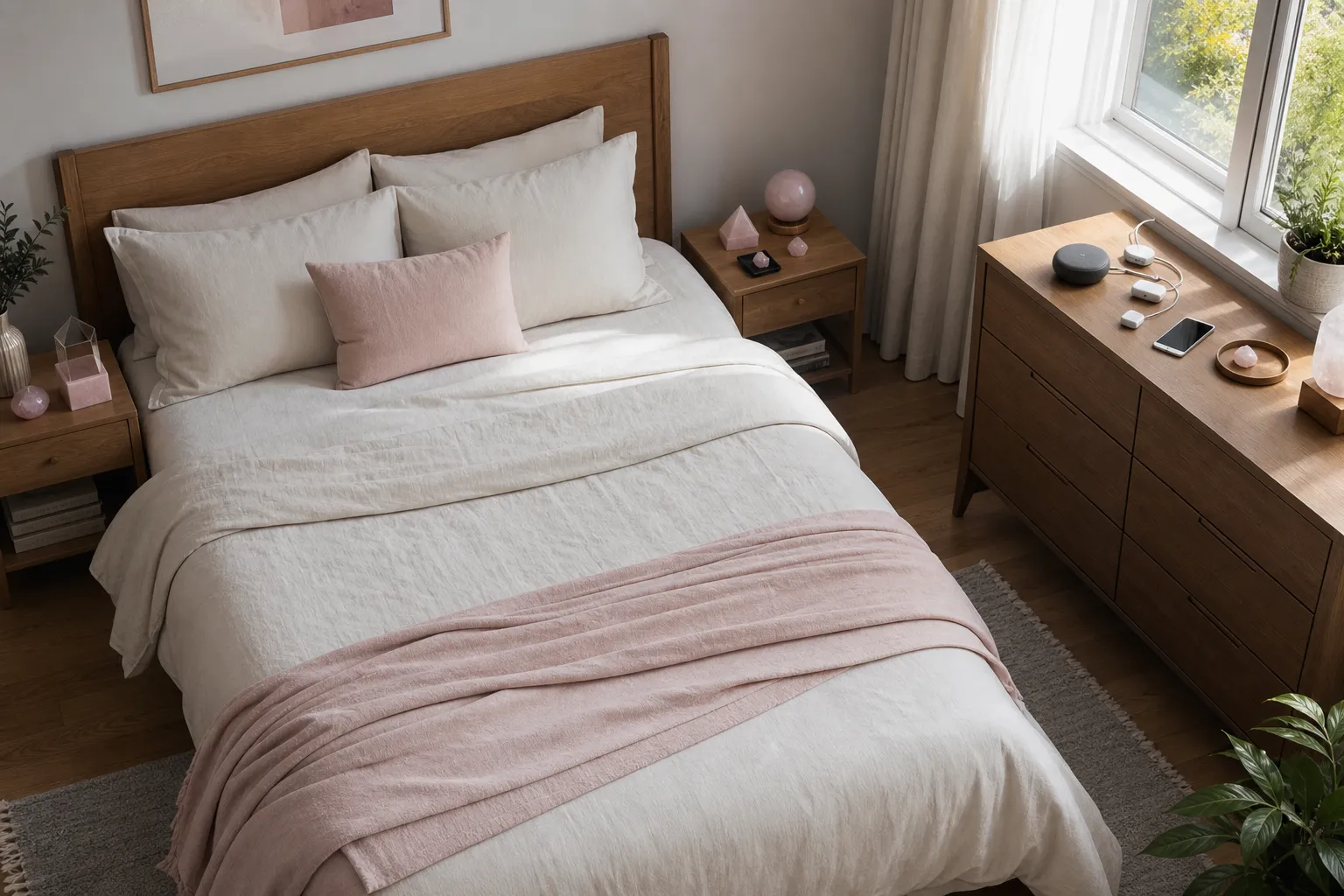
Build an EMF recovery sleep grid in two layers. First, make the bedroom layout less device-centered: move active transmitting devices away from the bed, reduce unnecessary powered clutter, and keep charging away from the pillow zone. Then, if you use rose quartz, stones, or geometric objects, place them as a symbolic ritual around that clearer sleep area.
That is the most defensible version of EMF recovery sleep grid placement. The device-distance choices are the measurable part. The grid is the personal meaning part. It may help the room feel more intentional, but public-health sources do not show that a grid changes electromagnetic fields, creates cellular rest, or reliably changes sleep outcomes.
broader context
Rose quartz context note
This narrower page makes more sense after the broader rose quartz context page.
Start With the Part That Can Actually Change Exposure
Before arranging stones, define the sleep area: the bed, bedside surfaces, and the space around your head and torso while you sleep. This keeps the setup grounded in real placement choices instead of vague energy language.
The first move is not decorative. It is separating active devices from the bed. Phones, tablets, wireless earbuds, laptops, smartwatches, routers, chargers, and powered accessories are not all the same kind of source, but they can make a bedroom feel electronically crowded. Public-health and regulatory materials treat electromagnetic fields as a broad category, with radiofrequency exposure as one area connected to wireless communication. For active transmitting devices, distance is a practical variable.
For a bedroom, begin here:
- Keep the phone away from the pillow and mattress instead of under the pillow, on the bed, or directly beside your head.
- Use airplane mode or turn off wireless functions when you do not need calls, messages, or alerts overnight.
- Move charging stations to a dresser, shelf, or desk outside the immediate sleep zone.
- Unplug nonessential powered items near the bed when they are not needed.
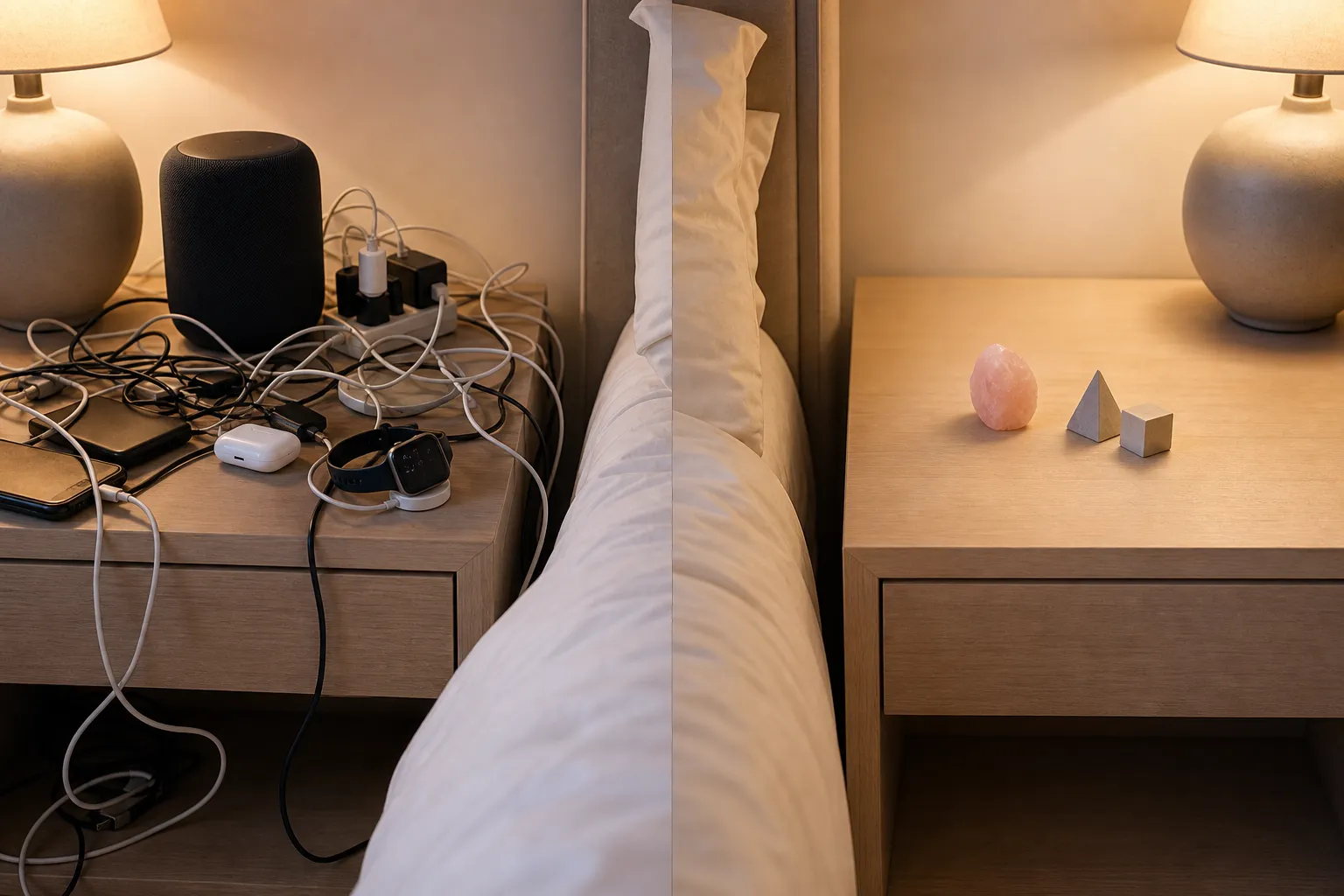
- Avoid turning the nightstand into a cluster of chargers, speakers, wearables, and glowing indicators.
This is not a claim that ordinary devices are automatically unsafe. It is a calm, distance-based way to reduce powered clutter and make the bedroom more rest-oriented. If your phone must stay available for emergency calls, place it across the room rather than beside your head. If you use it as an alarm, that same placement can still work and may reduce the habit of checking the screen in bed.
The key distinction is simple: moving active devices changes the physical layout. A symbolic grid does not replace that step.
Then Place the Symbolic Grid
Once the powered layout is cleaner, the sleep grid can become a room-organization ritual. This is where terms like spatial energy geometry, recovery sleep grid, cellular rest, and sleepmaxxing need careful handling. They can describe intention, atmosphere, and personal practice. They should not be treated as established EMF terminology.
A simple layout is enough. You do not need to cover the bedroom with objects or create an elaborate pattern. For a rose quartz-centered room, a restrained grid might look like this:
- One central piece on a dresser, shelf, or tray near the room’s quietest visual point.
- Two small stones placed symmetrically on opposite sides of the bed, away from cords and outlets.
- A fourth point near the room entrance or a reading chair, if the layout naturally supports it.
- No stones on heating elements, unstable shelves, tangled cables, or surfaces where they may fall at night.
Good sleep grid placement follows the actual room. A small bedroom may only need one central object and two side points. A larger room may allow a loose rectangle or diamond shape. The goal is not to create an invisible barrier. It is to give the room a visual rhythm: fewer devices near the bed, clearer surfaces, softer materials, and a symbolic geometry that reminds you what the room is for.
If you use rose quartz, keep its role in the symbolic and aesthetic layer. Rose quartz is often associated with softness, emotional warmth, and gentler interiors, but those associations should not be turned into claims about changing radiofrequency exposure or producing biological recovery. The stone can anchor the ritual. It should not be asked to do the work of distance-based habits.
What Changes the Best Placement
The best arrangement depends on the bedroom’s real constraints. A grid that looks balanced in a photo may not work in a room with limited outlets, shared sleeping needs, medical equipment, caregiving responsibilities, pets, children, or a phone that must remain reachable.
Start with the device that has the strongest reason to be near the bed. For many people, that is a phone used for alarms, family contact, accessibility, or emergency calls. Instead of forcing an unrealistic rule, choose a workable distance. Across the room is often more practical than outside the room. A shelf several feet from the bed is usually better than under the pillow. Airplane mode may be useful when connectivity is not needed, but it is not right for every person or every night.
Next, look at the bedside surface. If the nightstand holds a wireless charger, lamp, earbuds, watch charger, tablet, and phone, the first improvement is not a crystal pattern. It is deciding what actually needs to live there.
The bed frame matters too. Do not place objects where they can fall into bedding, interrupt sleep, or become a hazard in the dark. Under-pillow or under-mattress placement may sound intimate, but it is not necessary for a symbolic grid and can become uncomfortable or impractical. A visible tray, shelf, or bedside object is easier to maintain.
Shared rooms need a lighter hand. A personal ritual grid should not take over another person’s side of the bed or imply that everyone in the room has agreed to the same wellness framing. In that case, keep the grid on your own dresser, tray, or reading corner. The shared practical step can stay simple: fewer active devices close to the bed when possible.
Where the Evidence Stops
The available public references are useful for boundaries, not for validating the grid itself. Government and international public-health sources can help explain EMF terminology, radiofrequency exposure, safety-limit framing, and why distance from active transmitting devices is a practical variable. They do not establish that an EMF recovery sleep grid changes measured fields, produces cellular rest, or controls the body’s recovery process.
That boundary matters because the word “recovery” can sound stronger than the evidence allows. In this context, recovery is best read as a personal rest intention: a way of designing the bedroom to feel less cluttered, less device-centered, and more deliberate. It should not be read as a measured biological promise.
The same applies to sleepmaxxing. Some sleepmaxxing practices focus on habits that are easy to observe, such as a darker room, less nighttime screen use, cooler bedding, quieter routines, or fewer interruptions. A symbolic grid can sit beside those habits as a personal ritual. It should not be treated as the reason someone will sleep better.
There is also a terminology issue. EMF is an umbrella term, not a single uniform force. Electric fields, magnetic fields, and radiofrequency exposure are not identical. A phone, a lamp cord, a router, and a decorative crystal do not belong to the same category of action. If the goal is measurable exposure reduction, focus on active devices, distance, and whether a device is transmitting or powered. If the goal is symbolic spatial organization, be honest that the grid belongs to meaning, not measurement.
A Bounded Bedroom Layout
For a calm, realistic setup, use this order.
- First, clear the immediate sleep zone. Remove devices that do not need to be beside the bed. Move the phone away from the pillow. Relocate charging to a less intimate surface. Keep only what the night actually requires, such as a lamp, a book, water, or a necessary device placed with as much distance as practical.
- Second, choose a grid center. This could be a rose quartz piece on a dresser, a small bowl on a shelf, or a tray that holds a few objects. The center should be stable, visible, and away from cable clusters. It is not more useful because it is closer to your body. It is more useful when it helps the room feel ordered.
- Third, place two or three supporting points. Symmetry can be calming, but it does not need to be exact. A pair of small stones on opposite sides of the room, or one by the entry and one near a reading chair, can create enough spatial energy geometry for the ritual layer without crowding the bedroom.
- Fourth, keep the grid easy to maintain. If dust, cords, pets, children, or nighttime movement make the arrangement awkward, simplify it. A personal ritual grid that becomes visual clutter is working against its own purpose.
- Finally, name the boundary for yourself. The device-distance layer is practical bedroom spatial organization. The rose quartz or geometric layer is symbolic. Holding both layers clearly prevents the setup from becoming either dismissive or overclaimed.
Common Confusion
Grid placement and device distance are not the same thing
Moving an active device farther from the bed is a physical placement choice. Arranging stones is a symbolic placement choice.
Public-health RF guidance does not validate wellness geometry
Public-health sources can support cautious, proportionate language about exposure and distance. They do not establish that crystals or grid patterns change measurable fields.
More objects do not make the grid stronger
For this kind of bedroom practice, restraint is usually more coherent. A clear sleep area with fewer active devices and a small, intentional grid is more consistent than a crowded arrangement full of chargers, stones, lights, and accessories.
The Practical Answer
Build the EMF recovery sleep grid by clearing the bed area first, moving active devices away from the body, reducing unnecessary powered clutter, and then placing a small symbolic grid where it supports the room’s quiet visual order. Use rose quartz or other objects as markers of intention, not as substitutes for device-distance habits.
That gives the bedroom two honest layers: a measurable layer based on ordinary placement choices, and a symbolic layer based on personal ritual. The result is not a guaranteed recovery system. It is a more deliberate sleep area that respects both the reader’s wellness vocabulary and the limits of the evidence.