Grounded ritual practice
Building a Future Self Altar for Authentic Connection in 2026
A future self altar is a small, intentional space that helps you return to the person you are choosing to become. For 2026, the most grounded way to build one is to treat it as a symbolic personal practice space: a place for reflection, values clarification, journaling, visible reminders, and real-world follow-through.
Future Self Altar Manifestation can be meaningful as ritual language, but it should not be framed as proof that objects, crystals, or written intentions automatically create outcomes. The altar works best when it helps you notice your direction, remember your commitments, and take the next honest step.
In plain terms: you are building a quiet visual center for your future self practice, not a display of perfect identity.
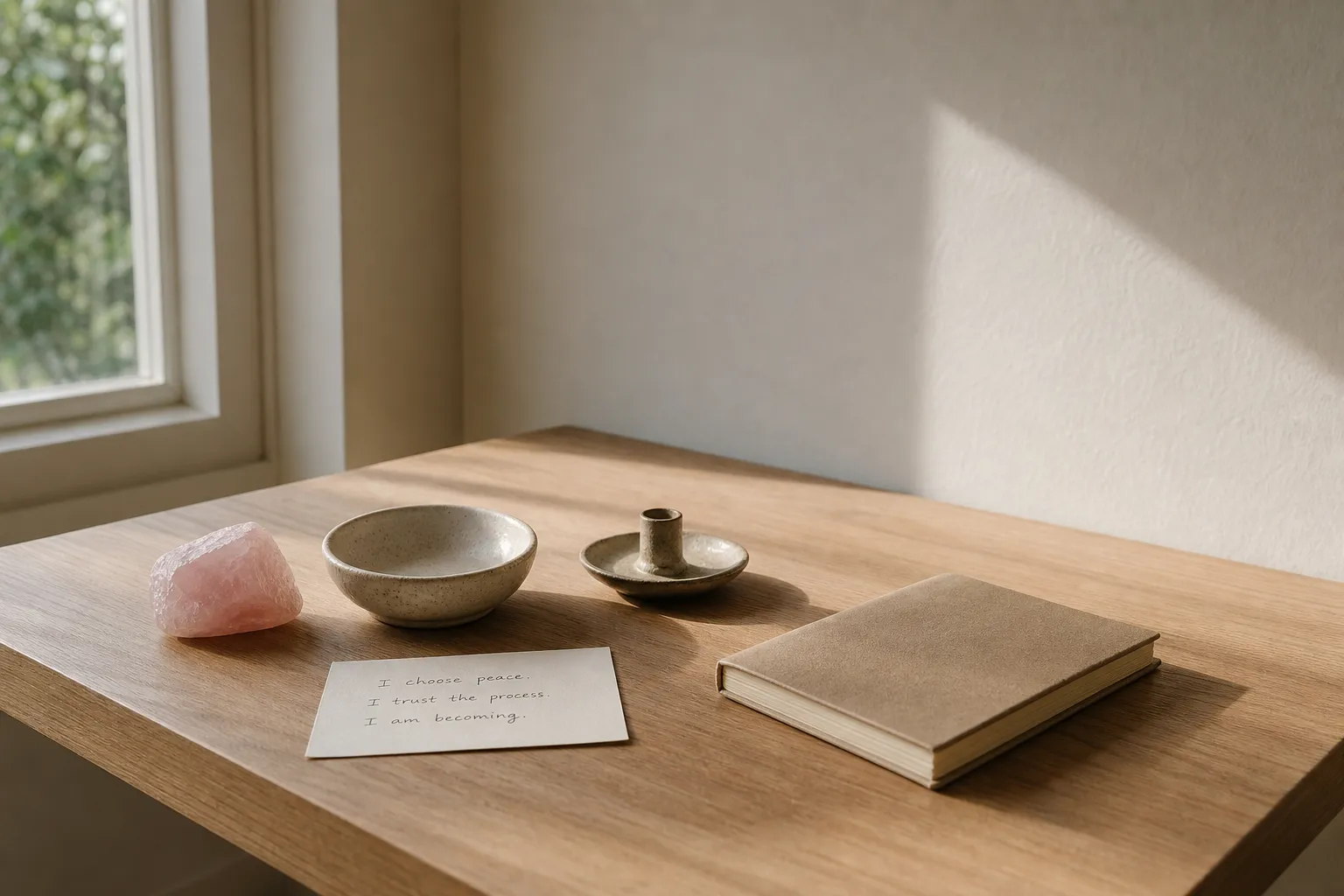
broader context
Rose quartz context note
This narrower page makes more sense after the broader rose quartz context page.
Build the Altar Around One Honest Question
Start with this question:
“What kind of connection am I trying to make more real in 2026?”
The answer might be connection with your own voice, your body, your work, your home, your creativity, your relationships, or a more truthful version of daily life. Keep it specific enough to guide the altar, but not so rigid that it becomes another performance.
Choose a small surface first: a shelf, windowsill, side table, desk corner, tray, or bedside area. The size matters less than whether you can see it regularly without letting it become clutter. A future self altar is strongest when it acts as an environmental reminder, not when it takes over the room.
Then add five simple elements.
A grounding object
Use something that feels steady: a stone, ceramic bowl, shell, wood piece, candle holder, or small object from your home. If rose quartz belongs in your practice, let it symbolize softness, self-respect, or emotional sincerity. Its color and texture can support the mood of the space without needing exaggerated claims.
A written intention
Write one believable sentence. For example: “I am practicing honest connection through the choices I repeat.” Avoid declarations that make you feel false. The altar should help you recognize your direction, not pretend you have already arrived.
A values marker
Add one object that represents a value, not a fantasy result. A key might stand for agency. A mirror might stand for self-honesty. A piece of fabric might stand for gentleness. A notebook might stand for discipline. This keeps the altar close to values clarification instead of vague wishing.
A real-world action cue
Include something that points to the next behavior: a pen for journaling, a weekly action card, a calendar note, a small envelope for money boundaries, a book you are actually reading, or a reminder to send the message you keep postponing. This is where grounded manifestation practice becomes useful: the symbol stays connected to action.
An empty space
Leave part of the altar open. The blank area prevents the space from becoming a pile of symbols and gives the practice room to change. In a year full of reinvention imagery, emptiness can be part of the honesty.
A useful guiding sentence is: “My future self altar shows the values I am practicing, the connection I am protecting, and the next action I am willing to take.”
Choose Objects for Meaning, Not Performance
The objects on a self reflection altar should be chosen for meaning, visibility, and personal honesty. They do not need to be rare, expensive, or spiritually dramatic. Ordinary objects often work better because they are already tied to daily life.
Rose quartz may fit if you are drawn to gentle color, heart-centered symbolism, and a softer interior mood. On this altar, it can represent tenderness, openness, or the choice to meet yourself without harshness. Its role is symbolic and aesthetic: it helps set the tone of the space.
A candle can mark attention. A bowl can hold notes. A photo can remind you of a place, person, ancestor, or earlier version of yourself, if using that image feels respectful. A handwritten card can keep the language close to your real life. A flower, leaf, or seasonal object can make the altar feel alive without turning it into a complicated ceremony.
The better question is not “Does this look spiritual?” but “Does this help me return to the connection I am choosing?”
A future self altar can include:
- a small piece of rose quartz or another stone used as a visual symbol;
- a handwritten 2026 intention;
- a weekly action card;
- a journal or folded prompt;
- a photograph, drawing, or color that represents a value;
- one object that reminds you to pause before reacting;
- one empty space for change.
Try not to build the altar from borrowed aesthetics alone. Social media altar images can make personal ritual look polished and complete. A real altar for self reflection may be quieter: a plain notebook, a boundary list, a candle holder, and a reminder to make one necessary call. The beauty is not separate from the follow-through.
Place It Where It Can Interrupt Autopilot
Intentional altar placement is not about finding a perfect mystical location. It is more useful to ask where the altar can be noticed at the right moment.
A bedroom altar may support morning or evening reflection. A desk altar may support work identity and focus. A living room altar may shape the atmosphere of the home. A closet shelf, drawer, or box altar may be better if the practice feels private.
Ask three placement questions:
- Will I see this altar when reflection is actually useful?
- Can I keep this space clean without making maintenance feel like pressure?
- Does this location feel private enough for honest intention?
Privacy matters if the altar holds vulnerable writing, relationship reflection, longing, grief, or identity questions. A visible altar can be beautiful, but consent and boundaries still apply. Your symbolic ritual does not need to be available for everyone’s interpretation.
If you live with others, consider a tray altar that can be moved. If your space is very small, use a box altar: open it for journaling, close it when you are done. If you travel often, use a card, stone, and folded note in a pouch. The altar does not need permanent architecture to hold meaning.
Give the Altar a Simple 2026 Rhythm
A future self altar becomes more useful when it has a rhythm. Without one, it may slowly become decoration. Decoration is not wrong, but it may not support the deeper task: building authentic connection through a grounded future self practice.
Once a week, stand or sit near the altar and answer one prompt. A few honest lines are enough.
Useful journaling prompts include:
- What did I do this week that matched the person I am becoming?
- Where did I perform an identity instead of living it?
- What connection needs care, repair, or clearer boundaries?
- What is one action I can take before the next time I return here?
- What object on this altar still feels true, and what no longer belongs?
Once a month, edit the altar. Remove what has gone stale. Replace intentions that now sound inflated. Add an action cue if the altar has become too abstract.
This keeps intention materialization in a grounded frame: the intention becomes more visible through behavior, choices, and repeated attention, not through a guaranteed hidden mechanism.
After journaling, choose one practical step and write it on a card. Keep it small enough to complete: send one email, clear one corner, schedule one appointment, revise one boundary, prepare one meal, outline one page, or ask one direct question. Place that card on the altar until it is done.
That is how the altar becomes more than an aesthetic focus altar. It becomes a witness to your next movement.
What Changes the Best Altar Design
The best design depends on what kind of authentic connection you mean.
Connection with yourself
If you want connection with yourself, use fewer objects and more writing space. A mirror, journal, and single stone may be enough.
Connection in relationships
If you want connection in relationships, include a boundary reminder alongside symbols of care, so the altar does not become a place where you romanticize one-sided effort.
Connection with creative work
If you want connection with creative work, include a tool, draft, color, or material sample that points toward making.
If your future self practice is tied to grief, major life change, or overwhelming emotional distress, keep the altar modest and supportive rather than intense. A symbolic space can hold reflection, but it should not replace practical help, trusted support, or appropriate professional guidance when those are needed.
Your background also matters. The word “altar” carries different meanings in different religious, cultural, and personal contexts. If you are borrowing forms from traditions that are not yours, slow down. A personal altar can be simple without taking sacred symbols out of context. Use objects from your own life, home, landscape, family memory, or chosen aesthetic language.
Budget changes the answer too. There is no need to buy a full altar set. A future self altar can be made from a clean cloth, a note, a candle holder, a stone you already own, and a card with one honest action. Buying more objects does not make the practice more sincere.
Common Confusion: Manifestation, Anchors, and Reality
The phrase “subconscious anchor” can be useful as metaphor. It suggests that a repeated visual cue may help you remember an intention before you drift back into habit. Here, it is not being used as a verified mechanism or promise. The altar may remind you; it does not guarantee transformation.
The same boundary applies to Future Self Altar Manifestation. If manifestation means naming what matters, arranging your environment around that direction, and taking repeated practical steps, the phrase can describe a grounded symbolic ritual. If it means the altar itself will create love, money, certainty, or a new identity without action, that goes beyond what this practice can honestly support.
A future self altar is not powerful because it proves the future. It is meaningful because it asks you to stay in relationship with your choices. It lets you see whether your objects, words, calendar, and behavior are telling the same story.
After two or three weeks, do not ask only whether the altar feels charged. Ask what changed in your behavior. Did you write more honestly? Did you complete the action cards? Did you remove an object that no longer matched your values? Did the altar help you pause before repeating an old pattern?
If nothing changes, simplify the altar and bring it closer to one concrete practice.
A Simple Future Self Altar Layout for 2026
Use this layout if you want a direct starting point:
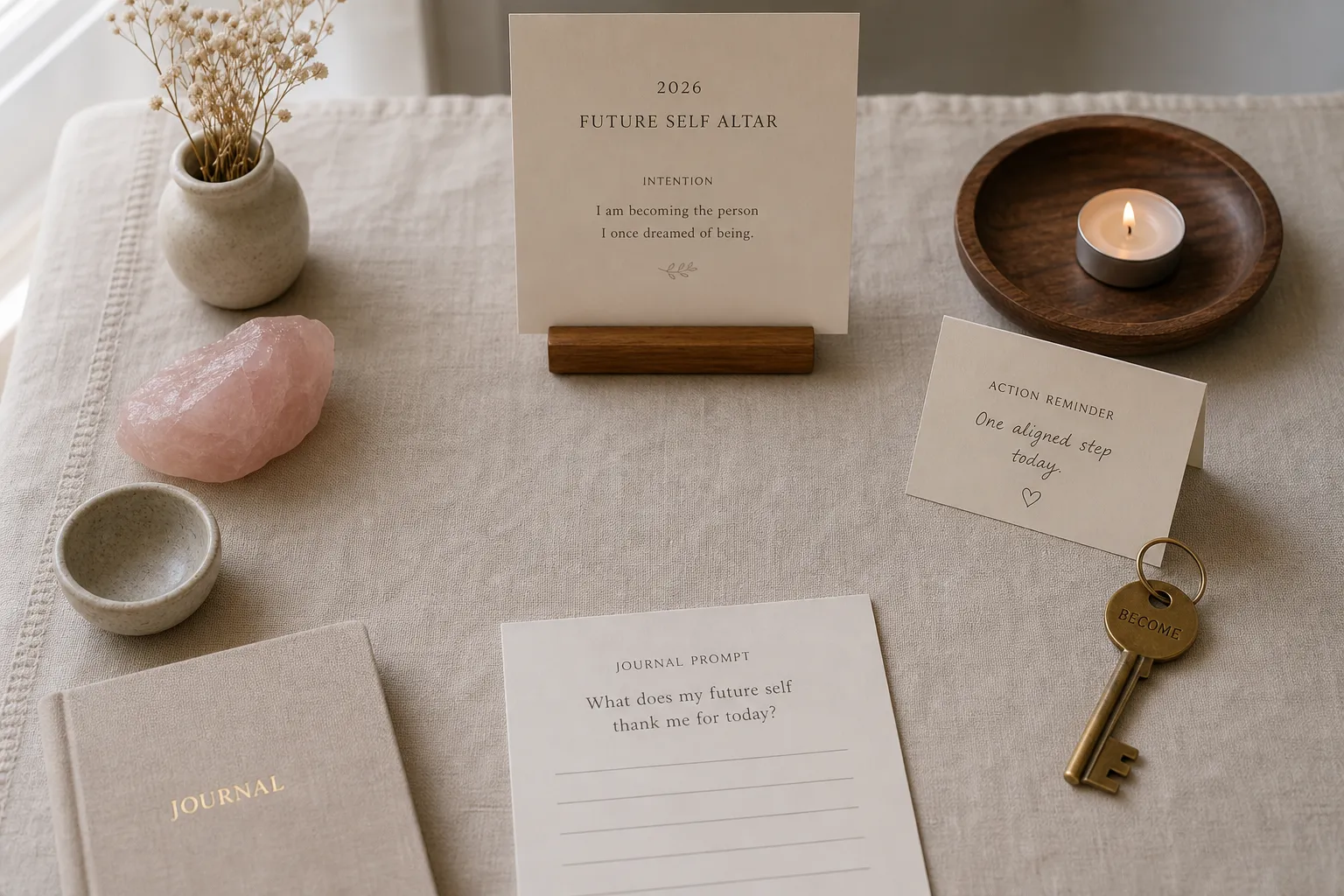
- Back center: one short, believable 2026 intention.
- Left side: one grounding object, such as rose quartz, ceramic, wood, or shell.
- Right side: one action cue, such as a pen, card, calendar note, or small tool.
- Front center: one journal prompt or weekly question.
- Open space: a clear area for change, rest, or seasonal objects.
This layout keeps symbolism and action in balance. The written intention names the direction. The grounding object gives the altar emotional tone. The action cue prevents the space from becoming passive. The prompt keeps the practice reflective. The open space keeps the altar from hardening into a fixed identity.
If you use rose quartz, place it where it supports the atmosphere without becoming the whole claim. Let it be a reminder of softness, not a guarantee. Let the altar be beautiful, but let it also be honest.
A future self altar for authentic connection in 2026 does not need to predict who you will become. It needs to help you meet the next version of yourself with clearer values, steadier attention, and a willingness to act in the real world.