Attention reset for alert-heavy work
Regaining Focus: Daily Grounding for Alert Fatigue
Daily grounding rituals for alert fatigue can help as short attention resets: a way to pause, notice your body and surroundings, and return to the next operational step with less automatic reactivity. For an IT professional facing alert storms, false positives, low-priority pings, dashboards, tickets, and on-call pressure, the aim is not to become calm while the system stays broken. The aim is to create a small gap between stimulus and response.
A feet-on-floor check, a 5-4-3-2-1 grounding scan, a few deliberate breaths before opening dashboards, or a brief post-incident reset may help you regain present-moment focus. These practices do not replace alert tuning, escalation design, workload support, incident protocol, or professional care when distress becomes serious.

broader context
Start with the main rose quartz page
This narrower page makes more sense after the broader rose quartz context page.
Why alert fatigue is not just a discipline problem
Alert fatigue is often described in healthcare and clinical decision-support literature as a response to repeated, excessive, irrelevant, low-value, or poorly timed alerts. That evidence base is not the same as IT operations, but it helps explain the mechanism: repeated interruptions can raise cognitive load, fragment attention, and contribute to desensitization or reduced responsiveness.
For IT professionals, the working version is familiar. A monitoring system fires too often. A dashboard shows too many yellow states. A ticket queue mixes urgent incidents with background noise. A low-priority notification arrives with the same sound and visual weight as a genuine production problem. Over time, the mind stops treating every signal as fresh information.
That does not mean the responder has a poor attitude. It means the alert environment is shaping attention. A grounding ritual works only at the human edge of that environment; it may help you notice, pause, and choose the next step more deliberately. It does not make a noisy alerting system well-designed.
Small grounding rituals that fit real alert work
The most useful grounding practices for IT professionals are short, repeatable, and unglamorous. If a ritual requires a perfect morning, a quiet room, or a ten-minute reset, it will probably fail during high-pressure alert overload. The better version fits inside the day you actually have: before opening dashboards, between tickets, after an alert burst, before a handoff, or after going off-call.
Before opening dashboards: one minute of breath and priority
Before you open the dashboard, place both feet on the floor and let your hands rest somewhere stable: desk, chair, keyboard edge, or notebook. Take three to five slower breaths. Then name the operational question before you look.
For example:
- “What system am I responsible for first?”
- “What is the escalation path if this is real?”
- “What alert source has the highest consequence?”
- “What am I not deciding alone?”
This is not a productivity performance. It is breath focus before dashboards so the first screen does not decide your mental state for you.
During a noisy burst: the 5-4-3-2-1 scan
A 5-4-3-2-1 grounding scan is a sensory attention exercise often described in grounding education resources. In an operations setting, keep it brief:
- 5 things you can see, such as the monitor frame, a status light, a notebook, a wall edge, or a cable.
- 4 things you can feel, such as your feet, chair, sleeves, or the desk surface.
- 3 things you can hear, including room sound, fan noise, or distant conversation.
- 2 things you can smell, or simply notice the absence of a clear smell.
- 1 thing you can taste, or the feeling of your mouth and breath.
Then return to the approved response process. Do not use grounding as a reason to delay a time-sensitive incident. Use it to reduce the automatic blur that can follow repetitive pings.
Between tickets: a feet-on-floor sensory check
A between-ticket reset ritual can take twenty seconds. Sit back, place both feet flat, and identify the pressure points: heel, toe, chair, back, forearm, fingers. Let your eyes move away from the screen for one breath. Then choose the next ticket or handoff step.
This kind of sensory grounding for alert fatigue is intentionally plain. It does not require a special object, though some people like a tactile anchor such as a smooth stone, a pen, or a piece of rose quartz on the desk. If you use one, treat it as a physical cue for attention, not as a claim about outcomes. The object is there to be touched, seen, and noticed.
Before responding: a STOP-style pause
A STOP pause before responding can be adapted for operational work:
- Stop for one breath before typing or acknowledging.
- Take a slower breath and release your shoulders if possible.
- Observe the body, the environment, and the alert priority.
- Proceed according to protocol.
The final word matters. Proceed according to protocol. The pause is not a substitute for the runbook, escalation rule, security procedure, or incident commander. It is a small way to avoid responding from pure startle.
After an incident: a short reset before the next context
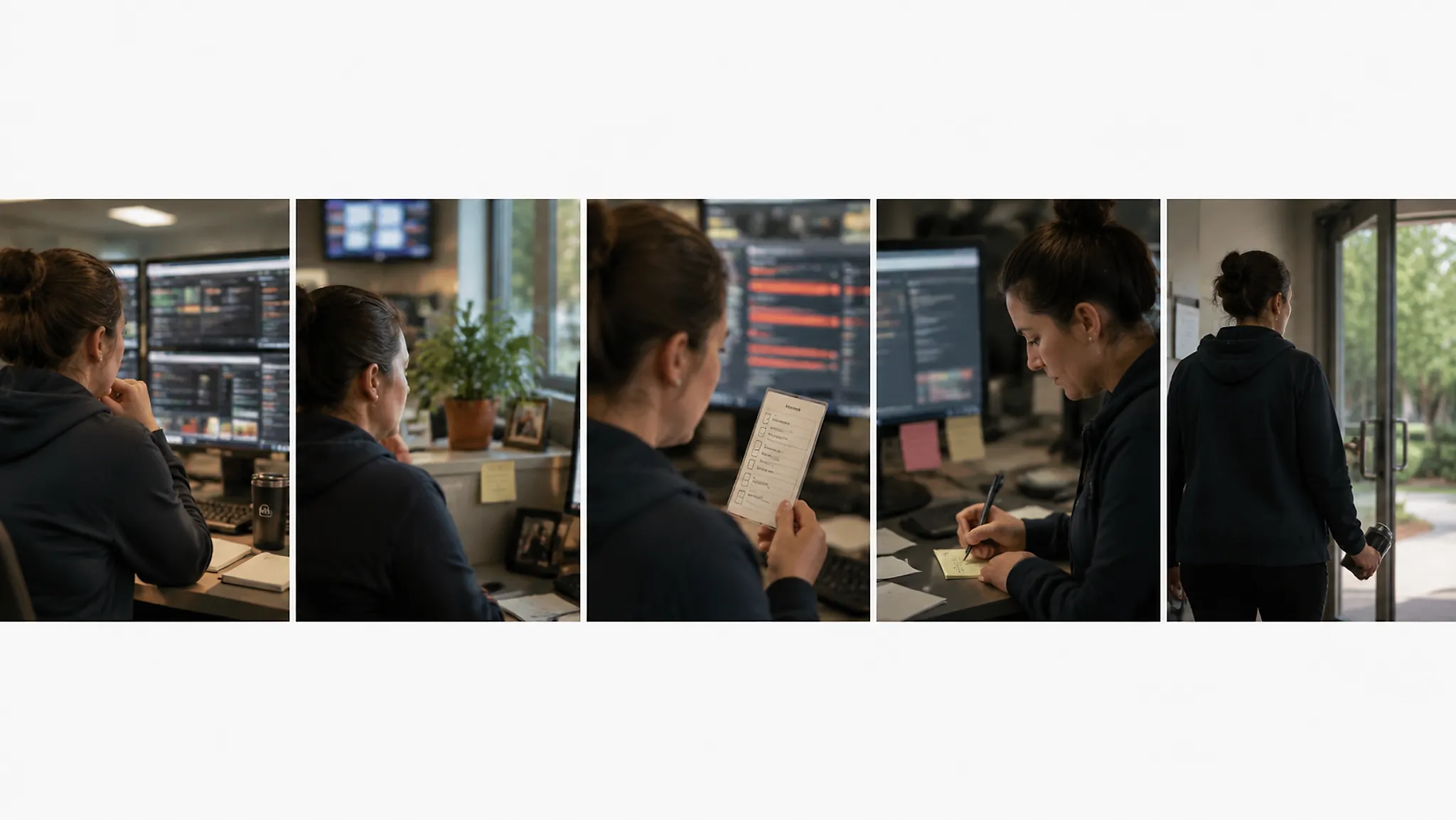
A post-incident grounding reset should be modest. Stand up if you can. Stretch your hands, neck, or shoulders without turning it into a workout. Drink water. Write one sentence about the next operational state: “Incident handed off,” “Follow-up ticket created,” “Waiting on owner,” or “No further action from me.” Then close or park the relevant windows.
This matters because alert fatigue is often compounded by unfinished cognitive loops. A short note, a cleared list item, or one physical reset can help mark the move from one demand to the next.
When grounding is not enough
Grounding is least appropriate when it becomes a private workaround for a public system problem. If alerts are routinely false, duplicated, poorly prioritized, or routed to the wrong people, the main answer is not more personal resilience. The alert system needs review. Escalation paths may need clearer ownership. Workload may need redistribution. On-call rotation may need support. Incident procedures may need to distinguish low-value noise from high-consequence signals.
A daily ritual can sit beside those fixes, not above them.
The answer also changes when alert fatigue is affecting safety-critical work, serious service obligations, security response, or personal functioning. If people are missing important alerts, overriding meaningful warnings, or feeling unable to recover between shifts, the next step should move beyond individual grounding. That may mean operational escalation, manager involvement, incident review, staffing support, or qualified mental-health support where appropriate.
Evidence boundary
Public sources are adequate for explaining alert-fatigue mechanisms and for describing common grounding techniques such as sensory awareness, breath focus, body scan, object focus, and 5-4-3-2-1. They are not strong enough to say that daily grounding rituals reliably reduce alert fatigue in IT professionals as a workplace outcome. The practical claim here is narrower: grounding may help some people create a brief attention reset during or after alert overload.
Common misunderstandings
One misunderstanding is that grounding is generic wellness language pasted onto engineering work. It can be, if it stays vague. For alert fatigue, useful grounding has to connect to a concrete work moment: before dashboard review, after a noisy alert burst, between tickets, before a handoff, or after an incident.
Another misunderstanding is that grounding means lowering the importance of every alert. That is not the goal. Some alerts should remain disruptive because they signal real consequence. The problem is when low-value, repeated, irrelevant, or false alerts train the responder to feel the same dull pressure all day. Grounding helps you notice your state before you decide what the signal means.
A third misunderstanding is that a ritual must be spiritual, elaborate, or aesthetically polished. It does not. A body scan for alert overload can be as simple as noticing jaw tension, shoulder position, breath, hands, and feet. Grounding before handoff can be a thirty-second note that names what is known, what is unknown, and who owns the next action. A ritual is useful only if it survives the workday.
A practical daily sequence for alert-saturated work
Use this as a small menu, not a strict program.
Start of shift
Before opening dashboards, take three to five slower breaths. Name the first operational responsibility and the escalation rule you may need.
First alert burst
Use a brief 5-4-3-2-1 scan or a feet-on-floor sensory check. Then return to triage.
Between tickets
Look away from the screen for one breath. Feel chair, feet, hands, and desk. Choose the next item deliberately rather than from notification pressure alone.
Before replying or acknowledging
Use a STOP-style pause: stop, breathe, observe, proceed according to protocol.
Before handoff
Write one short state note: what happened, what matters, what remains open, who owns the next step.
After going off-call or leaving the queue
Close the loop with a small physical reset: stand, stretch, drink water, clear one note, or edit the next-day list.
This is enough. If the ritual becomes another demanding task, it has missed the point.
The bounded answer
Daily grounding can support present-moment focus during alert fatigue by giving the overloaded responder a short pause, sensory anchor, and cleaner transition back to the next operational step. It is most useful when it is brief, tied to real alert moments, and paired with proper system-level work.
It is not evidence that grounding solves IT alert fatigue. It is not permission to tolerate broken alert design. The grounded path is both personal and operational: reset attention where you can, and keep pressure on the systems, staffing, and escalation rules that create the overload.