Workspace ritual
Clearing the Air: Smudging Rituals for Deep Work Focus
Negative energy smoke smudging can fit into a deep-work routine when it is treated as a symbolic workspace transition, not as proof that smoke changes energy, air quality, devices, magnetic fields, or productivity.
The most useful version is simple: clear the desk, reduce notifications, mark the room as a focused work zone, set one intention, and begin. The ritual works best as a doorway. It says: the scattered part of the day stops here; this block of work starts now.
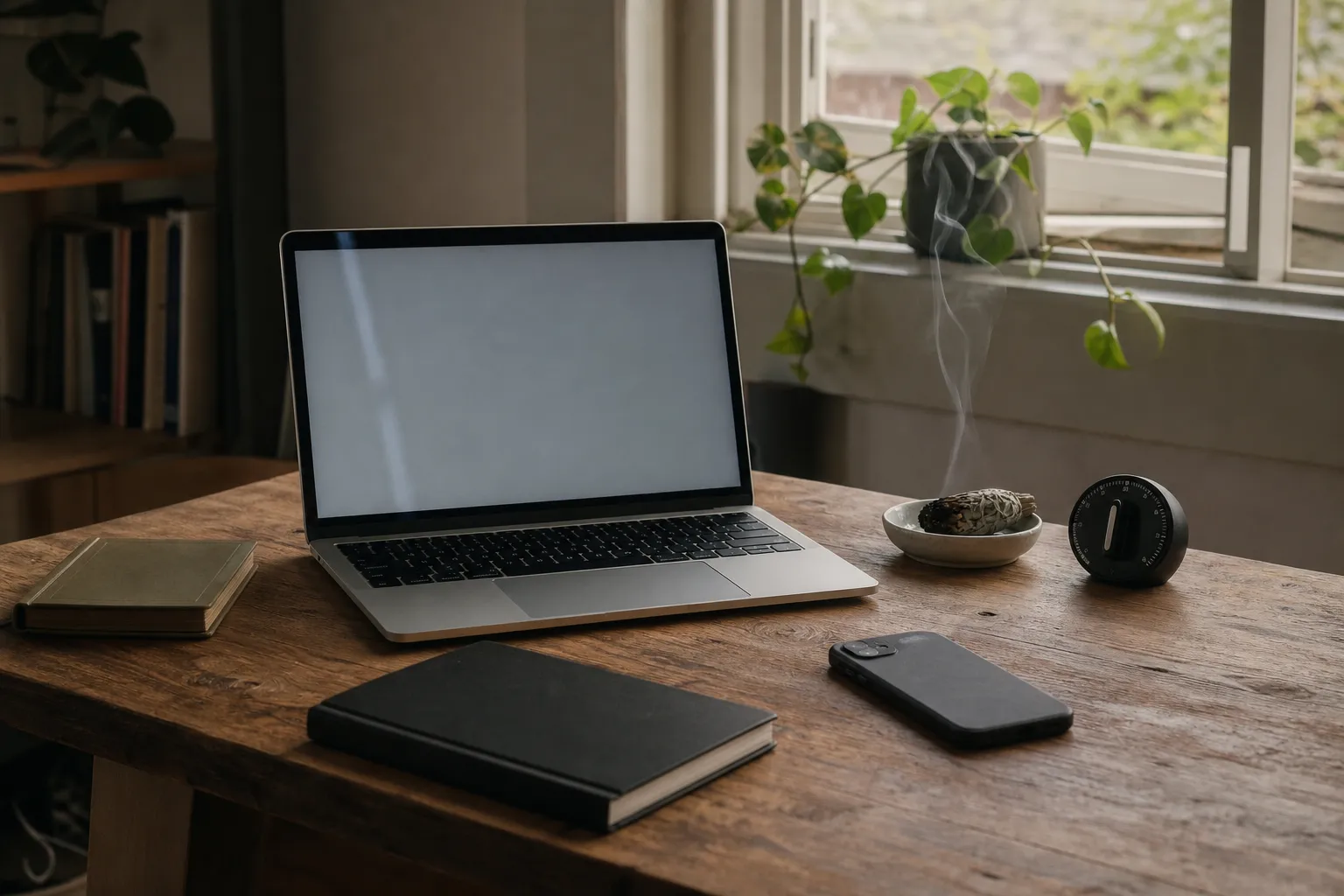
broader context
Start with the main rose quartz page
This narrower page makes more sense after the broader rose quartz context page.
What smoke smudging can honestly do
A smoke ritual can create atmosphere. It can slow the first minute of a work session. It can give your hands a quiet action before your attention settles. For readers who care about crystals, scent, ritual objects, and intentional rooms, that threshold may feel meaningful.
That meaning is personal. It belongs to belief language, mood, aesthetics, and routine. It is not the same as saying that smoke has removed negative energy from a room in a measurable way.
A grounded desk reset ritual might look like this:
- Remove cups, loose paper, and visual clutter.
- Put the phone away or switch it to a mode that reduces interruptions.
- Close extra tabs and silence nonessential notifications.
- Open a window if smoke is used and the room allows it.
- Move through the smoke ritual briefly, without trying to fill the room.
- State one work intention in plain language.
- Begin a timed focus block before checking messages again.
The useful part is the sequence. The room feels different because the conditions around your attention have changed: fewer visible distractions, fewer alerts, a clearer surface, and a marked beginning. Smoke may support the mood of that transition, but it is not doing the whole job.
If “negative energy” helps you name the residue of a crowded inbox, unfinished messages, tense meetings, or a room that feels mentally stale, it can work as metaphor. The key is not to confuse the metaphor with a verified physical process.
Keep atmosphere separate from claims
The language around smudging often mixes several things: spiritual clearing, scent, focus, emotional release, air quality, and sometimes technical-sounding claims about devices or fields. For this page, those ideas need to stay separate.
A personal smoke ritual may be described as:
- A sensory cue before work
- An intention-setting ritual
- A symbolic clearing of yesterday’s mood
- A way to make a desk feel less chaotic
- A threshold between digital noise and sustained attention
It should not be presented as:
- A confirmed method for removing negative energy as a physical substance
- A way to clear magnetic fields
- A tool for neutralizing digital signals
- A substitute for ventilation, cleaning, rest, or practical boundaries
- A guaranteed route to better productivity
“Magnetic field clearing” is especially easy to overstate. Without strong evidence, it belongs in the category of unsupported claim language, not workspace advice. Smoke does not need a technical explanation to have ritual value. If the act helps you mark a beginning, that is enough for a personal practice.
The same boundary applies to “digital noise elimination.” Smoke does not eliminate digital noise from devices. You reduce digital noise by changing digital conditions: muting alerts, moving the phone, closing apps, using a blocker, or deciding when messages can reach you. The ritual can frame that choice, but the practical reduction comes from the settings and boundaries you put in place.
A more grounded phrase is: “I am clearing the room of interruptions.” That keeps the statement anchored in action.
A simple deep-work smudging ritual
This is a small personal ritual, not a full ceremonial system. It is meant for a workspace and should be adapted or skipped if smoke is not right for the room.
Start with the desk, not the smoke. Put away anything that belongs to another task. If an object is emotionally meaningful, such as rose quartz, a notebook, a small bowl, or a lamp, place it where it supports the tone of the session rather than crowding the surface. The goal is not to decorate the whole room. The goal is to make one work zone feel clear.
Then reduce the digital inputs. Silence nonessential notifications, close messaging apps if possible, and move your phone out of immediate reach. This is the part that actually addresses interruption. If your work requires communication tools, set a narrow rule: one channel open, one check-in time, or one visible task list.
If using smoke, keep it brief and intentional. Open a window if the space allows. Move slowly around the desk or hold the smoke near the beginning point of the ritual. You do not need intensity. The action is a marker.
Say the intention plainly. “For the next forty-five minutes, I am working only on this draft” is stronger than a vague wish to become perfectly focused. The clearer the work boundary, the easier it is to begin.
Then begin immediately. Do not let the ritual become another delay. Open the document, review the first sentence, sketch the outline, sort the first note, or set the timer.
This is where the idea of a spatial sanctuary becomes practical. A sanctuary is not only a beautiful room. It is a space where fewer things are allowed to demand you at once. The ritual helps name that boundary; your choices enforce it.
When smoke is the wrong tool
Smoke is optional. Some rooms, bodies, leases, shared households, and work settings do not suit it. Because the available source set for this page does not support detailed health or indoor-air guidance, the conservative answer is simple: if smoke bothers you, someone else, or the room, do not use it.
Smoke-free smudging alternatives can preserve the ritual function without burning anything. You can open a window, ring a bell, wipe the desk, light an unscented candle where appropriate, place a stone beside the keyboard, wash your hands, or take a brief pause before starting.
The point is not the smoke itself. The point is the deliberate crossing from scattered attention into chosen attention.
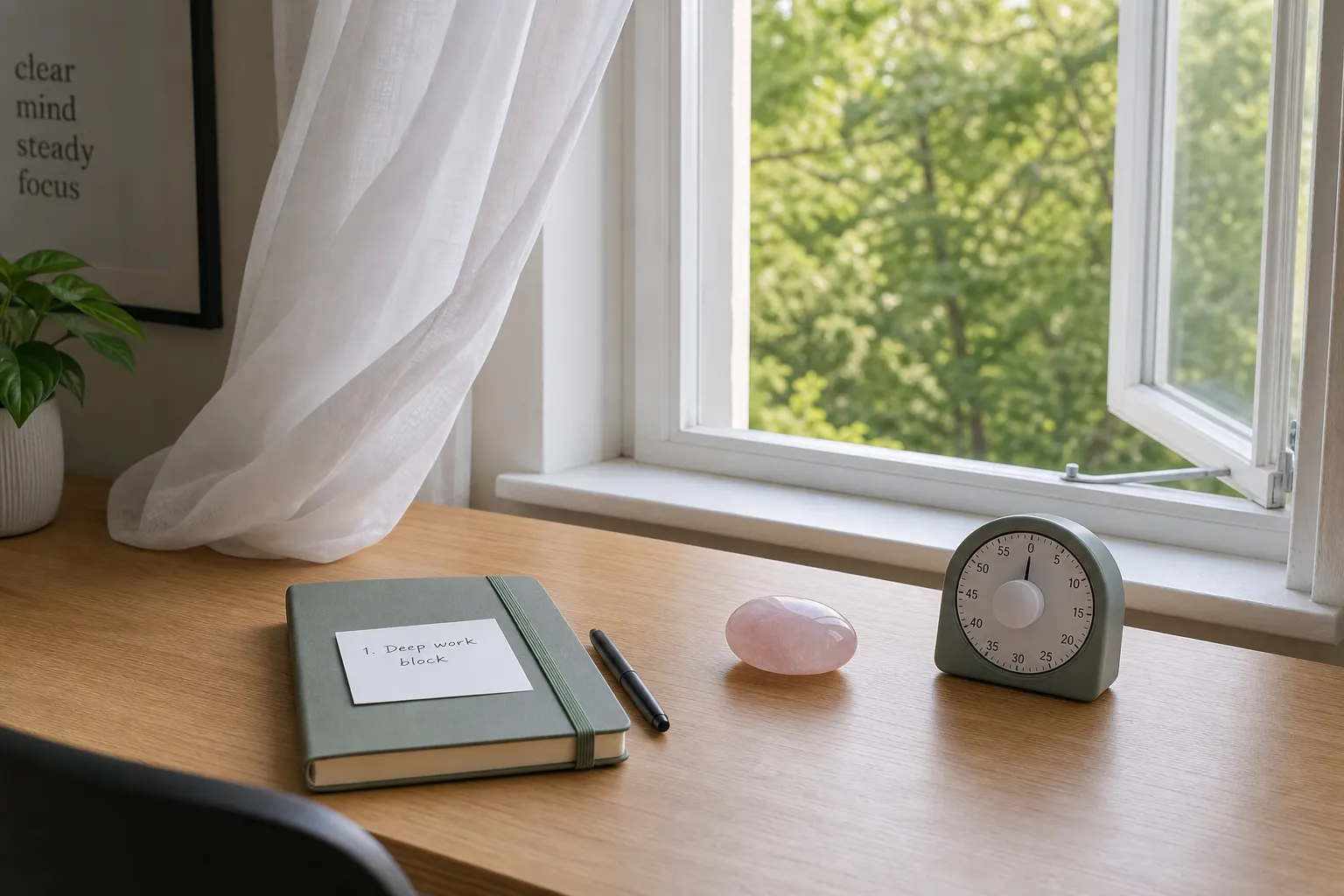
A smoke-free version might be:
- Clear the desk surface.
- Open the window for a minute if possible.
- Place one grounding object near the work area.
- Turn off avoidable alerts.
- Read the task aloud.
- Start the timer.
This can be just as aligned with symbolic smoke smudging because the ritual function remains intact. You are still interrupting the drift of the day. You are still marking the workspace as separate from casual browsing, unfinished chores, and constant messaging.
Common confusion around “clearing” and focus
The most common confusion is treating all forms of clearing as the same kind of claim. They are not.
Observable and practical clearing
Clearing a desk is observable. You can see fewer objects. Clearing notifications is practical. You can check whether alerts are paused.
Softer and symbolic clearing
Clearing attention residue is softer language: it describes the lingering pull of previous tasks, not a measured substance leaving the room. Clearing negative energy is belief or symbolic language unless stronger evidence is supplied for a specific claim.
Keeping those categories separate makes the ritual more honest and more useful. You do not have to defend the ritual as science to benefit from its structure. You also do not have to abandon atmosphere just because the evidence boundary is modest.
Another confusion is thinking the ritual must feel dramatic. A deep-work transition is often quiet. It may take three minutes. It may involve one breath, one cleared surface, one closed inbox, and one sentence of intention. The ritual should reduce friction, not become an elaborate performance that competes with the work.
There is also a cultural boundary. Without reliable cultural sources for a specific lineage or ceremonial context, it is better to use broad terms such as smoke ritual, personal clearing ritual, or symbolic smudging. Avoid claiming authority from traditions you are not prepared to explain with care.
For a personal workspace, the grounded language is enough: “I use this as a symbolic reset before focus.”
A balanced way to practice it
A balanced practice joins atmosphere with concrete boundaries. Let the smoke, stone, candle, bell, or open window create the feeling of an entrance. Let the practical steps do the work of reducing interruption.
If you use rose quartz or another object on the desk, keep its role symbolic and spatial. It can remind you of softness, patience, or the tone you want in the room. It does not need to be described as producing guaranteed emotional or productivity outcomes. Its value here is as a chosen anchor within the workspace.
A good deep-work ritual should leave you with fewer open loops, not more. If you finish the ritual and then keep adjusting objects, searching for the right playlist, rereading messages, or refining the atmosphere, the ritual has drifted into avoidance. Bring it back to one question: what is the first meaningful action of this focus block?
For many readers, the answer is simple: write the paragraph, review the document, sketch the design, sort the notes, or solve the first problem. The clearing ritual is complete when the work begins.
So yes, negative energy smoke smudging can belong in a deep-work routine if it is used as symbolic smoke smudging rather than proof language. Treat it as a threshold, pair it with actual digital noise reduction, keep smoke optional, and let the room become a spatial sanctuary through clear boundaries rather than exaggerated claims.