Symbolic boundary practice
The Rose Quartz Heart String Ritual: Setting Polyvagal Boundaries
A Heart string spell with rose quartz can be used as a symbolic boundary ritual: you hold a rose quartz heart or stone, work with a loose string as an image of emotional reach, and name what may stay close to you and what must remain outside your personal field.
In this version, “polyvagal boundaries” does not mean the spell causes a measurable nervous-system change. It means the ritual is paced around choice: orienting to the room, noticing whether you still want to continue, keeping the imagery gentle, and returning to ordinary surroundings before the practice becomes too intense. Rose quartz functions as a tactile focus object and heart-associated symbol, not as a verified emotional mechanism.
What the rose quartz heart string ritual is for
This is not a cord-cutting ceremony meant to control another person. It is a containment practice: a way to make a boundary visible to yourself through touch, image, words, and pause.
The “heart string” is best understood as a symbol of attachment, tenderness, longing, care, memory, or emotional reach. In everyday language, “heartstrings” often points to something that touches a person deeply. In a ritual setting, the string can become a symbolic line between compassion and overextension.
Rose quartz adds a familiar heart-centered image. In crystal and spiritual language, it is often associated with love, softness, and emotional warmth. Gemologically, rose quartz is a quartz material used as a gem or ornamental stone; that material fact does not establish an emotional or energetic effect. For this ritual, its value is practical and symbolic: it is visible, holdable, and easy to give meaning to.
The aim is simple
- to keep care without absorbing everything;
- to remember that closeness still needs consent;
- to create a psychological container for your own feelings;
- to name what belongs to you and what does not;
- to stop before the ritual becomes overwhelming.
If you searched for a heart string boundary spell because you feel pulled, drained, or emotionally tangled, the useful question is not “Will this spell fix the situation?” It is: “Can this ritual help me mark, in symbolic language, where my choice begins again?”
A gentle heart string boundary spell
Use this as a quiet personal practice. You can skip any step. You do not need a perfect stone, a special thread, a specific moon phase, or a dramatic emotional release.
You may want
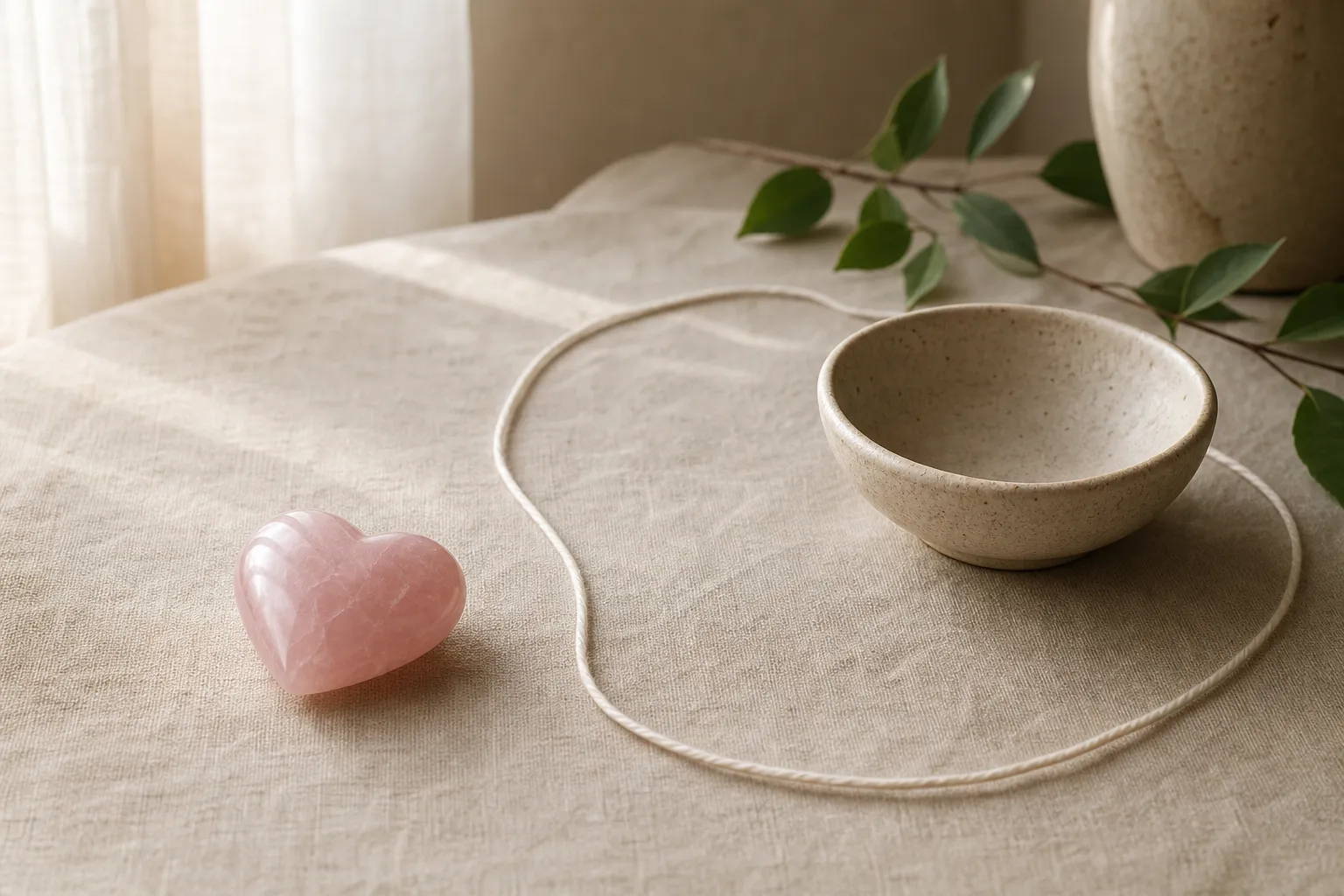
- a rose quartz heart, palm stone, bead, or small rose quartz piece;
- a short length of string, thread, ribbon, or cord;
- a small bowl, cloth, box, or folded paper to act as the container;
- a pen, if you want to write one boundary sentence.
Sit somewhere ordinary and safe enough: a bedroom floor, a desk, a chair by a window. The point is not to leave the room in your imagination, but to stay aware that you are in it.
Hold the rose quartz. Notice its temperature, weight, shape, and texture. Let your eyes move around the room and name three neutral things you can see. This is the polyvagal-inspired part in its lightest form: orient first, then enter the symbolism. Polyvagal theory often uses language about safety, connection, and bodily state awareness; here, that language is only a pacing lens.
Place the string beside the stone. Say, silently or aloud:
“This string represents the way my heart reaches. I do not need to cut off my care in order to have a boundary.”
Touch one end of the string to the rose quartz. Let that end represent your heart, your self-respect, or your capacity for care. The other end represents what is outside you: another person’s feelings, expectations, urgency, memories, demands, or projections.
Do not pull the string tight. Let it rest with some slack. A boundary does not have to be rigid to be real.
Name what belongs inside
Name one thing that belongs inside your psychological container. Keep it simple:
- “My pace belongs with me.”
- “My answer belongs with me.”
- “My body’s yes and no belong with me.”
- “My grief belongs inside my care, not inside someone else’s demand.”
- “My tenderness can stay without making me available to everything.”
Name what stays outside
Then name one thing that stays outside the container:
- “Other people’s urgency stays outside.”
- “Pressure to forgive before I am ready stays outside.”
- “The need to explain my whole heart stays outside.”
- “Someone else’s reaction stays outside.”
- “The old pull to abandon myself stays outside.”
Place the rose quartz and your end of the string into the bowl, cloth, box, or folded paper. This is the container. It does not trap you. It marks what you are choosing to protect.
If the words feel too strong, soften them. A ritual should not force emotional intensity. You can say only:
“Inside: me. Outside: what is not mine.”
When finished, place the string loosely around or beside the rose quartz. Knot it only if that feels peaceful, not pressured. Close with an ordinary action: drink water, wash your hands, open a window, touch the table, or put the stone somewhere visible. Returning to the room is part of the spell.
Why the “polyvagal” part should stay gentle
Polyvagal theory is a nervous-system framework that discusses safety, threat, connection, and state. In this ritual, its vocabulary is useful only if it keeps the practice slower, kinder, and more consent-based.
A symbolic rhythm for polyvagal boundaries
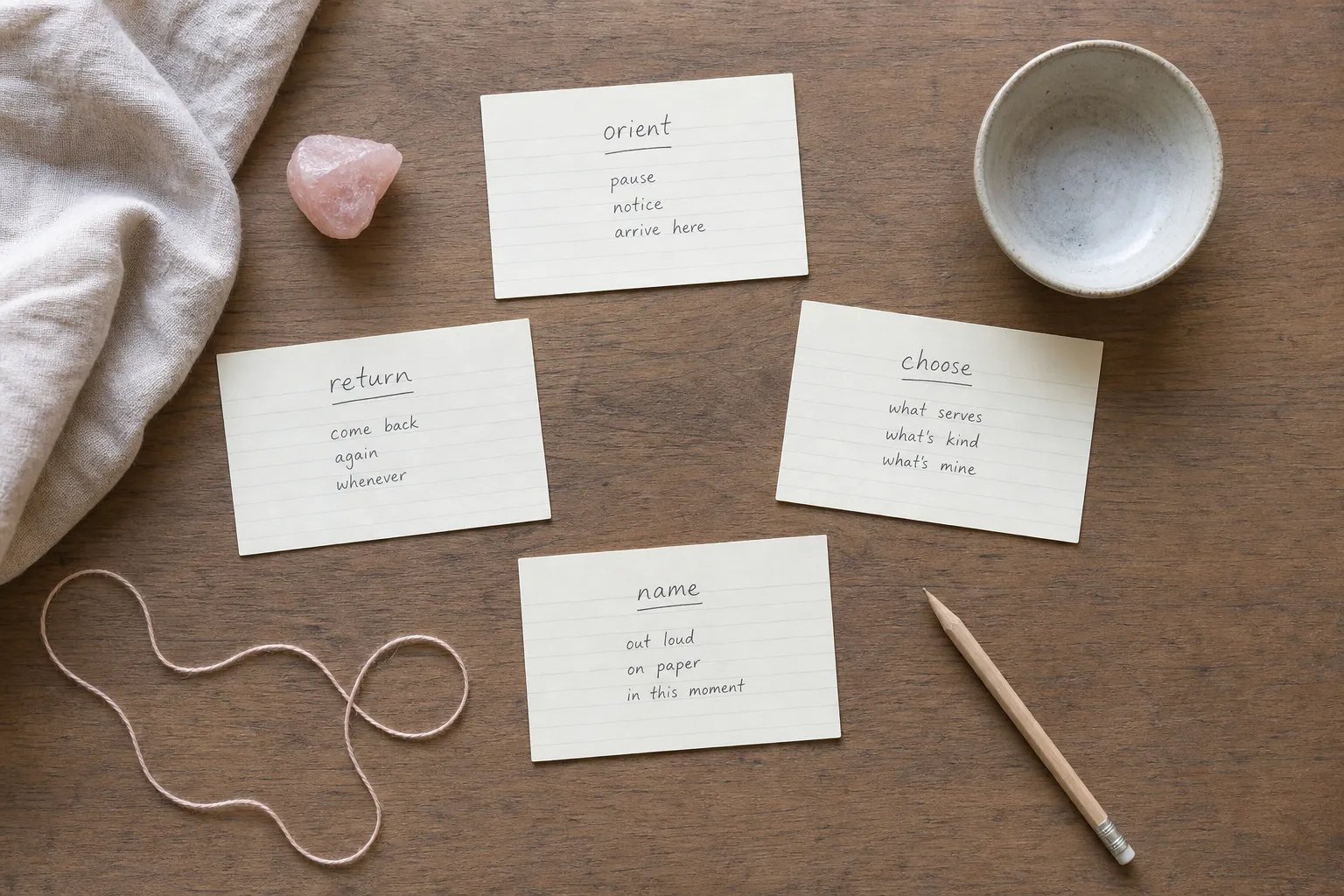
- Orient — look around and notice where you are.
- Choose — decide whether you want to continue.
- Touch — hold the rose quartz as a sensory anchor.
- Name — put one boundary into words.
- Soften — release the need to make the feeling dramatic.
- Return — come back to the room and your next ordinary action.
That is different from claiming the ritual produces a measurable physical result. The evidence available for rose quartz, polyvagal theory, and trauma-informed care does not support presenting a heart string spell as a clinical method.
The protective value of the polyvagal lens is practical: it reminds you not to rush, not to push through overwhelm, and not to confuse intensity with success. If you feel flooded, numb, panicked, unreal, trapped, or pulled into memories you did not intend to enter, stop the ritual. Look around the room. Choose support that fits the seriousness of what is happening.
What changes the ritual: consent, intensity, and the kind of bond
The same heart string imagery can feel very different depending on what you are working with. A small social boundary is not the same as an unsafe relationship. A tender memory is not the same as severe distress. The ritual should shrink or stop when the material becomes too charged.
Use the lighter version when the issue is everyday emotional spillover: answering messages too quickly, feeling responsible for everyone’s mood, overexplaining, or wanting a small symbolic reset before a difficult conversation.
Use a minimal version when the subject is grief, heartbreak, family pressure, or a relationship that still feels tender. In that case, do not try to address the whole story. Hold the stone, name one sentence, and stop.
When the ritual should not be the main container
Do not use the ritual as a substitute for real-world boundaries when safety is involved. Energetic boundaries can be personally meaningful, but they do not replace leaving danger, asking for help, documenting harassment, contacting appropriate services, or speaking with qualified support. If you are dealing with abuse, self-harm thoughts, crisis, severe distress, trauma symptoms, or a situation where you do not feel safe, the ritual should not be your main container.
The most important consent rule is this: the spell is about your participation, not another person’s will. Avoid instructions that try to bind, punish, force apology, force forgiveness, compel contact, or direct another person’s emotional life on your behalf. A clean heart string boundary spell says, “I decide what I carry.” It does not say, “I control what someone else becomes.”
Common confusion around broken heart strings
Searches about heart strings often carry a painful question underneath: “What does it feel like when a heart string breaks?” or “Can you break a heart string?”
In this ritual, “heartstrings” is not an anatomical claim. In spiritual and poetic language, a broken heart string usually means the felt rupture of connection: heartbreak, betrayal, grief, disappointment, or the moment when caring becomes too costly.
Broken heart string symbolism does not have to mean the bond is destroyed. It may mean the old form of attachment can no longer hold the weight placed on it. The string may need slack. It may need a boundary. It may need to be laid down for a while. It may need to connect you back to yourself before it reaches toward anyone else.
Another confusion is the idea that a strong emotional reaction means the spell is working. Not necessarily. Crying, shaking, numbness, anger, or sudden longing may simply mean the subject is tender. You are allowed to pause before interpreting anything. You are also allowed to make the ritual less vivid: no memory work, no names, no imagined confrontation, no dramatic cutting. A small sentence can be enough.
There is no need to worry about spelling variations such as “heart strings,” “heart-strings,” or “heartstring.” Here, the phrase points to the same symbolic idea: the felt line between the heart, attachment, and emotional reach.
The evidence boundary: meaningful does not mean verified
This ritual can be meaningful without being presented as scientifically established. The available public sources support adjacent boundaries: rose quartz can be identified as a quartz/gem material; polyvagal theory can be referenced as a framework around safety and state awareness; trauma-informed safety principles support choice, pacing, consent, and stopping when a practice becomes unsafe.
They do not establish that rose quartz changes emotions, that a heart string spell creates energetic protection, or that a symbolic boundary ritual produces clinical outcomes. There is also no curated firsthand ritual evidence here: no field test, practitioner case note, long-form user report, or verified outcome record.
That limitation does not make the ritual useless. It places it in the right category. It is a personal symbolic boundary practice. It may help you give form to an intention, create a pause, and choose language for what belongs inside your care. Its strength is not proof. Its strength is chosen meaning, held with clear limits.
A short closing version
If you want the simplest form, hold the rose quartz and place the string loosely around it. Look around the room. Say:
“My heart may stay soft. My boundary may stay real. What is mine returns to me. What is not mine rests outside this container.”
Then stop. Put the stone down. Let the ritual be small enough that you remain in choice.