Crystal Pairing Science
Mineral Synergy: The Science of Pairing Rose Quartz with Black Tourmaline
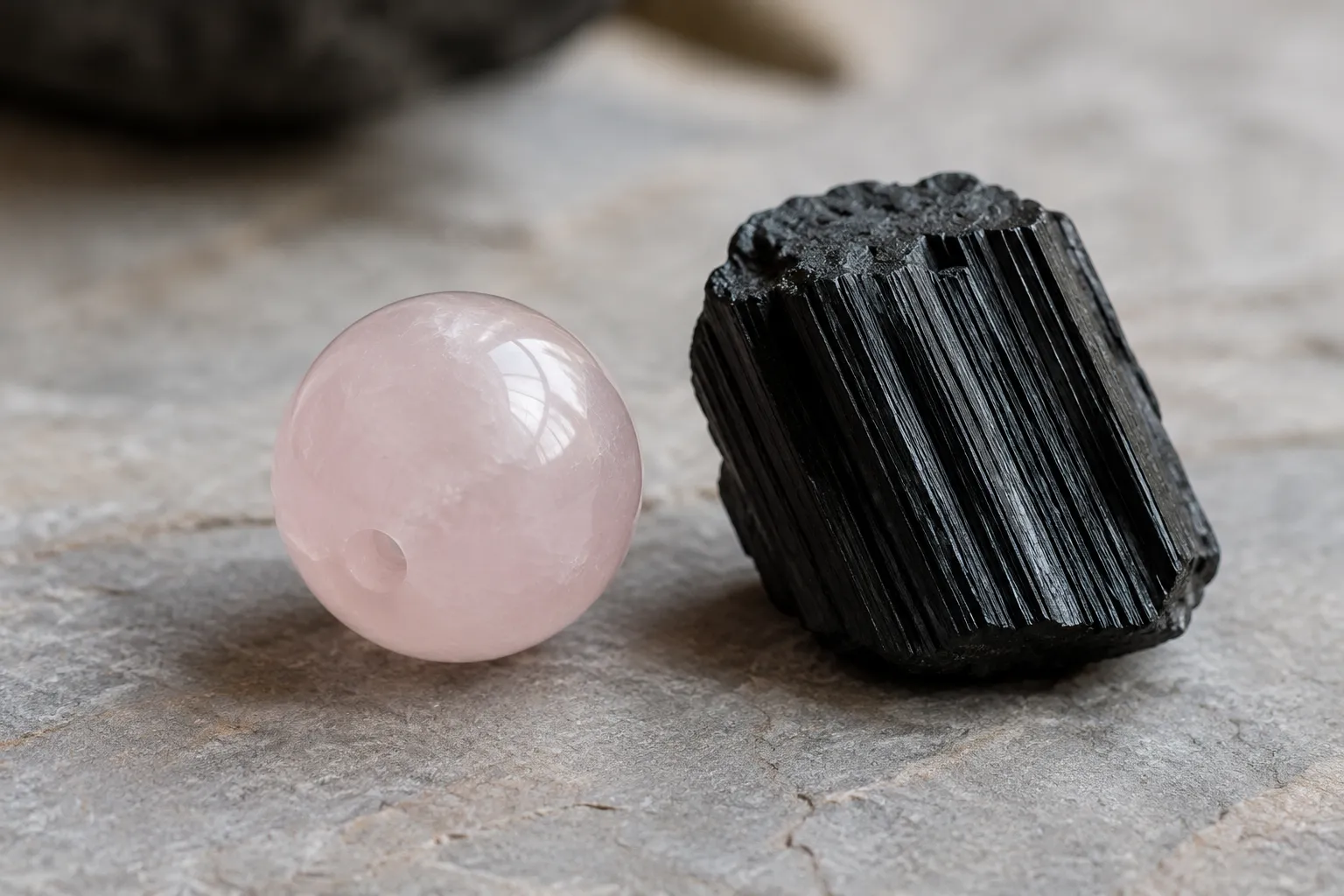
A pale rose quartz bead beside a striated black tourmaline crystal already explains much of the pairing: translucent pink against matte black, softness against density, a smooth gem material beside a darker columnar mineral. The direct answer is yes, rose quartz and black tourmaline make a sensible pairing for display, jewelry, symbolic ritual use, or curated crystal bundles. Mineral science does not show that they amplify one another, protect a person, or create a measurable energetic interaction.
Here, Crystal Pairing Science means disciplined comparison. It asks what the minerals are, how they differ, why the combination feels coherent, and where crystal-practice language begins. There is no mineralogical reason in the available sources to treat rose quartz and black tourmaline as physically incompatible in ordinary decorative or jewelry settings. There is also no strong evidence that the pair produces an established energetic effect.
broader context
Broader rose quartz guide
This narrower page makes more sense after the broader rose quartz context page.
What the Minerals Actually Are
Rose quartz is a variety of quartz, and quartz is commonly described as silicon dioxide. In gem and interior use, it appears as beads, cabochons, carved forms, spheres, tumbled stones, and larger decorative pieces. Its appeal starts with visible material reality: a soft pink to rose color, a gentle surface presence, and a long place in ornament.
Black tourmaline is usually discussed more precisely as schorl, a black member of the tourmaline mineral group. Tourmaline is not quartz; it belongs to a boron-bearing silicate group, and schorl is commonly described as an iron-rich sodium tourmaline endmember. In specimen form, black tourmaline crystals often appear dark, columnar, and striated, which gives them a different physical character from the smoother visual language of many rose quartz pieces.
That distinction matters because “chemical composition synergy” is easy to overread. The chemistry shows two different minerals with different classifications, compositions, structures, colors, and specimen habits. It does not show that their compositions combine into a shared energetic field, a stronger effect, or a conflict. The useful science is contrast, not proof of metaphysical behavior.
That contrast still has practical value. A rose quartz sphere beside a raw black tourmaline crystal can look deliberate because the materials do not visually blur together. In jewelry, pink quartz beads and black tourmaline accents create a clear color relationship. In a small ritual arrangement, the stones are easy to distinguish by sight and touch. The pairing works first as mineral literacy and visual composition.
Why the Pair Feels Symbolically Coherent
In crystal traditions, rose quartz is often associated with love, emotional softness, kindness, heart-centered symbolism, and self-regard. Black tourmaline is often associated with grounding, protection symbolism, energetic shielding language, and stability. Those meanings are cultural and symbolic. They are not the same thing as measured mineral effects.
Within that symbolic language, rose quartz and black tourmaline make sense together because they answer different parts of the same imagined scene. Rose quartz carries the soft side of the pairing; black tourmaline carries the boundary side. One is read as gentle and receptive, the other as anchoring and protective. Many crystal users find that combination intuitively balanced, especially when the pair is placed on a bedside table, worn as a bracelet stack, or arranged on a small altar.
The limit should stay visible. It is reasonable to use the pair as a reminder of tenderness with boundaries, calm decoration, or personal intention. It is not supported to say that the pair changes health outcomes, resolves emotional distress, blocks electromagnetic exposure, clears an aura as a measured fact, or guarantees a state of mind.
This is where the word “science” needs care. Mineral science can identify rose quartz, explain quartz as a material, distinguish schorl from quartz, and describe visible traits. It cannot, from the supplied evidence, validate energy amplification claims. A grounded answer about crystal pairing should not pretend otherwise.
Do Rose Quartz and Black Tourmaline Have Conflicting Energies?
The worry that rose quartz and black tourmaline might have “conflicting energies” appears in reader questions and crystal-culture discussions. Some people ask whether the stones cancel each other out, especially when they wear them together daily or see commercial lists warning against certain combinations. Those questions are real as reader anxiety; they are not evidence that a conflict occurs.
From a mineralogical standpoint, the available sources do not show a mechanism by which rose quartz and black tourmaline cancel each other out in ordinary use. They are different minerals placed near each other. Their physical identities do not become incompatible because one is pink quartz and the other is black tourmaline schorl.
From a symbolic standpoint, the answer depends on the user’s own system of meaning. If someone reads rose quartz as softness and black tourmaline as grounding and protection symbolism, the pairing can feel complementary. If a personal practice treats the stones as having incompatible roles, separating them may feel clearer. That is a ritual preference, not a mineral rule.
A useful test is to ask what kind of claim is being made.
“They are different minerals with strong visual contrast.”
Supported by mineral identity and appearance.
“They make a coherent symbolic pairing.”
Reasonable as crystal-practice language.
“They amplify each other’s energy.”
Not established by the supplied mineral sources.
“They cancel each other out.”
Not established by the supplied sources.
“Black tourmaline protects health or blocks EMF exposure.”
Not supported here as a factual outcome claim.
The pair does not need a hidden mechanism to be useful in a non-medical personal practice. It can be meaningful because the user assigns meaning to it. That is enough, as long as the meaning is not presented as a proven effect.
How to Read Curated Bundles and Energy Amplification Claims
Curated crystal bundles often present rose quartz and black tourmaline as an intentional combination. Retail language may frame the pair around love, protection, emotional balance, cleansing language, grounding, or energy amplification. That language explains why shoppers encounter the pairing, but it should not be treated as independent evidence.
A curated bundle is a commercial and aesthetic object before it is anything else. It may bring together stones that look good together, fit a theme, match common crystal symbolism, or satisfy search demand around “protection,” “love,” and “grounding.” None of that proves that the bundle has a measurable effect beyond its role as an object, symbol, or ritual prompt.
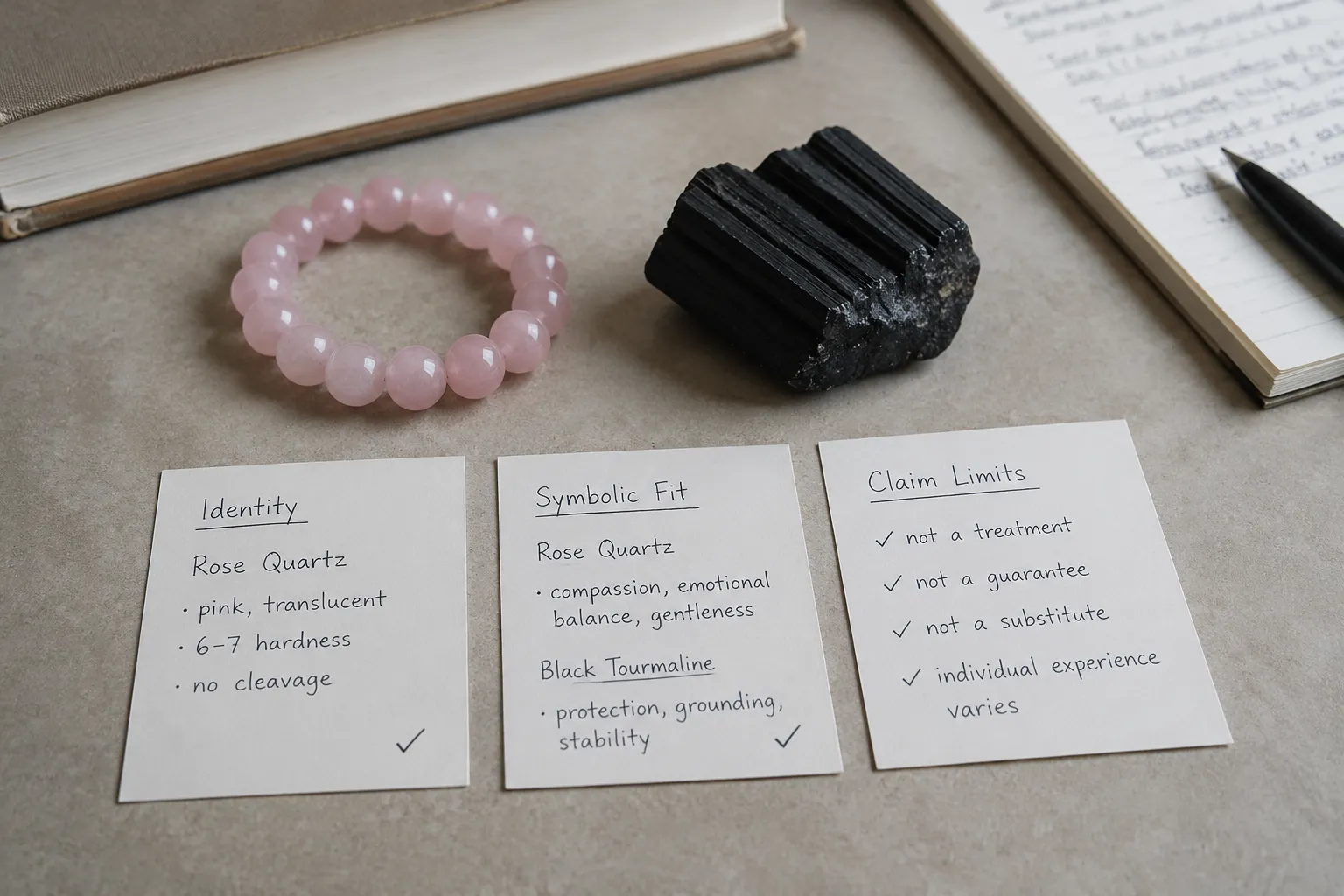
The better way to evaluate a bundle is to separate four layers.
- Mineral identity: Is the pink stone represented as rose quartz, and is the black stone represented as black tourmaline or schorl? Visual inspection has limits; seller labels are not the same as independent identification.
- Material presentation: Are the stones suitable for the intended use, such as display, beads, or a pocket stone? This is about form, finish, and ordinary handling, not energetic compatibility.
- Symbolic fit: Does the pairing’s meaning make sense to the person using it? Rose quartz plus black tourmaline is commonly read as softness with grounding or protection symbolism.
- Claim boundary: Does the seller move from symbolism into health, protection, or guaranteed outcome language? That is where the claim needs to be narrowed.
This keeps the pairing useful without letting marketing language take over. A bundle can be attractive and meaningful without being treated as a verified energetic technology.
When the Answer Changes
The answer changes when the question shifts from “Can these stones be paired?” to a more specific claim.
Display and jewelry
For ordinary display, the pairing is straightforward. A rose quartz carving and a black tourmaline specimen can sit together as a contrast in color, texture, and symbolic tone. For jewelry, the question is less about energy and more about construction: bead quality, setting, wire, cord, finish, and comfort for daily wear. The supplied evidence does not create a special incompatibility between the two minerals.
Ritual use
For ritual use, the answer depends on the user’s symbolic framework. Some people may like the pairing because it combines tenderness with steadiness. Others may prefer to keep stones separated by intention, space, or sequence. That preference belongs to the practice, not to mineral chemistry.
Health-adjacent claims
For health-adjacent claims, the answer narrows sharply. Complementary practices can be part of a personal routine, but the available source boundary does not support using rose quartz, black tourmaline, or the combination as a substitute for medical, mental-health, or safety advice. The National Center for Complementary and Integrative Health is useful here because it separates complementary-practice language from evidence-based medical care.
Authenticity questions
For authenticity questions, this page can only go so far. Rose quartz mineral identity and black tourmaline schorl identity are real mineral categories, but a particular stone’s authenticity cannot be guaranteed from a pairing article. Color, shape, and seller description can suggest a material; they do not replace proper mineral identification when certainty matters.
A Bounded Way to Use the Pair
A sensible way to approach rose quartz and black tourmaline is to let each layer do its own job. Let geology identify the minerals. Let design explain the visual contrast. Let symbolism describe why the pair feels emotionally legible to crystal users. Let evidence limits keep the language from becoming a promise.
The strongest supported reading is modest: rose quartz and black tourmaline are visually and symbolically compatible in common crystal practice, with rose quartz bringing pink quartz softness and black tourmaline bringing dark, grounding symbolism. The pairing does not need to be feared as an automatic energetic conflict. It also should not be promoted as scientifically proven energy amplification.
That is the honest mineral synergy: two different stones, one coherent pairing, and a clear line between the specimen and the symbol.