Trauma-informed orientation
The Safe “Here and Now”: Navigating Trauma with Physical Anchors
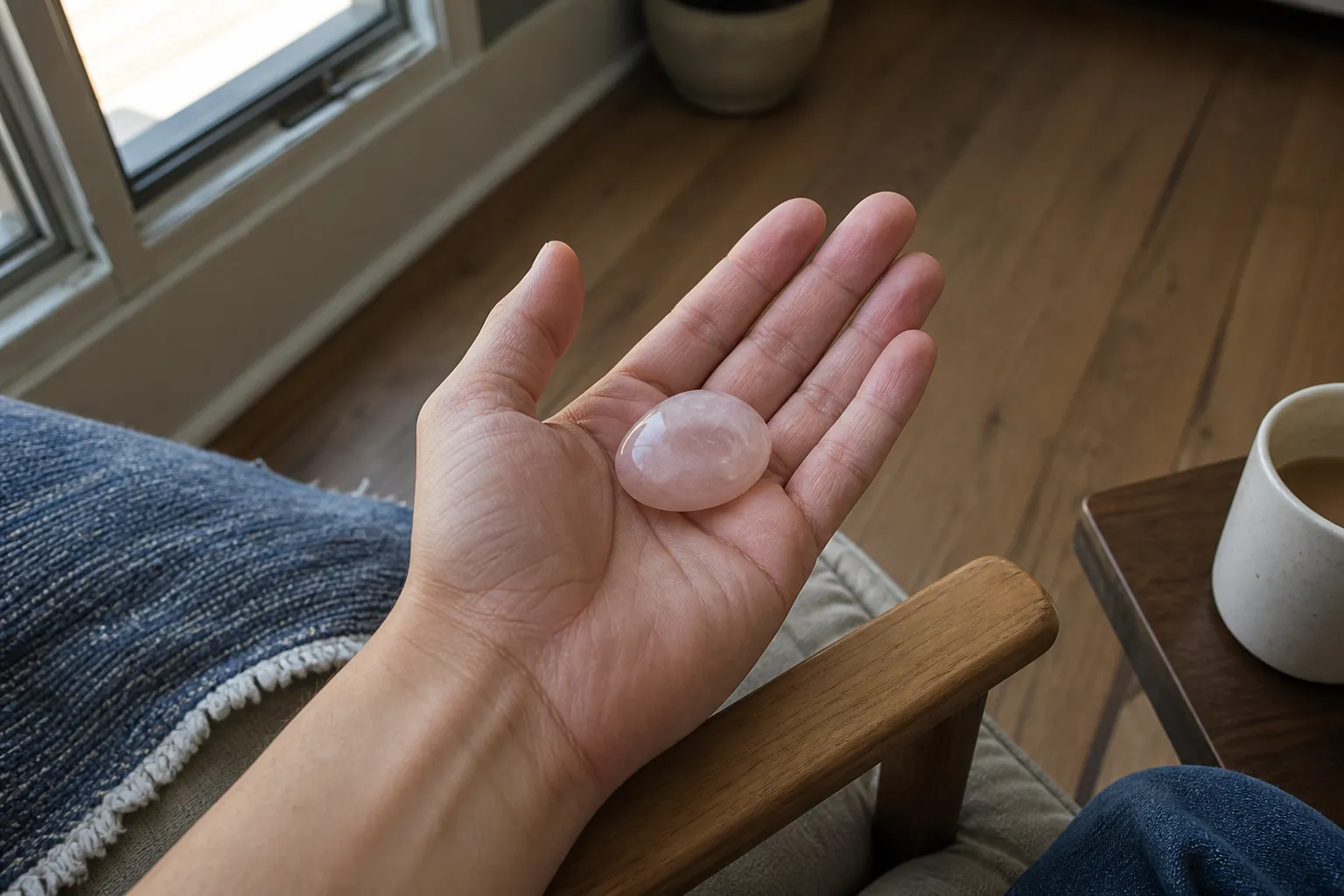
A smooth piece of rose quartz in the palm is first a material object: cool or warm, weighted, textured, visible against the room. In Somatic experiencing trauma recovery, that kind of gentle physical anchor may help some people turn attention toward the present moment. It gives the mind and body a concrete place to land: the chair under the back, the floor under the feet, the edge of a stone, the window across the room.
That is the useful answer. The necessary boundary is close beside it: a physical anchor is not trauma therapy by itself, not a way to process traumatic memory alone, and not a substitute for trauma-informed professional care when symptoms are severe, persistent, destabilizing, or unsafe.
What a Physical Anchor Can Do
A physical anchor is any present-time cue that can be noticed without pushing the body into intensity. It may be a stone, a textured fabric, the rim of a mug, feet pressing into the floor, the weight of a blanket, or the visible shape of a familiar room. The point is not the object’s symbolism. The point is that it can be sensed now.
Grounding resources in trauma-informed education often describe present-moment orientation as a way to reconnect with current surroundings when distress, flashbacks, dissociation, or hyperarousal make the past feel close. A physical anchor fits that frame because it offers something simple and current to register: pressure, texture, temperature, color, weight, sound, or position.
In Somatic Experiencing-informed language, this sits near orienting, resourcing, body sensation, and small-dose attention. The anchor is not there to force a dramatic shift. It is there to support a manageable observation: “my feet are on the floor,” “this stone has edges,” “the chair is holding my back,” “there is a door to my right.” Those details may help some people pause long enough to choose the next supported action.
The word “safe” needs care. The present moment does not automatically feel safe to every trauma survivor, especially with complex PTSD, dissociation, ongoing threat, or unstable surroundings. A more careful phrase is “available and current.” The anchor belongs to now; whether it feels supportive depends on the person, the setting, and the level of distress.
Why Small Anchors Fit the Window of Tolerance
The window of tolerance is often used to describe a zone where a person can stay connected enough to think, feel, and respond without becoming overwhelmed or shut down. Outside that zone, distress may move toward hyperarousal—panic, fight-or-flight energy, racing thoughts, agitation—or toward hypoarousal, such as numbness, collapse, shutdown, or feeling far away.
Physical anchors are most useful when they are modest enough to stay inside, or gently near, that window. A brief touch cue, a room-orientation cue, or a small movement can be easier to adjust than a long inward body scan. This matters because body-focused practices are not neutral for everyone. For some trauma survivors, close attention to the body can become activating.
Somatic Experiencing terms can help if they stay in proportion. Titration means working in very small amounts rather than flooding attention with too much sensation or memory. Pendulation can be understood here as moving attention between something mildly activated and something more neutral or steady. Resourcing means choosing cues that feel available, ordinary, or at least not emotionally loaded.
A physical anchor follows that rhythm when it remains brief and optional. Touch the object, notice one quality, look around the room, feel the chair, stop. If distress rises, the practice has already given useful information: this may not be the right anchor, the right moment, or a self-directed situation.
Choosing an Anchor Without Making It a Promise
A rose quartz palm stone works as an example because it is concrete: color, weight, surface, temperature. Its cultural symbolism may matter to some readers, but symbolism should not be confused with clinical effect. A stone does not regulate trauma because it is pink, meaningful, or associated with tenderness in ritual language. If it helps at all, it is because the person can use it as a present-time sensory cue.
Useful anchors tend to share a few practical qualities
- They are easy to stop using.
- They do not require closed eyes.
- They do not demand intense body scanning.
- They feel neutral, steady, or ordinary rather than emotionally charged.
- They can be paired with outward orientation, such as naming the room, the date, or nearby objects.
- They do not invite the person to revisit traumatic material.
For one person, a smooth stone may be too subtle; for another, it may be calm enough to notice without becoming absorbed. A textured keychain, a cold glass, a floor contact cue, or a slow turn of the head toward visible objects may be more useful. The anchor should serve orientation, not become a test of endurance.
This is where many online phrases need softening. “Find your anchor” is useful only if it means “choose a current, adjustable cue.” “Calm triggers” can overstate what a small practice can do. “Release trauma through the body” is too certain for the evidence and too risky for self-directed use. A quieter version is more accurate: physical anchors may help some people notice the present while distress is happening.
When an Anchor Is the Wrong Tool
A physical anchor is not always gentle just because it is simple. It may be the wrong tool if it increases panic, deepens numbness, brings on flashbacks, sharpens self-harm thoughts, increases unsafe impulses, or makes the person feel less present. It may also become unhelpful if it turns into pressure: “I should be able to stay with this.” That pressure can push grounding into self-directed trauma processing.
Complex PTSD adds another layer. People with complex trauma histories may have narrower or more variable windows of tolerance, stronger dissociation, relational triggers, or body sensations that are difficult to interpret. In that context, a physical anchor can still be part of a coping plan, but it should not be treated as enough support on its own.
A safer question is not “Does this anchor work?” but “What happens in the next thirty seconds?” If the person becomes more oriented, more able to notice the room, or more able to choose a safe next step, the anchor may be useful in that moment. If distress escalates or presence fades, stop and shift outward: open the eyes if they are closed, look for stable objects, contact a trusted person if appropriate, or seek professional or urgent help when safety is at risk.
No anchor should ask a reader to intensify traumatic memory, recreate body sensations from an event, push through discomfort, or stay with distress beyond capacity. That is the line this page is meant to hold.
What the Evidence Can and Cannot Support
The available evidence supports a cautious page, not a large claim. Somatic Experiencing has been studied in relation to PTSD, and reviews describe a developing but still limited clinical evidence base. That allows a careful statement: Somatic Experiencing-informed concepts may be relevant to trauma recovery discussions. It does not show that a stone, object, or self-guided anchor can resolve PTSD, complex PTSD, dissociation, or hyperarousal.
Grounding has stronger support as a coping and orientation frame than as a standalone recovery method. Trauma-informed education sources commonly present grounding as a way to reconnect with the present, notice current surroundings, and manage distress. That is enough to support practical language about present-moment orientation. It is not enough to promise emotional safety or long-term recovery.
Body-awareness concepts such as interoception and proprioception also matter. Interoception refers to sensing internal body signals; proprioception refers to sensing body position and movement. Somatic approaches often pay attention to these channels, but self-guided use should stay light. A physical anchor can lean more on external and contact-based cues—texture, pressure, room position—rather than asking a person to go deeply inward.
That distinction keeps the page grounded. A physical anchor may belong in a trauma-informed environment, ritual space, or everyday coping routine; it is not a replacement for care.
A Brief Way to Use an Anchor
If grounding is generally tolerable for someone, a physical anchor can be used in a short, reversible way:
- 1. Choose an object or contact point that feels neutral or steady.
- 2. Keep the eyes open or softly oriented to the room.
- 3. Notice one concrete quality: weight, edge, temperature, pressure, color, or location.
- 4. Name one present-time fact: “I am sitting,” “the floor is under my feet,” or “the door is there.”
- 5. Stop after a few breaths or a few seconds, before trying to do more.
This is not a trauma-processing protocol. It is a small orientation practice. The most important step is the option to stop.
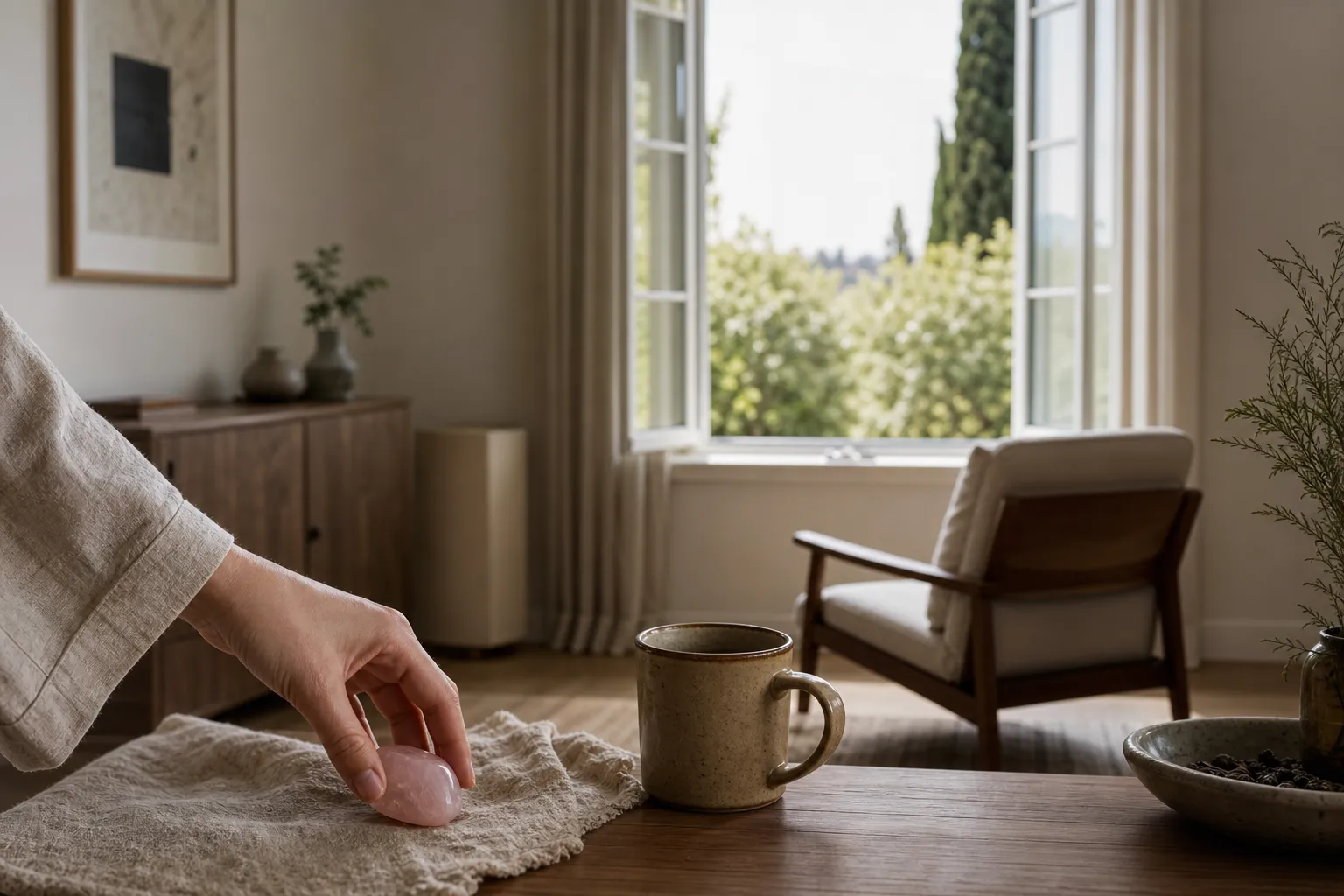
For readers who use rose quartz in ritual or interior spaces, the same boundary applies. The stone can sit on a bedside table, a desk surface, or in the hand during a pause. Its meaning may be personal, aesthetic, or symbolic. The material fact remains simpler: it is a touchable cue in the present. Keep the specimen before the symbol.
Common Confusion About Anchors
Some confusion comes from language that sounds empowering but becomes too absolute. “Back in the body” may be meaningful for one person and frightening for another. “Grounded” may mean present and steady, or it may become a demand to feel calm on command. “The body keeps trauma” is often used as shorthand, but it should not become an instruction to search the body for traumatic material without support.
Another confusion is believing that gentle means universally safe. A small object, a breath cue, or a body sensation can still connect with difficult memories. Trauma-informed use depends on choice, pacing, and the ability to stop.
The final confusion is mistaking coping support for recovery work. A physical anchor may help with the next minute: orienting, pausing, noticing the room, stepping away from a trigger, asking for help. Recovery from trauma, especially complex PTSD or persistent dissociation, usually needs more than a private object or self-directed exercise.
The safe “here and now” is therefore not a promise. It is a modest direction of attention: toward the room, the floor, the hand, the object, the current moment, and the next supported choice.