New moon decor layout
Rose Quartz Grid Layout Ideas for New Moon Decor
A usable new moon arrangement can be very simple: choose a clean tray, bedside table, shelf, or low altar surface; place one larger rose quartz focal stone in the center; arrange smaller pieces around it in a circle, crescent, or radial pattern; then add one or two clear quartz pieces only if you like the brightness beside the pink. This is the practical center of rose quartz grid layout decor: visible balance, spacing, color, and a symbolic timing cue.
The new moon can mark a quiet reset for the surface. It does not prove a spiritual, emotional, romantic, or health outcome. Treat the stones first as physical objects; let the pattern carry personal meaning after the arrangement is stable.
upward
Start with the broader guide
Use the broader guide first if you need the full scope before this page.
Start with the surface, not the symbolism
A rose quartz grid usually looks better when the surface is settled before the stones are chosen. A small tray, linen-covered shelf, bedside plate, shallow bowl, or clear section of a desk gives the arrangement a visible boundary. That boundary matters because pale pink stones can disappear on a busy surface.
For a new moon setting, darker or quieter backgrounds often make the pink easier to read: charcoal linen, warm wood, matte cream ceramic, smoked glass, or a dark stoneware dish. The point is not to imitate the night sky exactly; it is to give the rose quartz enough contrast to remain the main material.
Rose quartz should also stay grounded as a mineral object. Mineral and gemological references describe it as a quartz variety, commonly recognized by pink color that may appear pale, cloudy, translucent, or uneven. Those visible clues are useful for decor planning, but they cannot confirm authenticity by appearance alone. A polished pale pink stone may be rose quartz; color and a photograph are not enough to establish identity with certainty.
Before placing anything, check three details
- Surface protection: use a tray, cloth, coaster, or felt pad under rough or heavy pieces.
- Stability: keep towers, points, and spheres low or well-supported, especially on narrow shelves.
- Spacing: leave enough room to dust, move a candle, or lift a stone without knocking the pattern apart.
The grid begins as a room arrangement. The symbolism comes after the objects are stable.
Five new moon rose quartz grid layouts that work as decor
These layouts are editorial design suggestions, not source-proven formulas. Use them as visual patterns for a new moon rose quartz grid, then adjust the scale to the surface you actually have.
Minimalist bedside crystal circle
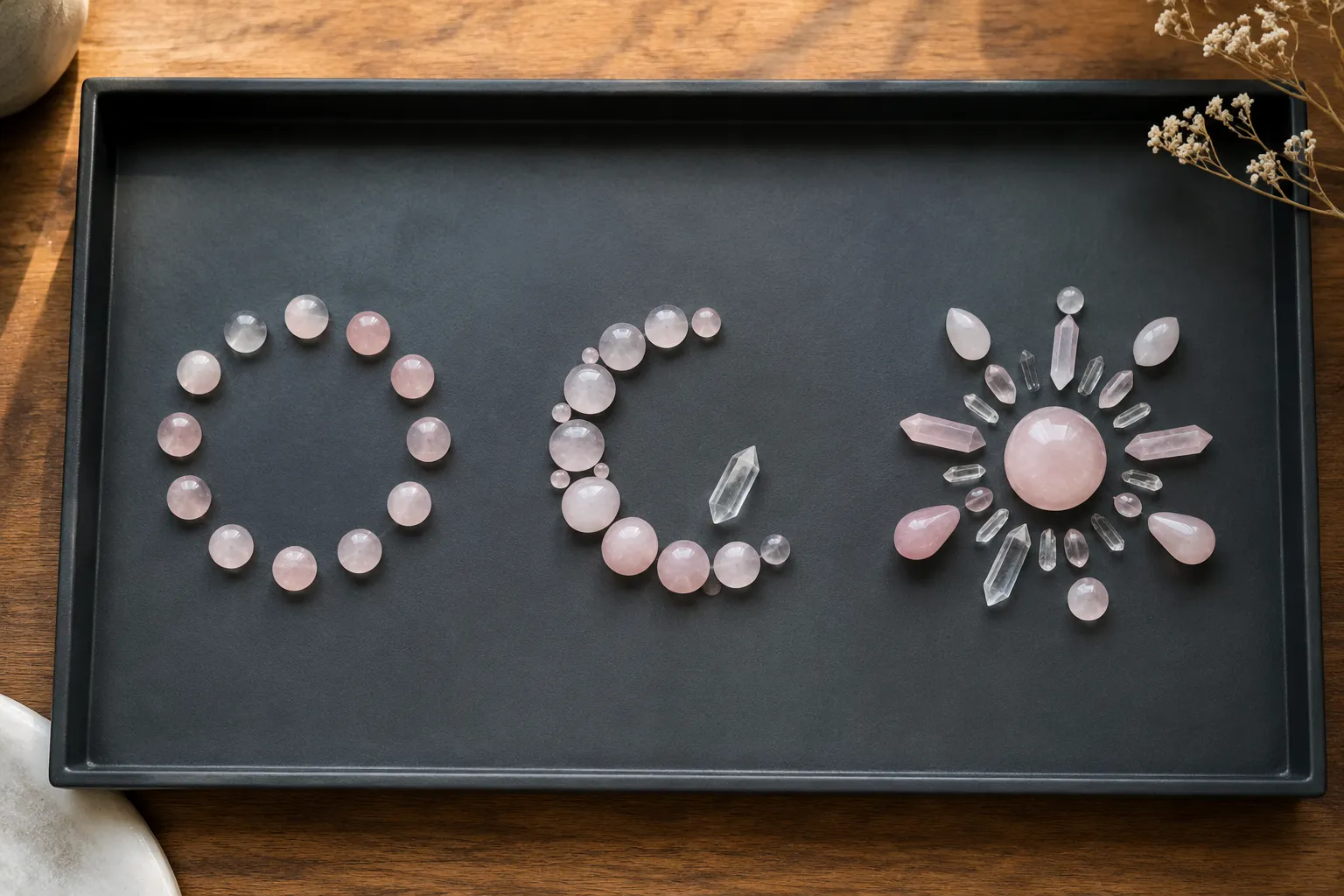
Place one central rose quartz keystone in the middle of a small dish or tray. Around it, set six to ten smaller rose quartz tumbles in a loose circle, with even gaps between each stone. If the central piece is cloudy or deeper pink, keep the surrounding stones smaller so the eye returns to the center.
This layout suits a nightstand because it is compact and easy to clean. The circle gives the display a contained feeling without needing many objects. If you use an intention card, slide it under the tray edge rather than placing paper near a candle.
Best for: a quiet bedside surface, small apartment shelf, or low-maintenance arrangement.
Crescent new moon tray
A crescent new moon tray uses the moon as a visual reference rather than a claim about effects. Start with a shallow oval or round tray. Place the largest rose quartz piece near one side, then curve smaller stones around it in a crescent shape. Leave negative space on the open side of the tray so the curve is easy to see.
This works especially well with mixed sizes: a rose quartz palm stone, a few small tumbles, and perhaps one clear quartz visual accent at each crescent tip. If you use the phrase “clear quartz amplifier,” keep it as practitioner vocabulary or symbolic language. In decor terms, the clear pieces add brightness, contrast, and a different texture beside the pink quartz.
Best for: a dresser, mantel, moon-themed shelf arrangement, or simple new moon reset display.
Radial crystal grid layout
A radial crystal grid layout places one rose quartz focal stone in the middle, then sends lines outward like spokes. Four, six, or eight directions are enough; more can look crowded on a small surface. Use matched rose quartz pieces if you want symmetry, or alternate rose quartz with clear quartz accents if you want more light and variation.
This is where sacred geometry language often appears in crystal culture. For this page, sacred geometry is better treated as symbolic layout vocabulary: circles, triangles, repeated spacing, radial balance, and centered composition. It may make the arrangement feel more intentional or visually ordered, but it should not be presented as a measurable mechanism.
Best for: a rose quartz altar display, coffee table tray, or larger shelf where the pattern can be seen from above.
Four corner room grid
A four corner room grid is less about a tabletop pattern and more about room placement. Put one small rose quartz piece at each corner of a room, shelf unit, desk mat, or tray. If you are working with a whole room, keep the stones visible and out of walking paths; if you are working with a tray, place them near the four corners and set the central rose quartz keystone in the middle.
This layout can be useful when the reader wants the grid to feel integrated with interiors rather than concentrated on one altar-like surface. It is also the easiest pattern to keep minimal: four small stones and one center piece are enough.
Best for: a reading corner, meditation nook, bedroom shelf, or desk zone where symmetry feels calm.
Soft rose quartz table decor with one focal stone
Not every new moon display needs to look like a formal sacred geometry crystal grid. A softer rose quartz table decor arrangement can use one focal stone, a low bowl, a folded cloth, and two or three supporting stones placed asymmetrically. The central rose quartz keystone still gives the eye a resting point, but the layout reads more like interior styling than a ritual diagram.
Add clear quartz visual accents only if they improve the composition. A single clear point or small cluster can brighten the pale pink; too many clear pieces can make the rose quartz feel secondary.
Best for: a dining sideboard, console table, open bookshelf, or living room vignette.
How to choose the central rose quartz keystone
The central keystone is simply the main focal stone. It does not need to be large, rare, or expensive. It only needs enough visual presence to organize the rest of the arrangement.
A good central rose quartz keystone might be
- a palm stone with soft color and an easy-to-see outline;
- a rough chunk with natural texture;
- a sphere on a stable stand;
- a low tower placed where it cannot tip;
- a heart shape, if the symbolism suits the room.
Choose the center by scale first. On a bedside tray, a small palm stone may be enough. On a mantel or long shelf, a tiny tumble can look lost unless it is raised on a dish or surrounded by clear spacing. The stone’s pink color, translucency, and inclusions can add character, but none of these visible traits should be treated as proof of exact identity, origin, or quality.
If the layout feels too sweet or crowded, reduce the number of pink pieces and use more negative space. Rose quartz can read as gentle and warm in interiors; it does not need to cover the whole surface.
Where the new moon belongs in the layout
NASA describes the new moon as the phase when the Moon is positioned between Earth and the Sun, so the side facing Earth is not illuminated in the way it is during brighter phases. For decor, that gives readers a timing cue: a darker, quieter moon phase can become a symbolic moment to clear a surface and begin again.
That timing cue should stay modest. A new moon date can help you decide when to refresh the tray, dust the stones, remove old notes, or write a short intention. It does not verify that the arrangement changes outside outcomes.
A grounded new moon sequence
- 1. Clear one small surface.
- 2. Wipe the tray or cloth.
- 3. Place the central rose quartz focal stone.
- 4. Add smaller stones in a circle, crescent, radial pattern, or four-corner layout.
- 5. Write one sentence in reflective language, such as “I am making room for steadier attention.”
- 6. Remove or rewrite the note at the next moon cycle if the display no longer feels current.
This keeps the practice visual and personal. It does not need stronger claims to be meaningful.
Candle, paper, and placement checks
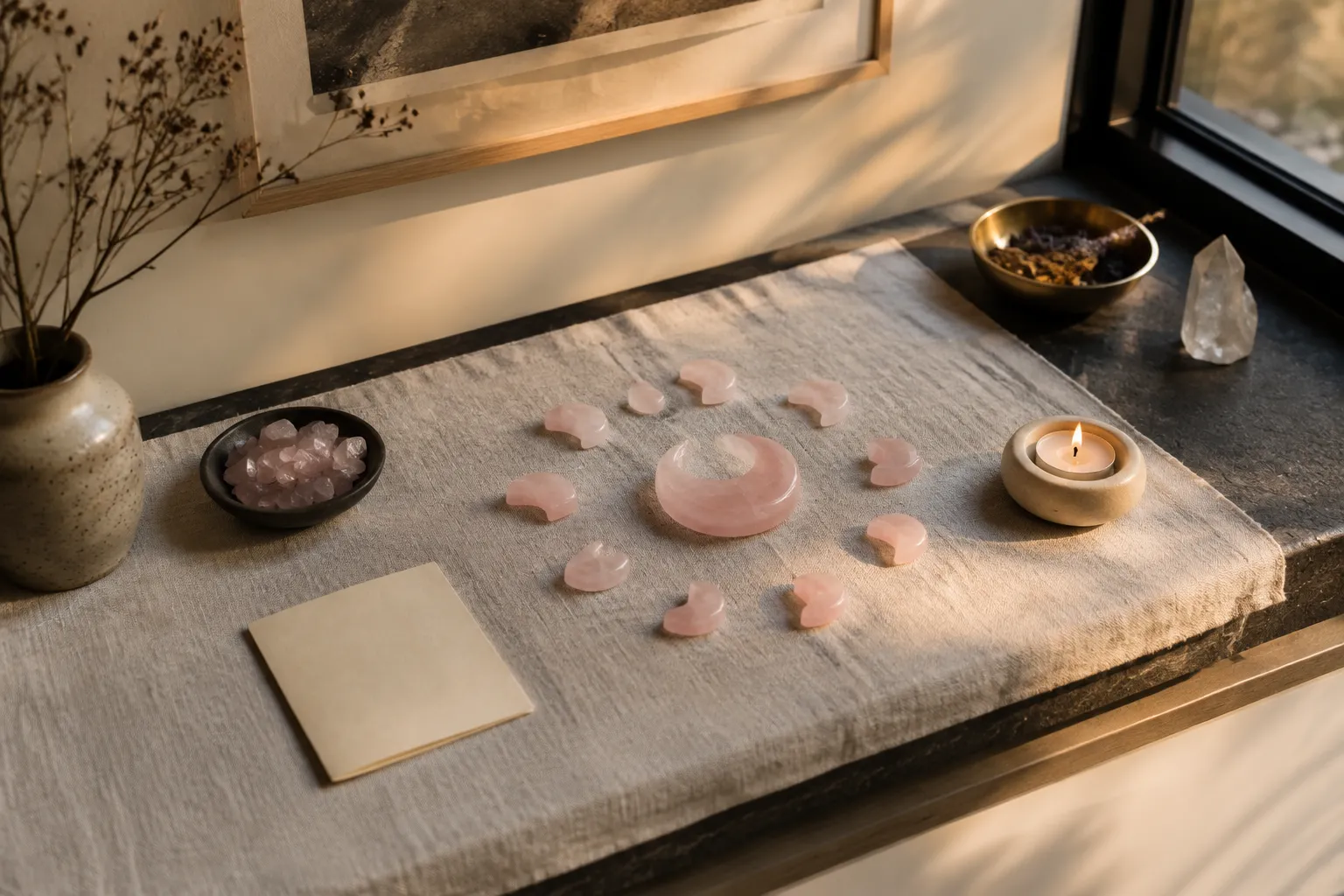
Candles often appear beside rose quartz altar displays, but they change the practical risk of the arrangement. Keep flame away from paper, dried flowers, loose fabric, curtains, books, and unstable crystal points. If the tray is crowded, use an unlit candle, a small lamp, or a battery candle instead.
Placement also affects how the grid survives daily life. A rose quartz shelf arrangement can be beautiful but impractical if it sits where doors swing, pets jump, or children reach. A bedside circle may look calm but become annoying if it takes over the place where glasses, medication, or a phone normally sits. The better layout is the one that fits the room.
A simple spacing rule: each stone should have enough air around it that you can pick it up with two fingers. If you cannot move one piece without disturbing three others, the grid is probably too tight for everyday decor.
Common confusion around sacred geometry, clear quartz, and proof
The language around crystal grids can sound more certain than the available evidence supports. It helps to separate the terms into design use and claim use.
Sacred geometry
Symbolic layout vocabulary for symmetry, circles, triangles, repetition, and radial balance.
Clear quartz amplifier
Common practitioner or market language; in decor, clear quartz works as a bright accent and contrast piece.
Central keystone
The main focal stone that organizes the visual pattern.
New moon grid
A layout refreshed or arranged around the astronomical new moon as a symbolic timing cue.
Rose quartz focal stone
The central pink quartz piece chosen for scale, color, texture, or personal meaning.
A pattern can feel meaningful without becoming evidence of a result. A clear quartz amplifier symbol can belong in the display as cultural or personal language, but amplification should not be described as a measurable fact. The same applies to sacred geometry crystal grid claims. Symmetry and repetition are visible; promised outcomes are not.
Wellness-adjacent language needs the same restraint. Public health sources such as NCCIH distinguish general wellness practices from health-outcome claims; for this page, rose quartz ritual use should remain personal, decorative, and reflective. It should not be positioned as a substitute for appropriate professional support when that is needed.
A compact layout recipe for a small new moon display
For a small surface, use this restrained version:
- Surface: one tray, dish, cloth, or cleared shelf area.
- Center: one central rose quartz keystone.
- Shape: six small rose quartz stones in a circle or crescent.
- Accent: one or two clear quartz pieces as visual contrast.
- Spacing: visible gaps between stones.
- Optional note: one short intention written in non-outcome language.
- Lighting: soft lamp or safely placed candle, with paper and fabric kept away.
This gives the display enough structure to read as a grid without turning it into a crowded collection. It also keeps the new moon reference where it belongs: a quiet timing cue and symbolic mood, not proof of what the stones will do.
A rose quartz grid can support a room’s atmosphere because it changes what the eye sees: pink mineral color, repeated shapes, a calm surface, and a chosen focal point. The rest is interpretation. Keep the specimen before the symbol, and the new moon layout stays both beautiful and bounded.