Sensory grounding
Interrupting Anxiety: Sensory Grounding for the Doomscrolling Era
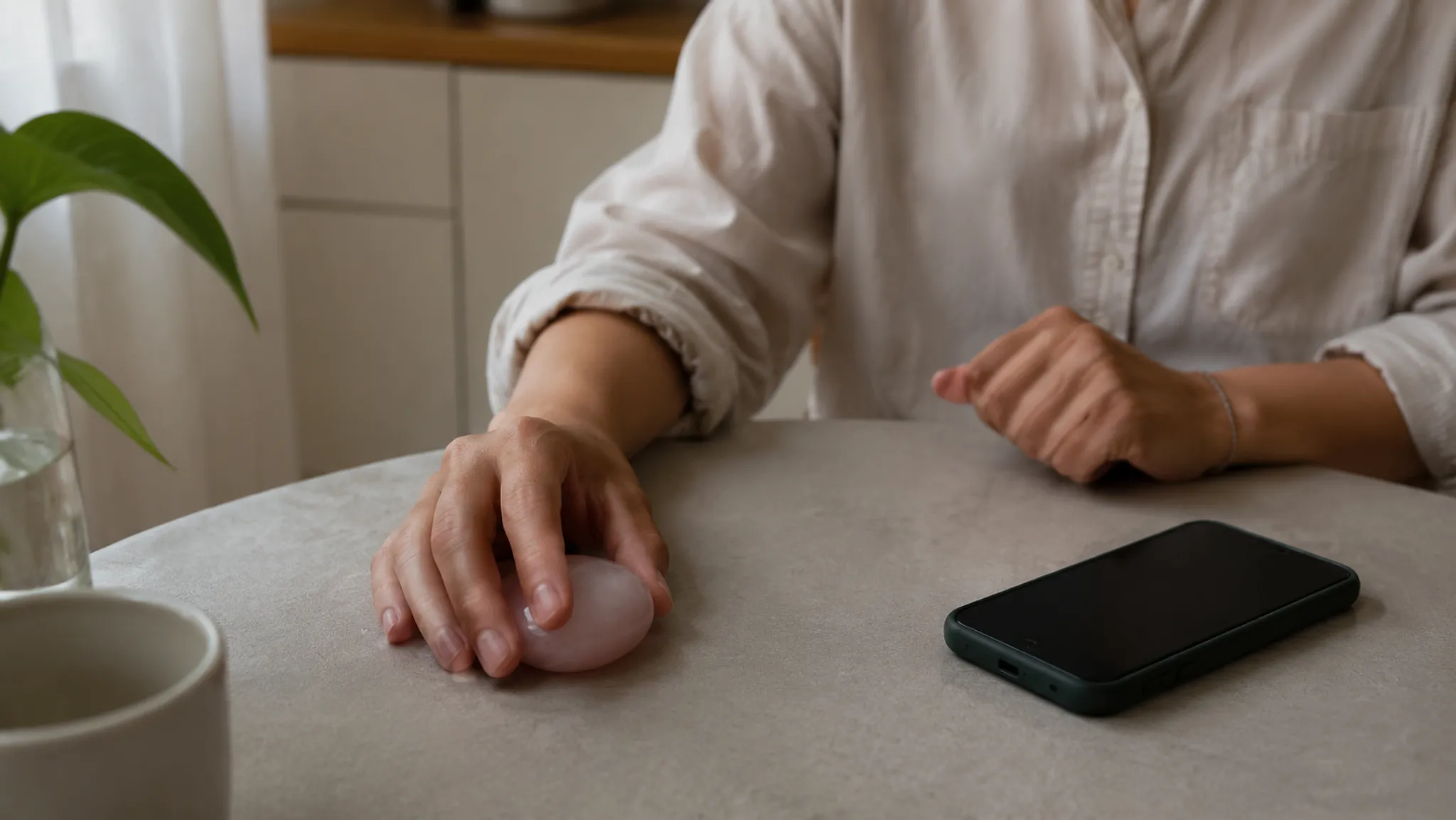
A polished stone on a desk has two layers: the surface the fingers can actually feel, and the meaning someone may have placed around it. For doomscrolling anxiety, the useful layer is the first one. Tactile texture-based sensory grounding is a small physical pause that moves attention from the feed to a real surface long enough to choose the next action.
That is the whole claim. This is not a clinical protocol for scrolling, and it does not show that a stone, fabric, or object changes mental health outcomes. The practical use is narrower: touch a chosen texture, name what the hand notices, register pressure or temperature, breathe once or twice, then decide whether the next tap is still the action you want.
broader context
Broader rose quartz guide
This narrower page makes more sense after the broader rose quartz context page.
The Small Job Texture Can Do
Doomscrolling can feel like a thought problem, but the loop is also bodily: thumb moving, eyes scanning, shoulders fixed, attention pulled back to the next update. Texture grounding gives the hand something else to register. The object does not need to be rare or symbolic. It needs to be close, safe to handle, and noticeable enough to compete with the phone for a few moments.
Grounding is commonly described in mental health education as a present-moment exercise that uses the senses. Five senses grounding, including the familiar 5-4-3-2-1 pattern, asks people to notice what they can see, hear, feel, smell, and taste. Touch and texture grounding narrows that broad idea to one channel: surface, edge, pressure, temperature, weight, friction.
For a scrolling pause, keep the method plain
- Lower the phone or place it face down.
- Put one hand on a chosen surface.
- Name three surface details: smooth, ridged, warm, cool, soft, grainy, polished, rough, firm.
- Notice where pressure lands in the fingers, palm, or wrist.
- Take one slow breath.
- Choose the next action: close the app, answer only the message you meant to answer, stand up, or continue with awareness.
The decision is part of the practice. The aim is not to force calm on command; it is to make the next tap less automatic.
Choosing a Texture That Holds Attention
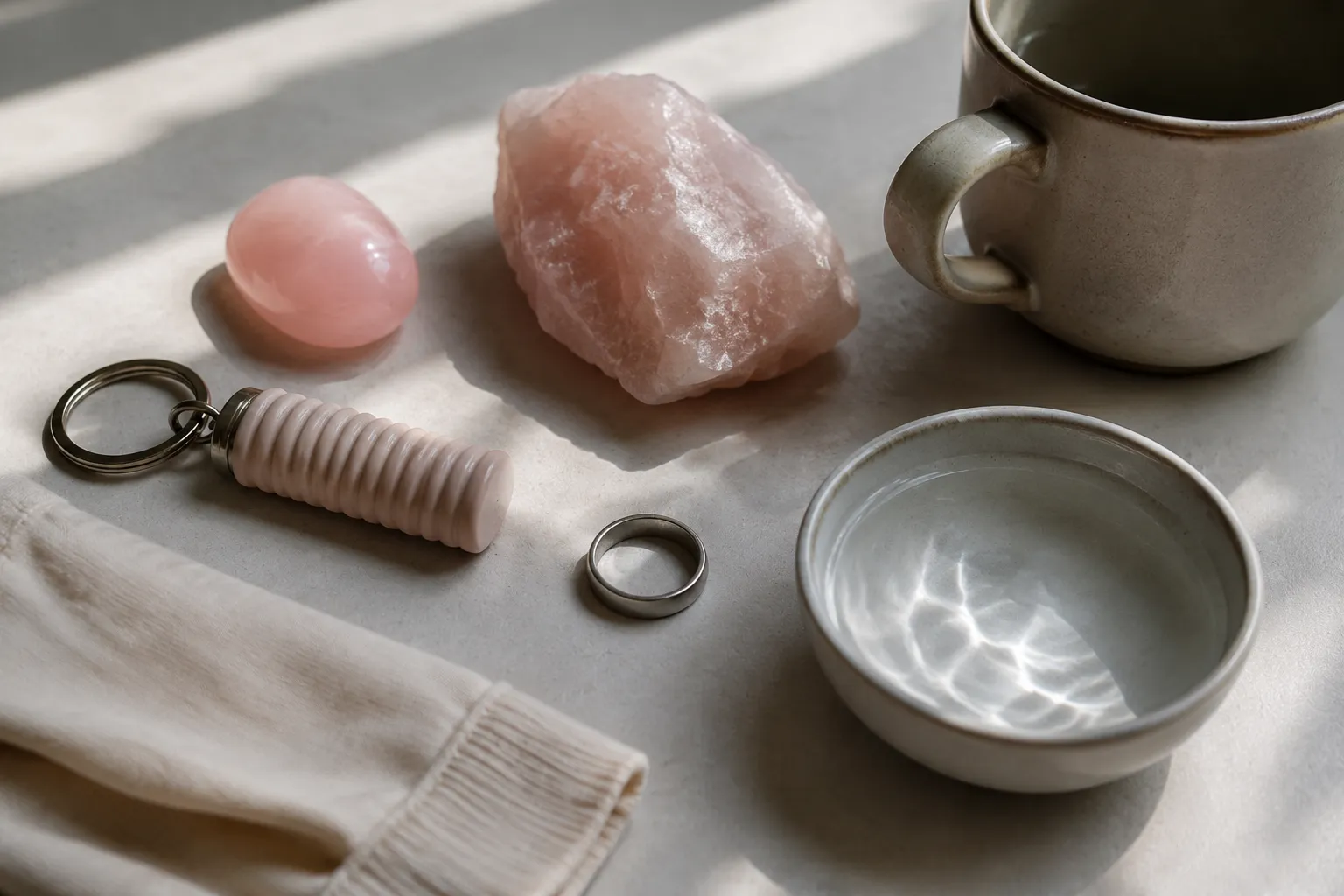
A texture grounding object works best when it is easy to reach and distinct enough to describe. A smooth stone, rough rock, ridged keychain, ceramic mug, metal ring, soft fabric, sleeve cuff, table edge, or water temperature on the hands can all serve the same basic function. The object is a tactile cue, not a treatment device.
Polished texture has a particular appeal because the fingers can read it clearly: smooth, cool, stable, continuous. A polished rose quartz palm stone, for example, can be used as a smooth stone grounding object if it already belongs on a desk, bedside surface, or ritual tray. What can be observed is the surface: its first coolness, the way it warms in the hand, the difference between rounded edges and flatter areas, the weight against the palm. What remains interpretation is any symbolic meaning assigned to the stone.
That distinction matters. A rose quartz object may carry personal meaning, interior softness, or ritual context for the person who keeps it nearby. Those meanings can make the object easier to remember and more likely to be used. They do not prove a special calming property in the material itself.
Stronger textures
Some people prefer rough stone, woven fabric, a ribbed mug handle, a ridged ring, or the edge of a sleeve cuff because these surfaces are harder to ignore.
Softer cues
Others may find rough, cold, or intense surfaces unpleasant, especially when already distressed. Fleece, cotton, warm water, a smooth ceramic cup, or familiar clothing may be easier to stay with.
The useful test is simple: can you name the surface without forcing it? If the object gives you three or four clear details, it can probably do the small job this page is asking of it.
What Changes the Answer
Texture based sensory grounding is more useful when the problem is a screen-driven checking loop than when the problem is severe distress. If the moment is “I keep checking, and each check makes me more tense,” a tactile pause may help slow the sequence. If distress feels unsafe, trauma-linked, persistent, or hard to function through, self-guided grounding should not be treated as enough support on its own.
The setting also changes the answer. At a desk, a tangible object for grounding can sit beside the keyboard: a smooth stone, small fabric square, ring, mug, or textured keychain. In bed, the most available cue may be bedding, clothing texture, the edge of a pillowcase, or the cool side of a phone case after the screen is turned down. In a public place, a ring, sleeve cuff, pocket fabric, or water on the hands may be more discreet than holding a dedicated object.
The intensity of the texture matters less than the clarity of attention. A rough rock may pull attention quickly because it has uneven points, temperature shifts, and edges. A polished object works differently; its value is the steady contrast between smoothness, coolness, weight, and pressure. Soft fabric may not seize attention as sharply, but it may be easier to stay with if roughness feels irritating.
Timing matters too. Tactile grounding is most realistic before the loop has gathered too much speed: after a headline tightens the body, after the third refresh, after noticing the urge to check comments again. Waiting until the scroll has become a long late-night spiral can make any small cue feel weak. The expectation should stay modest.
The Dopamine Story Is Too Simple
Doomscrolling is often described online as “dopamine hijacking.” The phrase may match the felt pull of a feed, but it is too blunt for this page’s evidence. The more supportable language is behavioral: attention capture, anxious checking, threat scanning, a screen-driven loop, and a physical cue that may create a pause.
That distinction is not cosmetic. If the problem is framed as a brain-chemistry mechanism that touch can reset, the object starts to sound like a corrective device. The available material does not support that. If the problem is framed as a repeated attention loop, the role of texture becomes more reasonable: it gives the hand and attention something immediate, concrete, and non-screen-based to notice.
Sensory therapies and sensory modulation can also be overread here. Sensory modulation appears in clinical and occupational therapy-adjacent contexts, and peer-reviewed work discusses structured sensory coping strategies in mental health services. That background shows that sensory strategies exist in broader care settings. It does not show that a polished texture grounding object, rough rock, or soft fabric reliably interrupts doomscrolling anxiety for the general reader.
The page evidence supports a practical adaptation, not a promised result.
A Texture Pause Without Making It Larger Than It Is
The most durable version is ordinary and repeatable. Keep one texture within reach of the place where scrolling tends to become anxious. It can be a mug, ring, keychain, sleeve cuff, table edge, stone, fabric scrap, or polished rose quartz object used as part of a room setting. It should be safe to handle, not sharp, not so cold or abrasive that the body braces, and not so precious that you avoid touching it.
When the loop starts, do not begin by demanding a feeling. Begin with description.
Place the phone down. Hold the object or touch the surface. Say, silently if needed: “cool, smooth, heavy,” or “rough, dry, uneven,” or “soft, warm, folded.” Add one pressure detail: “the edge is pressing into my index finger,” or “the fabric is moving under my thumb.” If attention jumps back to the feed, return to one more surface detail. Then choose the next action.
That choice can be small: close the app, open only the message you intended to answer, stand up for water, set a timer, or decide to keep reading with awareness. Tactile grounding does not need to win a moral argument against the phone. It only needs to insert a physical checkpoint.
For readers who use rose quartz symbolically, this is where meaning can sit beside material reality. The pink stone may belong to a calming corner, a bedside dish, a ritual tray, or a work surface chosen for a softer visual atmosphere. The sensory part remains the same: polished surface, cool contact, rounded pressure, visible color, object weight. The symbolic layer may make the practice feel more personal, but the grounded claim stays with touch.
Common Confusions Worth Clearing
Texture grounding is not proof that touch stops anxiety.
Public mental health education often presents grounding as a way to reconnect attention with the present moment, and touch can be part of that. The stronger claim, that a tactile cue reliably changes an anxious state during doomscrolling, is not established by the available material.
A stronger texture is not always better.
Pronounced texture may feel more anchoring for some people, but it is not a rule. Rough, cold, or intense surfaces can feel unpleasant or activating. If the texture makes the body brace, switch to something softer or warmer.
A dedicated object is not required.
Tangible objects for grounding can help because they are easy to remember, but the same principle works with clothing texture, a table surface, a mug handle, a metal ring, or water temperature on hands. The practice is attention to present sensory detail, not ownership of a special item.
A crystal object does not need an inflated claim to be useful.
A smooth stone grounding practice can be meaningful, aesthetically fitting, and tactile without being framed as changing health outcomes. For this site’s lane, that boundary is important: the specimen before the symbol.
When Grounding Is Not Enough
Use tactile texture grounding as a small coping aid for a specific moment: the hand is scrolling, the mind is scanning, the body is tense, and a physical cue might create enough pause to choose differently. That is its reasonable scope.
Look for qualified mental health support when anxiety is persistent, severe, connected to trauma responses, accompanied by panic that feels unsafe, or interfering with daily functioning. Seek urgent help if distress includes self-harm thoughts or immediate safety concerns. In those situations, a grounding object can still be a comfort, but it should not be treated as a substitute for appropriate care.
The cleanest answer is this: tactile texture-based sensory grounding may help some readers interrupt doomscrolling by shifting attention from the screen to touch long enough to make a next choice. A polished stone, rough rock, soft fabric, clothing edge, mug, ring, or water on the hands can all serve that pause when the claim stays as modest as the method.