Lunar ritual protocol
The 2026 Worm Full Moon: A Precise Astrological Protocol for Charging Pink Amethyst
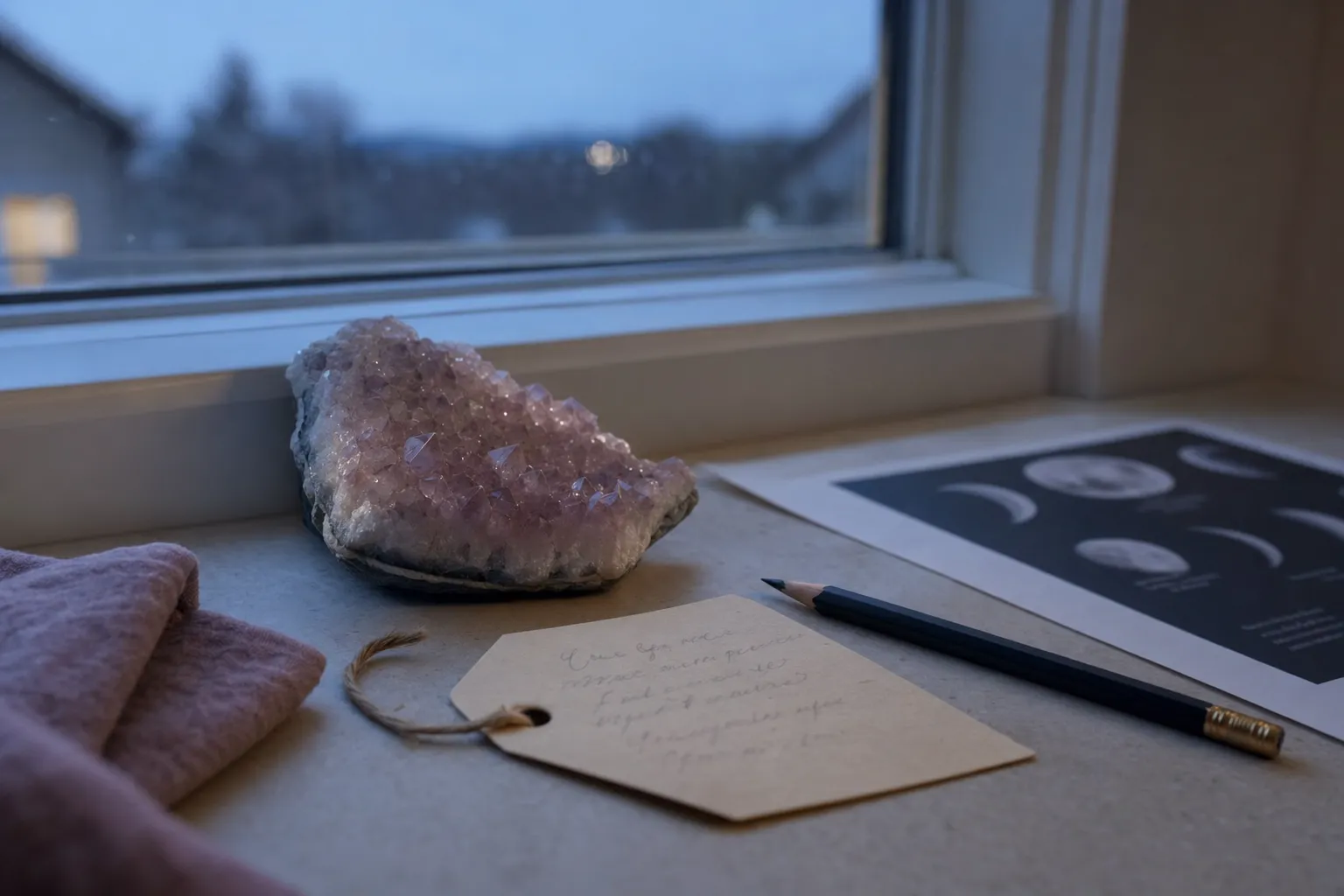
A pink amethyst cluster on a windowsill is a mineral object before it becomes a ritual object: pale violet to rosy color, uneven crystal pockets, dust-catching edges, and a surface that can be scratched, soaked, or knocked if handled carelessly. For the 2026 Worm Full Moon, the cleanest Lunar Charging Ritual is symbolic rather than mechanical: verify the full moon date and local peak time with a reliable moon-phase calendar, place the pink amethyst where it can sit undisturbed, write one intention around renewal or release, leave it through your chosen full moon window, then close by recording what the object is meant to remind you of.
This protocol does not claim that moonlight measurably changes the stone. It treats the Worm Moon as a seasonal marker and the crystal as a focus for reflection.
broader context
Broader rose quartz guide
This narrower page makes more sense after the broader rose quartz context page.
The Protocol at a Glance
Use this sequence if you want a precise, tradition-aware Worm Moon ritual without turning symbolic crystal charging into a promise.
Step 1
Confirm the timing
Confirm the 2026 Worm Full Moon date and peak time for your location. Do not rely on unsourced graphics or copied social posts.
Step 2
Choose a window
Choose a charging window: peak evening, overnight, or a calm hour near the full moon. Symbolic timing matters more than forced exposure.
Step 3
Prepare the stone
Prepare the pink amethyst dry, stable, and clean enough for display. Avoid water, smoke, damp outdoor surfaces, or unstable ledges unless you have separate care guidance.
Step 4
Write one sentence
Write one sentence of intention. Keep it reflective, not outcome-promising.
Step 5
Place the stone
Place the stone under moonlight, near a window, or on a dedicated cloth. Direct moonlight is optional in a symbolic ritual.
Step 6
Close the reminder
Close by naming the reminder you want the crystal to hold. The change is in attention and practice, not a verified mineral effect.
A precise astrological protocol can still be modest. Precision here means clear timing, careful handling, and defined language; it does not mean guaranteed results.
How to Time the 2026 Worm Moon Ritual
The first timing step is verification. This article does not have a citation-ready astronomical source for the exact 2026 Worm Full Moon date, peak time, or local visibility, so begin with a separate check from a reputable moon-phase calendar, observatory, planetarium, or astronomy source. Use the date and peak time for your time zone, not a screenshot made for another region.
Once you have that timing, choose one of three ritual windows:
Peak window
Begin within a few hours of the listed full moon peak, if that is practical and restful.
Evening window
Place the pink amethyst after sunset on the night most closely associated with the full moon in your location.
Reflective window
Use the evening before or after if weather, travel, sleep, or home safety makes the exact time awkward.
The peak window suits readers who enjoy astrological precision. The evening window suits readers who want the visible rhythm of the full moon without staying awake at an inconvenient hour. The reflective window is the grounded option when life is not arranged around a lunar timetable.
If you follow astrology, you may also note the moon sign from your preferred astrological source, but keep that layer separate from astronomy. Astronomy can give you a phase time. Astrology gives symbolic interpretation. They are not the same evidence category.
Preparing Pink Amethyst Without Over-Handling It
Pink amethyst ritual work often borrows the language of cleansing, charging, and intention-setting. Here, those words are ritual language, not proof that the stone has been altered. The observable task is simpler: keep the specimen stable, dry, and protected from careless handling while you use it as a visual anchor.
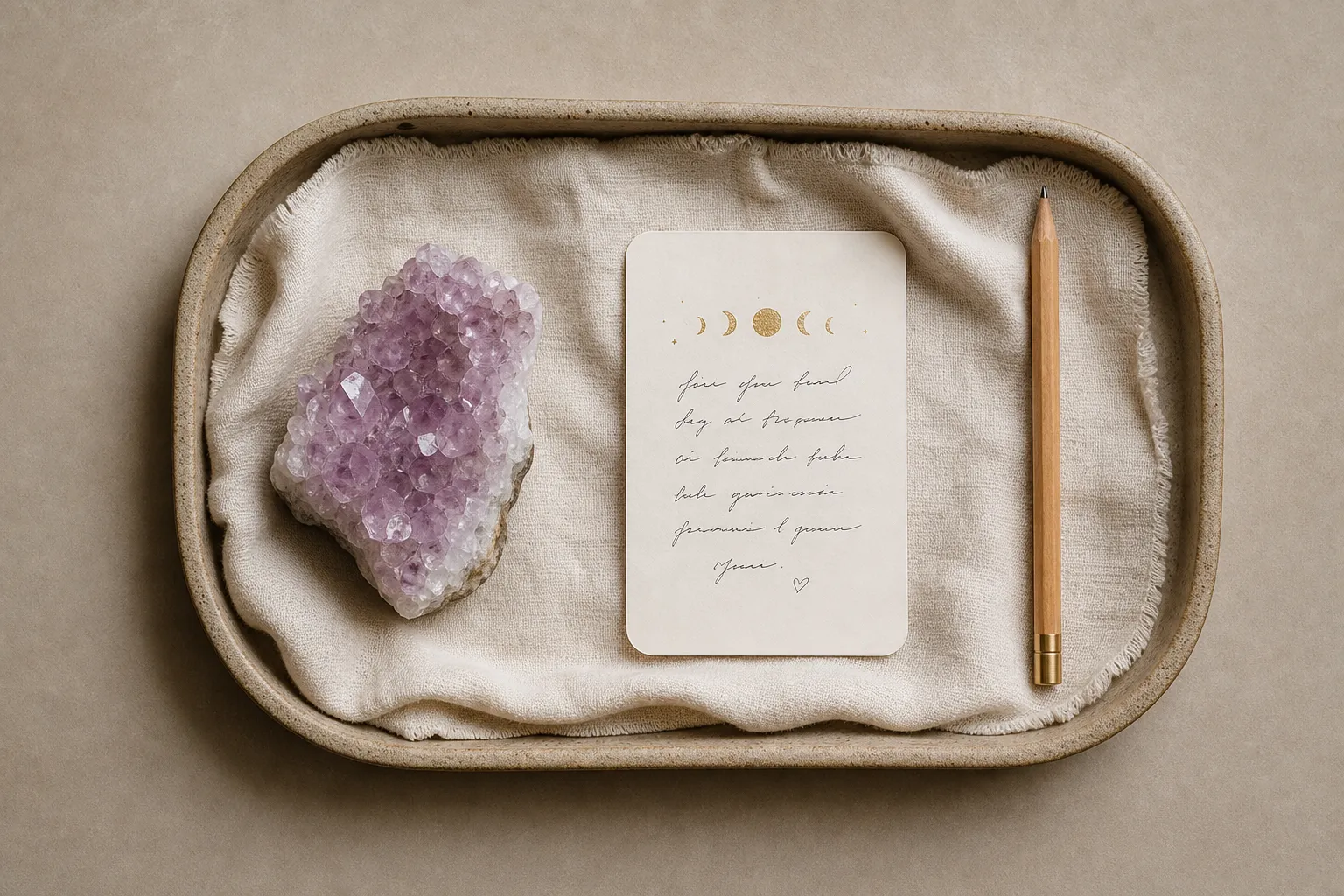
Before the Worm Moon ritual, place the pink amethyst on a clean cloth, shallow dish, tray, or shelf where it will not slide. If the piece has points, cavities, or a rough matrix, avoid rubbing it aggressively. If it is polished, wipe only as gently as the object reasonably allows. This is not a mineral-care manual; it is a conservative setup for a quiet ritual.
Do not make the scene more dramatic than the object can tolerate. A bowl of water, loose candle wax, heavy smoke, wet grass, salt, or an outdoor railing may look ceremonial, but none is needed for symbolic crystal charging. If you use a candle nearby, keep flame away from cloth, paper, curtains, and the specimen’s display area. If you place the stone outside, retrieve it before dew, rain, pets, children, or early-morning activity can affect it.
A windowsill is enough. A small table near a window is enough. A covered indoor altar space is enough. The point is not to force the moon onto the stone; the point is to create a deliberate setting where full moon reflection can happen without damage or distraction.
The 2026 Worm Full Moon Charging Sequence
Begin by setting the pink amethyst down before you write anything. Let the specimen determine the scale of the ritual: a small tumbled piece may need only a folded cloth and a note; a larger cluster may need a stable tray and a clear surface. The ritual should fit the stone, not the other way around.
- Verify the moon phase. Check the 2026 Worm Full Moon date and local peak time from a reliable moon-phase source. Write the date and time at the top of your ritual note.
- Name the season without overstating it. The Worm Moon is commonly treated in popular lunar language as a late-winter or early-spring full moon theme, often associated with thawing ground, return, and renewal. Because no cultural-history source is available here, treat that naming context as a familiar seasonal frame rather than a universal fact.
- Choose one intention. Write a single sentence beginning with “I will use this month to notice…” or “I am ready to release my attachment to…” Keep it behavioral and reflective. For example: “I will use this month to notice where I rush softness into certainty.” That wording stays inside lived practice rather than promising an external result.
- Place the pink amethyst. Set the stone on its cloth, tray, or shelf. If moonlight reaches it, fine. If clouds, walls, city light, or building direction interrupt direct light, the ritual can still work as a symbolic observance. The calendar timing and your attention carry the practice.
- Read the intention once. Read it quietly, without asking the crystal to guarantee an outcome. If you use astrology, you may add a brief phrase for the full moon’s sign or house placement according to your own chart system, but keep it as interpretation.
- Leave the stone undisturbed. Let it sit for your chosen window: one hour, the evening, or overnight. Longer is not automatically better. A stable placement matters more than a dramatic duration.
- Close the ritual. In the morning or at the end of the window, pick up the note before moving the stone. Write one closing line: “This pink amethyst will mark my return to…” or “This stone will remind me to pause before…” Then return the piece to its ordinary place.
That is the complete Lunar Charging Ritual. Its precision comes from sequence, timing, and language; its limits come from not pretending the sequence proves a physical or spiritual mechanism.
What Can Change the Answer
If the verified full moon peak occurs during daylight where you live, use the nearest evening rather than treating daytime as a failure. Full moon timing is astronomical; ritual timing is practical. You are not losing the ritual by choosing the nearest workable night.
If the sky is cloudy, keep the ritual indoors. Cloud cover does not need to become a spiritual obstacle. Since this protocol is symbolic, visible moonlight is welcome but not required.
If your pink amethyst is fragile, large, expensive, sentimental, or hard to replace, do not put it outdoors. The more meaningful the object is to you, the less it should be exposed to avoidable handling risks. A written note beside the stone can carry the ritual frame without moving the specimen.
If you share a home, choose privacy over performance. A drawer-top, bedside shelf, or quiet desk can be more coherent than a conspicuous display that makes the ritual feel self-conscious. The ritual is meant to focus attention, not prove anything to an audience.
If you use other crystals, keep pink amethyst as the center. Rose quartz, clear quartz, or amethyst may be meaningful in adjacent practices, but adding many stones can blur the single question this ritual answers. For this Worm Moon protocol, the pink amethyst is the anchor.
Common Confusion Around Charging, Cleansing, and the Worm Moon
Charging as a factual claim
The most common confusion is treating “charging” as a factual claim when the support here only allows ritual language. In crystal spirituality, charging often means dedicating an object to a purpose, refreshing its symbolic role, or placing it within a chosen lunar rhythm. That is different from showing that moonlight has changed the mineral in a measurable way.
One Worm Moon meaning for everyone
A second confusion is treating the Worm Moon name as if every reader inherits the same cultural meaning. Without a visible cultural-history source, it is safer to use the term as a popular full moon name and a seasonal prompt, not as a single authoritative tradition. If your own cultural or family practice uses different moon names, use that context instead.
Extra elements as requirements
A third confusion is assuming the ritual must include water, salt, smoke, or flame to be complete. It does not. Those elements can introduce avoidable care and safety concerns, and this protocol does not need them. The clean version is dry, quiet, and easy to repeat.
Over-precision
A final confusion is over-precision. Some readers try to match the exact minute of the full moon, the exact moon sign, the exact direction of the window, and the exact material surface. If that helps you focus, keep it. If it makes the ritual brittle, simplify. A precise ritual is not the same as a fragile one.
A Short Checklist Before You Begin
Use this checklist on the day of the 2026 Worm Full Moon:
- I have checked the full moon date and local peak time from a reliable moon-phase source.
- I have chosen a realistic window: peak, evening, or nearby reflective time.
- The pink amethyst is on a stable, dry surface.
- No flame, water, smoke, salt, weather, or ledge risk is necessary for the ritual.
- My intention is one sentence, reflective, and free of promised outcomes.
- I know where the stone will return after the ritual closes.
If any item feels uncertain, adjust the setup rather than forcing the ritual. The best version is clear enough to repeat and modest enough to stay honest.
The Boundary That Keeps the Ritual Grounded
The 2026 Worm Full Moon can be used as a meaningful time marker for a pink amethyst ritual, but the strongest version of the practice keeps three layers separate. The moon phase is an astronomical event that needs verification from a reliable calendar. The Worm Moon name is a seasonal and cultural phrase that should not be overclaimed without source support. The charging protocol is a symbolic, spiritual, or reflective practice, not a demonstrated change in the stone.
That boundary does not make the ritual empty. It makes it cleaner. Pink amethyst can sit in the room as a specimen, an interior object, and a chosen symbol at the same time; the ritual simply gives that symbol a date, a sentence, and a quiet return to ordinary use.