Buyer-facing surface screen
The Acetone Test: How to Spot Dyed Smelting Quartz Instantly
A quick acetone wipe can help with one narrow question: is there loose, surface-applied color on a rose-quartz-like stone?
In the Acetone Quartz Test, pink, red, purple, or other visible color on a white swab is a warning sign. It may point to surface dye, a colored coating, residue, or unstable treatment. For a buyer, that is useful information.
The limit matters just as much: a clean swab does not confirm natural rose quartz. It does not rule out stable dye, internal treatment, glass, synthetic or regrown quartz, coated material, or another rose-quartz-like substitute. Use the wipe as a quick red-flag screen, not as an authenticity test.
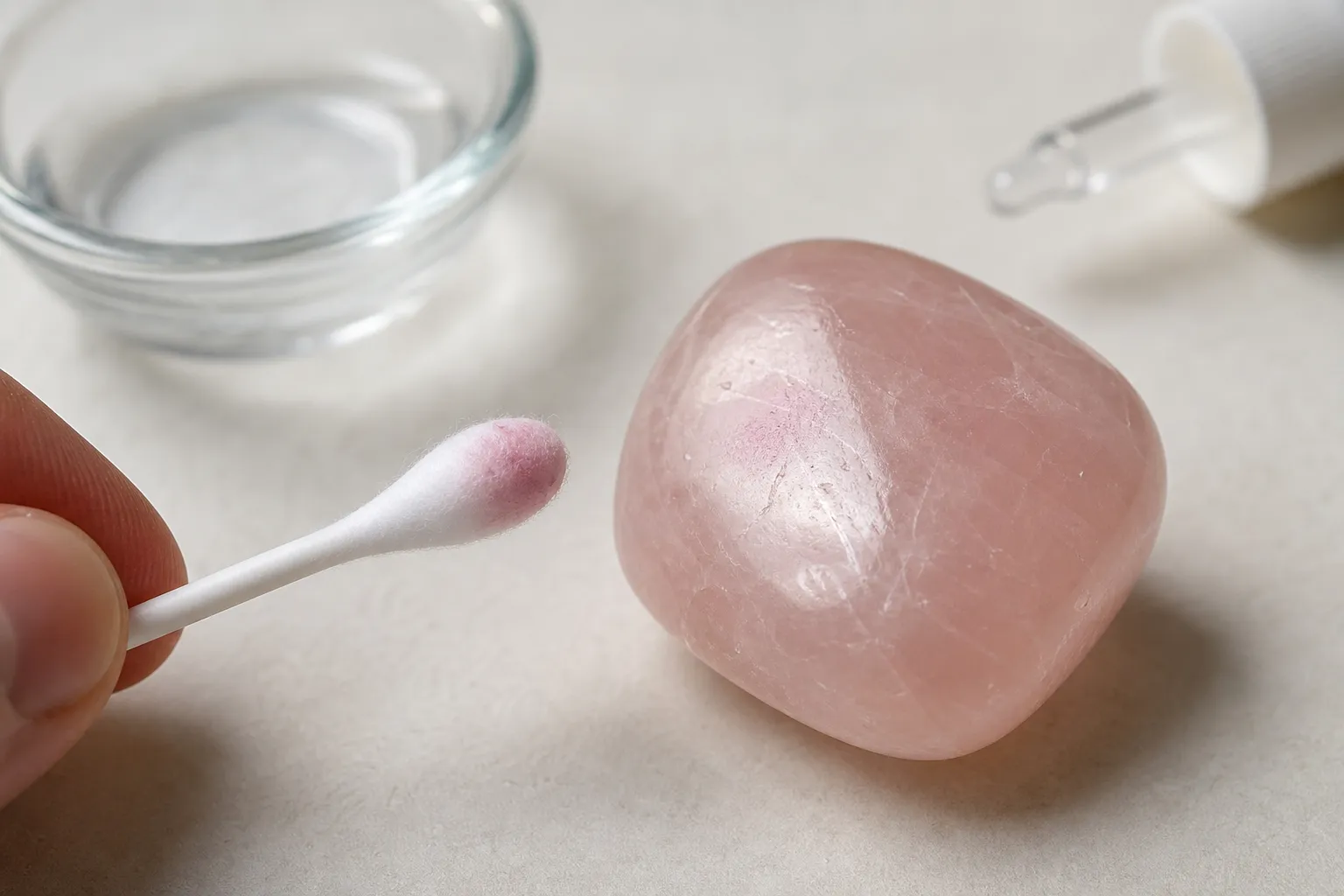
What the acetone wipe can tell you
The test only checks the surface. It asks: “Is there color loose enough for a lightly moistened white swab to pick up?”
If color appears on the swab, that is meaningful in a practical buying situation. Natural rose quartz should not shed pink color onto cotton during a light wipe. A visible stain suggests that at least part of the color may be applied or unstable rather than coming from the stone’s own internal color.
This is why the test comes up around Fake Rose Quartz, dyed quartz, and shop-language pieces sold as dyed smelting quartz. The issue is not only whether the object contains quartz. The buyer’s real concern is whether the soft pink appearance is natural rose quartz or a manufactured rose-quartz-like look.
A positive result may look like this
- The swab turns pink, red, purple, or another noticeable color.
- Color collects around cracks, pits, bead holes, drill holes, or carved recesses.
- The wiped area looks paler, patchy, or rubbed after testing.
- Color transfer happens quickly with only light contact.
Those signs do not identify the full material. They are enough, however, to pause the purchase, ask for clearer disclosure, or avoid a piece being sold as natural rose quartz.
A negative result is much weaker. If the swab stays white, all you know is that this quick wipe did not lift obvious loose color from that spot.
How to use the test, if the piece is suitable
The least risky version is a small surface check on a low-value, unmounted, bare quartz-like stone. Do not use this test on something you cannot afford to mark, dull, loosen, or change.
A cautious buyer-facing method
- Choose only a bare, unmounted area. Avoid metal settings, glued caps, elastic cord, plating, paint, resin, lacquer, foil backs, stringing, and unknown coatings.
- Use a white cotton swab or white cloth. White makes any color transfer easier to see.
- Moisten lightly. Do not soak the stone.
- Start in a hidden spot. The underside, back edge, or inside a drill hole is less exposed than the front face.
- Wipe briefly and gently. Heavy rubbing can abrade a surface and confuse the result.
- Check both the swab and the stone. Color on the swab is the warning sign. A clean swab is only a negative surface result.
- Stop if the surface changes. Dulling, tackiness, coating lift, adhesive odor, or loosened parts means the test is no longer a simple screen.
This should not be treated as universally Non-Destructive Testing. Consumer stones are not always one clean mineral surface. Jewelry and decorative crystal pieces may include adhesives, dyes, fillers, films, resins, paints, plated findings, elastic, or unknown finishes. Acetone may affect some of those materials even if the quartz-like surface itself appears unchanged.
Skip acetone entirely on valuable, sentimental, antique, mounted, coated, composite, repaired, glued, resin-filled, painted, plated, or mystery-material pieces.
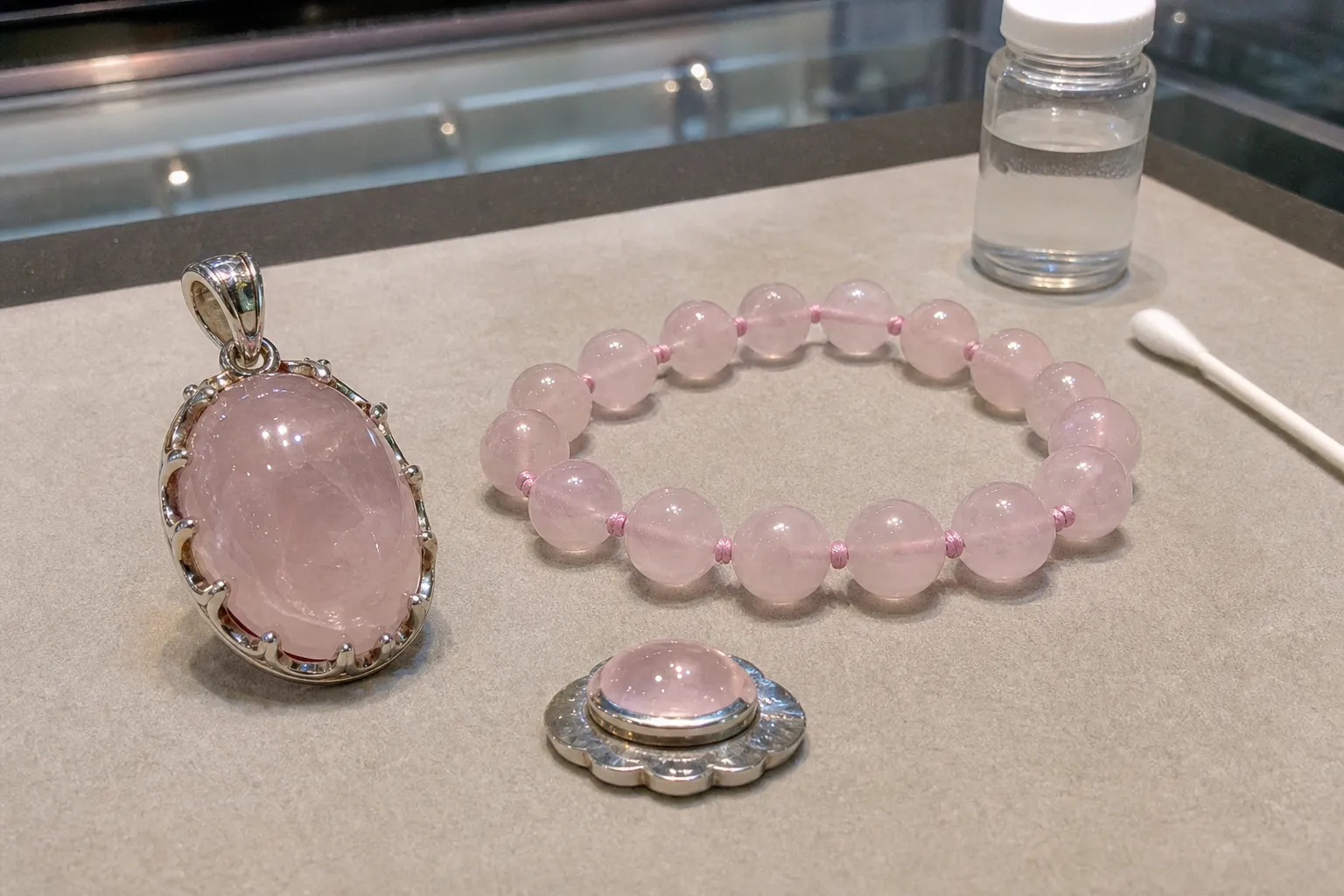
Why a clean swab does not mean “real rose quartz”
The most common mistake is over-reading a negative acetone result. A clean swab does not make the stone genuine.
A treated or imitation piece may not stain the swab because
- The color is inside fractures or pores, not loose on the outer surface.
- The dye or pigment is stable under a brief wipe.
- A coating protects the color from immediate transfer.
- The tested spot is not the treated area.
- The material imitates rose quartz without using wipeable dye.
- The piece is glass, synthetic, regrown, composite, or otherwise misrepresented in a way acetone cannot reveal.
Gemological research on quartz-family materials and treated stones points to the same broader lesson: appearance can be difficult to interpret from one simple observation. Some color treatments concentrate in fractures, pores, or growth-related features. Other identification questions may require magnification, spectroscopy, microscopy, or other gemological methods.
For rose quartz, the issue is not simply “pink paint versus natural stone.” Natural rose quartz color is tied to causes inside the material. A surface wipe does not test that internal color origin, and it cannot separate natural rose quartz from every treated, synthetic, regrown, glassy, or quartz-like substitute.
Color on the swab is a red flag. No color on the swab is not a pass.
“Smelting quartz” is market language, not a clear gemological category
The term smelting quartz appears in listings and buyer conversations, but it is not a precise identification by itself. Shoppers often use it for rose-quartz-like material that may look melted, reconstituted, glassy, dyed, synthetic, or otherwise unlike natural rose quartz.
That matters because Smelting Quartz Identification cannot rely on a product label. A seller’s wording may describe style, appearance, manufacturing language, or loose marketplace habit rather than mineral identity.
The acetone wipe does not define “smelting quartz.” It only checks whether a small area gives up visible color.
A grounded way to read the term
- If a listing says “smelting quartz,” do not assume it means natural rose quartz.
- If a piece is sold as rose quartz but looks neon, glassy, unusually uniform, or heavily saturated, ask for disclosure.
- If acetone lifts color, treat the natural rose quartz claim as doubtful.
- If acetone does not lift color, keep evaluating instead of declaring the piece genuine.
For inexpensive decorative stones, that may be enough to guide a buying decision. For jewelry, higher-value carvings, or pieces sold with strong authenticity claims, it is not enough.
When to stop and ask for identification
At-home screening has a place, but it should not become repeated wiping, soaking, heating, scratching, or experimenting with other solvents.
Ask a qualified gemologist or jeweler when
- The piece is set in jewelry.
- The seller claims natural rose quartz, but the color, price, or surface looks suspicious.
- Color appears concentrated in cracks, holes, or carved recesses.
- The material looks glassy, coated, resinous, or unusually uniform.
- The item is valuable, antique, inherited, or hard to replace.
- A clean acetone wipe conflicts with other warning signs.
- You need documentation rather than a personal buying impression.
Mounted jewelry deserves extra caution. A ring, pendant, bracelet, or strand is not just quartz. It may include glue, filler, plating, soldered parts, thread, elastic, backing material, dyed cord, or surface finish. A solvent wipe aimed at the stone can easily become a test on the setting.
Quick interpretation chart
The buyer takeaway
The acetone wipe test is useful only as a quick warning screen for visible dye transfer on quartz or rose-quartz-like material. It can help you reject a suspicious item when color comes off on a white swab.
It cannot confirm natural rose quartz, cannot define “smelting quartz,” and cannot replace proper gemological identification.
If you use it at all, use it only on a low-value, unmounted, bare, inconspicuous area. Stop at the first sign of color transfer or surface change. For anything set, coated, valuable, sentimental, or sold with a serious authenticity claim, skip the home solvent test and ask for qualified inspection instead.