Symbolic arrangement
Balancing Solar and Heart Energies: The Essential One-Yin-One-Yang Crystal Grid Method
A one-yin-one-yang crystal grid is best understood as a small, visible arrangement for personal reflection, not as a validated device that balances the body or changes external circumstances. Place two crystals in a simple relationship: one represents the inward, receptive, or soft quality you associate with the heart; the other represents the outward, focused, or active quality you associate with the solar plexus.
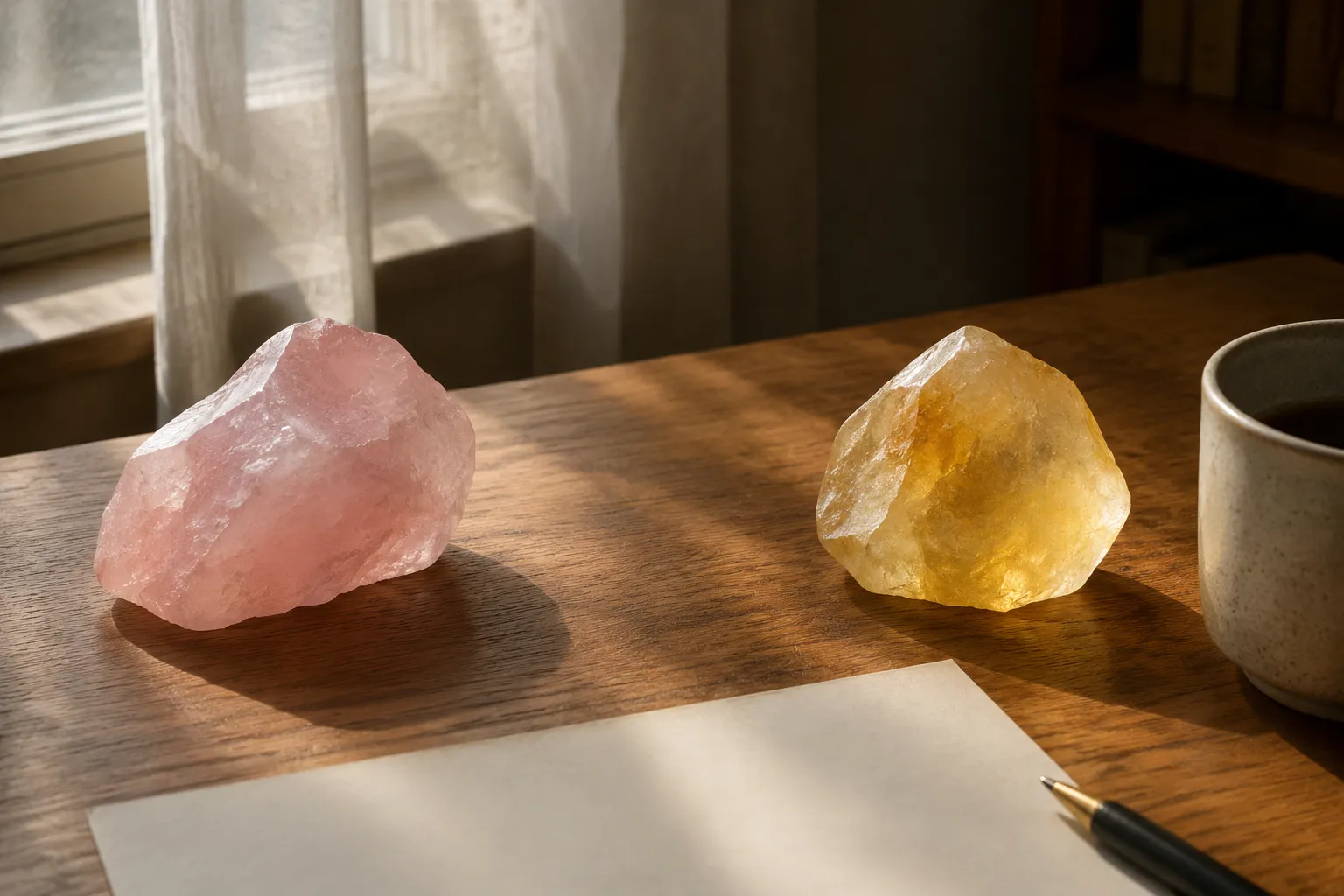
Rose quartz can serve as the heart-facing symbol. The second stone can be chosen for visual contrast or personal meaning. This is the practical answer behind the search term Yin Yang Energy Grid.
The arrangement may help you pause, name an intention, or give a room a deliberate focal point. Its meaning comes from the framework you bring to it. Placement alone cannot confirm a physical, energetic, emotional, relationship, or spiritual effect.
upward
Read the full overview first
Use the broader guide first if you need the full scope before this page.
Begin With the Visible Layout
Start with two clean, stable objects and a surface where they can remain undisturbed for a short period. A tray, shelf, bedside table, or writing desk is enough. The layout does not need an elaborate geometric pattern; the essential feature is the relationship between the two stones.
A simple solar plexus and heart crystal grid might look like this:
- Place the rose quartz on one side as the heart-associated stone.
- Place a second crystal opposite it as the solar-plexus-associated stone.
- Leave enough space between them for the contrast to remain easy to see.
- Write one sentence about the quality you want to hold in view, such as openness alongside discernment.
- Remove or rearrange the stones when the arrangement no longer serves that reflective purpose.
The supplied material does not establish that a particular distance, direction, shape, stone size, or color pairing creates a distinct result. Those choices belong to design and ritual. They may make the grid more legible to you, but they do not turn it into a measurable instrument.
Symmetry is optional in a visible crystal grid layout. Two stones of similar size can create a balanced appearance; different shapes can make the contrast more apparent. A polished rose quartz piece beside a rougher specimen creates a different visual conversation from two matching tumbled stones. That difference belongs to interiors and personal interpretation.
What “Yin” and “Yang” Mean Here
Here, yin and yang are used as complementary symbolic qualities. In a concise cultural sense, the terms describe paired aspects understood through their relationship rather than as isolated, permanent categories. Britannica supports this limited cultural framing; it does not provide evidence for a modern crystal-grid technique.
For a personal ritual arrangement, you might associate:
- Yin: receptivity, quiet attention, softness, inward listening, or rest.
- Yang: direction, initiative, clarity, outward attention, or deliberate action.
These associations are interpretive. They are not fixed meanings that every reader must accept. You may place yin on the heart side and yang on the solar plexus side; another person may reverse them. Label the choice as symbolic.
Phrases such as “solar plexus power,” “heart energy,” “emotional tranquility,” and “energy shock absorber” belong to ritual, market, or reader language in this context. They should not be treated as anatomical descriptions, psychological categories, or technical explanations of what a mineral does.
A more useful question is not, “Which stone controls which energy?” It is, “What two qualities do I want to hold in view at the same time?” That keeps the arrangement connected to reflection rather than to an unsupported cause-and-effect claim.
Where Rose Quartz Fits
Rose quartz is a real mineral object before it becomes a symbol. You can observe its surface, translucency, inclusions, polish, fractures, shape, and overall color. A gemological reference such as GIA helps separate those material observations from the meanings people attach to the stone.
Appearance alone cannot establish every detail about a piece's identity, treatment history, origin, or market description. A photograph or casual inspection is not a substitute for appropriate testing when those details matter.
Within a one-yin-one-yang crystal grid, rose quartz is commonly associated with tenderness, affection, softness, emotional reflection, and visual warmth. Those associations may explain why someone chooses it for the heart-facing position. They do not establish that the stone produces emotional tranquility, repairs a relationship, absorbs difficult energy, or changes a person's internal state.
This distinction matters when a label gives a stone an energetic role. “Heart stone” may be meaningful language in a ritual setting, while “rose quartz” refers to a mineral name. The descriptions can appear together, but they should not be confused:
| Layer | What it can describe |
|---|---|
| Material | A physical stone with observable features |
| Cultural or ritual language | Yin, yang, heart, solar plexus, balance, or intention |
| Personal interpretation | What the arrangement reminds you to notice or consider |
The first layer concerns the object. The second supplies a symbolic vocabulary. The third belongs to the person using the grid.
A Grounded Way to Arrange the Pair
A grid can work as a reflective prompt when its purpose is clear. Keep the process small and observable.
1. Choose the contrast
Select two stones that you can distinguish visually or symbolically. Rose quartz may represent a receptive or heart-associated quality. The second stone may stand for focus, confidence, movement, or another quality you choose. There is no need to assign it a measurable solar-plexus function.
2. Give Each Stone a Role
Write a short label for each position. For example:
- “soft attention”
- “clear direction”
Choose labels that describe your intention rather than implying that the stones can identify or correct a condition. The grid works as a visual language when the roles are simple enough to remember.
3. Establish the Relationship
Place the two stones opposite each other, side by side, or at two points of a small triangle. Use the layout that makes the relationship easiest to read. A one-yin-one-yang arrangement does not require an elaborate pattern; the two complementary roles are the central idea.
4. Use One Prompt
Look at the pair while considering a question such as, “Where could I combine gentleness with clear action today?” This is a personal reflection exercise. The answer comes from your thinking, writing, or conversation, not from a demonstrated signal emitted by the stones.
5. Close the Arrangement
Put the crystals away, leave them as decor, or photograph the layout for your own record. Closing the practice helps keep its scope clear. It is a chosen moment of attention, not a test of whether an invisible force has changed.
If the arrangement looks crowded, unstable, or visually confusing, change it for practical reasons. A tidy surface and a clear relationship are enough.
Common Confusion About Balance
The word “balance” can describe several different things. In interiors, it may mean that two objects distribute visual weight across a surface. In a symbolic practice, it may mean holding two qualities in awareness. In wellness marketing, it can suggest a physical or emotional outcome. These meanings should not be collapsed into one another.
A balanced-looking arrangement is observable as design. A balanced symbolic pair is an interpretation. A claim that the stones balance solar plexus or heart conditions would require a different level of evidence, and the supplied material does not provide it.
The same applies to the phrase “energy shock absorber.” It may function as a reader's metaphor for a calming object or a reminder to pause. It is not a material property established by the stone's placement. Rose quartz's color, polish, or position cannot confirm an effect on mood, health, relationships, or surrounding people.
Personal sensation deserves a similarly careful description. You may feel more settled after sitting with the grid, or you may simply enjoy the visual order and the time away from a busy task. That experience can be meaningful. It does not, by itself, demonstrate a measurable energy change.
What the Grid Cannot Establish
The available sources do not support treating this arrangement as a medical, mental-health, diagnostic, protective, or outcome-producing practice. NCCIH provides a useful government health-information boundary: energy-based practices should not be presented as a substitute for appropriate professional care or as evidence that a ritual changes a diagnosed condition.
Keep the practical limits visible:
- Crystal placement cannot confirm an effect by appearance or position alone.
- A rose quartz specimen cannot validate a claim about emotional or energetic change.
- Yin and yang language does not prove that two stones physically balance one another.
- A peaceful room or satisfying ritual does not establish a health outcome.
- Personal interpretation should not be presented as a universal result.
- The arrangement should not replace medical, mental-health, or other professional support when that support is needed.
These limits do not make the practice meaningless. They clarify what kind of meaning it can reasonably carry. A grid may function as a prompt, a decorative composition, a journaling cue, or a personal ritual arrangement. It remains a chosen symbolic form.
A Practical Check Before You Keep It
Before leaving the grid in place, ask three questions:
Can I describe what is physically present?
Name the stones, their visible features, and the layout without adding energetic conclusions.
Have I labeled interpretation as interpretation?
Use phrases such as “I associate,” “this represents,” or “this arrangement reminds me,” rather than presenting symbolic roles as material functions.
Am I asking the grid to do more than reflection or decor?
If the expectation involves changing health, diagnosed distress, relationships, safety, or another external outcome, the arrangement has moved beyond what this page's evidence can support.
The strongest one-yin-one-yang crystal grid is not the most elaborate one. It is the one whose physical layout is easy to see, whose symbolic roles are clear, and whose limits remain intact. Rose quartz can sit beside a complementary stone as a reminder to consider softness and direction together. That is a grounded use of ritual language, held beside the material reality of the mineral.