Rose Quartz Color Myths
Debunking the Myth: Why Titanium Doesn't Cause the Pink in Rose Quartz
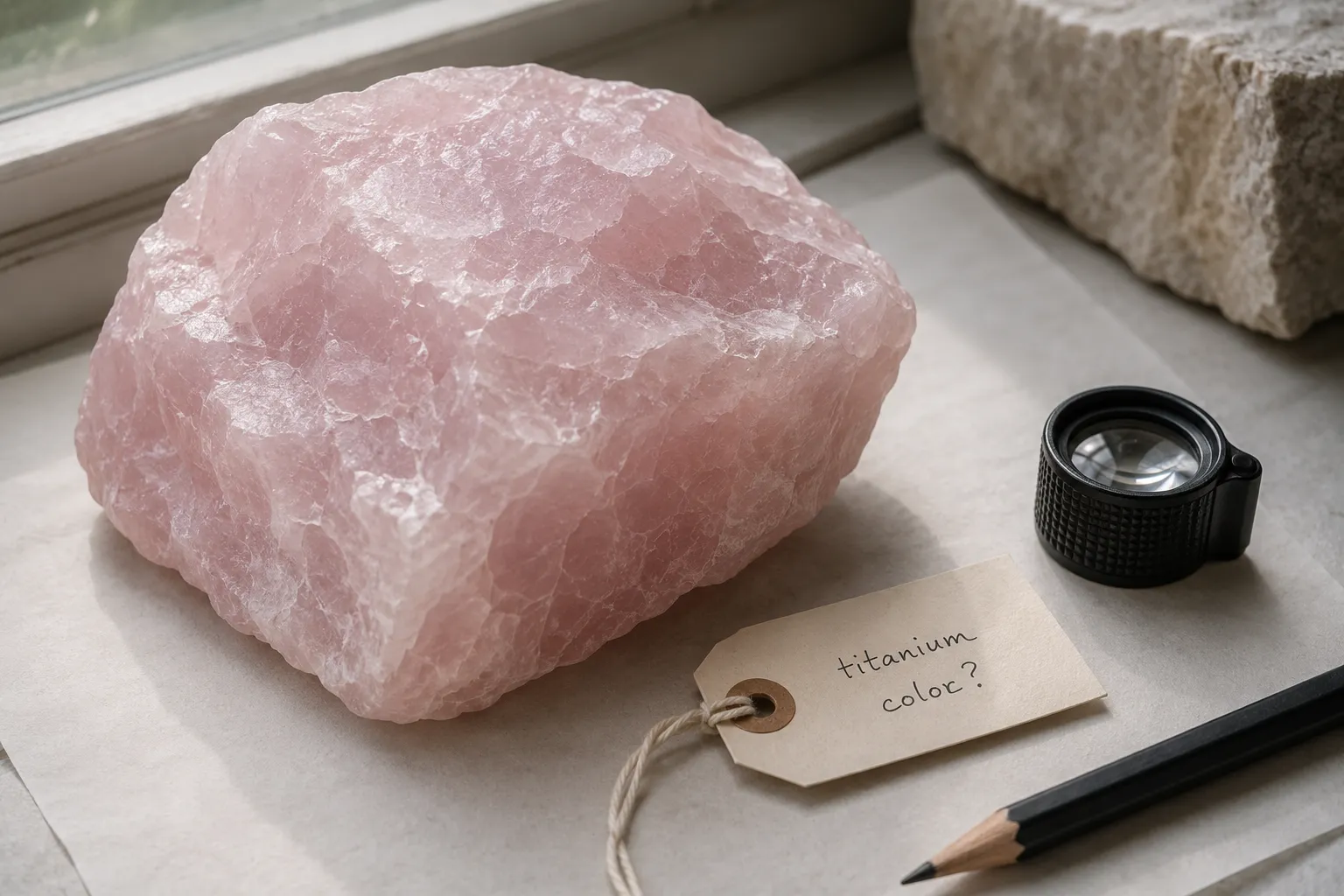
A pale, cloudy piece of rose quartz can look as if its color must come from one simple trace element. That is why the line "titanium makes rose quartz pink" still shows up in shop labels, short crystal explainers, and older mineral summaries. The cleaner answer is narrower: for common massive rose quartz, titanium alone is not enough to explain the pink.
Current gemological and mineralogical references more often point to microscopic aligned silicate fibers, also described in technical writing as fibrous nanoinclusions. Titanium has not disappeared from every technical discussion, but the old titanium impurity myth is too simple for the stone most readers are actually holding.
This is the useful boundary for Rose Quartz Color Myths: visible pink can start the question, but appearance alone cannot confirm the coloring mechanism.
upward
Read the full overview first
Use the broader guide first if you need the full scope before this page.
The Short Correction
Older explanations often said rose quartz was pink because of trace elements such as titanium, iron, or manganese. That wording is easy to remember, so it stayed alive in market language. It also sounds plausible, because many minerals do get their color from small chemical differences.
For common massive rose quartz, though, the stronger modern explanation points away from a single-element story and toward extremely small inclusions inside the quartz. GIA describes rose quartz as getting its delicate pink color from microscopic inclusions of aligned silicate mineral fibers, generally similar to but not identical with dumortierite. The American Mineralogist paper on fibrous nanoinclusions in massive rose quartz points in the same direction: the color is linked to tiny fibrous material within the quartz, not just one ingredient mixed through it.
That does not make every older titanium reference nonsense. Technical discussions have included Ti3+ color-center ideas and iron-titanium charge-transfer language in rose quartz research. The problem is the leap from that technical nuance to a shop-level sentence that says titanium makes rose quartz pink. For ordinary massive rose quartz, that sentence leaves out the part that matters most.
Better label language
"The pink color of common massive rose quartz is commonly associated with microscopic fibrous inclusions; older sources may mention titanium, iron, or manganese."
It is less tidy, but closer to the evidence.
What a Stone in Hand Can Actually Show
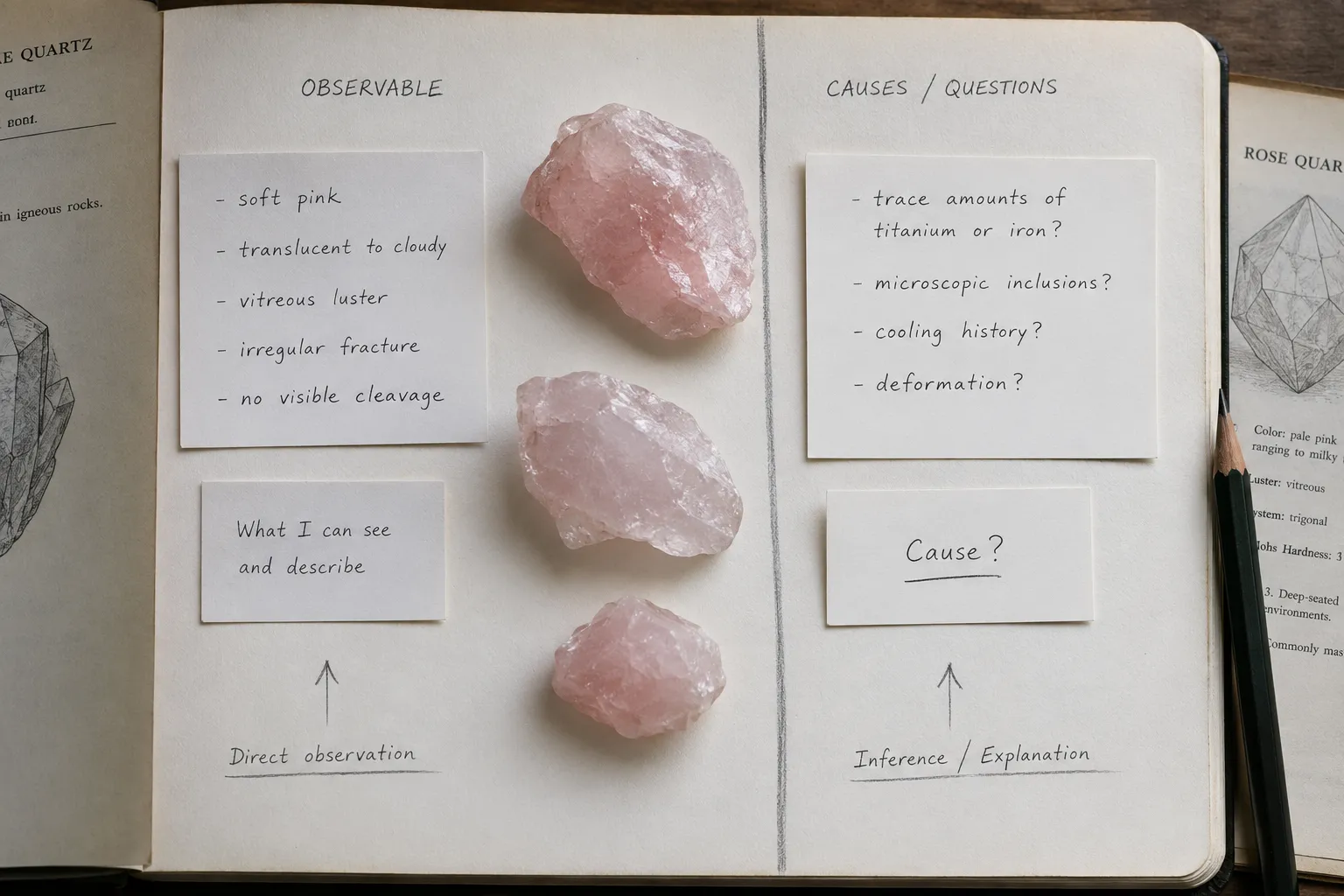
A piece of rose quartz can show visible clues before it shows a cause. Many common specimens are translucent to cloudy rather than glass-clear. The color may be soft pink, stronger rose, unevenly distributed, or paler in thin areas. A carved bead may look more saturated than a rough edge because thickness, polish, and lighting change the way the color reads.
Those clues help describe the material, but they do not identify the mechanism. Milkiness does not prove fibrous nanoinclusions. A deeper pink patch does not prove more titanium, iron inclusions, or manganese coloration. A photo under warm light can make the same stone look different from the same stone beside a window.
Star rose quartz is a useful example of the gap between seeing an effect and proving a cause. Some cut rose quartz can show a star-like asterism when light reflects from aligned internal features. That visible star suggests something about orientation inside the material, but it still does not let a casual viewer assign chemistry, locality, treatment history, value, or authenticity from appearance alone.
The same caution applies to rough stones, beads, spheres, towers, and interior pieces. A pink quartz object may give you visible clues about color, translucency, texture, and cutting style. It does not give you a laboratory answer by eye.
Visible description
- Soft pink, stronger rose, or uneven color
- Cloudy to translucent body
- Different color reading in thin edges, polished beads, or warm light
- Texture, cutting style, and possible star effects
What sight cannot settle
- Exact coloring mechanism
- Chemistry, locality, or treatment history
- Value or authenticity
- Whether titanium, iron, manganese, or fibrous inclusions explain that specimen
Why Iron and Manganese Still Show Up
The titanium impurity myth rarely travels alone. In commercial and social wording, rose quartz is often described as colored by "trace amounts of titanium, iron, and manganese." Sometimes that sentence is presented as settled fact. Sometimes it sits beside newer language about microscopic inclusions, which makes the two explanations look interchangeable.
Iron inclusions and manganese coloration belong in the discussion as historical and technical context, not as a simple buyer rule. Older explanations proposed that manganese or titanium-related color centers might be responsible for the pink. Later research complicated that picture for common massive rose quartz by emphasizing microscopic fibrous inclusions. That is why the cleanest correction is not "one element was wrong." It is that the old trace-impurity sentence is too thin.
There is also a language problem. "Impurity" is broad in public mineral writing. It can mean a trace element in a crystal lattice, a tiny included mineral, or a simplified explanation for color. In rose quartz, those differences matter. A phrase like "colored by titanium" can sound as if titanium atoms alone are the visible pink switch, while the better-supported explanation for massive rose quartz involves tiny aligned inclusions that are not captured by that shorthand.
When a seller or caption says "titanium, iron, and manganese," the reasonable move is not to assume bad intent. Treat it as simplified or outdated language unless it is tied to a specific mineralogical reference or test result. Ask what the phrase means: a casual color story, a general educational note, or a statement about that exact specimen.
Massive Rose Quartz Is Not Every Pink Quartz
The distinction between massive rose quartz and crystalline pink quartz keeps this topic from becoming overconfident. Most decorative rose quartz pieces are massive: they occur in large, non-euhedral masses rather than sharply formed transparent crystals. That is the material usually being discussed when gemological sources describe microscopic aligned silicate fibers and fibrous nanoinclusions.
Rare euhedral or crystalline pink quartz can involve a different color discussion. Some sources treat crystalline pink quartz as distinct from common massive rose quartz, with different behavior and possible color mechanisms. So it is not careful to collapse all pink quartz into one universal explanation.
That matters for search terms like "titanium makes rose quartz pink," because the reader may be looking at a tumbled stone, a rough chunk, a carved object, or a rarer crystal specimen. The common correction applies best to ordinary massive rose quartz. If the object is an unusual crystalline pink quartz specimen, the answer may need a more specific mineralogical context.
There is another confusion to keep out of the way: not everything called "rose quartz" in public language is mineral rose quartz. The phrase can also appear as a color name, glaze name, decor shade, or marketing label. Those uses should not be pulled into the mineral-color question. This page is about quartz as a mineral object.
How to Read a Shop Label
A shop label is usually written for quick recognition, not for mineral precision. "Rose quartz, pink from titanium" may be trying to answer a common question in a short line. It may also be repeating an older explanation that has not been updated.
A more careful reading uses three checks.
- Check 1Look at what kind of claim the label is making. "Rose quartz" as a name is different from "this specimen's color was identified by chemical testing." The first is ordinary naming. The second would need stronger support than a display card.
- Check 2Separate visible description from cause. "Soft pink, cloudy, translucent" describes what you can see. "Colored by titanium" explains why it is pink. Those are different levels of claim.
- Check 3Notice whether the source distinguishes massive rose quartz from crystalline pink quartz. A short label may not have room for that distinction, but an educational page should not skip it when discussing mechanism.
For a buyer, the practical answer is modest: do not use the titanium line as an authenticity test. Do not reject a stone only because a label uses older wording, and do not accept a stone as more authentic because the label sounds newer. Appearance and label language can guide better questions, but they cannot confirm chemistry, origin, treatment history, or value.
Where Symbolic Language Belongs
Rose quartz is commonly associated with love, softness, emotional reflection, decor warmth, and ritual intention. Those meanings can shape how people place the stone in a room, choose it for a personal object, or use it in reflective practice. They are not evidence for the mineral color mechanism.
That separation matters because color myths often absorb symbolic language. A caption may move from "soft pink color" to a statement about what the stone means, then back to titanium or manganese. The result sounds smooth as a story, but it mixes interpretation with geology.
A grounded reading keeps the two lanes apart. The pink color of common massive rose quartz is a material question, best handled through mineralogical and gemological evidence. The emotional or aesthetic meaning of the color is interpretive, better treated as symbolic language. One does not prove the other.
The Boundary
The titanium-alone explanation is not the best current answer for why common massive rose quartz is pink. The stronger evidence points to microscopic aligned silicate fibers or fibrous nanoinclusions, with older titanium, iron, and manganese explanations left as historical or technical nuance rather than a complete shop-label answer.
At the same time, a stone's pink color does not let you confirm the mechanism by sight. Visible clues such as softness of color, cloudiness, translucency, or star effects can help describe the specimen. They cannot identify exact chemistry, prove origin, confirm treatment history, or settle authenticity.
So the clean correction is this: titanium does not simply cause the pink in ordinary rose quartz. For massive rose quartz, that explanation is better treated as an outdated shortcut. The specimen can be appreciated for its visible pink presence and its symbolic associations, but the cause of that color belongs to mineral evidence, not to a single-element myth.