Touchless spa design
The Future of Spas: Blending Touchless Tech with Analog Rituals
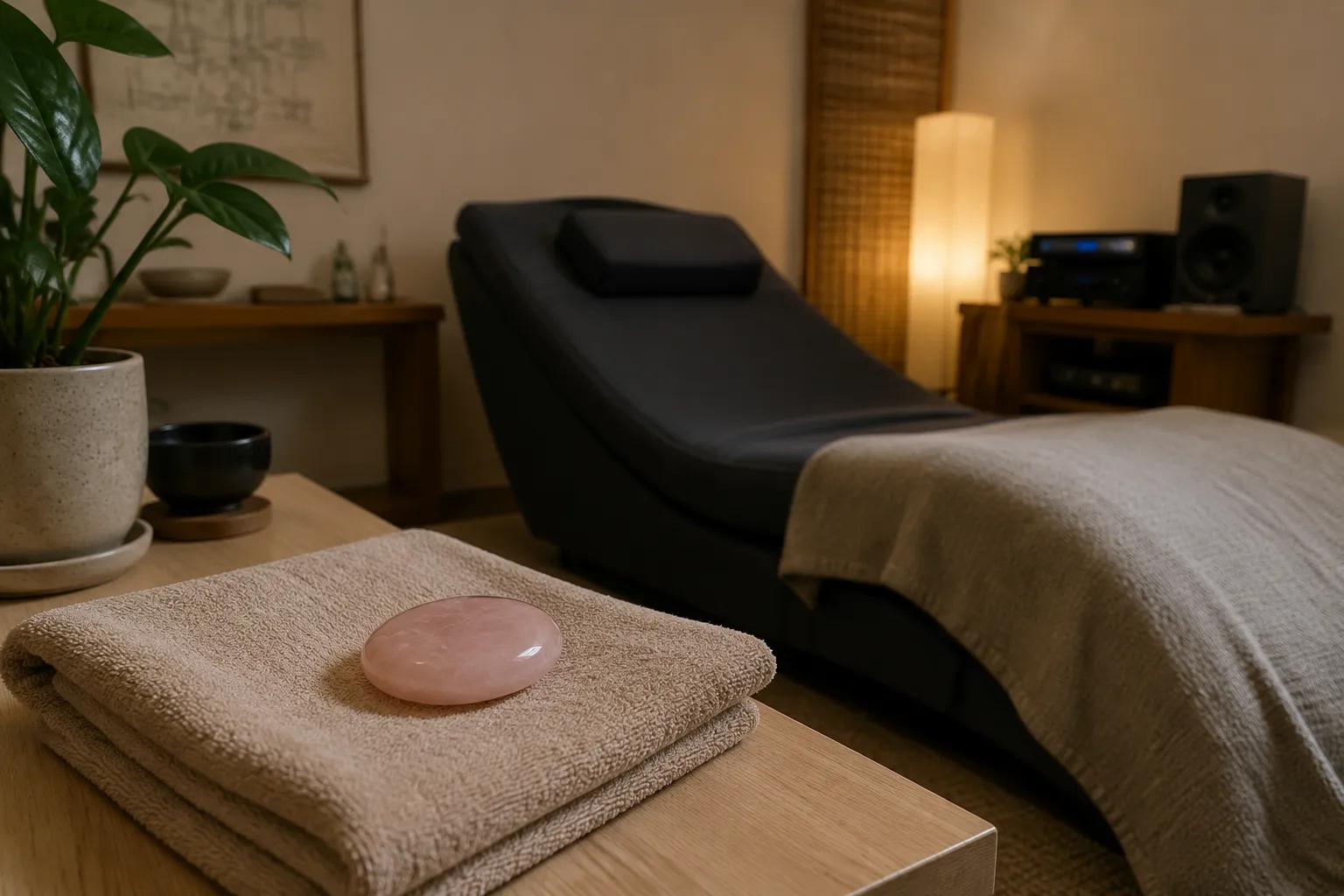
A rose quartz palm stone on a warm towel does not prove anything about the body. It does give the guest a visible object, a texture, and a pause before the machinery begins. That is the cleanest way to understand Synergistic touchless therapies with analog crystal rituals: not as a stronger wellness claim, but as a more carefully staged relaxation sequence.
The future-facing spa model is less about replacing human touch than about sequencing it differently. A vibroacoustic-style lounger, infrared warmth, light, sound, compression, water, or scent can create a therapist-light sensory interval; an analog ritual with rose quartz, breath, bowls, silence, or intention-setting can give that interval emotional shape. The supportable claim is experiential: the blend may feel more immersive, coherent, and luxurious. The available public source base does not establish medical outcomes, crystal effects, or energetic mechanisms.
broader context
Broader rose quartz guide
This narrower page makes more sense after the broader rose quartz context page.
Technology Carries Sensation, Ritual Carries Meaning
Touchless spa experiences work best when the technology is treated as atmosphere and sensory structure, not as an autonomous result-maker. In spa-industry discussion, touchless or therapist-light services are commonly framed through sound, vibration, heat, light, infrared, compression, water, scent, and recovery-oriented rest. Professional Beauty’s trade coverage supports that service-design context: spas are exploring multisensory journeys in which equipment can sit beside, before, or after hands-on work.
That matters because the word “touchless” can sound cold. A fully clothed session on a vibroacoustic therapy lounger may involve music or sound while vibration is transmitted through a table, lounge, mattress, or tactile transducers. The guest is not necessarily being handled by a therapist during that interval. Without framing, the experience can feel like lying inside a device. With framing, it can become one stage in a deliberate sensory spa sequence.
Analog crystal rituals answer a different need. A rose quartz object, a bowl placed near the body, a short intention-setting moment, or a therapist-led arrival pause gives the guest something slow, visible, and human-scaled. The specimen comes before the symbol: rose quartz is a mineral object with color, translucency, weight, and surface; its meanings around softness, affection, or emotional gentleness are cultural and interpretive. In a spa, that interpretive layer can be meaningful without being presented as a measurable force.
So the grounded version of the future spa is not “technology plus crystal equals greater effect.” It is more modest and more convincing: technology can deliver controlled sensory input, while analog ritual can make the session feel less mechanical and more personally legible.
Where Vibroacoustic-Style Tools Fit
Vibroacoustic therapy is often described as low-frequency sound vibration transmitted through the body by tactile transducers built into a table, chair, lounge, or similar surface. Some spa menus describe the guest as fully clothed, positioned for rest, listening to music or soundscapes while feeling vibration through the support beneath them. Those details are useful for understanding how spas explain the service, though many come from commercial provider pages rather than independent clinical sources.
For this page, vibroacoustic-style equipment is best understood as one sound and vibration tool within a broader spa journey. It may sit after a short arrival ritual, before a massage, between heat and quiet rest, or as a stand-alone decompression session. Its role is sensory: heard sound, felt vibration, stillness, and contrast with the ordinary pace of the day.
A restrained high-end sequence
- A therapist or host welcomes the guest, checks comfort needs, and explains the session in plain language.
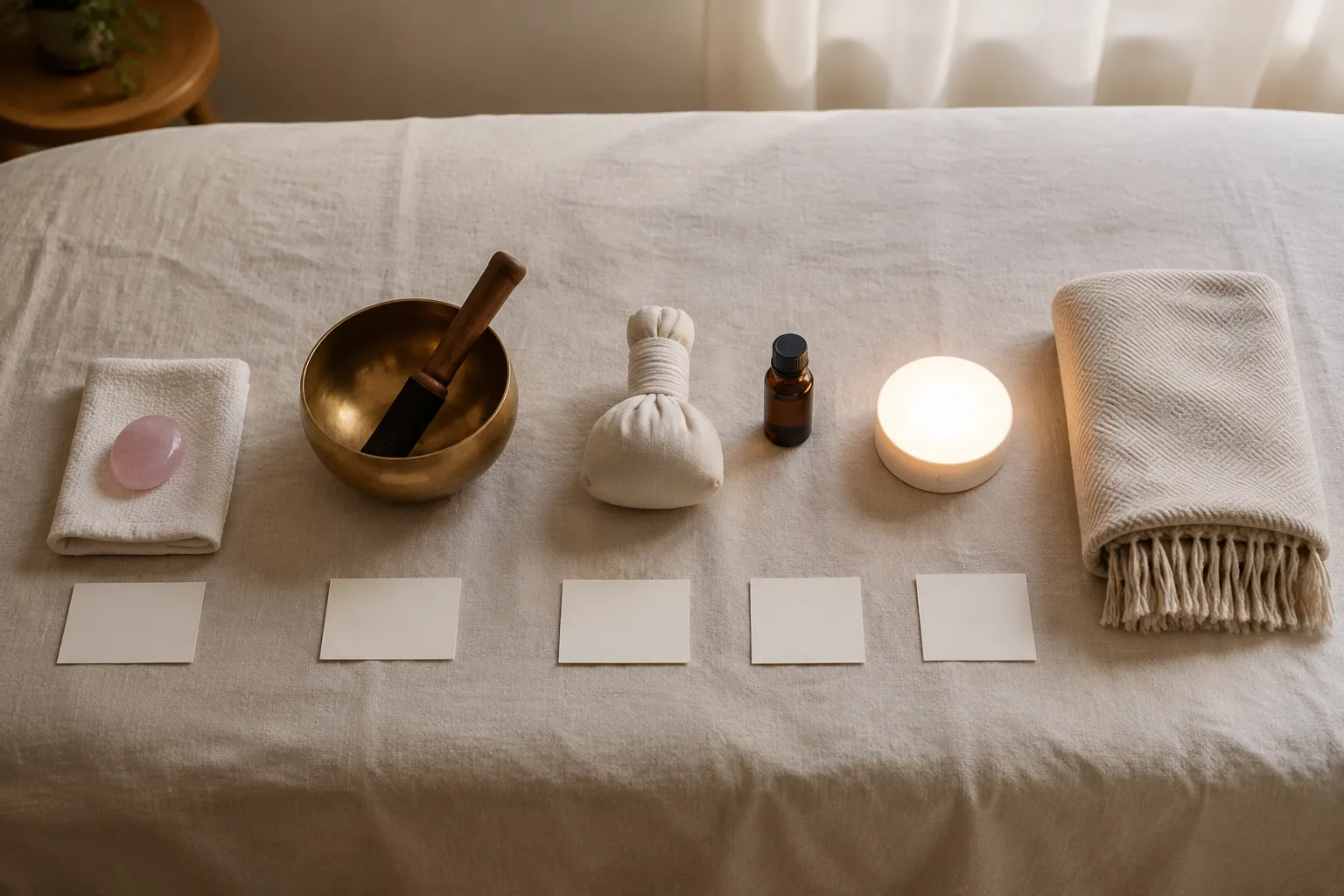
- The guest holds or sees a rose quartz piece as a symbolic object, not as a promised agent of change.
- Sound, vibration, warmth, scent, or light are introduced in a controlled interval.
- The session closes with quiet integration, water, and enough time to return slowly.
That structure lets the spa use innovation without turning the equipment into the whole story. The therapist remains important, even when the session is therapist-light. The human role shifts toward host, screener, translator, and keeper of pacing.
This is also where sensory spa sequencing becomes more precise than “stacking treatments.” Layering can be thoughtful, but more elements do not automatically make a better experience. A vibration bed, a sound bath, rose quartz, infrared heat, scent, and light can become too much if they are all presented at full intensity. Luxury often depends on restraint.
What Analog Crystal Ritual Adds
The crystal side of this conversation needs careful language. Spa menus and lifestyle coverage often use phrases around high vibration, aura, chakras, cleansing, ancient sound practices, and high-end healing. Those phrases help explain the market atmosphere readers may have encountered, but they do not become evidence just because they appear in polished service copy.
A grounded analog crystal ritual can still have value as ritual context. Rose quartz can be placed in the room as a color and texture cue. It can be held during a breath pause. It can mark the beginning or end of a session. It can serve as a symbolic object for crystal intention setting, especially when the host makes clear that the intention is reflective rather than outcome-guaranteeing.
This distinction protects both the guest and the ritual. If a spa says that rose quartz softens the visual field, supports a gentle room mood, and gives the guest a tactile point of focus, the claim stays close to observable design and symbolic use. If it says the stone produces a specific health or energetic result, the claim outruns the current evidence base.
Analog ritual also corrects one weakness of touchless technology: abstraction. A vibroacoustic table may be sophisticated, but the guest may not understand what is happening beyond sound and vibration. A rose quartz object, a bowl tone, a short spoken frame, or a few minutes of silence makes the session easier to inhabit. The ritual does not need hidden mechanics to be useful as a spa-language container.
For rose quartz readers, this is familiar territory. Meaning can sit beside material reality. The stone can be selected for its pale color, cool weight, and association with gentleness, while the page still refuses to turn that association into a treatment claim.
What Changes the Answer
The blend becomes stronger when the spa can explain each layer in ordinary terms. “This part is sound and vibration.” “This part is warmth.” “This object is symbolic.” “This pause is for settling.” When each element has a clear role, touchless technology and ritual can feel coordinated rather than decorative.
Unsupported outcome language
Claims about brainwave control, cellular effects, pain relief, sleep improvement, chakra correction, aura cleansing, or medical-style results need stronger independent evidence than the supplied source set provides. Without that evidence, those claims should be treated as marketing language or spiritual-adjacent framing, not as established fact.
Guests with health concerns
Provider pages often mention screening topics around implanted electronic devices, pregnancy, seizure history, recent surgery or injury, cardiovascular conditions, bleeding or clotting concerns, very low blood pressure, and other serious medical issues. Because those lists come mainly from commercial providers, they should not be treated as a final medical standard. They are enough, however, to justify a conservative step: anyone with relevant medical concerns should ask qualified medical guidance and trained spa staff before using vibration-based equipment.
There is another practical exception: touchless should not mean unattended. A future spa may use fewer hands during a session, but it still needs human care around consent, comfort, volume, heat level, positioning, exit options, and post-session pacing. A claims-limited spa experience can still be attentive.
Common Confusion
Touchless does not remove the therapist
The most common misunderstanding is that touchless spa design removes the therapist. In a better model, the therapist becomes less like a constant manual operator and more like a spa host. That host explains the sequence, checks for discomfort, interprets the equipment honestly, and keeps the guest from being left alone with unfamiliar sensations.
Crystals do not make the technology more effective
A second confusion is that adding crystals makes the technology more effective. The better statement is narrower: analog crystal rituals can make the session feel more tactile, symbolic, and aesthetically coherent. They can help guests mark a transition from ordinary time into spa time. They do not need to be framed as biomedical mechanisms.
“Therapy” is not a treatment promise here
A third confusion sits inside the word “therapy.” Vibroacoustic therapy is a term used in the field and in spa menus, but on this page it should not be read as a promise of treatment. In a spa setting, the supportable description is a sound-and-vibration experience designed for relaxation, decompression, and sensory immersion. Anything stronger would require stronger sources.
This is where “high-end healing” needs editorial discipline. As a cultural phrase, it points to luxury wellness environments where guests seek calm, care, beauty, ritual, and meaning. As a factual claim, it becomes risky quickly. The clearer language is relaxation without treatment claims.
The Evidence Boundary
The visible source base for this topic is thin. The strongest usable public reference in the supplied material is trade coverage that supports spa-industry and service-design context: touchless and therapist-light experiences are being discussed through sound, vibration, heat, light, infrared, compression, water, scent, recovery tools, and multisensory guest journeys. That does not establish clinical efficacy, safety standards, or crystal-related benefits.
Commercial spa pages are still useful for understanding how these services are described to guests. They show recurring language around vibroacoustic loungers, embedded transducers, fully clothed sessions, music, low-frequency vibration, consultation, and pairing with massage or facials. They also show the overreach: nervous-system claims, cellular language, sleep and pain language, chakra language, and energetic certainty that the current curated material cannot support.
Supported framing
The experience is multisensory, therapist-light, symbolic, tactile, aesthetic, reflective, and intended for physical relaxation, quiet, decompression, and a more considered transition between stimulus and rest.
Unsupported framing
The pairing should not be presented as guaranteeing outcomes, changing health conditions, replacing care, verifying energetic effects, or proving that crystal symbolism has a measurable mechanism.
A responsible spa page, then, should present the blend as design rather than proof. It can say the experience is multisensory. It can say it is therapist-light. It can say the rose quartz ritual is symbolic, tactile, aesthetic, and reflective. It can say the intended guest experience is physical relaxation, quiet, decompression, and a more considered transition between stimulus and rest.
It should not say that the pairing guarantees outcomes, changes health conditions, replaces care, verifies energetic effects, or proves that crystal symbolism has a measurable mechanism.
The future of spas may well include more touchless technology and ritual layering. The most credible version will not be the loudest one. It will be the one that lets sound, vibration, warmth, stone, silence, and human hosting each stay in their proper lane: sensation, setting, symbol, and care, without promise language.