Optical explanation
The Tyndall Effect Explained: Why Your Rose Quartz Glows Blue Under Light
If your rose quartz looks blue in a flashlight beam, direct sunlight, or a close-up jewelry photo, the most likely explanation is light scattering. The stone has not necessarily “turned blue,” and it is not automatically emitting its own light.
In some rose quartz, very fine internal particles, tiny inclusions, or cloudy zones can redirect shorter wavelengths of visible light more strongly. Blue light has a shorter wavelength than red light, so the scattered light can appear bluish from certain angles. That is why the phrase Tyndall Effect Quartz can be useful: it describes an optical effect caused by light interacting with small internal features, not a separate mineral identity.
A blue cast in rose quartz does not automatically mean the stone is fake, fluorescent, dyed, rare, or a formal blue variety. It usually means the stone, the light source, and your viewing angle are lining up in a way that makes scattered blue light visible.
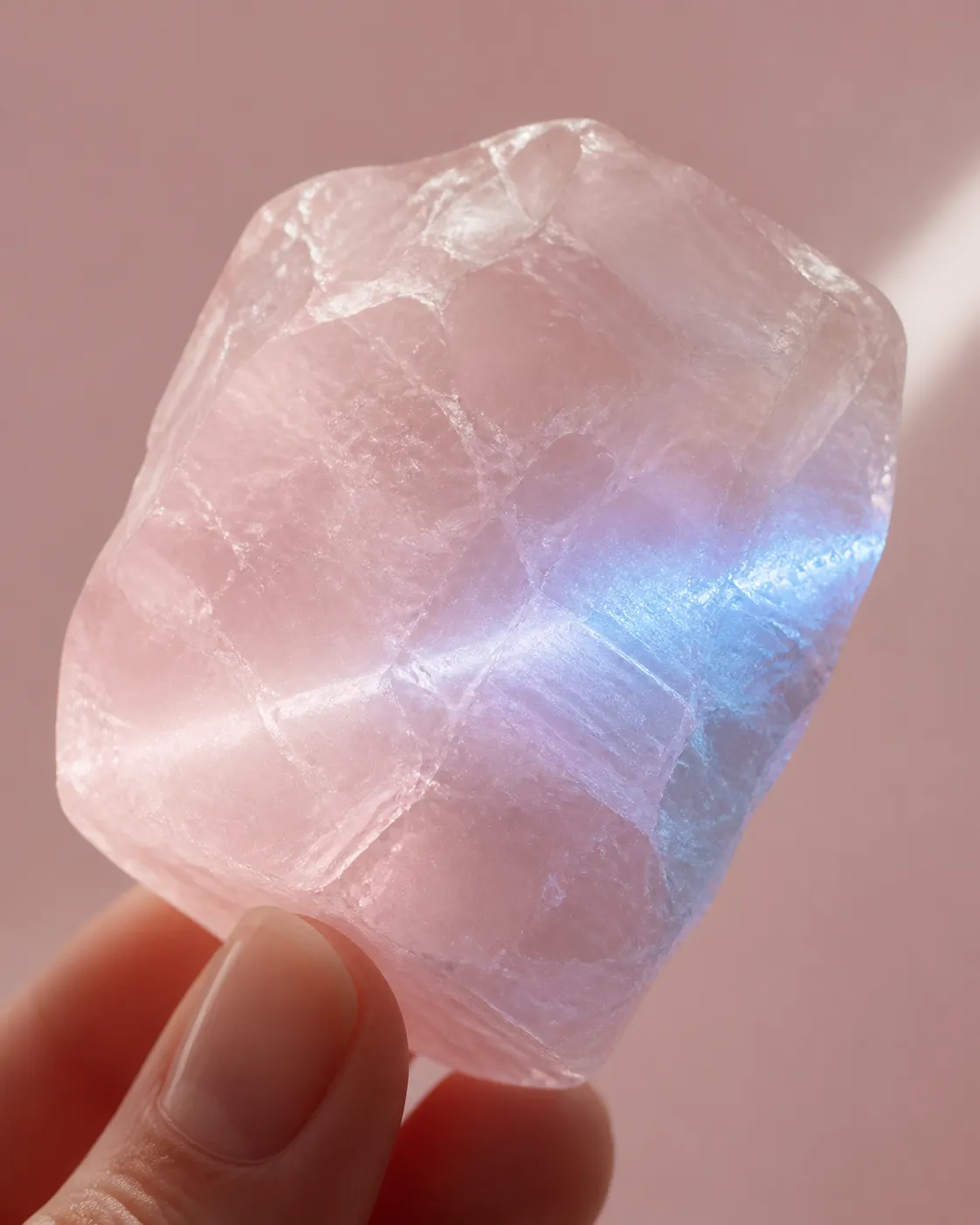
What the Tyndall effect means here
The Tyndall effect is a scattering effect. When light passes through a medium containing very small dispersed particles, some of that light is redirected toward the viewer. A familiar example is a beam of light becoming visible in mist, smoke, or a cloudy liquid.
Rose quartz is not mist or liquid, of course. But some pieces are not optically empty inside. Quartz can contain fine inclusions, hazy areas, and other internal structures. When light passes through a translucent piece, those features may scatter part of the beam.
That scattered light may appear as:
- a faint blue haze inside the stone,
- a cool blue edge,
- a blue flash when the stone is turned,
- or a stronger blue cast in a backlit photo.
The important distinction is this: the rose quartz may still have a pink or pale rose body color. The blue you see can be an optical appearance created by the light path through the stone.
Why the blue shows up
Visible light contains different wavelengths. Shorter wavelengths, which we see toward the blue end of the spectrum, are often scattered more efficiently by very small particles than longer red wavelengths. This is the broad optical idea behind many blue scattering effects, although a rose quartz pendant and Earth’s atmosphere are very different settings.
In rose quartz, the blue appearance depends on three things working together:
-
Internal scattering features
Tiny inclusions, fine particles, or cloudy structures give light something to scatter from.
-
Directional light
A flashlight, phone light, direct sunbeam, or strong jewelry photography light can make the effect easier to see than soft room lighting.
-
Viewing angle
The blue may appear, fade, or disappear as you rotate the stone or move the light.
This is why two rose quartz pieces from the same tray can behave differently. One may stay softly pink. Another may show a blue haze through the center or along an edge when lit from the side.
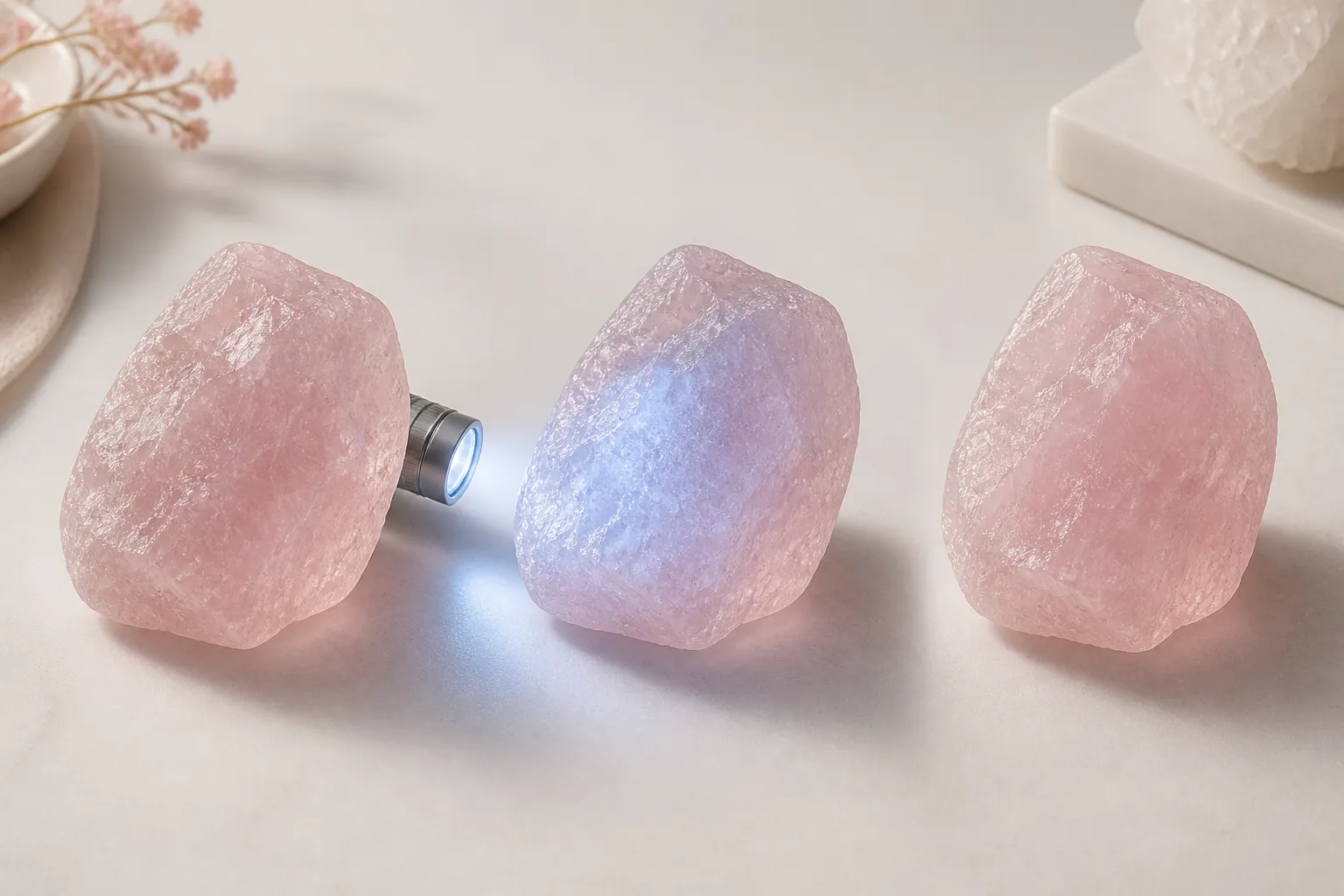
Why milky or translucent rose quartz often shows it better
The blue cast is usually easier to notice when rose quartz is translucent, slightly milky, or internally hazy. A completely opaque piece may not transmit enough light for the effect to show clearly. A very clear piece may not contain enough scattering structure to make the blue visible.
This does not make one piece better than another. It only explains why the effect appears in some stones and not in others.
A strong backlight can make the difference especially obvious. In normal room light, the stone may look pale pink. Under a narrow beam, it may show a cool internal glow. In a photograph, the effect can look even stronger because camera exposure, white balance, background color, and reflections all influence what the viewer sees.
Scattering is not the same as fluorescence
The word “glow” causes much of the confusion. In everyday language, people use “glow” to mean that something looks bright, lit at the edge, or luminous in a photo. In optical terms, those descriptions are not all the same.
With Tyndall-style scattering, incoming light is redirected by tiny internal features. The stone is not necessarily producing light of its own.
With fluorescence, a material absorbs energy, often ultraviolet radiation, and then emits visible light at another wavelength. That is a different optical process.
So if your rose quartz looks blue when a white flashlight shines through it, scattering is usually the cleaner explanation. If someone is discussing visible emission under ultraviolet light, that becomes a separate fluorescence question. Appearance alone is not a full gemological test.
The blue is not necessarily the stone’s body color
A rose quartz piece can look pink in ordinary light and bluish under a beam. That does not mean its main color is blue.
Body color is the color the material generally shows under typical viewing conditions. A scattering color is conditional. It depends on the size and distribution of internal features, the direction of the light, and the angle of view.
This matters especially with jewelry photos. A pendant may look dramatically blue in a seller’s image because it is backlit or photographed against a cool-toned surface. In hand, the same piece may read as pale rose, milky pink, or nearly colorless with a faint blue haze.
A blue cast does not prove the stone is fake
A blue effect by itself does not prove imitation, dye, glass, or synthetic origin. Natural quartz can contain internal features that affect how light moves through it.
At the same time, the blue effect does not prove natural origin, locality, rarity, or value either. It is one visual observation, not a complete identification.
If identity, treatment, or valuation matters, the answer depends on proper gemological testing, not a single color impression under a flashlight.
Why trade names make this confusing
Most people meet this question through jewelry listings, social media photos, or collector conversations, not optical physics. That setting encourages loose descriptive language.
Terms such as “blue rose quartz,” “blue quartz,” or “rare blue glow” may describe a real visual impression, but they can also blur together several different things:
- rose quartz showing blue scattering,
- quartz with a blue body color,
- quartz with other inclusion-related blue appearances,
- trade names,
- locality stories,
- or marketing language.
For this specific question, the most precise wording is simple: rose quartz with a blue scattering effect or rose quartz showing Tyndall-style scattering. That describes what is being seen without turning the effect into a claim about classification, origin, or price.
A quick way to read what you are seeing
You cannot identify a stone fully by eye, but these questions can help you sort the observation:
-
Does it look pink or pale rose in normal light?
If so, the blue may be an optical effect rather than the main body color.
-
Does the blue appear mainly with a flashlight, sunlight, or backlighting?
Directional light supports a scattering explanation.
-
Does the blue change when you rotate the stone?
Angle dependence is common in light-path effects.
-
Is the stone milky, hazy, or translucent?
Fine internal structures can make scattering easier to see.
-
Is the blue effect being used to claim rarity, origin, or high value?
Treat that as trade or collector language unless supported by proper identification.
The short answer
Rose quartz can look or “glow” blue under light when tiny internal particles, inclusions, or cloudy structures scatter shorter wavelengths of visible light toward your eye. Because blue light is strongly visible in many fine-particle scattering situations, the effect can appear as a cool haze, edge glow, or blue flash under a flashlight, sunlight, or camera lighting.
That blue appearance is best understood as Tyndall-style light scattering. It is separate from fluorescence, separate from permanent blue body color, and separate from trade-name claims. The effect can be beautiful, but it is conditional: it depends on the stone, the light, and the angle from which you see it.